Showing posts with label handspun. Show all posts

Saturday, May 10, 2014

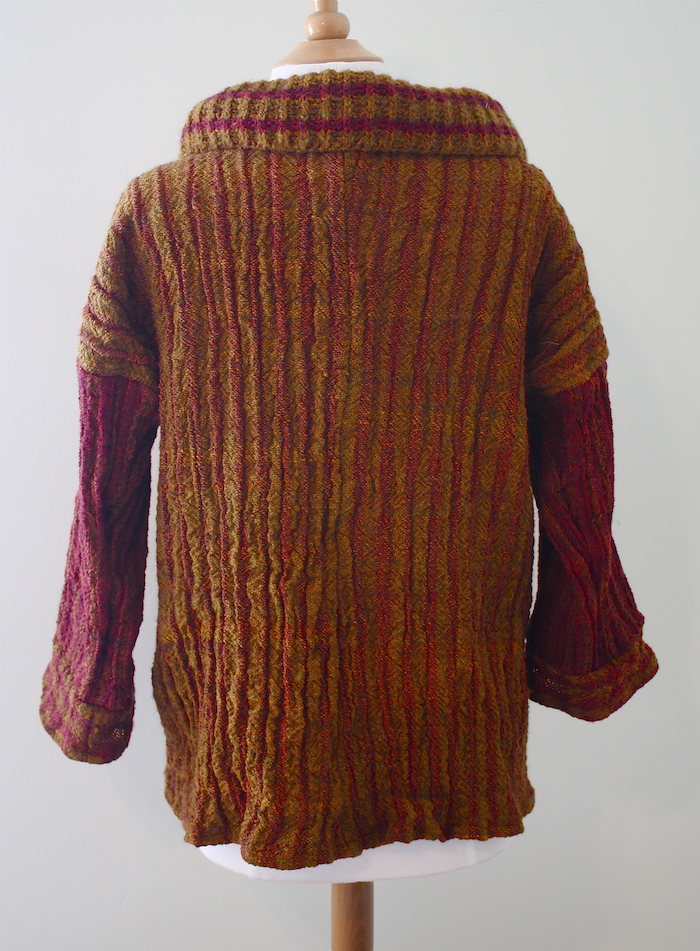
Here's the Coat I Wove with S and Z Overtwist


This coat is woven with handspun overtwist singles, as I wrote about a couple of posts ago. (I did not include the blood, sweat, tears, and toil that went into it as well....)

Three kinds of wefts made three different fabrics: the checks on the front used both gold and burgundy as weft yarns, while the back was woven with only the gold yarn as weft. Which you see here.

The sleeves and inside front panel used burgundy yarn as weft -- shown below.


I am loving this coat! The fabric collapses and crinkles wonderfully, adding flexibility and interest to the garment, which is my own design. (Partly out of necessity, because I barely had enough fabric to make a jacket, let alone follow a pattern.)

I knitted the color using a brioche stitch from Barbara Walker's first volume of knitting stitches and added a Dorset button for a decorative closure. It isn't really used as a button, because I secured it with a sturdy hidden snap -- which I prefer on fabric like this, because it's hard to create a buttonhole that doesn't stretch and distort the fabric somewhat.

It's for sale in my Etsy shop, but I am not so sure that, ultimately, I won't keep it for myself. Those are the perks of making your own garments: If you like it, it CAN be yours!


Thursday, March 27, 2014

Weaving with Overtwisted Handspun Singles: It Only LOOKS Hard


I repeat: It only LOOKS hard. The photo above shows a warp chain of overtwisted handspun singles. I used Ashland Bay's multicolored Merino roving in Mojave and its Colonial (Corriedale) roving in Goldenrod (no longer available, I believe). I am not a whiz-bang spinner, but I can do overtwist! I spun two different yarns, both approximately sport weight, with the Goldenrod in Z-twist and the Mojave in S-twist.

Why go to all this trouble? I love fabric that has loads of texture and personality, with yarns that misbehave in wonderful ways after washing. Although I haven't yet made a garment out of the fabric that I'm weaving (most of it is still on the loom), here is what the finished product looks like.


And here.


I love the pleats and bumps and the tracking, which you can see pretty clearly in the photo. To achieve this effect, I wound a warp of stripes in S and Z twist: 8 ends of Z (Goldenrod) and 8 ends of S (Mojave). Then, for the example above, I wove plain weave with a Z-twist weft. And then washed it. 

Just to clarify: S and Z twist refer to the direction of the plying or spinning of a yarn.


Here's what the fabric looked like just off the loom, before washing.


Even before I put it in hot water, it had a mind of its own:


I can't quite figure out why it's creating a Z twist, other than the fact that the Mojave yarn (red, spun in S-twist) seemed to have more energy than the Goldenrod. Just a theory.

If you want to know more about how I wove this fabric, what follows is a brief tutorial. For starters, pay no attention to the twisting and turning of the yarns in the warp chain. Treat them just as you would any others.


The warp starts to look more orderly once you've inserted the least sticks, so:


It looks even better when you tighten the heck out of the warp as you're beaming it:


Threading: Well, the yarns insist on maintaining their original twist when you're threading them and after threading as well. So you have to be very patient with them!


It all works out in the weaving, which creates a pretty conventional-looking cloth, as you saw at the beginning of this post. After washing -- well, as Laura Fry aptly titled her book, there's "Magic in the Water"!

One postscript: This June I will be flying to London to study with Ann Richards at the Handweavers Studio and Gallery. She is the author of "Weaving Textiles That Shape Themselves" and she is inspirational! I hope to take many photos and post a lot of good information after I return.