Showing posts with label collapse weave. Show all posts

Thursday, July 19, 2018

What We Wove at Convergence: Echo, Jin, Shadow Weave, Rep, Double Weave, and Even Collapse Fabric

Echo Weave on 8 shafts on a warp of light blue and dark blue 10/2 cotton. 
The weft is 20/2 cotton in golden orange. Woven by Virginia Lee.

You've heard about Echo, which is based on an extended parallel threading that weaves a warp-emphasis fabric with lots of color and strong patterns. But do you know about all the different structures you can weave on the same parallel threading? In addition to Echo, you can weave Jin, Shadow Weave, Rep Weave, Double Weave and even collapse cloth, simply by changing your tieups and treadlings.

I taught a workshop on this subject last week at Convergence, the biennial conference for the Handweavers Guild of America, held this year in Reno, Nevada. "One Warp, Many Structures: An Exploration of Extended Parallel Threading" looked at all the possibilities I mentioned above. To teach this, I designed 9 different patterns -- 3 for 4 shaft looms, 3 for 8 shafts, and 3 for 12 shafts -- and invited students to choose a pattern and wind a warp using two colors of 10/2 pearl cotton. (I also named all of these patterns, using simple descriptions as a mnemonic device -- otherwise I couldn't remember them all!)

Below is a photo essay showing some of the beautiful samples the folks in my workshop created, with brief descriptions for each. It was a visual feast!

Above on left: Echo Weave sample using 8-shaft pattern, "Many Rivers," in light blue and off-white warp yarns. On right: the same pattern, this time in Double Weave, with top layer woven in off-white 10/2 cotton and bottom layer woven in 18/2 merino. The bottom layer fulls with hot water, soap, and agitation, making the top layer collapse and pucker. Woven by Roberta McKinney.


 Echo in the 8-shaft pattern, "Falling Stars," using different colors of weft yarns in 20/2 cotton. 
Note how the the weft color completely changes the color of the fabric. Woven by Teresa Edmisten.

Left to right: Double Weave and Shadow Weave samples woven on 8 shafts in the "Fun House" pattern. 
Woven by Judith Rees.

 Clockwise, starting from top left: Echo,
Double Weave, and Rep Weave on a 4-shaft pattern called "Op Art."  Woven by Diana Abrell.

Rep Weave in the "Fun House" pattern on 8 shafts. Woven by Virginia Lee. 

Shadow Weave on 8 shafts in the "Falling Stars" pattern. I think this was woven 
by Rachelle Weiss -- my apologies for not knowing for certain.

 Above, the 8-shaft "Fun House" pattern on a warp in two shades of blue for warp yarns. 
The red weft creates the impression of 4 different colors in the fabric. Woven by Judith Rees.
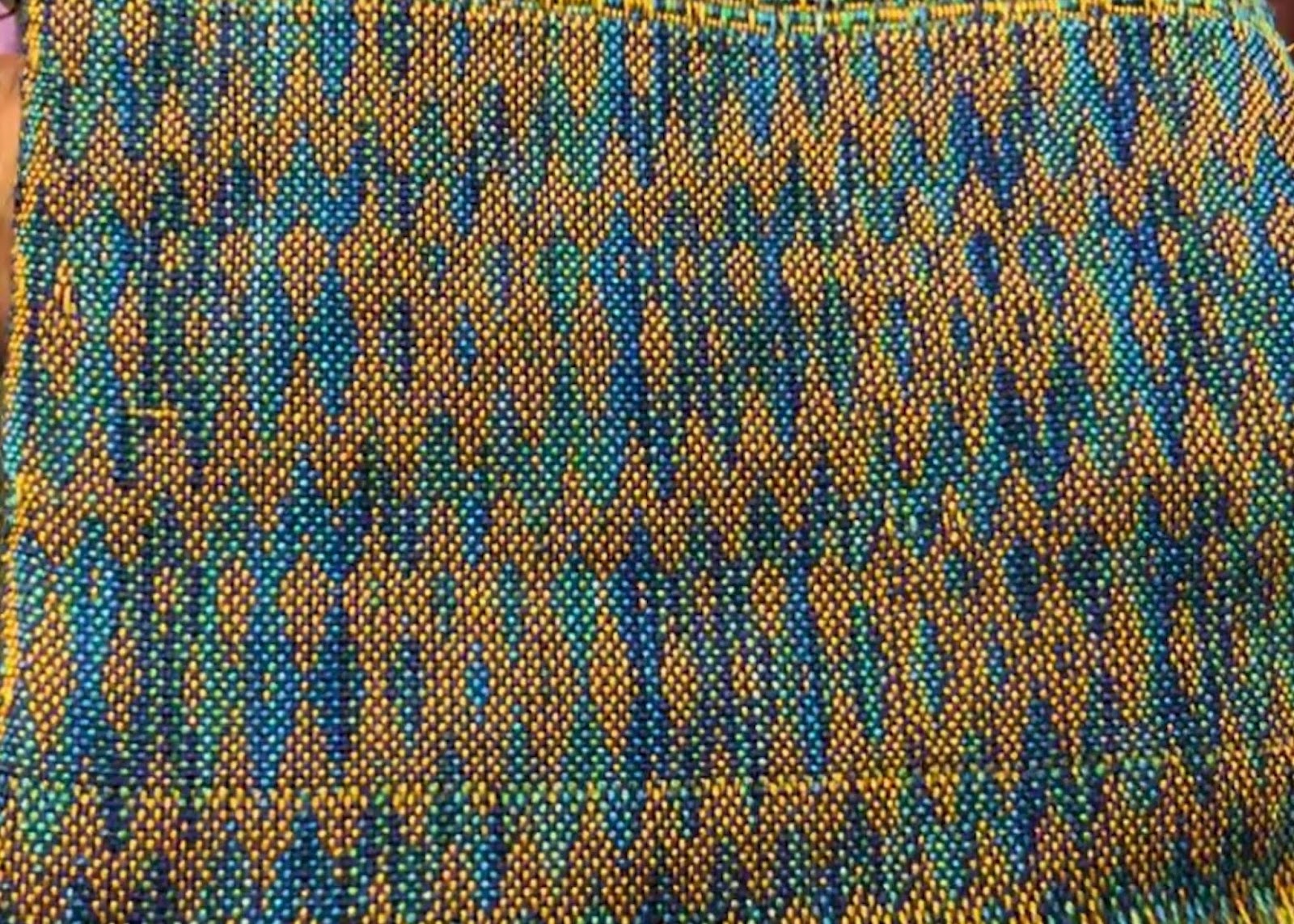

The two photos above: front and back of the "Falling Stars" pattern on 8 shafts in Double Weave. 
The warps alternate between a golden yellow and a hand-painted yarn in shades of green and blue. Woven by Sharlet Elms.


The two photos above: front and back of collapse cloth in the 8-shaft "Falling Stars" pattern, woven as Double Weave. The weft alternates between 10/2 cotton in gold (front) and 18/2 merino in purple (back). With washing, soap, and a lot of agitation, the merino fulls on the back, making the layer on the top collapse into pleats. Woven by Sharlet Elms.


"Many Rivers" design woven on 8 shafts. Pictured from top to bottom: 
Echo, Shadow Weave, and Jin. Woven by Virginia Glenn.


Pictured above, clockwise from top left: 8-shaft "Falling Stars" pattern in Shadow Weave, 
Double Weave, Rep Weave, and again in Double Weave. Woven by Ruth Ronan.


Blooming Leaf pattern on 4 shafts woven as Jin. Woven by Sharolene Brunston.


Above, top to bottom: "Fun House" pattern for 8 shafts. The top two samples are woven using a different Echo tieup and treadling from the bottom 4 samples. The bottom 4 samples are all the same tieup and treadling for Echo, but using different colored wefts. The warp yarns are light blue and turquoise. Woven by Carie Kramer.


Thanks for reading! And many thanks to the staff of HGA for putting together another wonderful gathering of the clan!


Wednesday, June 13, 2018

Fishing Line, Gold Gimp, and Wool/Lycra: What a Difference a Weft Makes!


You know what it's like when you're at the end of a warp -- and you decide to just throw something in to see what happens? And you LOVE the results? That's just what happened to me a few days back, as I was weaving up samples for my upcoming workshop at Convergence, "Deflected Double Weave as a Collapse Weave."

Let's start at the beginning of the warp, with a design I created for Deflected Double Weave on 8 shafts. I wove up the first sample with 10/2 cotton in purple and 18/2 merino in red in both warp and weft, aiming for a collapse effect using differential shrinkage. (The wool shrinks in the washing and the cotton doesn't, so it puckers and collapses and creates lots of texture.)

Here's the original draft.


Here's how it wove up, before washing.


I was worried, before I washed this, that it would collapse diagonally. But it didn't, because each diagonal "step," with a vertical line of red connected to a horizontal line of red, actually has two opposing vertical and horizontal lines on the back of the fabric, making a square shape of yarn that will shrink. That's the nature of Deflected Double Weave: not only do individual yarns weave plain weave -- but groups (blocks) of yarns will weave in and out of each other, as warp or weft floats.

Here's how the sample looked after washing with hot water and agitating with dish soap.


So, skipping to the end of my warp -- remember where I threw in an unusual weft yarn just to see what happened? In this case, I chose a lambswool/lycra yarn that would easily collapse. Here's what it looked like before washing.


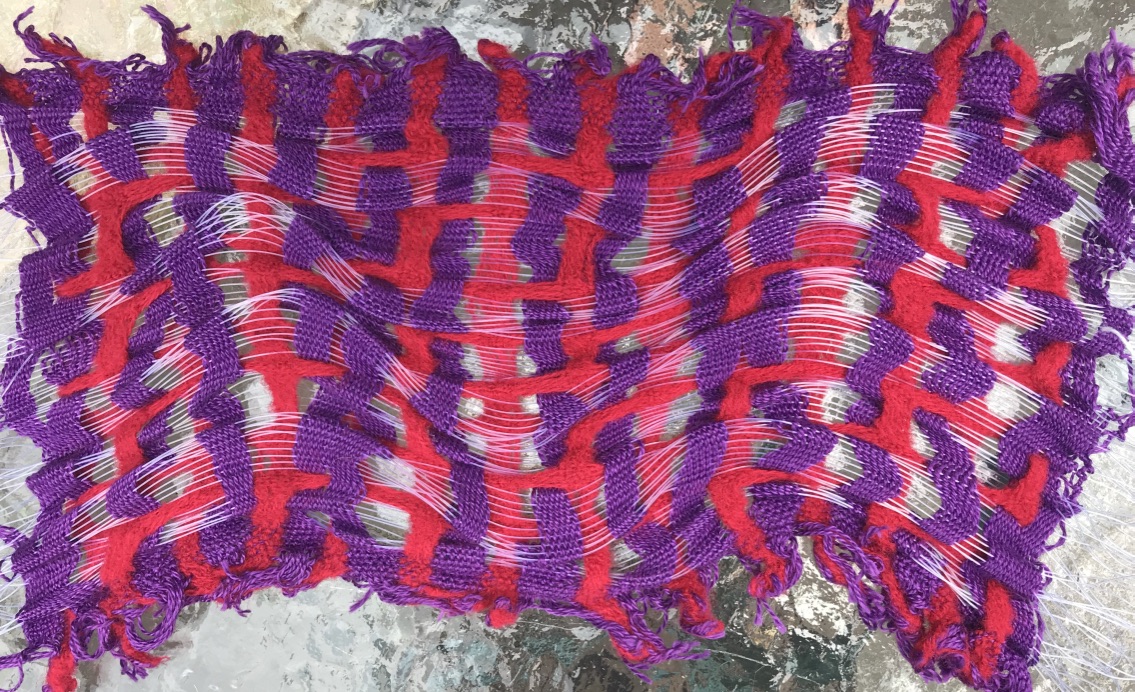
I'm posting this photo extra-large in hopes that you can see the wool/lycra: Looking closely at the squiggly red weft yarns, can you see a bit of white here and there? That's the lycra, very loosely plied with the lambswool. It's hard to imagine it will collapse much -- but it does. A lot, to the extent that the fabric shrinks maybe 50 percent width-wise. And you can stretch it back to its original width! Here's the finished sample.


And what about the fishing line? It's also called "monofilament," and it's a great way to create interesting effects with yarns that DON'T shrink but instead make the fabric curve and undulate.

Here's the original sample, before and after washing, using the 10/2 pearl cotton and 18/2 merino in both warp and weft. (You'll note that I varied the tieup and treadling from the first draft.)


And here's what it looks like, before and after washing, substituting 14-pound fishing line for the 18/2 merino in the weft. (Picture a weaver walking into Gander Mountain to purchase weft yarns....)


Wild, huh? I can see this writ large, for a wall hanging or even a window hanging, much like a stained-glass piece that lets the light shine through. One of my favorite weavers of all time, Liz Williamson, uses monofilament as an accent weft in conjunction with a wool or other collapse weft, which makes her fabrics curve and wind in graceful and unexpected turns.

As for the gold gimp: Here's the original sample, before and after washing.


And here's what happened, shown before and after washing, when I substituted gold gimp yarn for the red merino in the weft.


Gimp is a metallic-looking yarn, typically used as an accent. (Gimp is made of a core, such as cotton, wrapped in a sparkly thread and used in embroidery and trims.)

Still more samples to weave for Convergence. This is why we don't get a lot of housecleaning done these days.... but it's way more fun. Thanks for reading!


Monday, October 9, 2017

More Pleats, Please: Collapse Cloth on a 60/2 Silk Warp


Off the plane, out of the box, off the grid – however you phrase it, textural fabrics are three-dimensional and non-rectilinear, unlike any other kind of weaving. In addition to the beauty of color and structure, texture is another pillar of weaving. That's why I love dimensional fabrics so much! I like to describe them as “Tactile Art.”

Studying collapse techniques over the past year, my mantra has been “Sample, sample, sample.” (Never mind that I used to think I just wasn’t a samplin' kinda gal.) Sampling offers so much information, because structures, yarns and finishing can create so many different results. And, to my surprise and delight, just 4 shafts can produce beautiful fabrics that, at first blush, appear very complex.

Which is the case with my latest round of samples, on a warp of 60/2 silk in purple and black stripes. I was in search of pleats – the kind that people weave when they have two back beams that they advance at different intervals, with one layer of a double-weave warp on each of the two back beams. 

Simply put, with this technique, one layer is woven for just a few picks, in a “short” section, and then the second layer is woven as a longer section – many more picks. The shorter layer draws the longer layer in – and after washing, the layer with more picks flattens out into nice neat pleats. Ironing might enhance the effect, depending on what you're going for.

Which is a great technique, except that I don’t have two back beams on my loom. So I set about finding an alternate method. 

Here is my first sample, aiming for horizontal pleats.


No ironing, just washing, although I think ironing might help. The piece was set at 96 epi -- 48 epi per layer -- which sounds grueling, but it's not so bad with a small sample on a table loom.

Here's what it looked like, front and back, before washing.


You see all the floats on the back? That's what draws in the pleats on the front. The back yarns relax because they are not held in by a structure, while the plain weave in the front has to curve because it IS held in by a structure. 

Are these designs all about relaxing? About yarns and structures doing what they want do naturally? I often wonder about the metaphors in there....

Here is the drawdown, as seen from the front.

So then I got to thinking: If the pleats work well with a horizontal structure, they could work well with a vertical structure, using the same yarns. Plus, I would be able to experiment with different wefts, using a variety of exotic and overtwisted yarns. So I recreated the cross, put the lease sticks back in, pulled the threads out of the heddles, and re-threaded them for vertical pleats.

Here's the drawdown. Different shade of purple, I know.... 


Funny thing: You would think that if I wove the exact same structure -- a double weave where the two layers alternate as stripes, one layer weaving plain weave while the other layer floats behind it -- and I just turned it, the results would be the same. 

Right?

No, not at all. The warp threads that draw in vertically with the first structure DO NOT DO THIS when they are weft threads. Take my word for it. I do not know why. (This happens all the time with collapse techniques: When you turn a draft, the yarns do not behave or misbehave the same way.)

Undaunted, I proceeded to try a variety of energized and exotic yarns as weft, weaving double weave and plain weave and playing with floats. For instance, I do not recommend warping with crepe silk from Habu -- it seems to be about the grist of human hair -- but it's wonderful to use as weft. Here are some photos of the results.


Before washing: 60/2 silk warp, 30/1 S-twist wool. Bottom third is woven in plain weave.


Same swatch, after washing, showing double-weave structure


Same swatch, after washing, showing plain-weave structure


After washing: double-weave structure using 60/2 silk/stainless steel in ecru as weft. The first photo in this blog post shows a detail of this swatch. 


After washing: a double weave sample using silk crepe as weft.

It's tough to show the dramatic shrinkage of the sample above. It was 12" in the reed and is now about 3" wide, mainly because the weft is a gossamer-weight silk crepe from Habu Textiles. The grist is roughly 33,000 yards per pound. (Compare that with 60/2 silk, which is 15,000 yards per pound, and you get an idea of how fine this is.) It shrinks up amazingly well, but you have to weave an awful lot of fabric at a shrinkage rate of 75 per cent.

Later this month, I will be teaching a workshop on collapse fabric at the Etobicoke Handweavers and Spinners Guild in Toronto, Ontario. Looking forward to collapsing and relaxing! Thanks for reading.


Thursday, April 13, 2017

More Collapse-Cloth Samples on 4 Shafts


LOTS more! I have been preparing more than a dozen samples for a workshop I'm teaching this summer at the MAFA Conference at Millersville University in Pennsylvania: "Collapse Fabrics on 4 Shafts." And, without giving away the drafts and all the details, I'd like to share some photos and descriptions of the results.

Pictured above: a 2-block weave on a warp of 60/2 silk, using a weft of 60/2 silk alternating with 18/2 JaggerSpun Superfine Merino. Here's what the sample looked like before washing, just off the loom:


Pretty different, right? That's the beauty of weaving dimensional fabric: What is geometric and two-dimensional on the loom becomes a fabric that is far more organic and three-dimensional after finishing. All it takes is a little bit of warm water, soap, and agitation. In the case of this sample, the wool will full and shrink, drawing the silk in width-wise. The geometric squares of orange, red, and dark blue in the warp become concave ovals. Very interesting and very forgiving for weavers like me who aren't always exact about selvages, picks per inch, even treadlings (but don't tell anyone).

A few more before and after photos below.


18/2 JaggerSpun Superfine Merino warp and weft. Above is the front of the piece before washing, and below is the back.


 And here's what the sample looks like after washing, front and back.


 Fun, I think! Much more quirky and natural-looking.


Above, a pretty ho-hum piece of fabric woven in plain weave -- red, gold, and lavender 16/2 bamboo in warp and weft -- with a supplemental-weft pattern using embroidery cotton in natural. I pulled the embroidery cotton tight to create a woven-shibori resist. (Looks like some kind of sea creature to me.)


Wash and scrub and agitate, check to make sure everything is working, repeat -- then take out all the embroidery cotton and...


Here's a close-up:


So for me, the weaving advice of "sample, sample, sample" has helped immensely -- to learn and to share with others who love this technique. After MAFA, I will be teaching how to weave dimensional fabrics on 4 and 8 harnesses at the Hartford Artisans Weaving Center in Hartford, CT. And in September I will lecture on the subject at the New York Guild of Handweavers. More sampling to come!