Showing posts with label murmurations. Show all posts

Thursday, April 24, 2025

Now on Exhibit at the Handweaving Museum in Clayton, NY


I call this piece "Murmurations" because the intertwining curves remind me of the shape-shifting patterns of starlings.
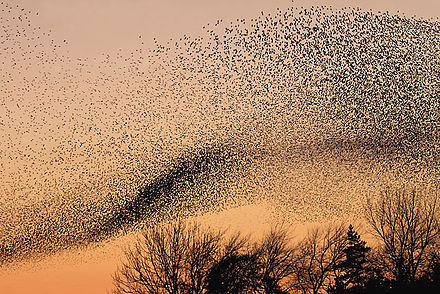
Public domain, courtesy of Wikipedia

These formations in flight are called murmurations because of the soft fluttering sound of the birds' wings as they speed through the sky. I think it's a lovely word. But the real reason they do this is to elude predators, primarily hawks, before roosting. Imagine trying to catch just one starling among thousands flying in ever-changing patterns at top speed? Nature offers us astounding beauty and we admire it and honor it in the arts -- music, photography, dance, painting -- and yes, weaving.

"Murmurations" is about 2 yards long by 2 feet wide, woven on a 32-shaft Echo threading in alternating warp colors of royal blue and mint green 16/2 cotton. The weft is a single-ply silk noil of unknown grist, dyed in peacock colors, a variegated pattern that adds subtle interest to the cloth. (I've found that silk noil is often the perfect weft for Echo designs, as it nests in between the warps, almost hiding, yet adding an ever-so-important shading to the cloth.)

Here's the draft -- and there's a key point I want to make in this post for those who are interested in weaving parallel-threaded designs. (The colors in the Fiberworks drawdown are different from those in the final weaving because, as many of you know, what seems to work well in Fiberworks doesn't always translate well in the actual cloth.)


It's easier to get an idea of the threading when you look at a detail. 


Note that the threading itself looks a bit like a murmuration of starlings. That's because it's curved, of course, but it's also because of the unique interval between the two parallel threadings.

When I teach Echo designs, I always start with the basic rules -- one of which is that when you're threading with two parallel lines, each in a different color, they're separated by an interval of half of the number of shafts you're using. So an 8-shaft Echo pattern would have an interval of 4 between the two parallel lines, as in the photo below.

So, if you look at the first four warp ends, alternating in white and black, you'll see they are separated by an interval of 4 (again, because the design is on 8 shafts), starting with 8, 4, 7, 3, 6, 2, 5, and 1. Here's the full drawdown.


But if I change the interval from 4 to 5, note how the pattern changes.


The difference may be subtle, but when you're designing -- and playing with two warp colors, one weft color, different tieups, and different treadlings -- an unorthodox interval between your two parallel lines in the threading can make a significant difference. And sometimes a very pleasing one at that.

So that's part of how I developed my pattern for "Murmurations." I created an Echo design on 32 shafts, but instead of using an interval of 16 shafts (half the number of shafts I have) between the parallel lines, I played around a bit with different intervals and finally settled on an interval of 4. It helped create the illusion of the patterns that starlings make in flight.


But enough about weaving technique. Let me give you the details of the exhibit that includes "Murmurations" at the Handweaving Museum in Clayton, NY, which is part of the Thousand Islands Arts Center.


The show features the work of three weavers from the Weavers' Guild of Rochester: Mary McMahon, Ruth Manning, and me. It runs from April 23 through May 17, with a reception on the evening of May 9. Here's a sneak peak, just after we'd mounted all of the pieces, but before the identification cards were put up (I breezed through so as not to give it all away):


If I do say so myself, it's a great exhibit, well worth your time to visit -- whether you drive, walk, run, or fly!


Friday, December 20, 2024

What's (Almost) on the Loom Right Now?


Well, not quite on the loom yet, but this is what I'm aiming for. It's a 32-shaft Echo design I call "Murmurations" because it reminds me of those wonderful rounded forms made by starlings and other flocks of birds as they shape-shift aerobatically across the sky.

A murmuration of starlings (courtesy of Wiktionary)

If you're lucky enough to see one, you will marvel at the sight. As magical as they appear, there are practical reasons for the birds to create these ever-changing forms in flight: They serve to help protect them from predators like peregrine falcons. Like sheep, the starlings create safety in numbers -- and they keep moving as well. Even a peregrine falcon will have a hard time catching a single bird among the hundreds or even thousands in constant motion.

Anyhow, I like the pattern and I love weaving with Echo designs, because you can achieve so many different designs just by changing the tieup and treadling. Like this one in double weave (shown as a detail, because the overall design is really big.)


Or this, woven as Shadow Weave (well, sort of), again shown just as a detail because the design is so large.


So I'm rather excited to start weaving and see the results. (Side comment: A friend and I were talking about the differences between a weaving design as seen in Fiberworks versus how it turns out when it's woven. I see Fiberworks as a sort of "flight simulator" -- that is, it gives you a pretty good approximation of what you're going to get on the loom, but you never really know until you weave it up.) And the weft color makes a difference, of course. And the sett, and the beat...

Here are my warp colors, in 16/2 unmercerized cotton, to be set at 48 epi.

The colors don't show up really well in this photo. That's mint green on the left and royal blue on the right. So the weft for my first design (seen as the first photo in this post) will probably be a copper/rust color, serving as a complement to the blue and turning the mint green into more of a rusty gold.

This post is dedicated to good intentions, because my Megado loom isn't completely dressed yet. The warp is beamed, but now I have to thread some 1,200 ends.

View from the front

Rear view

So here's a toast to weaving in the new year, to challenging ourselves, to threading myriad numbers of heddles, and to keeping our fingers crossed that our designs will translate really well from Fiberworks to the loom!

And to weavers everywhere: Merry Christmas, Happy Hanukkah, Bright Solstice, Joyous Kwanzaa, and best wishes for any and every celebration at this time of year.

Thanks for reading!