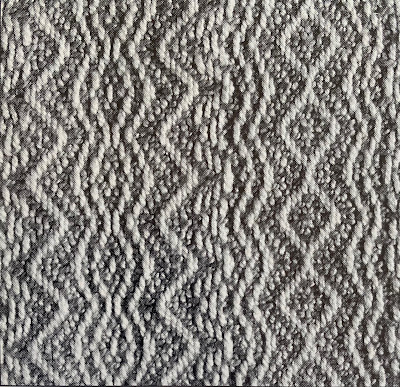
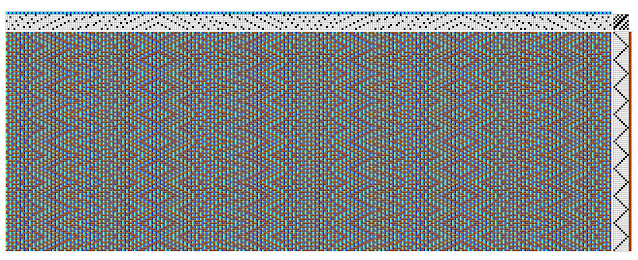
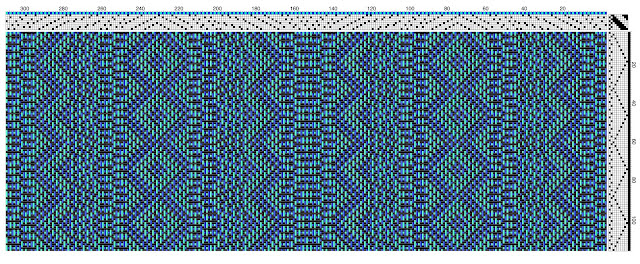
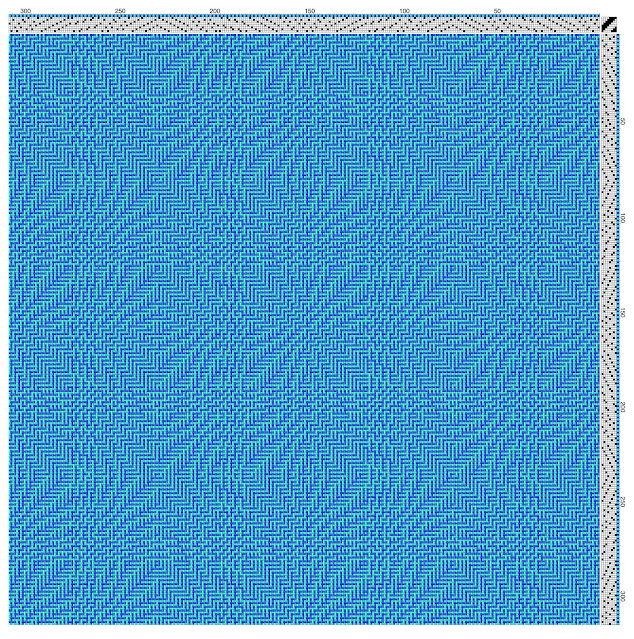
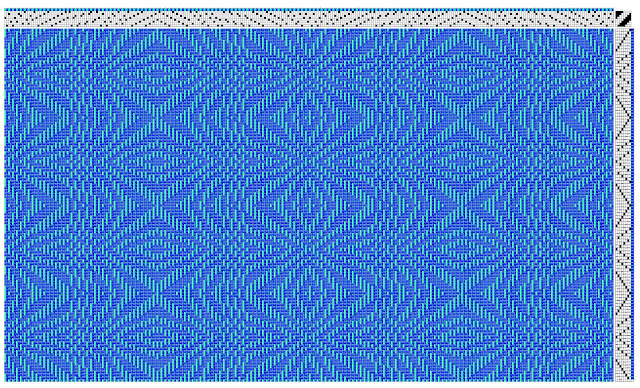
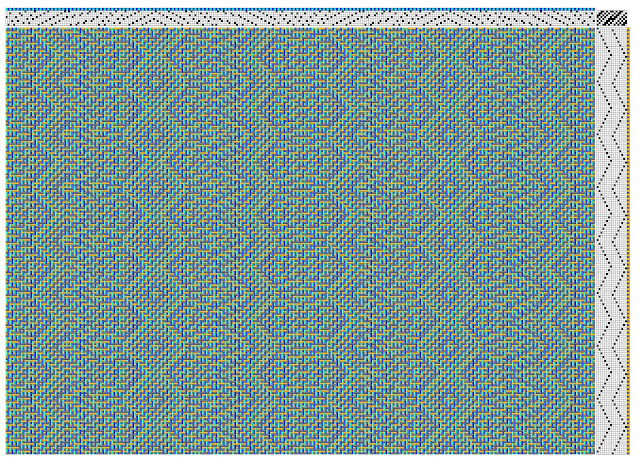
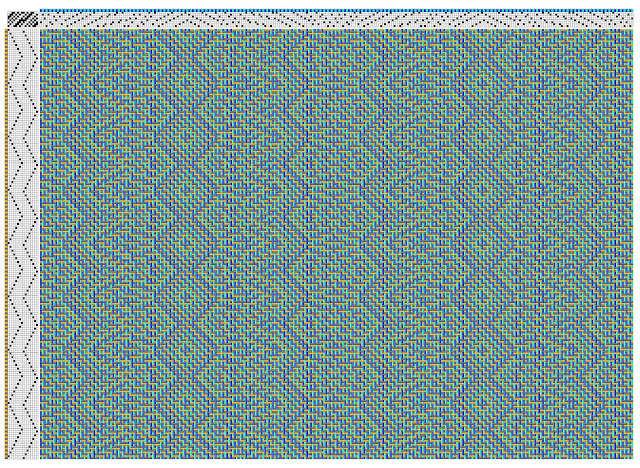
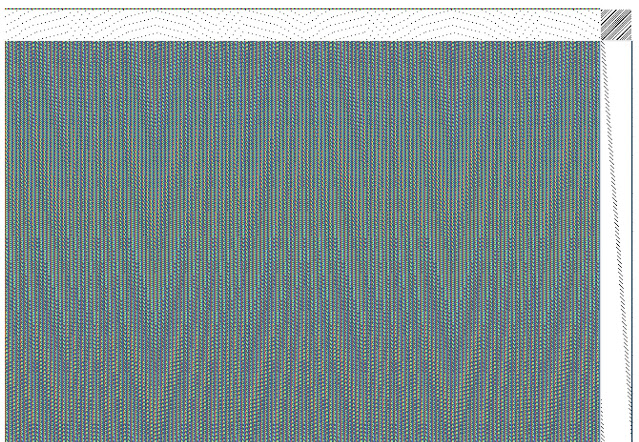
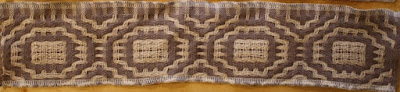
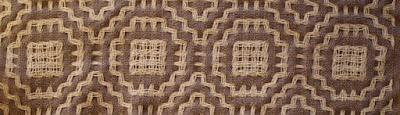
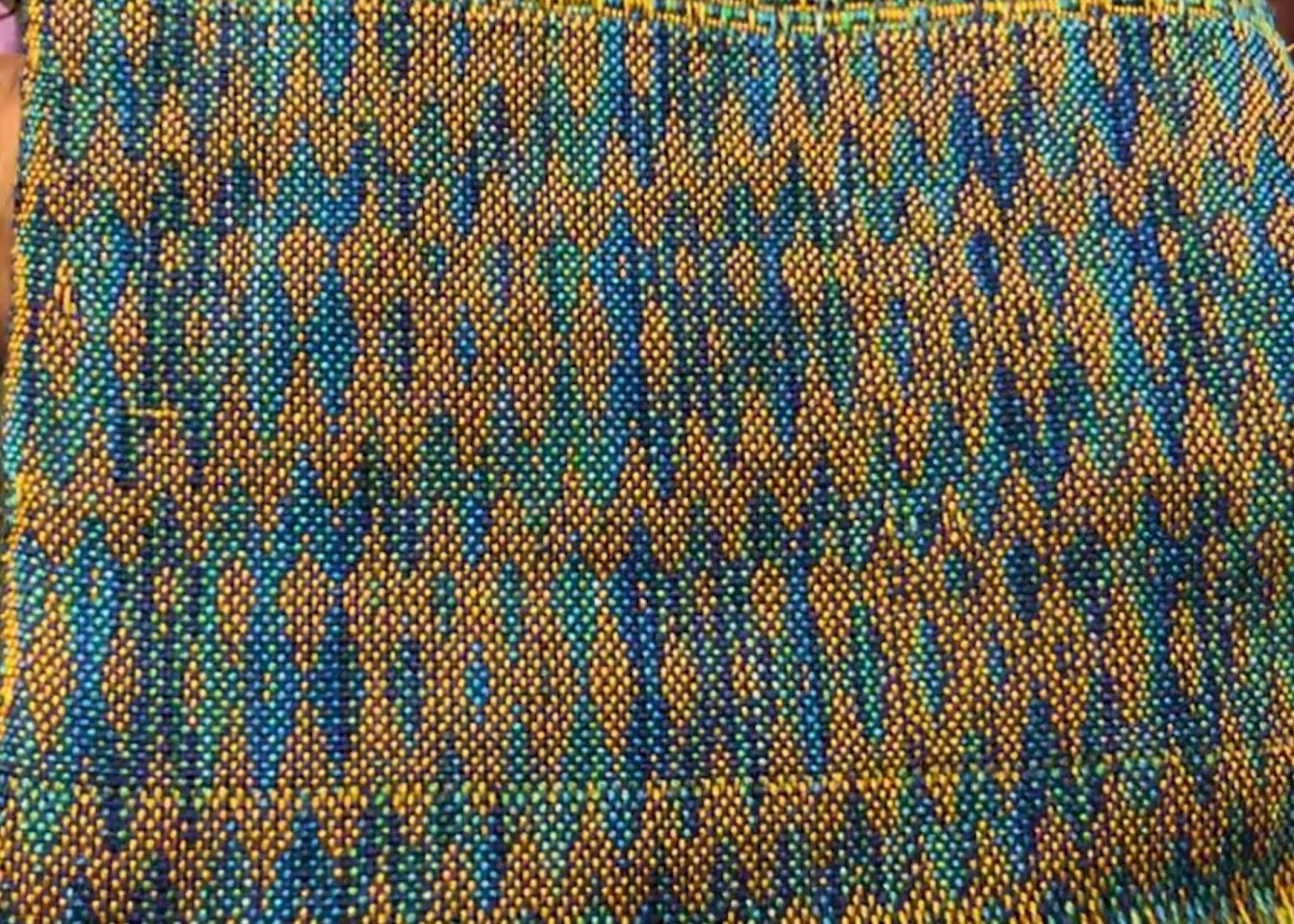
Well, not quite on the loom yet, but this is what I'm aiming for. It's a 32-shaft Echo design I call "Murmurations" because it reminds me of those wonderful rounded forms made by starlings and other flocks of birds as they shape-shift aerobatically across the sky.
Friday, December 20, 2024
What's (Almost) on the Loom Right Now?
Thursday, March 17, 2022
More Explorations in Parallel Threading: Playing with Strickler #728
Monday, January 17, 2022
Through the Weaving Glass: Some Thoughts on Counting Picks...
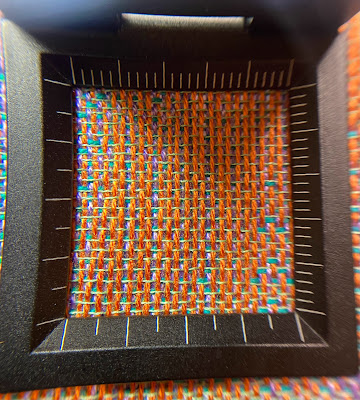
The photo above shows a "pick-glass," outlining a square inch of cloth. I took the photo with my iPhone, shooting through the lens of the pick glass, and the image is surprisingly clear.
(OK, I have to confess here that I always thought it was spelled "pic" -- until I looked up "pick-glass" on Google. Yes, it's true. Now I know.)
If you're thinking this is a useful device and you want one, you can find them on Amazon, of course, by searching for "counting glass" or "thread counting glass" or "pick counting glass." I'm sure they're used all the time in the textile industry. For weavers, it's a very handy device.
In the photo above, I have woven what looks like a 24 picks per inch on a warp sett at 24 warp ends per inch -- which would be a balanced weave, except that I'm using different weights of yarn in the warp and the weft. (The orange warp ends are 16/2 bamboo and the pale green weft yarns are silk/stainless steel at an unknown grist, something like 20,000 yards per pound.)
Also, this is double weave, so there are another 24 warp ends and 24 weft picks on the back side of the cloth. You can see some of the warp and weft peering out in lilac and turquoise, respectively. So we're really talking about 48 epi and 48 ppi total. I decided to use my pick glass to reassure myself that I wasn't beating the gossamer-fine weft too hard.
Because weavers are persnickety, right? And rightfully so, as we want our cloth to have a good hand and our weave structures to look just so, whether it's plain weave or satin or twill or whatever. For that reason, weaving patterns will often specify ends per inch and picks per inch along with the type of yarns to be used.
If we're not paying attention, we wind up with this:
Monday, December 21, 2020
More Explorations in Extended Parallel Threadings
![]() |
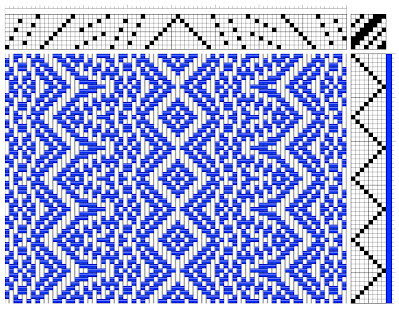
First, how to create the design itself? I think I found the original pattern, a twill pattern with elements of a Crackle threading, on Handweaving.net. Can't remember, exactly, because it could also have been on Pinterest. Both are great places to scan weaving drafts for ideas. Here's what the original draft looks like.
As for Rep (below): Well, not so great, but I think it was partly owing to my choice of wefts, where I alternated 20/2 cotton (thin weft) and black rayon chenille (thick weft). I think this sample would have been better if I changed my sett, making it much denser, and chose something thicker and less textured than the chenille for the thicker weft. Nevertheless, I see some potential here!
Thursday, July 19, 2018
What We Wove at Convergence: Echo, Jin, Shadow Weave, Rep, Double Weave, and Even Collapse Fabric
I taught a workshop on this subject last week at Convergence, the biennial conference for the Handweavers Guild of America, held this year in Reno, Nevada. "One Warp, Many Structures: An Exploration of Extended Parallel Threading" looked at all the possibilities I mentioned above. To teach this, I designed 9 different patterns -- 3 for 4 shaft looms, 3 for 8 shafts, and 3 for 12 shafts -- and invited students to choose a pattern and wind a warp using two colors of 10/2 pearl cotton. (I also named all of these patterns, using simple descriptions as a mnemonic device -- otherwise I couldn't remember them all!)
Below is a photo essay showing some of the beautiful samples the folks in my workshop created, with brief descriptions for each. It was a visual feast!
Above on left: Echo Weave sample using 8-shaft pattern, "Many Rivers," in light blue and off-white warp yarns. On right: the same pattern, this time in Double Weave, with top layer woven in off-white 10/2 cotton and bottom layer woven in 18/2 merino. The bottom layer fulls with hot water, soap, and agitation, making the top layer collapse and pucker. Woven by Roberta McKinney.
Woven by Judith Rees.
by Rachelle Weiss -- my apologies for not knowing for certain.
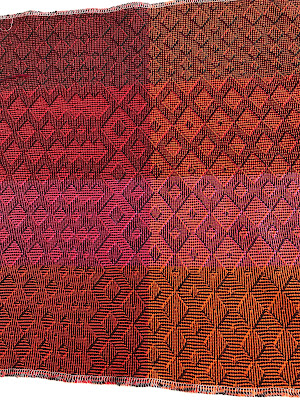
The two photos above: front and back of the "Falling Stars" pattern on 8 shafts in Double Weave.
The warps alternate between a golden yellow and a hand-painted yarn in shades of green and blue. Woven by Sharlet Elms.
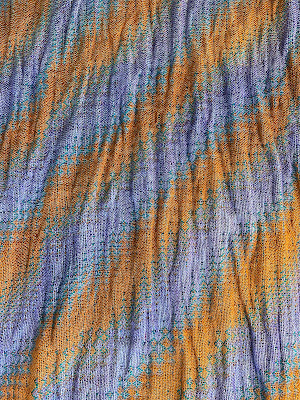
The two photos above: front and back of collapse cloth in the 8-shaft "Falling Stars" pattern, woven as Double Weave. The weft alternates between 10/2 cotton in gold (front) and 18/2 merino in purple (back). With washing, soap, and a lot of agitation, the merino fulls on the back, making the layer on the top collapse into pleats. Woven by Sharlet Elms.
"Many Rivers" design woven on 8 shafts. Pictured from top to bottom:
Echo, Shadow Weave, and Jin. Woven by Virginia Glenn.
Pictured above, clockwise from top left: 8-shaft "Falling Stars" pattern in Shadow Weave,
Double Weave, Rep Weave, and again in Double Weave. Woven by Ruth Ronan.
Blooming Leaf pattern on 4 shafts woven as Jin. Woven by Sharolene Brunston.
Above, top to bottom: "Fun House" pattern for 8 shafts. The top two samples are woven using a different Echo tieup and treadling from the bottom 4 samples. The bottom 4 samples are all the same tieup and treadling for Echo, but using different colored wefts. The warp yarns are light blue and turquoise. Woven by Carie Kramer.