Showing posts with label 24 shafts. Show all posts

Monday, June 14, 2021

24-Shaft Four-Color Double Weave Sample Extravaganza Scarf


8 different samples do not a scarf make.

Another name for this could be "The Greedy Weaver Scarf." I've tried so many tieup/treadling/weft yarn variations on this 24-shaft threading that I really couldn't settle on just one sample for a scarf. So I wove a scarf using eight of my favorites -- and even that wasn't enough! But I will wear it with pride.

Also, I will use it as a resource and a teaching tool. I'm getting more and more immersed in the mysteries of four-color double weave: How the colors shift with the patterns, how the colors change depending on what color they're next to (part of the over-arching theory of simultaneous contrast), how the textures change with active yarns in the weft, how the two sides can be quite different, how much latitude this gives for designing. I could go on!

And I will in this blog post ;o) Let's start with the vital statistics: This is a 24-shaft pattern in a two-color extended parallel threading at an interval of 12 shafts. For the warp, I used 16/2 bamboo in rusty orange and a lilac I dyed myself because the color I wanted wasn't available. The sett was 60 epi and there were 816 ends in the warp plus two ends on either side for floating selvages.

Here's what the threading looks like (this shows one repeat out of two):


Because I repeated this once for 816 ends, there's a line right down the middle in some of the designs, which I really don't like, but be that as it may. These are samples! I wanted to play with tieups and treadlings to see what happened.

My first sample -- one of my favorites -- looks like this:


For the wefts, I used a 16/2 cotton in bright turquoise along with a 20/2 cotton in soft yellow, with the following tieup and treadling. (The treadling is just an 11-end advancing point twill.) The result is lots of color -- how many different colors, I can't really count.


Next I tried a tieup that produced a rectilinear design. I learned about it from Mimi Anderson, immediate former president of Complex Weavers, who creates beautiful scarves in four-color double weave. Here's my sample, followed by an image of the tieup and treadling.


Still with me? To keep things moving, I will show you just two more samples with their tieups and treadlings -- my two other favorite patterns.
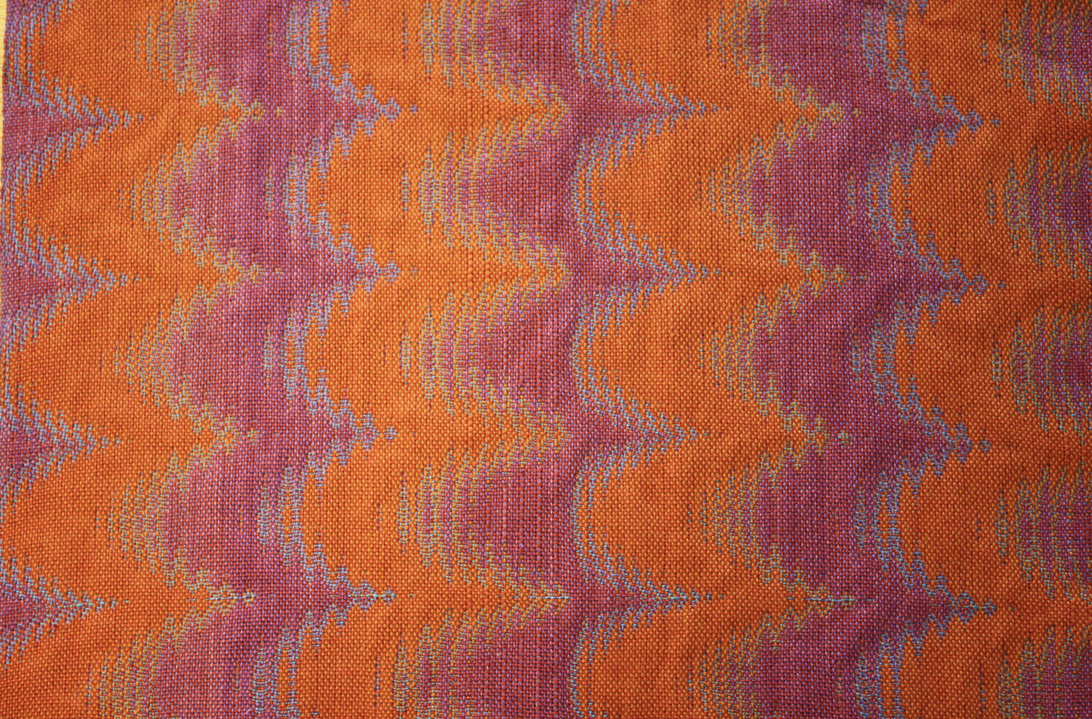

Another favorite, front


And back


And below, my most favorite (that's a double superlative), which I think I'll use for a garment. The wefts are 16/2 cotton in bright turquoise and a gossamer-fine (20,000 yds./lb.) silk/stainless steel yarn in mint green. The silk/stainless relaxes after washing and makes the cloth pleat randomly thanks to separate "pockets" where the double weave divides into two layers. At other points in the fabric, the two layers are integrated, which allows for a lot of textural interest.


On the top layer of the fabric, the silk/stainless steel weft is so fine 
that you see mostly the warp colors.


On the bottom layer of the fabric, the 16/2 turquoise weft adds a blue cast.


And here's the tieup and treadling.

Thanks for reading! Happy weaving.


Tuesday, September 8, 2020

Designing Echo as Double Weave for 16 Shafts


Pictured above: a drawdown of the front of a 16-shaft 4-color double-weave pattern that I just finished designing. (You'll find the tieup for this, as well as a view of the back of the pattern, at the end of this post. I have to go through all my steps in figuring it out before I reveal it to you!)

My inspiration came from Pinterest, where a while back I came upon a design I really admired. 


It was for 24 shafts and I have just 16 on my Toika, but still I had to figure out what made it so appealing. It was for double weave in an Echo threading and the tieup looked like this:


My first reaction was, "Oh boy, here's one of those irregular double-weave tieups that makes absolutely no sense." And my second reaction was, "How did they DO that?" My third reaction was, "I want to do that!" 

I knew that the original tieup had been modified -- "carved" you might say -- to veer off a straight twill angle for some of the shafts, creating interesting and eccentric patterns in the cloth. So I set about adapting the design to 16 shafts, first by breaking the 24-shaft tieup into two sections, one each for the top and bottom layers of the original 24-shaft draft.

Here's what they look like.

Tieup for the top layer

Tieup for the bottom layer

Back to Stubenitsky's Echo and Iris, of course. On page 89, she lays out her method of designing double weave tieups based on what she terms a "ratio." (Note here: Of all the listings in the index of this book, "Ratio" is cited the most. Something to ponder.)

She begins with what she calls the "ground tie-up." Below is what the ground tieup looks like for a 16-shaft double weave in Echo. For both layers, this ensures that half of the shafts will weave plain weave throughout. (You can't really weave anything with this tieup; it just gives you a stable ground for creating designs using the other half of the shafts.)


It isn't as inscrutable as it may first appear. On treadle 1 (for the top layer, which is treadled with all the odd-numbered treadles), you'll weave plain weave by raising shafts 1, 3, 5 and 7. On treadle 2 (for the bottom layer, which is treadled with all the even-numbered treadles), you'll weave plain weave by lifting shafts 10, 12, 14 and 16. 

An aside: With double weave, the shafts that are "raised" to weave the bottom layer are actually being lowered from the perspective of the bottom layer, because the bottom layer is weaving upside down (from the weaver's perspective). It's helpful to think of the tieup for the bottom layer as a sort of photo negative, where up is down (black is white) and down is up (white is black).

Note that the second half of the tieup for both layers is totally blank. That's where Stubenitsky's ratio comes in. For this, I tried a tieup with a ratio of 4:4, meaning that, in the second half of the treadling above the ground tieup, 4 shafts are raised and 4 shafts are down in an ascending order for both layers (top and bottom layers, on odd and even-numbered treadles).

Here's how that 4:4 ratio looks.

Next I created a tieup with a 5 to 3 ratio, which looks like this.


Here's a 6 to 2 ratio:


And finally I designed a 7 to 1 ratio:

So here is what the drawdowns look like, respectively.


4 to 4 ratio


5 to 3 ratio


6 to 2 ratio


7 to 1 ratio

And here, below, is the grand finale: what I call a "carved" tieup for this pattern on 16 shafts (the pattern that appears in the first image of this post). 


And here's the image of the back of the drawdown for this (again, the front is the first image that appears in this blog post).


I like both sides quite a bit, but the problem is that there are quite a few warp floats of 7 picks. Not great, really, but then again, I'm considering that this is double weave -- so 7 divided by 2 layers is really a float of 3.5 for one layer. Round that up to 4 and it would be acceptable if this were Echo or Jin, so maybe it's not a problem?

More to ponder... Thanks for reading!