Showing posts with label silk/stainless steel yarn. Show all posts

Monday, January 17, 2022

Through the Weaving Glass: Some Thoughts on Counting Picks...


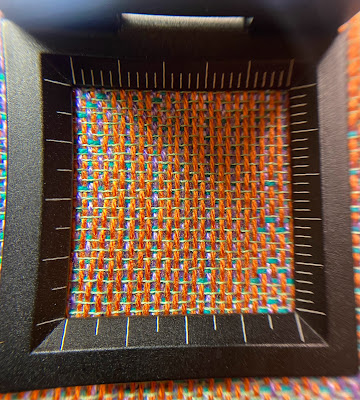
The photo above shows a "pick-glass," outlining a square inch of cloth. I took the photo with my iPhone, shooting through the lens of the pick glass, and the image is surprisingly clear.

(OK, I have to confess here that I always thought it was spelled "pic" -- until I looked up "pick-glass" on Google. Yes, it's true. Now I know.)

If you're thinking this is a useful device and you want one, you can find them on Amazon, of course, by searching for "counting glass" or "thread counting glass" or "pick counting glass." I'm sure they're used all the time in the textile industry. For weavers, it's a very handy device. 

In the photo above, I have woven what looks like a 24 picks per inch on a warp sett at 24 warp ends per inch -- which would be a balanced weave, except that I'm using different weights of yarn in the warp and the weft. (The orange warp ends are 16/2 bamboo and the pale green weft yarns are silk/stainless steel at an unknown grist, something like 20,000 yards per pound.)

Also, this is double weave, so there are another 24 warp ends and 24 weft picks on the back side of the cloth. You can see some of the warp and weft peering out in lilac and turquoise, respectively. So we're really talking about 48 epi and 48 ppi total. I decided to use my pick glass to reassure myself that I wasn't beating the gossamer-fine weft too hard.

Because weavers are persnickety, right? And rightfully so, as we want our cloth to have a good hand and our weave structures to look just so, whether it's plain weave or satin or twill or whatever. For that reason, weaving patterns will often specify ends per inch and picks per inch along with the type of yarns to be used.

If we're not paying attention, we wind up with this:
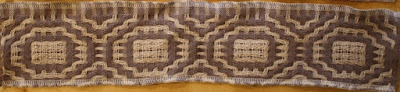
Deflected double weave with squashed motifs, woven by me when I wasn't thinking

Instead of this:

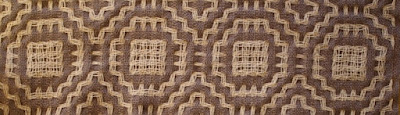
Deflected double weave with balanced motifs, after I started beating gentler

Here is another sample, a well-balanced 12-shaft shadow-weave design of mine, woven by Maryann Ariizumi:


Shadow weave should be sett and beat as a balanced weave, because the structure is essentially plain weave, with floats of 2 ends or picks here and there. Warp and weft yarns are identical, typically.

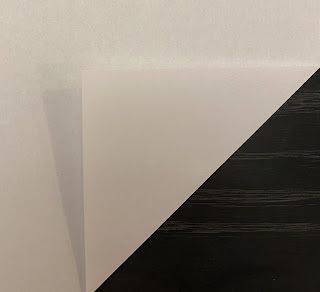
One way to achieve this kind of balance in your weaving is to simply eyeball the pattern. Twills, for instance, should rise at a 45-degree angle. Another way is to take a piece of paper and fold it in at the corner, like this: 


If you fold it carefully, so that the top of the fold falls along the horizontal and the side of the fold falls along the vertical, you'll get a 45-degree angle, which you can just place on top of your fabric to compare it with what you've woven. Works great!

But other times, when you're weaving with a fine warp and/or weft and you're aiming for a specific number of picks per inch, you will definitely want to count threads. 


A pick glass also helps in analyzing structures and trying to check out errors or the direction of yarn twist (S or Z). It's very comforting to know for certain what's going on.

In fact, I carry mine in my purse, along with a 6" ruler. How's THAT for the definition of a weaving nerd?

Same fabric as in the first photo, through the camera lens

Thanks for reading!


Monday, June 14, 2021

24-Shaft Four-Color Double Weave Sample Extravaganza Scarf


8 different samples do not a scarf make.

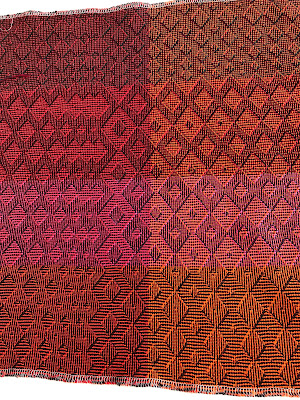
Another name for this could be "The Greedy Weaver Scarf." I've tried so many tieup/treadling/weft yarn variations on this 24-shaft threading that I really couldn't settle on just one sample for a scarf. So I wove a scarf using eight of my favorites -- and even that wasn't enough! But I will wear it with pride.

Also, I will use it as a resource and a teaching tool. I'm getting more and more immersed in the mysteries of four-color double weave: How the colors shift with the patterns, how the colors change depending on what color they're next to (part of the over-arching theory of simultaneous contrast), how the textures change with active yarns in the weft, how the two sides can be quite different, how much latitude this gives for designing. I could go on!

And I will in this blog post ;o) Let's start with the vital statistics: This is a 24-shaft pattern in a two-color extended parallel threading at an interval of 12 shafts. For the warp, I used 16/2 bamboo in rusty orange and a lilac I dyed myself because the color I wanted wasn't available. The sett was 60 epi and there were 816 ends in the warp plus two ends on either side for floating selvages.

Here's what the threading looks like (this shows one repeat out of two):


Because I repeated this once for 816 ends, there's a line right down the middle in some of the designs, which I really don't like, but be that as it may. These are samples! I wanted to play with tieups and treadlings to see what happened.

My first sample -- one of my favorites -- looks like this:


For the wefts, I used a 16/2 cotton in bright turquoise along with a 20/2 cotton in soft yellow, with the following tieup and treadling. (The treadling is just an 11-end advancing point twill.) The result is lots of color -- how many different colors, I can't really count.


Next I tried a tieup that produced a rectilinear design. I learned about it from Mimi Anderson, immediate former president of Complex Weavers, who creates beautiful scarves in four-color double weave. Here's my sample, followed by an image of the tieup and treadling.


Still with me? To keep things moving, I will show you just two more samples with their tieups and treadlings -- my two other favorite patterns.


Another favorite, front


And back


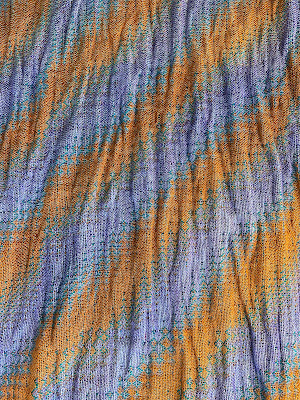
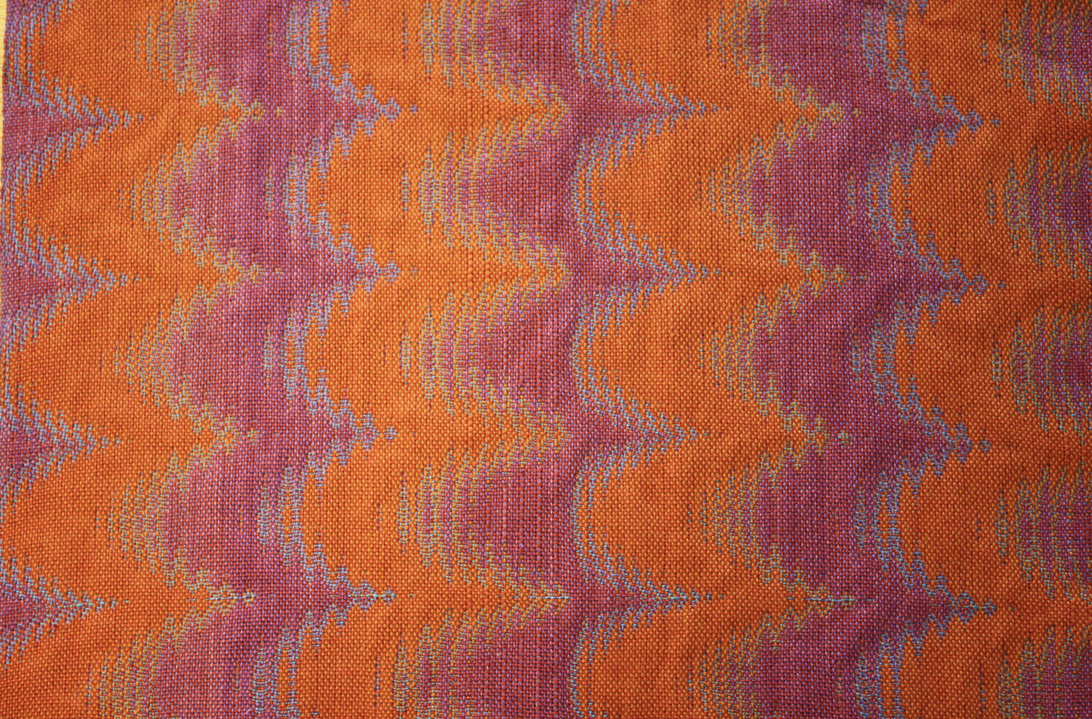
And below, my most favorite (that's a double superlative), which I think I'll use for a garment. The wefts are 16/2 cotton in bright turquoise and a gossamer-fine (20,000 yds./lb.) silk/stainless steel yarn in mint green. The silk/stainless relaxes after washing and makes the cloth pleat randomly thanks to separate "pockets" where the double weave divides into two layers. At other points in the fabric, the two layers are integrated, which allows for a lot of textural interest.


On the top layer of the fabric, the silk/stainless steel weft is so fine 
that you see mostly the warp colors.


On the bottom layer of the fabric, the 16/2 turquoise weft adds a blue cast.


And here's the tieup and treadling.

Thanks for reading! Happy weaving.