Showing posts with label extended parallel threading. Show all posts

Monday, June 14, 2021

24-Shaft Four-Color Double Weave Sample Extravaganza Scarf


8 different samples do not a scarf make.

Another name for this could be "The Greedy Weaver Scarf." I've tried so many tieup/treadling/weft yarn variations on this 24-shaft threading that I really couldn't settle on just one sample for a scarf. So I wove a scarf using eight of my favorites -- and even that wasn't enough! But I will wear it with pride.

Also, I will use it as a resource and a teaching tool. I'm getting more and more immersed in the mysteries of four-color double weave: How the colors shift with the patterns, how the colors change depending on what color they're next to (part of the over-arching theory of simultaneous contrast), how the textures change with active yarns in the weft, how the two sides can be quite different, how much latitude this gives for designing. I could go on!

And I will in this blog post ;o) Let's start with the vital statistics: This is a 24-shaft pattern in a two-color extended parallel threading at an interval of 12 shafts. For the warp, I used 16/2 bamboo in rusty orange and a lilac I dyed myself because the color I wanted wasn't available. The sett was 60 epi and there were 816 ends in the warp plus two ends on either side for floating selvages.

Here's what the threading looks like (this shows one repeat out of two):


Because I repeated this once for 816 ends, there's a line right down the middle in some of the designs, which I really don't like, but be that as it may. These are samples! I wanted to play with tieups and treadlings to see what happened.

My first sample -- one of my favorites -- looks like this:


For the wefts, I used a 16/2 cotton in bright turquoise along with a 20/2 cotton in soft yellow, with the following tieup and treadling. (The treadling is just an 11-end advancing point twill.) The result is lots of color -- how many different colors, I can't really count.


Next I tried a tieup that produced a rectilinear design. I learned about it from Mimi Anderson, immediate former president of Complex Weavers, who creates beautiful scarves in four-color double weave. Here's my sample, followed by an image of the tieup and treadling.


Still with me? To keep things moving, I will show you just two more samples with their tieups and treadlings -- my two other favorite patterns.
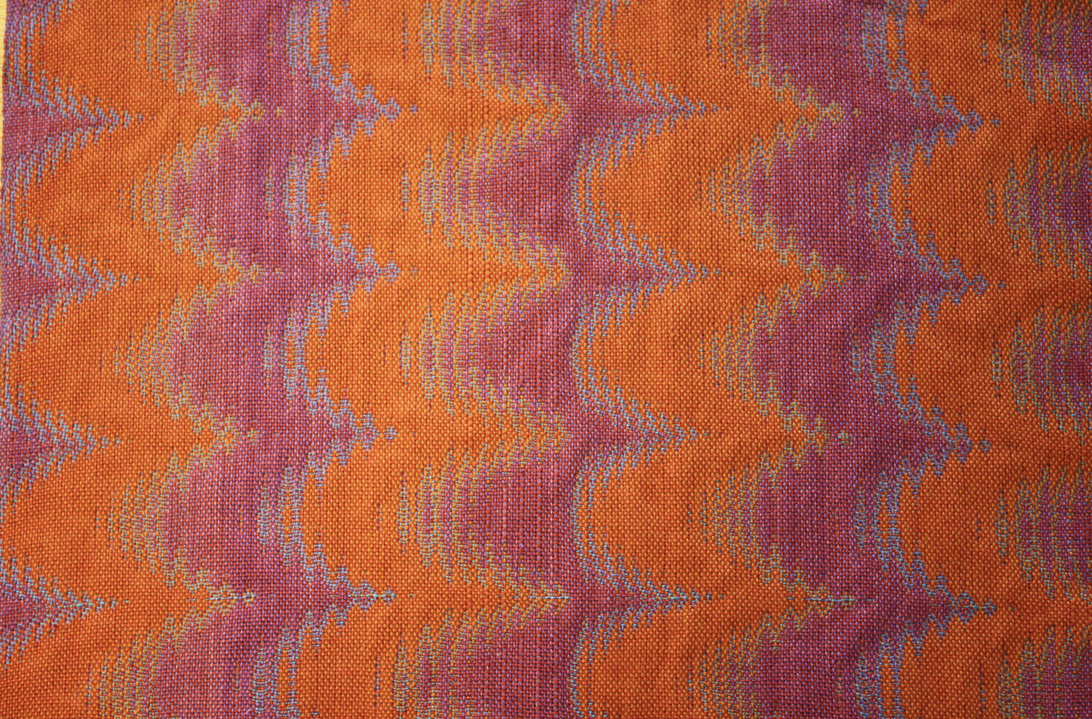

Another favorite, front


And back


And below, my most favorite (that's a double superlative), which I think I'll use for a garment. The wefts are 16/2 cotton in bright turquoise and a gossamer-fine (20,000 yds./lb.) silk/stainless steel yarn in mint green. The silk/stainless relaxes after washing and makes the cloth pleat randomly thanks to separate "pockets" where the double weave divides into two layers. At other points in the fabric, the two layers are integrated, which allows for a lot of textural interest.


On the top layer of the fabric, the silk/stainless steel weft is so fine 
that you see mostly the warp colors.


On the bottom layer of the fabric, the 16/2 turquoise weft adds a blue cast.


And here's the tieup and treadling.

Thanks for reading! Happy weaving.


Monday, December 21, 2020

More Explorations in Extended Parallel Threadings

Pictured here: a 12-shaft design woven on an Echo threading in 20/2 silk. I call this design "Burano" because it has a lacy look, reminding me of the lace-makers on the island off of Venice. 

So let's walk through the steps in creating this design and weaving the different samples in Echo, Jin, Shadow Weave, Rep and Double Weave. (This is exactly what we do in my workshop, "One Warp, Many Structures: An Exploration of Extended Parallel Threading." I must really like the process, because I keep repeating the format on my own, at home....)

First, how to create the design itself? I think I found the original pattern, a twill pattern with elements of a Crackle threading, on Handweaving.net. Can't remember, exactly, because it could also have been on Pinterest. Both are great places to scan weaving drafts for ideas. Here's what the original draft looks like.


Intricate, symmetrical, appealing -- reminds me of a butterfly! I starting playing on Fiberworks, expanding the design to 12 shafts using an extended parallel threading. And this is one of the designs I came up with: an Echo tieup on an advancing and descending twill treadling.


Following one of my other workshops -- "Paint Two, Beam One" -- I hand-painted two warps of 20/2 silk. The first was in a range of blues and the second in purples and rose colors, but I decided I needed more color, so I added two more painted warps in complementary colors, creating four stripes bordered on both sides by two ends of black. And here's how it wove up. 


This sample is the same pattern as in the first photo of this blog post. I used a bronze-colored weft in 20/2 cotton, because the gold tones really warm up the overall tones of the warp. And then I proceeded to weave up samples in Echo, Jin, Shadow Weave, Rep and Double Weave, varying my tieups, treadlings and weft yarns, all on the same extended parallel threading.

I am so grateful to my weaving teachers, particularly Bonnie Inouye and Marian Stubenitsky. I first learned about the potential of extended parallel threadings through a workshop taught by Bonnie, "Opposites Attract," in which she explores the potential of Echo threadings to achieve a broad range of structures. And I also continue to learn from Marian Stubenitsky's definitive work, Weaving with Echo and Iris, in which she took Echo designs and ran with them, showing countless possibilities for variations on 4 to 32 shafts.

Here's how my Jin sample wove up, offering yet another example of why I love Jin so much:


And here's how the threading works with Shadow Weave, shown here in a detail:


As for Rep (below): Well, not so great, but I think it was partly owing to my choice of wefts, where I alternated 20/2 cotton (thin weft) and black rayon chenille (thick weft). I think this sample would have been better if I changed my sett, making it much denser, and chose something thicker and less textured than the chenille for the thicker weft. Nevertheless, I see some potential here!


And then I wove up a double-weave sample, which I also like very much:


Just one more, this one in another variation of Echo:


Subtle, yes, but still I like it -- particularly the way the diamond shapes change in both size and color throughout the stripes.

Weaving at home and teaching weaving on Zoom have both given me great comfort this past year. And we all need comfort, even as we are painfully aware of how others lack food, shelter, health care and health itself. This year has given us hardship and hope in equal doses. Friends and loved ones are farther away and closer in our hearts. May you and yours enjoy the blessings of this season of light, however you may celebrate, and may you take comfort in every way you can in the year to come!


Tuesday, September 8, 2020

Designing Echo as Double Weave for 16 Shafts


Pictured above: a drawdown of the front of a 16-shaft 4-color double-weave pattern that I just finished designing. (You'll find the tieup for this, as well as a view of the back of the pattern, at the end of this post. I have to go through all my steps in figuring it out before I reveal it to you!)

My inspiration came from Pinterest, where a while back I came upon a design I really admired. 


It was for 24 shafts and I have just 16 on my Toika, but still I had to figure out what made it so appealing. It was for double weave in an Echo threading and the tieup looked like this:


My first reaction was, "Oh boy, here's one of those irregular double-weave tieups that makes absolutely no sense." And my second reaction was, "How did they DO that?" My third reaction was, "I want to do that!" 

I knew that the original tieup had been modified -- "carved" you might say -- to veer off a straight twill angle for some of the shafts, creating interesting and eccentric patterns in the cloth. So I set about adapting the design to 16 shafts, first by breaking the 24-shaft tieup into two sections, one each for the top and bottom layers of the original 24-shaft draft.

Here's what they look like.

Tieup for the top layer

Tieup for the bottom layer

Back to Stubenitsky's Echo and Iris, of course. On page 89, she lays out her method of designing double weave tieups based on what she terms a "ratio." (Note here: Of all the listings in the index of this book, "Ratio" is cited the most. Something to ponder.)

She begins with what she calls the "ground tie-up." Below is what the ground tieup looks like for a 16-shaft double weave in Echo. For both layers, this ensures that half of the shafts will weave plain weave throughout. (You can't really weave anything with this tieup; it just gives you a stable ground for creating designs using the other half of the shafts.)


It isn't as inscrutable as it may first appear. On treadle 1 (for the top layer, which is treadled with all the odd-numbered treadles), you'll weave plain weave by raising shafts 1, 3, 5 and 7. On treadle 2 (for the bottom layer, which is treadled with all the even-numbered treadles), you'll weave plain weave by lifting shafts 10, 12, 14 and 16. 

An aside: With double weave, the shafts that are "raised" to weave the bottom layer are actually being lowered from the perspective of the bottom layer, because the bottom layer is weaving upside down (from the weaver's perspective). It's helpful to think of the tieup for the bottom layer as a sort of photo negative, where up is down (black is white) and down is up (white is black).

Note that the second half of the tieup for both layers is totally blank. That's where Stubenitsky's ratio comes in. For this, I tried a tieup with a ratio of 4:4, meaning that, in the second half of the treadling above the ground tieup, 4 shafts are raised and 4 shafts are down in an ascending order for both layers (top and bottom layers, on odd and even-numbered treadles).

Here's how that 4:4 ratio looks.

Next I created a tieup with a 5 to 3 ratio, which looks like this.


Here's a 6 to 2 ratio:


And finally I designed a 7 to 1 ratio:

So here is what the drawdowns look like, respectively.


4 to 4 ratio


5 to 3 ratio


6 to 2 ratio


7 to 1 ratio

And here, below, is the grand finale: what I call a "carved" tieup for this pattern on 16 shafts (the pattern that appears in the first image of this post). 


And here's the image of the back of the drawdown for this (again, the front is the first image that appears in this blog post).


I like both sides quite a bit, but the problem is that there are quite a few warp floats of 7 picks. Not great, really, but then again, I'm considering that this is double weave -- so 7 divided by 2 layers is really a float of 3.5 for one layer. Round that up to 4 and it would be acceptable if this were Echo or Jin, so maybe it's not a problem?

More to ponder... Thanks for reading!


Monday, February 10, 2020

Jin Is a Tonic


Actually, you can't weave true tabby when you're weaving Jin on an Echo threading. It's more of a half-basket weave, but anyhow....

This post talks about the rewards of Jin, also known as Turned Taqueté, and why it's such a popular structure to weave with, especially when it's woven on an Echo threading.

[First, however, a few credits to share. Kathi Grupp, advertising and marketing manager for the Handweavers Guild of America, deserves applause for starting the meme above, because she was the one who came up with it during a workshop I taught in Atlanta. Thank you, Kathi!

And, since we're talking about Echo and Jin, let's extend thanks also to Marian Stubenitsky, Bonnie Inouye and Margaret Coe, all of whom have made enormous contributions to the storehouse of knowledge in this area -- ever since Alice Schlein first introduced and named the design known as Echo in Weaver's magazine back in the 1990s. To be clear, Jin is an ancient structure, dating back thousands of years, as discussed by Becker in his seminal book, Pattern and Loom. But right now I'm focusing on the gorgeous waving multicolored designs that weavers are creating today.]

So, in Atlanta with Kathi Grupp and members of the Chattahoochee Handweavers Guild, we were discussing the popular weave structure known as Jin and how it solves all kinds of float problems when you want to design a viable fabric on an Echo threading.

Let's start with Echo, because that's the threading many folks use in designing Jin. Working with weaving software to design an Echo pattern, often you'll "test" your design with an ascending twill tieup, where half of the shafts are down and half are raised (meaning that when any warp thread in the design is up, its parallel will be down). Your pattern will show on either side, but in different colors. Brilliant! So many weavers love Echo designs, because they offer lots of freedom in creating curves.

Sometimes the test tieup for Echo works beautifully, depending on the threading. But, more often than not, it creates lots of long floats. Like this:


Bonnie Inouye's rule of thumb is that, when you're weaving Echo, you don't want warp floats that are longer than 5 picks (or weft floats that are wider than 5 warp ends). So this design fails by that standard.

What to do? Keep calm and add tabby -- to weave Jin -- which, by definition, will never give you warp floats of more than 3 picks. For that reason alone, Jin is a tonic. Plus, with two or three or four colors in the warp (using an extended parallel threading) and with the right color in the weft, you'll often get iridescence and, sometimes, new and unpredictable colors that are created by combinations of your basic colors in the warp and weft.

Further, I like to say that Jin is a very tidy structure, because of the uniformity of the 3-pick-long warp floats.


Another way to deal with the warp floats in an Echo design, rather than weaving Jin, is to break up the tieup. (I sometimes jokingly say that we are "tabbifying" the tieup, which is another way to "Keep Calm and Add Tabby.")


With this tieup, you're still weaving Echo, but you are limiting your warp floats to no more than 3 picks (and limiting your weft floats to no more than 3 warp ends). I like the way the advancing point twill treadling works to create strong black and purple zig-zagging lines in the design. The colors really dance on the screen, which tells me that it would be worth trying to weave, maybe using similar colors.

Talking about tabby: To repeat, you can't weave true tabby with Jin on an Echo threading. As I mentioned, you wind up with something like a half-basket weave, where one weft floats over two warps. 

Jin is described by John Becker in his book Pattern and Loom as "warp-faced compound tabby." It's warp-faced because of the 3-pick-long warp floats on both sides of the fabric. And it's a compound structure (as is Overshot, for example) because if you remove the pattern wefts, you will still have some kind of ground cloth (made up of the tabby weft shots). A compound weave structure has two things going on at once, as I understand it.

Terminology is a challenge in weaving, almost like another language. That's one of the reasons I write these blog posts: They help me to understand the language of weaving.

Hope this helps you, too. Thanks for reading!


Friday, August 16, 2019

The Story of a Scarf


I'll start with the basics: This is a 12-shaft weave, using three hand-painted warps in 60/2 reeled silk, at a sett of 60 epi, using an extended parallel threading, with a 120/2 spun silk weft.

Oh and it's not quite finished (what you don't see in the photo is the unplied fringe on the back of the mannikin).

I call this design "Pagoda" because the pattern looks like the multi-tiered roof of a Buddhist temple. See the the cascading pattern in the middle of the photo? And the colors remind me of Asian silk fabrics. Plus the cultivation of silk itself originated in China.


The story behind this piece is that it wasn't really planned at all!

It simply started with the yarn, which was undyed reeled silk from Habu. I purchased it for a bargain price when our guild was selling the yarns and equipment of a good friend, the late, abundantly creative Joy Duskin. I didn't even realize it was reeled silk -- which means silk that is thrown (or wound) straight from the cocoon, the most treasured silk of all. (Most of us purchase and weave with spun silk, which comes from incomplete pieces of the silk filaments and is less sleek and durable.)

I had never woven with reeled silk -- and this was in the gum, to boot! ("In the gum" means that the sericin from the silkworm's spit, which helps maintain the structure of the cocoon, has not been removed, so that the silk is stiff and has a matte finish. Silk can't be dyed in the gum. Also, removing the gum improves the luster, hand, and texture of the silk.)

The yarn sat in my sewing room for at least a year -- until I got together with two friends, Molly McLaughlin and Deb Kaplan. They both know lots about silk and Deb patiently showed me how to de-gum my skeins in hot water and soda ash.

This story is getting way too long, so let's cut to the dyeing: I wound two warps and hand-painted them with MX fiber-reactive dyes in two different colorways -- and THEN decided that they were too close in their hues. So I hand-painted a third warp. That's why you see a band of color in the center of the photo and different-colored bands on either selvage. I was planning an Echo design, which is typically threaded color A, color B, color A, color B, etc. For this scarf, using three hand-painted warps, the threading was A-B-A-B for about 4 inches, then A-C-A-C for about eight inches, then back to A-B-A-B for the last four inches.

Below is my design line, which I created on 8 shafts instead of 12, which left room to create a parallel threading 6 ends above the original design line. I chose not to put this on a network, just to see what happened.

Original design line on 8 shafts

The threading on 12 shafts: 
My original design line plus a parallel line 6 shafts above

In Fiberworks, here are the steps involved.

1) I expanded the number of shafts to 12 by going into the dropdown menu labeled "Tieup," clicking on "Shafts and Treadles," and increasing the number of treadles to 12.

2) Next, I clicked on the "Warp" dropdown menu, then clicked on "Parallel Repeat." I left the box checked that says "Add Shafts Above" (because I already created 12 shafts to work with), then I clicked on "Shafts shift by 6," and then clicked "Apply."

Next I created a classic Echo (also used for Rep) tieup, which is an ascending twill tieup with half the shafts up and half the shafts down, like so:

And then I created an advancing point-twill treadling, but that was all long warp floats and definitely unweavable.


Still, it was easy to solve, just by adding a parallel treadling. Using Fiberworks, this was done by clicking on the "Treadling" dropdown menu, clicking on the command that says "Extended Parallel," then putting the number "5" in the box labeled "Treadles Shift By," and then clicking on "Apply." (I shifted by 5 treadles instead of 6 as I had in the threading because I wanted to use only 10 treadles. So I divided 10 by 2 to get the correct parallel for the tieup.) This is the way Rep is treadled, on an extended parallel treadling. But the scarf isn't traditional Rep Weave, because I use only one weft yarn rather than the two (one thick, one thin) that characterize Rep.


And here's what the final drawdown looks like. (The red lines in the warp tell me where I need to shift my color arrangements from ABAB to ACAC, remembering that I'm using three hand-painted warps.)


Here's a closer look at the scarf itself.


And one more view...


I hope to enter this in an exhibit next year -- and I will let you know if and when it's accepted! Thanks for reading.