Showing posts with label A Pocket Dictionary of Weaving Terms for Today's Weavers. Show all posts

Monday, December 17, 2018

Sett and Re-Sett: Weaving Circles with Echo and Jin


This post is dedicated to Ingrid Boesel, master weaver and, together with her husband, creator of Fiberworks. Ingrid passed away last Friday and weavers around the world will sorely miss her generosity and creativity.

It seems that the more I weave, the more I go back to basics: sett, beat, yarn choices. I think it's important to ask questions all the time, taking nothing for granted.

That's what I've been doing over the past few weeks, weaving up samples for a workshop I'm teaching in April at the New Hampshire Weavers Guild: "Echo and Turned Taqueté for 4 Shafts and More."

Because Echo and Turned Taqueté (now better known as Jin) are warp-emphasis structures, they call for a dense sett: typically more than a twill but less than for double weave. BUT, many folks are weaving 4-color Echo and using a looser sett, even a plain weave sett, because they want to maximize the color effects, creating iridescence by using the same grist yarns in both warp and weft.

For the samples in the photos above, I used 20/2 pearl cotton in the weft and in the warp, which was sett at 36 epi, normally used for plain weave.* I also tried out a variety of weft yarns, all in 20/2 cotton, but using different combinations.

Here's what the pattern looks like woven as Jin, adding a tabby treadling.


Same threading, same sett, different treadling. And the circles are ovals. (Jin, because you're inserting tabby, always stretches out the pattern.)

Here's the drawdown for the Echo design at the top of this post. (Let me know if you want me to share the WIF with you.) I cropped the image, because it's way too big to show any details otherwise. I've used an advancing point twill in the threading and treadling both, so that the circles change in subtle ways across the design.


But back to sett. I really loved the way this fabric turned out, surprisingly, as the sett is way more open than I've ever used for Echo. So, out of curiosity, I decided to re-sley the warp at 48 epi, which is a twill sett for 20/2 cotton. I changed the tieup and treadlings as well because I still wanted rounded shapes.

So here's a different tieup and treading, sett at 48 epi.


Four colors total in warp and weft, and I'm still getting those rounded shapes, although I don't like this design as well.

Next I wanted to see what happened at 60 epi, which is a traditional sett for Echo (denser than twill at 48 epi, but more open than double weave at 72 epi). And I had to rework the treadling again to compensate for the denser sett.


This time I used a 12-weight embroidery thread for the weft (about 10,000 yards per pound), because I wanted a finer yarn. It's a variegated thread in shades of green, which adds a kind of sparkle to the fabric.


Here's what the same design looks like with a weft of 60/2 silk (a sort of coral color, which you see in the middle section of this sample).


So much more to do -- and to show you! I started playing with the treadling, like so:
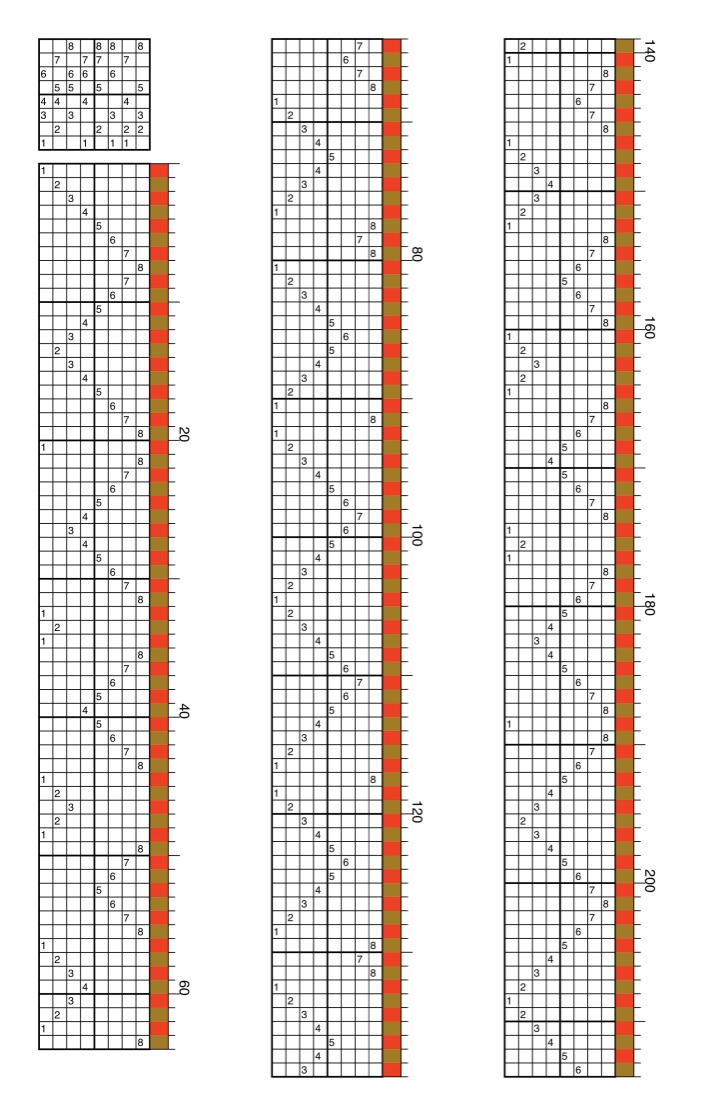

Which resulted in a completely different look that I like very much -- except I should have tried different colors for the weft (I used gold and red in 20/2 cotton for this sample).


I also tried a networked treadling (achieved by clicking on the treadling dropdown menu in Fiberworks, selecting "Fill Treadling" and choosing the "Redraw on Network" command). It's similar to the circles design in the photo at the top of this post, yet slightly different in that the blocks seem to show more.


And then there's this variation in the treadling:

Which results in this pattern:


I got here very easily, thanks to Fiberworks, again by clicking on the "Treadling" dropdown menu and then clicking on "Fill Treadling" and choosing a 13-thread Extended Twill. (Remember that I'm using the Mac version, so it might be different in the PC version.)

Lots of ways to weave in circles. Please try this at home! And thanks for reading.


*For those who aren't familiar with the Master Yarn Chart, a free PDF download from Interweave, it's a great resource. In it, you'll find the grist and three recommended setts (for lace, plain weave, and double weave) for every yarn that has been used in projects for Handwoven magazine since 2000. When I'm weaving with a new yarn, I use the Master Yarn Chart as a guide and adjust my sett if necessary after that.


Friday, April 15, 2016

Understanding Turned Taqueté

I think it's Elvis Costello who said, "Writing about music is like dancing about architecture." 

You could say the same about weaving. Writing about weaving is like... painting about cooking. He's making two contradictory points at once, to my thinking: first, that it makes no sense to try to verbalize what is going on -- and second, on the other hand, you may be doing something interesting in the attempt!

Hence, this blog post. 

I'll start with Madelyn van der Hoogt, who defines Taqueté (the unturned structure) as a "weft-faced compound tabby." 

"A weft-faced pattern weave with two or more sets of complementary wefts. Even warp ends separate the weft sets so that one set (color) is on the surface of the cloth and the other(s) on the back. Odd warp ends bind the complementary wefts in alternate (tabby) order, thus the name weft-faced compound tabby, also called taqueté and summer and winter polychrome...."

from A Pocket Dictionary of Weaving Terms for Today's Weavers, by Madelyn van der Hoogt, copyright 1989

In grappling with definitions and drawdowns and actual fabric, I decided to go back to basics, which would be a simple 4-harness threading. It gets clearer and clearer the closer you look. Here's a drawdown for Turned Taqueté, below, threaded on a straight draw with two pattern blocks in the treadling.


Treadles 1 and 2 are the plain weave or tie-down picks, while 3 and 4 are the pattern picks. If you look at the tie-down picks (just by looking at the first treadling block on the upper right-hand corner of the draft), you'll see that the weft is tied down alternately by brown warps on harnesses 2 and 4. That's the tabby in this compound structure. At the same time, warps on harnesses 3 and 1 -- the pattern warps -- are lifted over 3 picks. Back and forth and back and forth, which is pretty much what we weavers do ;o)

So, as Madelyn says, one warp thread floats over 3 picks and the warp thread next to it floats under 3 picks. (This happens alternately, with picks in between, of course, so that the warp floats are not parallel with each other.) But this basic fact is, really, the beauty of Turned Taqueté: you have a pattern on both sides of the cloth, because the structure is warp-emphasis on both sides of the cloth.

Here's another way of looking at it. Since Taqueté (this time, not turned Taqueté, but the original structure, which is weft-emphasis) resembles Summer and Winter, let's compare the two at their simplest level, on 4 shafts.

Above, a simple Summer and Winter pattern using two colors in the weft. You will see that there are weft floats (in blue, floating over 3 warps) and warp floats (in white, floating over 3 picks), with the weft colors defining the pattern. Treadles 1 and 2 weave tabby (so that warp threads on harnesses 1 and 2 are on opposite sheds). Threads on harnesses 3 and 4 are the pattern warps, with two blocks in the treadling to alternate the pattern. If you turn the piece over, you would see the pattern in reverse.

Now let's look at a Taqueté drawdown, using the same threading and the same weft colors. Unlike the Summer and Winter drawdown above, there are only weft floats (floating over 3 warps) and no warp floats of more than 2. But, just like Summer and Winter, if you turn the draft over, you would see a mirror image of what we see here. (That is, where there are white weft floats you will see blue weft floats, and vice versa.) This is a weft-emphasis fabric, while Summer and Winter has both a warp and a weft emphasis.

Now, below, we turn the draft: Threading becomes treadling and vice versa. The tieup changes and the tie-down picks are now on treadles 1 and 2. The structure is the same -- except that we have turned the fabric 90 degrees and weft floats are now warp floats.


This is only a beginning -- and a wordy one at that! Still, it helps me immensely to understand what is going on. My aim is to design more complex patterns that maximize the potential of this structure, because it allows for showing off colors and patterns.

Thanks for reading, and thanks so much to Betz Frederick in Phoenix, Arizona, who has asked all the right questions and contributed so much to my own understanding! Here, for your viewing pleasure, is a photo of a scarf she recently completed, a network-drafted Turned Taqueté pattern using two painted warps in an extended parallel threading.