Showing posts with label 20/2 cotton. Show all posts

Monday, December 17, 2018

Sett and Re-Sett: Weaving Circles with Echo and Jin


This post is dedicated to Ingrid Boesel, master weaver and, together with her husband, creator of Fiberworks. Ingrid passed away last Friday and weavers around the world will sorely miss her generosity and creativity.

It seems that the more I weave, the more I go back to basics: sett, beat, yarn choices. I think it's important to ask questions all the time, taking nothing for granted.

That's what I've been doing over the past few weeks, weaving up samples for a workshop I'm teaching in April at the New Hampshire Weavers Guild: "Echo and Turned Taqueté for 4 Shafts and More."

Because Echo and Turned Taqueté (now better known as Jin) are warp-emphasis structures, they call for a dense sett: typically more than a twill but less than for double weave. BUT, many folks are weaving 4-color Echo and using a looser sett, even a plain weave sett, because they want to maximize the color effects, creating iridescence by using the same grist yarns in both warp and weft.

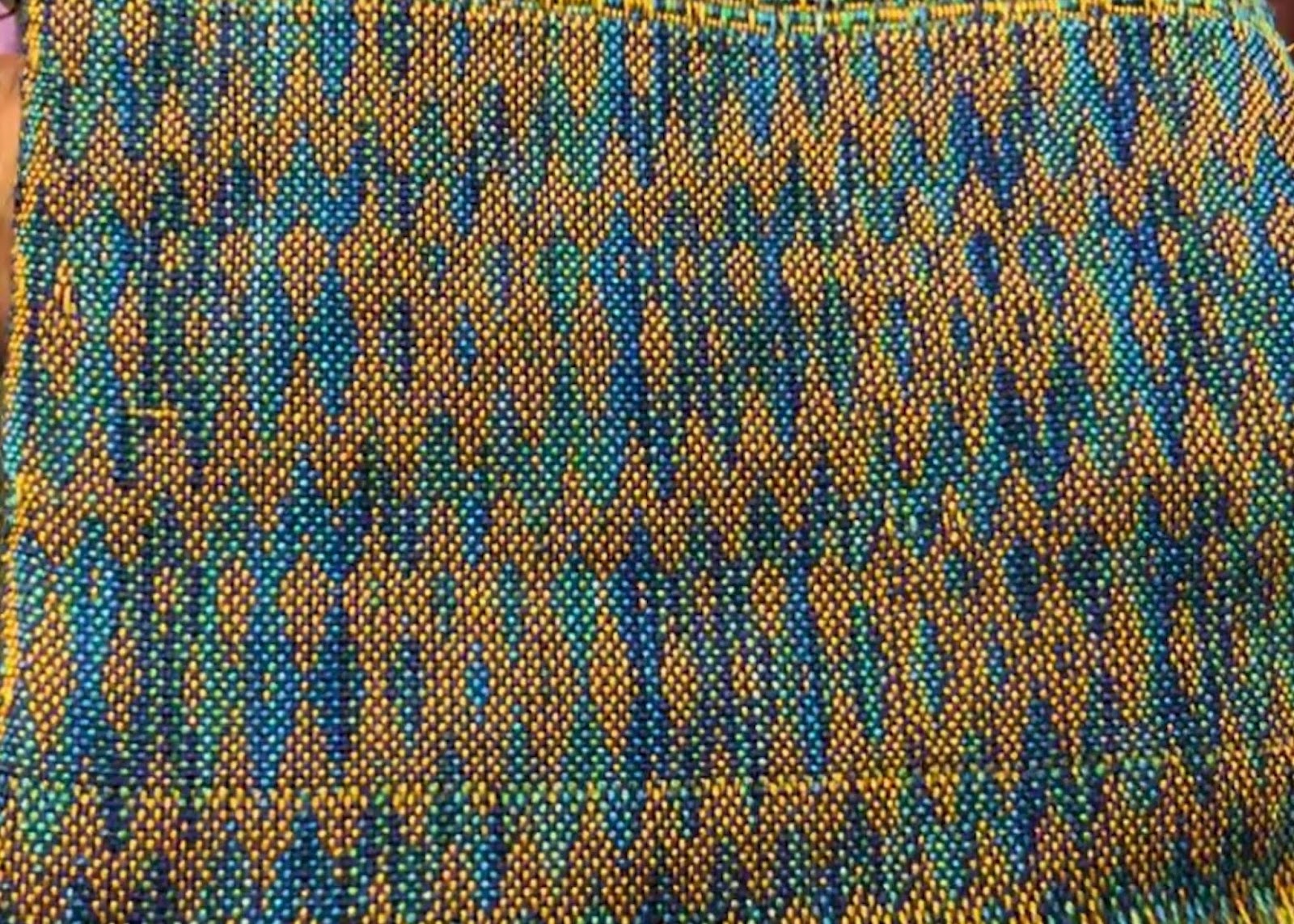
For the samples in the photos above, I used 20/2 pearl cotton in the weft and in the warp, which was sett at 36 epi, normally used for plain weave.* I also tried out a variety of weft yarns, all in 20/2 cotton, but using different combinations.

Here's what the pattern looks like woven as Jin, adding a tabby treadling.


Same threading, same sett, different treadling. And the circles are ovals. (Jin, because you're inserting tabby, always stretches out the pattern.)

Here's the drawdown for the Echo design at the top of this post. (Let me know if you want me to share the WIF with you.) I cropped the image, because it's way too big to show any details otherwise. I've used an advancing point twill in the threading and treadling both, so that the circles change in subtle ways across the design.


But back to sett. I really loved the way this fabric turned out, surprisingly, as the sett is way more open than I've ever used for Echo. So, out of curiosity, I decided to re-sley the warp at 48 epi, which is a twill sett for 20/2 cotton. I changed the tieup and treadlings as well because I still wanted rounded shapes.

So here's a different tieup and treading, sett at 48 epi.


Four colors total in warp and weft, and I'm still getting those rounded shapes, although I don't like this design as well.

Next I wanted to see what happened at 60 epi, which is a traditional sett for Echo (denser than twill at 48 epi, but more open than double weave at 72 epi). And I had to rework the treadling again to compensate for the denser sett.


This time I used a 12-weight embroidery thread for the weft (about 10,000 yards per pound), because I wanted a finer yarn. It's a variegated thread in shades of green, which adds a kind of sparkle to the fabric.


Here's what the same design looks like with a weft of 60/2 silk (a sort of coral color, which you see in the middle section of this sample).


So much more to do -- and to show you! I started playing with the treadling, like so:
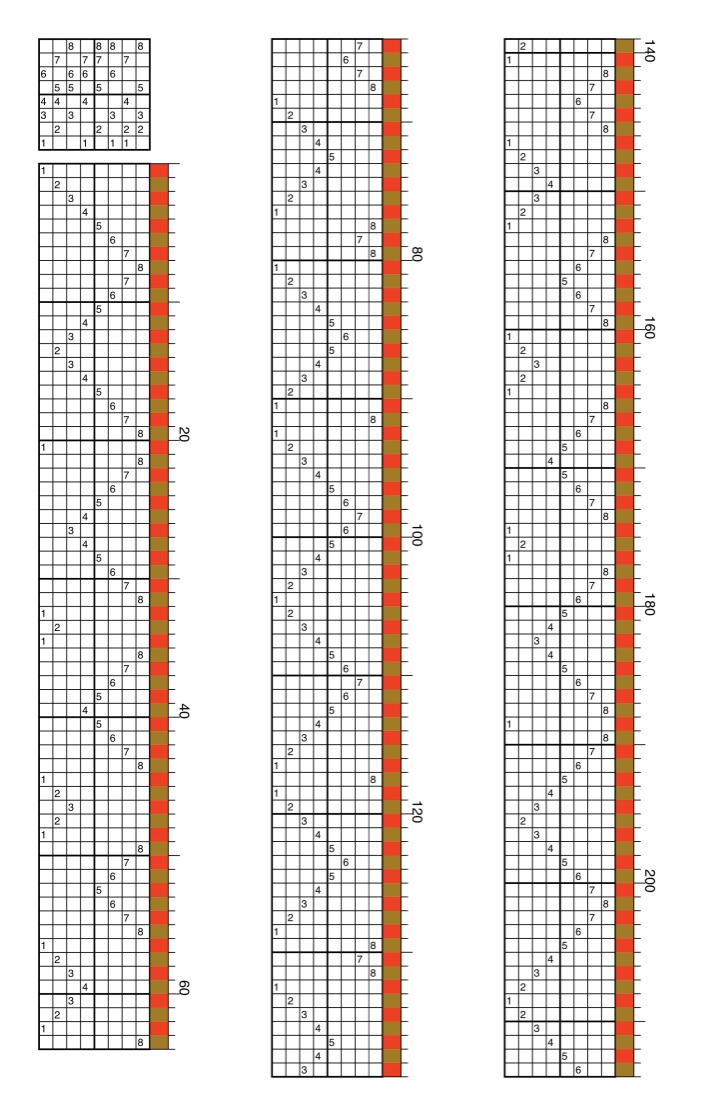

Which resulted in a completely different look that I like very much -- except I should have tried different colors for the weft (I used gold and red in 20/2 cotton for this sample).


I also tried a networked treadling (achieved by clicking on the treadling dropdown menu in Fiberworks, selecting "Fill Treadling" and choosing the "Redraw on Network" command). It's similar to the circles design in the photo at the top of this post, yet slightly different in that the blocks seem to show more.


And then there's this variation in the treadling:

Which results in this pattern:


I got here very easily, thanks to Fiberworks, again by clicking on the "Treadling" dropdown menu and then clicking on "Fill Treadling" and choosing a 13-thread Extended Twill. (Remember that I'm using the Mac version, so it might be different in the PC version.)

Lots of ways to weave in circles. Please try this at home! And thanks for reading.


*For those who aren't familiar with the Master Yarn Chart, a free PDF download from Interweave, it's a great resource. In it, you'll find the grist and three recommended setts (for lace, plain weave, and double weave) for every yarn that has been used in projects for Handwoven magazine since 2000. When I'm weaving with a new yarn, I use the Master Yarn Chart as a guide and adjust my sett if necessary after that.


Thursday, October 18, 2018

Collapse Fabrics with Deflected Double Weave


One side of the fabric

The other side

While it may not look like it, the above sample is Deflected Double Weave. Because it's woven on just 4 shafts, it's a very simple two-block pattern -- but it's Deflected Double Weave nonetheless, woven as a collapse fabric.

Here's the drawdown.


It looks pretty simple, eh? The warp is 20/2 cotton in stripes of purple and teal, sett at 36 epi. The weft is 20/2 cotton in a deep purple alternating with a fine wool/stainless steel yarn in fuchsia. This yarn is what creates the collapse effect: See the weft floats across the second block in the warp? At 75% wool and 25% stainless steel, these weft floats will relax and collapse when washed with hot water and soap, because the wool fulls while the stainless makes it crinkle. You can actually take this fabric and flatten it out or you can scrunch it up to get the crumpled effect you see in the photos. 

Here's what it looks like on the loom. -- gauzy, flat, and simple.


I used another yarn for the second weft in another sample: silk crepe from Habu Textiles. It's about 33,000 yards per pound, so fine that you can hardly see it!


It's very tough to wind this gossamer thread on a pirn (I always use an end-feed-delivery shuttle for fine and overtwisted yarns). It breaks so easily, as you can imagine. I actually used a doubling stand to help me, where I place the large bobbin that holds the silk crepe at the bottom of the stand and feed the yarn up through the tube that's used for doubling. It keeps the yarn nice and straight, which helps as I wind it onto the pirn.

So in this case I've substituted the silk crepe for the fuchsia-colored wool/stainless. The silk crepe floats and draws the warp ends in dramatically, making neat pleats!

One side of the fabric

The other side

Here's what it looked like before washing, in loom state:


To me, this fabric presents a real problem, because the sample is only about 7" wide! On the loom, it's 24.44" wide. -- that's more than 70% shrinkage, width-wise. So I like the first sample better, because it's about 12 to 14" wide after washing, which seems like a better width for a scarf. (That's what I want this fabric to become.)

Votes, opinions? I welcome you to voice your choice before I start weaving!

But before I end this post, I wanted to add a couple more photos. If you read my blog regularly, you may remember last month's post, showing a baby wrap I just finished for our new grandson, Owen. This month I finished knitting a sweater for him, using Elizabeth Zimmerman's Baby Surprise Jacket, knitted on #5 knitting needles with Kauni Effektgarn in space-dyed rainbow colors. I love the autumn colors and the vegetable buttons, especially since my daughter and son-in-law love vegetable gardening.


That's all for this month! Thanks for reading.


Friday, September 14, 2018

Baby Wrap in 16-Shaft Echo and Jin: On My New Computer Loom!


Echo, which is a border at the beginning and the end of the wrap

A detail

Great news! I have a new (to me) computer dobby loom: a 16-shaft Toika Eeva with a 40 cm weaving width. This Scandinavian beauty came to me by way of my friend and fine weaver Hedy Lyles, who enjoyed this loom but was moving up to 24 shafts.

Here's Eeva, getting dressed. 


A view from the back of the loom

I wound a warp of 10/2 Tencel, 1187 ends, 8 yards long, so that -- at 40 epi -- I would have a weaving width just shy of 30" and plenty of length for sampling before I weave up a 5-yard-long wrap. 

Because I've been teaching a lot of workshops on 4-shaft, 8-shaft, and 12-shaft Echo (and other structures you can weave on the same threading, using different tieups and treadlings), I decided to expand my repertoire to 16 shafts. Here's just a section of the Echo design, based on an advancing point twill in both threading and treadling.

I can't really show you the entire drawdown because it's too large to reproduce on this page. Anyhow, it gives you the idea: I broke up the pattern line in several spots because I like the abrupt shift, almost giving the impression of stripes.

The wrap will be Echo for just 24" on each end, with Jin filling up the center. I did this for two reasons: 1) I love the variations between the two structures and 2) the Echo pattern has warp floats of as many as 5 picks while the Jin design, by definition, never has a float of more than 3 picks. So I figured that the fabric woven in Jin would be just that much stronger and more durable when it comes to supporting an infant.

Here's what the Jin design looks like (again, only a portion of it, as the entire design wouldn't show up well at all in this narrow space). Because I'm showing you just a portion, the design looks asymmetrical -- but the pattern is symmetrical.
And here's what the Jin design looks like on the loom:


The other side of the fabric (maybe a bit harder to see)

I find that there is a bit of a learning curve with a computer loom. For instance, if I have a misstep on the pedal that controls the treadling, it's hard to instruct the weaving program to go back. At least for me it is: sometimes the computer wants to loop around and I find myself right back where I started, having to unweave. And then you have to tell the computer to unweave. It's a tricky conversation, at least until I get the hang of it.

The upside is that the weaving goes much faster and is less physically taxing. This is especially helpful with a 20/2 cotton weft, which I'm weaving at about 30 picks per inch.

And another advantage: those 16 shafts! There is a lot to learn and a lot of designing to do and I'm looking forward to it.

Back to the wrap itself: One of the things I love about Echo and Jin is the color dynamics. I deliberately chose an unlikely combination of warp colors -- burgundy and turquoise -- because I knew from experience that the weft alters the overall color of the fabric in surprising ways, often producing the iridescence that Marian Stubenitsky covers so well in her book, Weaving with Echo and Iris. For the weft I chose an orange/coral color, sort of a cantaloupe, because it warms up the warp, so to speak. Below is a photo of samples of different-colored wefts, with the cantaloupe-colored weft at the very bottom of the photo. 


This is a very special project for a very special new person in our lives: Our first grandchild, Owen, who is now almost 3 months old. I think it will look good on him, don't you?


Thursday, July 19, 2018

What We Wove at Convergence: Echo, Jin, Shadow Weave, Rep, Double Weave, and Even Collapse Fabric

Echo Weave on 8 shafts on a warp of light blue and dark blue 10/2 cotton. 
The weft is 20/2 cotton in golden orange. Woven by Virginia Lee.

You've heard about Echo, which is based on an extended parallel threading that weaves a warp-emphasis fabric with lots of color and strong patterns. But do you know about all the different structures you can weave on the same parallel threading? In addition to Echo, you can weave Jin, Shadow Weave, Rep Weave, Double Weave and even collapse cloth, simply by changing your tieups and treadlings.

I taught a workshop on this subject last week at Convergence, the biennial conference for the Handweavers Guild of America, held this year in Reno, Nevada. "One Warp, Many Structures: An Exploration of Extended Parallel Threading" looked at all the possibilities I mentioned above. To teach this, I designed 9 different patterns -- 3 for 4 shaft looms, 3 for 8 shafts, and 3 for 12 shafts -- and invited students to choose a pattern and wind a warp using two colors of 10/2 pearl cotton. (I also named all of these patterns, using simple descriptions as a mnemonic device -- otherwise I couldn't remember them all!)

Below is a photo essay showing some of the beautiful samples the folks in my workshop created, with brief descriptions for each. It was a visual feast!

Above on left: Echo Weave sample using 8-shaft pattern, "Many Rivers," in light blue and off-white warp yarns. On right: the same pattern, this time in Double Weave, with top layer woven in off-white 10/2 cotton and bottom layer woven in 18/2 merino. The bottom layer fulls with hot water, soap, and agitation, making the top layer collapse and pucker. Woven by Roberta McKinney.


 Echo in the 8-shaft pattern, "Falling Stars," using different colors of weft yarns in 20/2 cotton. 
Note how the the weft color completely changes the color of the fabric. Woven by Teresa Edmisten.

Left to right: Double Weave and Shadow Weave samples woven on 8 shafts in the "Fun House" pattern. 
Woven by Judith Rees.

 Clockwise, starting from top left: Echo,
Double Weave, and Rep Weave on a 4-shaft pattern called "Op Art."  Woven by Diana Abrell.

Rep Weave in the "Fun House" pattern on 8 shafts. Woven by Virginia Lee. 

Shadow Weave on 8 shafts in the "Falling Stars" pattern. I think this was woven 
by Rachelle Weiss -- my apologies for not knowing for certain.

 Above, the 8-shaft "Fun House" pattern on a warp in two shades of blue for warp yarns. 
The red weft creates the impression of 4 different colors in the fabric. Woven by Judith Rees.


The two photos above: front and back of the "Falling Stars" pattern on 8 shafts in Double Weave. 
The warps alternate between a golden yellow and a hand-painted yarn in shades of green and blue. Woven by Sharlet Elms.


The two photos above: front and back of collapse cloth in the 8-shaft "Falling Stars" pattern, woven as Double Weave. The weft alternates between 10/2 cotton in gold (front) and 18/2 merino in purple (back). With washing, soap, and a lot of agitation, the merino fulls on the back, making the layer on the top collapse into pleats. Woven by Sharlet Elms.


"Many Rivers" design woven on 8 shafts. Pictured from top to bottom: 
Echo, Shadow Weave, and Jin. Woven by Virginia Glenn.


Pictured above, clockwise from top left: 8-shaft "Falling Stars" pattern in Shadow Weave, 
Double Weave, Rep Weave, and again in Double Weave. Woven by Ruth Ronan.


Blooming Leaf pattern on 4 shafts woven as Jin. Woven by Sharolene Brunston.


Above, top to bottom: "Fun House" pattern for 8 shafts. The top two samples are woven using a different Echo tieup and treadling from the bottom 4 samples. The bottom 4 samples are all the same tieup and treadling for Echo, but using different colored wefts. The warp yarns are light blue and turquoise. Woven by Carie Kramer.


Thanks for reading! And many thanks to the staff of HGA for putting together another wonderful gathering of the clan!