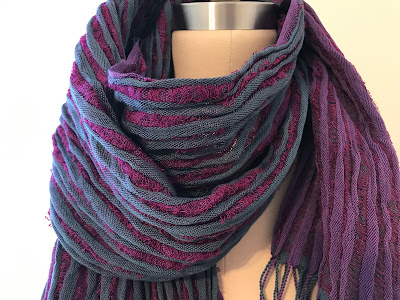
Pictured above: A scarf woven on 4 shafts in deflected double weave. The warp is 20/2 cotton in stripes of teal and purple and the weft uses these yarns plus a wool/stainless-steel yarn (see the floats above, in fuchsia). The scarf looks like gauze on the loom, but when you wash it in gentle soap and lukewarm water, the wool/stainless floats crinkle up and draw in horizontally, creating vertical pleats in the fabric.
I love these surprises in the finishing! And one of the easiest ways to achieve them is by using active or energized or exotic yarns -- a large category that includes yarns that will shrink, twist, collapse, and/or relax after washing.
Right now I'm teaching a Zoom workshop for the Reno Fiber Guild, "Deflected Double Weave for Collapse Fabrics." I put together a short handout on the active yarns we're using and how they work and I thought it was worth sharing in a blog post. Here's the list -- of course, it's not comprehensive -- along with photos and images of the yarns under magnification.
Fine Gold Gimp (Metallic Yarn)

The thicker version of this yarn doesn't work well for creating texture in fabrics, but the finer version can add a lot of interest. It's really 77% polypropylene and 23% metallic. And it's hard to find: The only vendor in the States that sells it is Made in America Yarns, a Philadelphia company that lists it under the name "fine metallic gimp yarn."
This is what a single strand looks like at 60X magnification.

And here's what it looks like after weaving and washing.

The polypropylene shrinks up with warm water and soap, bending and crimping the metallic coils around it. When used as weft, this can create some interesting motifs as it shrinks the fabric width-wise.

Wool/Stainless-Steel Yarn

This yarn, available from Habu Textiles, is what I used as weft in the scarf pictured at the beginning of my post. You can achieve similar effects with silk/stainless-steel yarn, available from Lunatic Fringe. Here's what it looks like under 60X magnification, unwoven (first photo) and woven and washed (second photo).

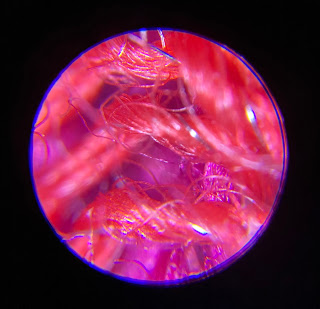
The wool shrinks in the washing and the stainless-steel filament bends with it, so that the sample is drawn in. I find that you can actually shape the garment, either flattening it out or stretching it vertically to create vertical pleats. It all depends on your mood ;o)

Deflected double weave sample on 8 shafts

Deflected double weave sample on 12 shafts
18/2 Merino Wool
Nothing beats wool for differential-shrinkage effects. Combine it with cotton or silk or some other inactive yarn and you'll get pleats and poufs and lots of texture. (Note: I don't recommend using JaggerSpun Zephyr, because the silk component doesn't full in comparison with the 18/2 superfine merino. Also, be careful not to purchase super-wash wool yarn, because these yarns are chemically treated NOT to full or shrink.)

Hand-painted warp of 18/2 JaggerSpun superfine merino

1 strand of 2-ply yarn, before fulling

Magnified image of the yarn after weaving and fulling

16-shaft deflected double weave sample after fulling, using 18/2 merino and 10/2 cotton in both warp and weft (hand-painted warps and wefts)
Venne Colcolastic (and Other Elasticized Yarns)

This yarn has two components: a fine 2-ply mercerized cotton and an elasticized single. Here's what it looks like under magnification:

And here's what it looks like under magnification and after weaving and washing:
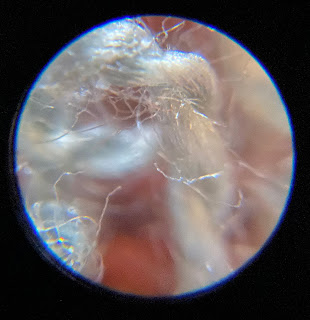
My explanation for this effect is that the elastic draws in and the cotton is drawn in with it, crinkling and twisting up as it goes. Below is a sample of a 4-shaft deflected-double-weave piece I wove with long weft floats of the Colcolastic. (You're viewing the warp horizontally.)


Active yarns are just one way to create textured fabrics. You can also achieve dimensional effects just by weaving structures that lend themselves to texture: turned twills, honeycomb, waffle weave, and of course deflected double weave will create curves and pleats even without the aid of active yarns.
Weavers will sometimes get preoccupied with color and structure, forgetting about that third invaluable characteristic of our craft, that of texture. In her definitive book, On Weaving, Anni Albers devotes a chapter to "Tactile Sensibility," focusing on the importance of matière:
"Matière is the word now usually understood to mean the surface appearance of material, such as grain, roughness or smoothness, dullness or gloss, etc., qualities of appearance that can be observed by touch.... Surface quality of material -- that is, matière -- being mainly a quality of appearance, is an aesthetic quality and therefore a medium of the artist...."
Weaving, in her view, brings us back to our ancient tactile sense. Of course, the yarns we use are central to this achievement.
Thanks for reading!


