Monday, March 12, 2012

Woad vs. Indigo: Here's What Happens When You 'Get the Blues'


Last Saturday at the Weaving and Fiber Arts Center, I taught a class on "Getting the Blues: Natural Dyeing with Indigo and Woad." The short story is that, among some 275 plants that have usable amounts of indigo in their leaves, woad and indigo are the most popular worldwide, indigo itself (indigofera tinctoria) being the most popular natural blue dye of all time. Both have been used for thousands of years (woad, for example, was used in the British Isles by the Picts to paint themselves blue during warfare). The textile industry in southern France, centered in Toulouse, was devoted to woad -- until the 16th century, when indigo was introduced from Asia and, literally, blew it out of the water! (OK, so I can't resist a bad pun.)

Indigo has the most concentrated levels of the blue pigment, which is why it's preeminent among its competitors. So I thought we'd have a class to demonstrate why. The photos below give you some of the results. (There are several qualifiers here: We were using chemical vats, not the fermentation vats of tradition, and students were using a variety of fibers. None were mordanted; all were soaked in water, some for days.)


 Above, Janet Leone's wool yarn dyed in indigo (left) and woad (right).


Photo: This was some wool roving that Judith Trolley brought along. She hadn't had a chance to soak it in water -- but the results were wonderful, none the less. She dyed this with both woad and indigo, to achieve a varied effect. Next comes the spinning, which I hope she'll share with us!


Photo: Mohair boucle brought by Eleanor Hartquist -- the skein on the left was dyed with woad, and the skein on the right was dyed with indigo.

Conclusion, from our brief and less-than-scientific experiment: All else being equal, indigo does, truly, provide deeper blues. Woad yields a lighter color, with just a bit more aqua to it, but equally beautiful, if not more so, to my eye. Ah, yes, the colors of southern France!

Thanks to all for a wonderful mess, er, class. And thanks especially to the folks who helped clean up. The dyeing kitchen looked pristine when they finished!

Sunday, February 26, 2012

Fleur de Laine


Just in time for spring: a "Fleur de Laine" pin (sounds fancy, but it's French for "wool flower") in purple, lavender, olive, and gold -- new in my Etsy shop.

I've also added some yarns in spring colors of lichen, dusty rose, and grass green.

100% merino handspun yarn in lichen 

Merino/silk handspun yarn in dusty rose

Merino/silk handspun yarn in grass green

For these and more, visit my Etsy shop at http://www.etsy.com/shop/denisekovnat-- and thanks for reading!


Wednesday, January 11, 2012

Sunshine and Rain (and very little snow, and a very hard time)

My Dad and Lynn, my son's girlfriend, at Christmas

I'm writing this to tell you why I have not written anything for the past few weeks. My dear Dad, pictured above, has had a series of strokes and is ailing.

In some ways, it's hard to write in a blog -- which is a very public medium -- about feelings so close, writing to strangers about something so painful. And yet, we are all human, right? Subject to the same joys and sorrows.

Dad wearing his new bolo tie and bomber jacket

My Dad was -- is -- my hero, my strong man. Some "friends" once told me years ago that I was too close to my parents, that they would die someday and that I should "cut the apron strings." I never did. So this time, this pain of losing, is the other side of love.

For you who have felt this way and have somehow rejoined the living, I thank you. Maybe that verb isn't right. I bless you. For me, I am an operatic mourner. I find it so hard. I feel like Puff the Magic Dragon. And words, to use the old cliche, are inadequate.

So, if you're reading this, just look at the photos for a minute and know what a guy my Dad was and is. And help us all say goodbye when the time comes.

Wednesday, November 30, 2011

Beaming (a Warp) with Pride


Today has been a good day: My loom is finally warped. It's a 12-yard warp, 1900-plus ends total, of 60/2 silk. It's actually two warps, since I painted 12 bouts in two different color ways and then beamed them all together to create alternating stripes. (An homage to the late Estelle Carlson, who gave a workshop to our guild on a similar technique.)

The tale is best told in pictures.

Winding the warp, with a cross at both ends:


I wound 12 warp bouts, about 160 threads each, so that the dyeing would go smoothly and the yarns were less likely to get tangled. (Emphasis on LESS likely.)

Next came the painting:


I wanted to paint two contrasting and simultaneously harmonizing color ways, inspired by the image of a Soleri bell that hangs in the Japanese maple tree in our garden. One color way moves from turquoise to teal to periwinkle to gold (the bronze bell, with a verdigris patina); the other travels from purple to burgundy to copper to olive to gold (like the autumn leaves on the Japanese maple). I want to see these colors play against each other, juxtaposed in narrow stripes on a fabric.

Next came beaming the warp, the biggest challenge of all. If it isn't beamed right, it won't weave right. And this is a very, very fussy warp.

So now it's all "on the beam," as they say. The view from the front:


It all looks so nice and neat, doesn't it? Well, it wasn't. Not at all. There are some tricks to make it easier, however. For starters, when you beam 60/2 silk, it's a good idea to forget about the lease sticks and just use a raddle -- then, when you're at the end of the warp (when the warp is nearly all on the warping beam), you insert your lease sticks, move them around behind the heddles, and start your threading. That way the silk won't get abraded or stuck in the lease sticks.

Another secret of working with very fine silk: Don't make any mistakes. I made mistakes. Long story short: I called my weaving guru, Joyce Robards, midway through the process to say some nasty things about silk. She made me feel better.

So now the warp is finally beamed, although I still have worries about how it all will weave. 

Tomorrow begins the threading....

One more image to share with you: the last honeysuckle blossom of the season, brought to you by Mother Nature, the greatest dyer of them all.


Saturday, November 19, 2011

Samples from a Class on Shiva Artist Paintstiks


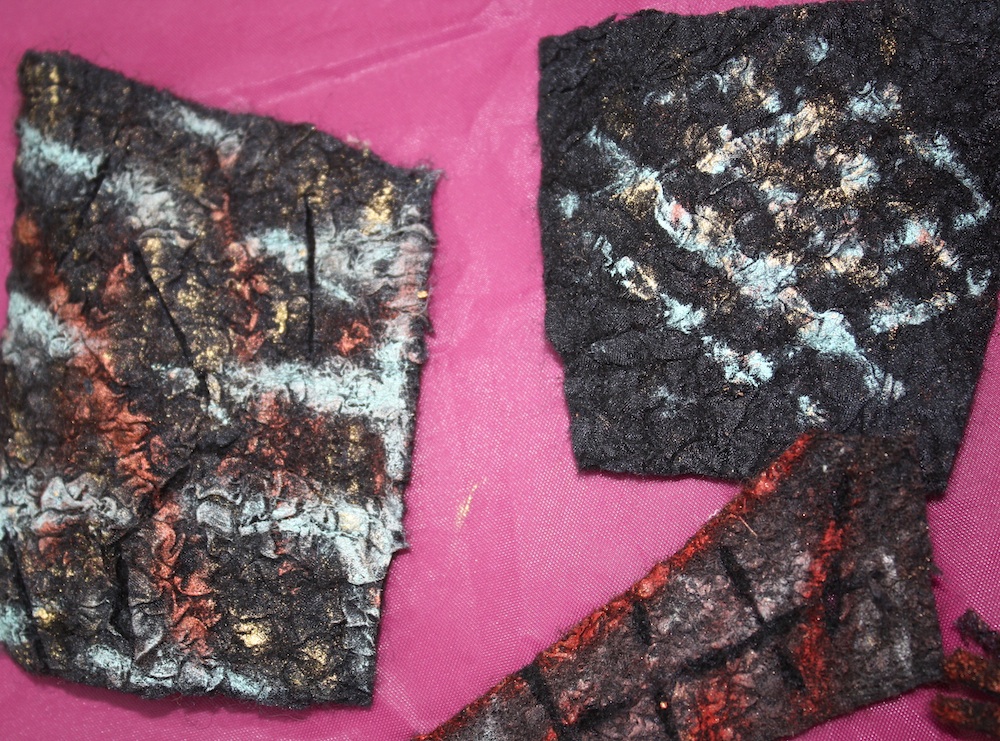
Last Friday at our Weaving and Fiber Arts Center (www.weaversguildofrochester.org), I taught an introductory class on oil-based paint sticks, commercially named Shiva Artist Paintstiks. They're a wonderful way to add color and interest to any fabric, as they're essentially oil paint in solid form. Once the paints are set, which takes about two days, they'll stand up to unlimited washing (except for dry cleaning, which uses solvents).

Above, you see a sample by Dana Connell, a rubbing from an Indian print block. Here are a few more samples that students created.

Iridescent silver on black fabric, from a stencil.

More images from stencils, these made using several different iridescent colors.


Free-form drawing with Paintstiks on felt.

Paintstiks and their accompanying tools are available from Dharma Trading Company as well as from Cedar Canyon Textiles. Cedar Canyon also supplies instructional books and videos to help you maximize your work with these painterly tools.

To date, I've used them on some of my hand-dyed fabrics to provide a splash of color and interest.


Who knows? Maybe someday I'll use them to paint a warp. An idea worth pondering....


Friday, November 11, 2011

Buy the Book!


In celebration of its 65th anniversary, the Weavers' Guild of Rochester has published Weaving Lives at 65. It's a full-color book offering 33 weaving projects from the guild's 65th anniversary exhibit last May. The full-page photos accompany weaving drafts for every project, as well as close-ups of additional pieces from our exhibit. It's a masterful display of the diversity of this guild's accomplishments in the fiber arts.

Join in the celebration of the essential role that weaving guilds play in the handmade movement in America today.

Click the link below to order your copy, which supports the teaching efforts of the Weaving and Fiber Arts Center (part of the Weavers' Guild of Rochester). And thank you!