Wednesday, November 14, 2012

Homespun


Some time ago, a friend described me as being more "homespun" that she was. I took it poorly at the time: Didn't that mean something humble, not artful, probably plain?

Nowadays I have a different take on the word, a lot more positive -- in part because handspun is homespun! The word can mean something beautiful. Or at least I try to spin something beautiful.


Lately, I've been working on spinning a two-ply thick-and-thin yarn: above, in merino and silk. Your first ply alternates between very thin and very thick, while your second ply is as even as your fingers can make it. Both plies are overspun slightly. When you ply them together, you use the even ply as a binder and you loop the thick-and-thin ply around it, as playfully as can be.

This technique is well described and illustrated in "Spin Art: Mastering the Craft of Spinning Textured Yarn" by Jacey Boggs. You can learn more about it here: http://www.youtube.com/watch?v=kAEx88UX-6Y

At the top of the page and below are photos of two yarns spun in merino. All are available now in my Etsy shop, Random Acts of Color..


Friday, October 19, 2012

Shibori Dyeing with Walnut and Indigo

 
Silk chiffon, first dyed with indigo, 
then shibori-dyed using walnut

It's not easy, at least in my view. The colors of natural dyes are far more subtle and the behavior of natural dyes is far more quixotic than with man-made dyes. With acid dyes, what you want to achieve and what you achieve can be one and the same, or very close. With natural dyes -- well, it depends and it depends.

How much dye do you use? Which mordant and how much? How long do you let the fabric "cure"? Indigo, of course, has quite predictable colors -- but try creating shibori effects. Not so easy!

Even so, I insist on trying, because the colors are so gentle and the patterns so intriguing.

Quilting cotton, first dyed with cochineal,
then over-dyed with indigo, then tied and immersed in walnut,
then clamped and immersed in indigo

In addition to the challenge of achieving predictable results, I think it's the softness of the colors that distinguishes natural dyes from man-made dyes. It's an understated palette -- unless, that is, you devote countless hours to dyeing and overdyeing, in order to achieve really saturated colors.

Wool gauze, dyed in two successive walnut baths,
then clamped with resists and immersed in a discharge vat,
and finally clamped with resists and immersed
several times in an indigo vat

This last fabric, pictured above, was perhaps the hardest-won, in terms of the colors achieved. First I immersed it in walnut. Then, not quite satisfied with the depth of color, I created another walnut vat and immersed the fabric once again. I might have stopped there -- the color was a deep, rich brown -- but I wanted some kind of resist pattern on the piece. So I tied it up and immersed it in a discharge vat, then retied it and immersed it in an indigo vat. The results were disappointing -- VERY disappointing. A wrinkled fabric the color of mud, with a darker muddy pattern and permanent creases from the heat of the dye vat. (No photos of THAT, needless to say.)

Final steps: trying once again, I threw the whole piece in a discharge vat. It worked like a giant eraser, taking out all the color of the previous two steps. Back to a rich walnut color. Finally I clamped the piece with resists and immersed it again in a highly concentrated indigo vat. Yay! Colors and pattern that work just fine.

I'm teaching the course next spring at the Weaving and Fiber Arts Center. Details to appear soon in the "Classes" section of this blog.


Sunday, September 30, 2012

'Tis the Season for Walnut Dyeing

Time to harvest these

To achieve this

As with pretty much all my friends in the Northeast, it seems, right now I have a walnut tree nearby dropping nuts all over the place. For tree huggers like me who want to know more: the Black Walnut Tree is also called "Stinkweed" when it's small, because it grows fast and just about anywhere, refusing to yield to weeding -- and when you do manage to pull it up, it stinks.

These trees are wonderful, however, because they produce a great hard wood. Also, you can make dye from the hulls of the fruit. You can even eat the nuts, although I found it hard to get much food out of them. You can stain wood with the hulls, as my Dad did with a salad bowl I bought years ago.

The walnuts are high in tannins, which serve as a mordant and make for a very potent dye. Just look at my gloves:

I recommend you wear gloves

Here's a brief pictorial essay on making dye from black walnuts. I did mordant my fabric, by the way, with about a teaspoon of alum in maybe two gallons of water.


First, you harvest about 20 green to green/brown walnuts per gallon of water. Crush the daylights out of them, removing the nuts themselves. Here, I used a big stone tool. A friend of mine insists that you get better results when you put them in a bag and drive over them. I tried that, too. Either way, you're going to have to work to chop them up into maybe one-inch-wide pieces.

Throw all the crushed hulls, minus the nuts, into a vat of boiling water and then simmer them for about an hour. To me, the dye solution has a wonderful, nutmeg-like smell! Let the whole mixture cool overnight.


You're ready for dyeing. While some sites will tell you to add maybe one cup of dye solution to a gallon of water to dye your fabric, I found that this gave me very pale colors. So now I simpy immerse my fabric directly into this solution, without diluting it at all. The results are a warm golden brown, as I showed you in the photo at the top of the page. Here it is again:


The fabric, by the way, is three yards of 100% wool gauze, originally in off-white, purchased at the famed and wonderful fabric shop, Delectable Mountain, in Brattleboro, Vermont. (The name comes from the book Pilgrim's Progress, although e.e. cummings also refers to "Delectable Mountains" in his book, The Enormous Room.) The website, which I highly recommend: http://www.delectablemountain.com/


Friday, September 21, 2012

Next on the Loom, Something Simple: Indigo-Dyed Cotton Rugs

Warping from the back, without tension

After working with hand-dyed warps of 60/2 silk and filament-like overtwist weft, it's time for something very simple: cotton rugs! I need a bathroom rug and so does my daughter (I think), so I'm warping with "Newport" pearl cotton from Henry's Attic, 830 yards per pound, sett at 8 epi. The warp will be about 30" wide on the loom, aiming for a 2' wide rug after some shrinkage. We'll see what happens.

The weft is also indigo-dyed, also from Henry's Attic: Pigtail (on the right, at 175 yards per pound) and cotton chenille (on the left, weighing in at 500 yards per pound, which sounds like I'm announcing a prize fight). I'm planning on weaving alternating stripes. The rugs should wind up about a 2' x 3' size each. Again, we'll see what happens!


Friday, September 7, 2012

New on Etsy: Half Moon Jacket and "Fleur de Laine" Scarf


The credit goes to Noro Silk Garden Lite -- a yarn that works magic with colors, in a soft blend of wool and silk -- as well as to the creator of this wonderful sweater pattern. It's the "Sunrise Circle Jacket," available from Kate Gilbert at www.kategilbert.com

The scarf in the photo was crocheted using the same yarn, but the pattern is my own. I call it a "Fleur de Laine Scarf," as it's composed of dozens of small, medium, and large "flowers" crocheted in a circle, just as you would a yarmulke! I'm giving a course on the technique this fall at the Weaving and Fiber Arts Center. (See "The Center" at www.weaversguildofrochester.org or check out my page on courses in this blog.)

A few more views of this jacket, which I knitted using size 6 circular needles. It's a size large to extra large, following the directions for size 38 in the pattern.


For many more versions of this wonderful sweater, check out Ravelry.com! If you're a knitter and you haven't yet joined, I heartily suggest you do.

Saturday, August 11, 2012

Another Wonderful Poem by Anonymous (with a few edits on my part)


The Weaver*

My life is but a weaving
Between Nature and me.
I cannot choose the colors;
But we work steadily.

Often we're weaving sorrow,
And I in foolish pride
Forget She sees the upper
And I, the underside.

Not till the loom is silent
And the shuttles cease to fly
Shall She unroll the canvas
And explain the reason why.

The dark threads are as needful
In the weaver's skillful hand
As the threads of gold and silver
In the pattern Nature planned. 

*A note: I altered this poem a bit, adapting it to my own thoughts and speech. The original author used the word "God" and "He" where I use "Nature" and "She."

Saturday, June 23, 2012

Coming in the fall: Classes on Dyeing with Weld and Onion Skins

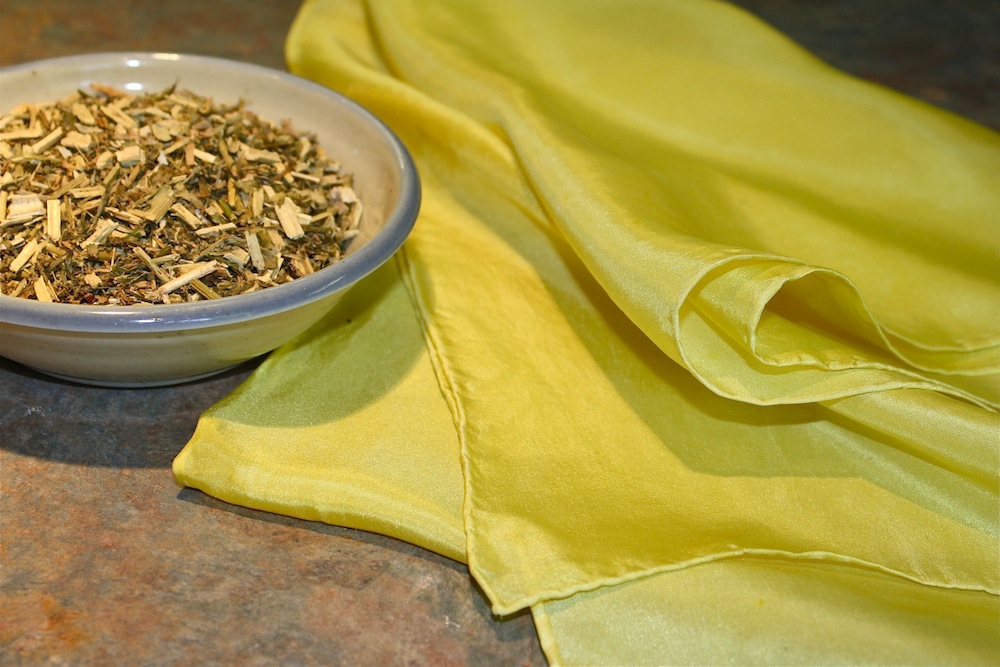
Dried weld (left) and 8mm China silk scarf dyed at approximately 100% weight of goods.

Yarn dyed with good old cooking-onion skins. Note that the yarn was already a pale yellow color, so the resulting color is a deeper gold than if the yarn had been natural.

This fall at the Weaving and Fiber Arts Center, I'll be teaching a class on dyeing with weld, an ancient dye for achieving bright yellow, and onion skins, which yield a golden color. For the upcoming schedule of classes (soon to be posted), please visit the website for the Weavers' Guild of Rochester, which sponsors the Weaving and Fiber Arts Center, at www.weaversguildofrochester.org