Showing posts with label Rosepath. Show all posts

Friday, November 22, 2024

Let's Do This! Strickler's Pattern #728 for a Baby Blanket


 My nephew and his wife are expecting their second child in early December -- so of course I had to weave them a baby blanket. That's what weavers do, right?

It had to be machine washable (but I dryed it on the line, to prevent shrinking), without long floats, soft to the touch (of course), and, at least in my opinion, made with natural fiber. Again, in my opinion, cotton is the way to go, particularly unmercerized cotton because it's softer and loftier than mercerized cotton.


Like pretty much everyone else, I love pattern #728 from A Weaver's Book of 8-Shaft Patterns by Carol Strickler. This multiple-tabby pattern has charm and subtlety -- and also offers the opportunity to play with color by adding stripes that emphasize the various motifs. (If you have the book, it's the pattern on the bottom-right corner of page 228.)


I think I've seen more weavings in this pattern than in any other well-known 8-shaft design. For those of you who don't own the book, here's the threading and tieup:


The design is by Joan McCullough of Campbellford, Ontario, Canada, who just passed away in October, sadly. But what a gift she gave us. The design is described as rosepath in multiple-tabby weave, deriving from page 48 of The Rosepath Motif: An Approach to Weaving Design by Margaret Windeknecht.

A brief explanation: multiple tabby is simply a series of threadings, typically evenly spaced among the shafts -- each of which, when tied up correctly, will weave tabby. For instance, instead of threading tabby as 1, 2, 3, 4, 5, 6, 7, 8 and tying it up as 1, 3, 5, 7 versus 2, 4, 6, 8, you can thread tabby as 1, 5, 2, 6, 3, 7, 4, 8 and tie it up as 1, 2, 3, 4 versus 5, 6, 7, 8. It really doesn't matter how you thread for tabby, as long as you tie up your shafts to weave on opposites.

In the case of Strickler #728, we're not weaving tabby but rather twill variations using a 3/2/1/2 ascending twill tieup. This creates a variety of interesting motifs in the warp when treadled with a point draw, as you see in the treadling below.


Here are the basics for warping, weaving, and finishing the blanket.

Warp yarn: 6/2 unmercerized cotton from Webs (in my case, I wound 21 stripes of 15 ends each in turquoise and then, in between these stripes, I wound 4 stripes of 24 ends each successively in sage, yellow, and light yellow, yellow, and sage, for a total of 20 stripes.)

Weft yarn: 6/2 unmercerized cotton
Sett: 24 epi. Sley 2 ends/dent in a 12-dent reed. 
Width in reed: 33.29"

Begin by weaving a 1-inch-long base for the cloth (for turning over and hemming) using 10/2 cotton as weft to prevent the hem from being too thick. Do the same at the end of the cloth.

After this, using a weft of 6/2 cotton, weave the treadling pictured above in as many repeats as needed to achieve a blanket that is 2 yds. in length (not including the total of 2" of hem fabric woven with 10/2 cotton).

Finish by running a zig-zag stitch along the cut fabric on both ends of the blanket. Tuck this end under and iron the hem flat in preparation to stitch down the hem.

Hem as seen from the front of the blanket (which I define as the side with the warp-emphasis motifs, which appear slightly textured, as if emboss)..)

Hem as seen from the underside of the blanket (the side that has less texture, appearing to emphasize the weft more).

I washed the blanket in my top-loader, using cool water and regular detergent. I then hung it to dry (rather than putting it in the dryer, where it would shrink more) and finished by ironing it neatly. The final dimensions are about 2 feet 6 inches wide by 4 feet long.

There you have it! An attractive, functional, warm, and cozy blanket for the soon-to-be-newborn of the soon-to-be-parents in your life. On 8 shafts, it weaves up fast -- maybe just in time for the holidays?

Thanks for reading!


Thursday, March 17, 2022

More Explorations in Parallel Threading: Playing with Strickler #728


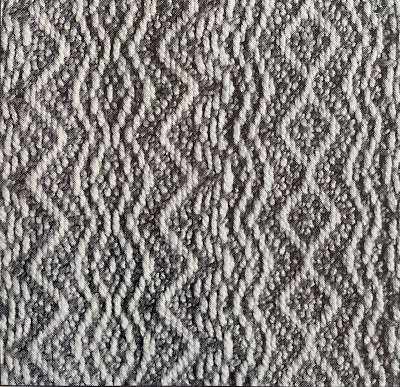
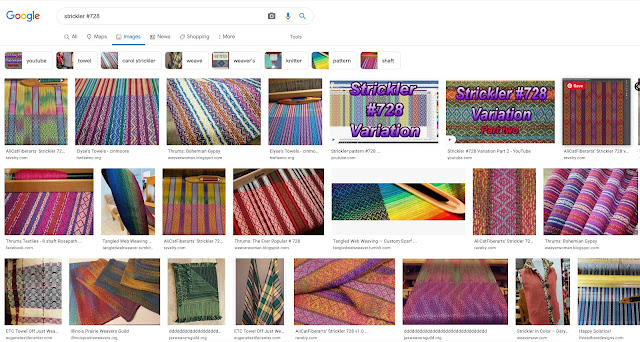
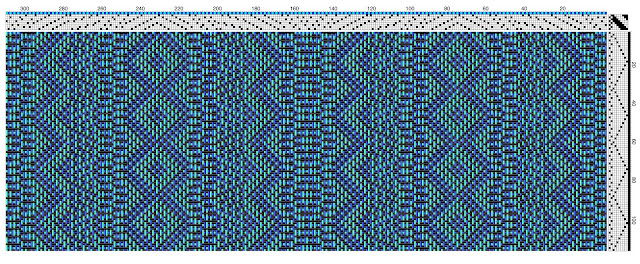
Among the 10 or 20 most popular contemporary weaving patterns, Strickler #728 (first photo) is among them, I would guess. I've seen many iterations on Facebook and it never fails to dazzle. And if you "Google" the pattern, the variations go on and on, as you can see in this screen shot from my computer....


Credit goes to Joan McCullough, who designed this intricate, ornate gem -- a Rosepath motif in multiple tabby, which is one of the favorite structures of my "weaving mother," Joyce Robards. (Shout out to Joyce, whose "Many Friends" design appears on the facing page in Strickler.)

It's the endless possibilities for interactions of color and pattern, I believe, that entice most weavers. But for this post, I would like to play with the design potential of #728 using an extended parallel threading, otherwise known as an Echo threading. Once again, McCullough's pattern shines!

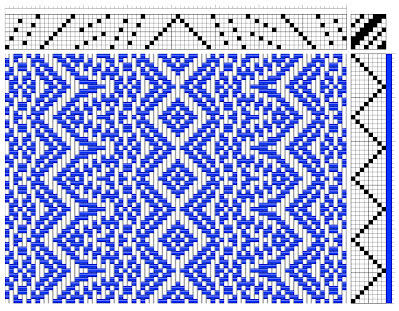
The original draft of #728

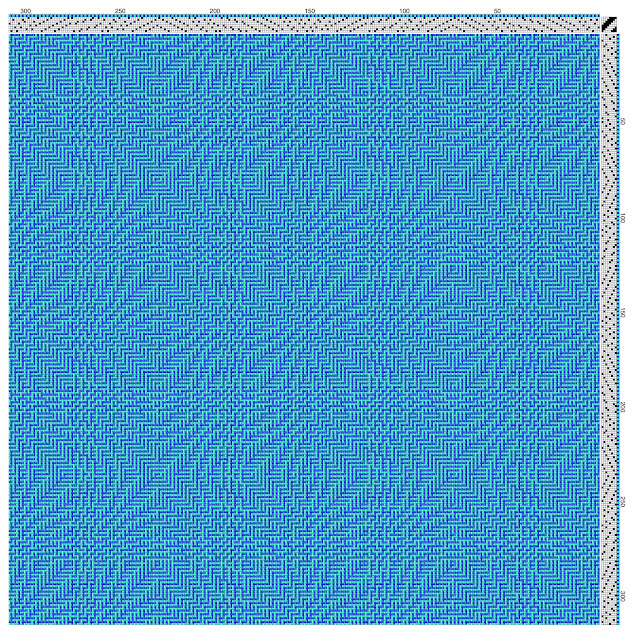
Above is the original threading, tieup, and treadling you find in Strickler. To create the same pattern in Echo, all you need to do is click on the "Warp" dropdown menu in Fiberworks, choose "Parallel Repeat," then "Overlapping Repeats Shifted by 4," and then "Apply." (Please note that the "Parallel Repeat" command is available only with Fiberworks Silver. Also, I am using a Mac, which has slightly different commands from a PC.)

Here's what you get:


Yes, there are some threading issues: above, you see there are eight sections where two sequential warps are threaded on the same shaft. My answer is simply to alter those threads by moving one of each pair up a shaft, reflecting the pattern below them (on the right) and above them (on the left). Here is the result:


Now we have a viable Echo design, using the same tieup and treadling as the original twill pattern.


I could see using different-colored stripes in the warp as weavers love to do with the original twill design, so that the linear motifs are outlined and clarified.

What about Jin? Using the same parallel threading, all you need to do is create a 4/4 descending twill tieup and add tabby shots in between. (Note that I changed the weft color to black to emphasize the patterns.)

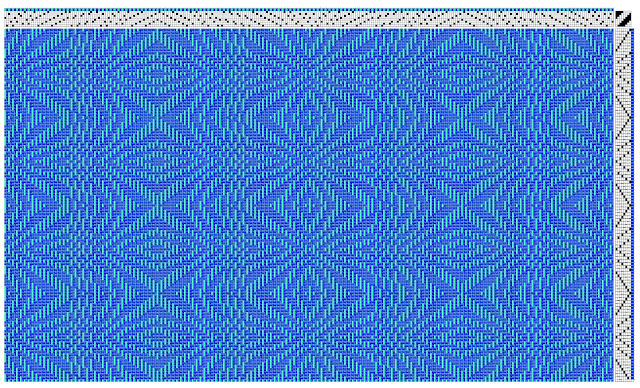
The appeal of 728 continues. So let's try Shadow Weave, which is also on a parallel threading -- as well as a parallel treadling, with a 4/4 ascending-twill tieup.

"Instrestring," as my son used to say when he was a toddler. This may be a bit dizzying, but then again, it all depends on the colors you choose and the function of the piece.

Not much different from Shadow Weave is Rep: same threading, tieup, and treadling. The only changes are that the sett goes from plain weave to denser than double weave and the weft has alternating thick-and-thin yarns.


I like this. Again, I see a lot of potential for playing with different-colored stripes in the warp. 

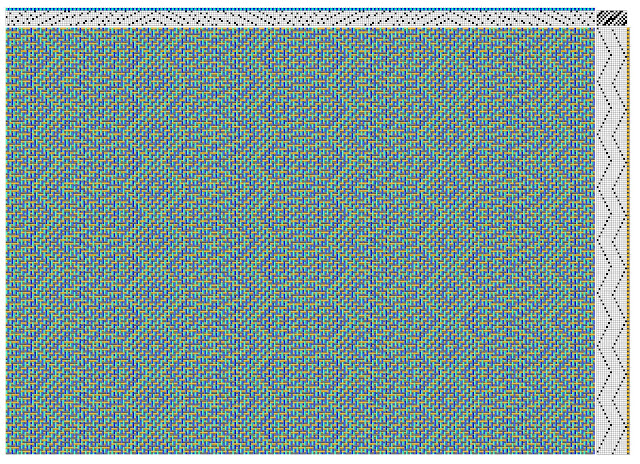
Last, there's double weave, yet another structure that can be designed on an extended parallel threading. 

728 in double weave, front

And back, although not much different

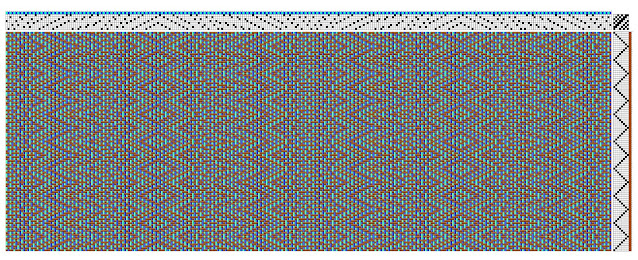
McCullough's design comes through in so many variations -- and on just 8 shafts! I got to thinking: I have a 32-shaft Megado, so I wonder what would happen if I expanded the threading to 32 shafts, using a 4-color, 4-end parallel threading?


The way I see it, this pattern is something like Beethoven's Ode to Joy, endlessly pleasing, whether it's performed as a piano solo or with a full symphony and chorus. 

And who knows? Maybe I could develop a workshop on this? From Echo to Jin to Shadow Weave to Rep to Double Weave, from 8 shafts all the way to 32...

Thanks for reading!