Showing posts with label 10/2 cotton. Show all posts

Friday, November 22, 2024

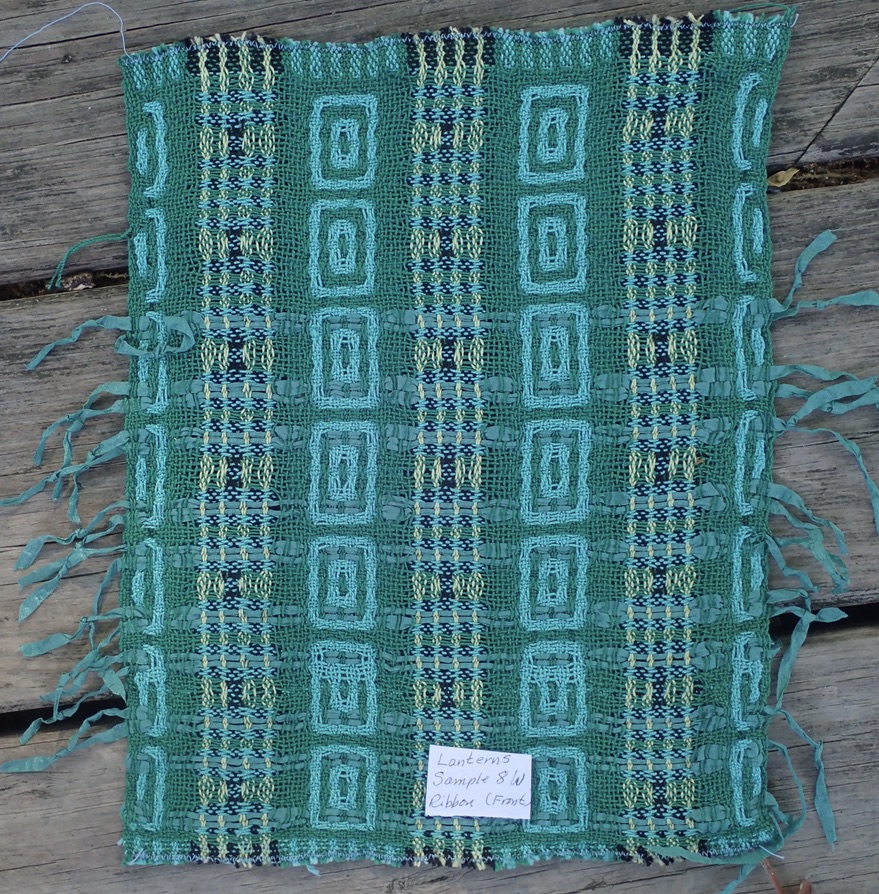
Let's Do This! Strickler's Pattern #728 for a Baby Blanket


 My nephew and his wife are expecting their second child in early December -- so of course I had to weave them a baby blanket. That's what weavers do, right?

It had to be machine washable (but I dryed it on the line, to prevent shrinking), without long floats, soft to the touch (of course), and, at least in my opinion, made with natural fiber. Again, in my opinion, cotton is the way to go, particularly unmercerized cotton because it's softer and loftier than mercerized cotton.


Like pretty much everyone else, I love pattern #728 from A Weaver's Book of 8-Shaft Patterns by Carol Strickler. This multiple-tabby pattern has charm and subtlety -- and also offers the opportunity to play with color by adding stripes that emphasize the various motifs. (If you have the book, it's the pattern on the bottom-right corner of page 228.)


I think I've seen more weavings in this pattern than in any other well-known 8-shaft design. For those of you who don't own the book, here's the threading and tieup:


The design is by Joan McCullough of Campbellford, Ontario, Canada, who just passed away in October, sadly. But what a gift she gave us. The design is described as rosepath in multiple-tabby weave, deriving from page 48 of The Rosepath Motif: An Approach to Weaving Design by Margaret Windeknecht.

A brief explanation: multiple tabby is simply a series of threadings, typically evenly spaced among the shafts -- each of which, when tied up correctly, will weave tabby. For instance, instead of threading tabby as 1, 2, 3, 4, 5, 6, 7, 8 and tying it up as 1, 3, 5, 7 versus 2, 4, 6, 8, you can thread tabby as 1, 5, 2, 6, 3, 7, 4, 8 and tie it up as 1, 2, 3, 4 versus 5, 6, 7, 8. It really doesn't matter how you thread for tabby, as long as you tie up your shafts to weave on opposites.

In the case of Strickler #728, we're not weaving tabby but rather twill variations using a 3/2/1/2 ascending twill tieup. This creates a variety of interesting motifs in the warp when treadled with a point draw, as you see in the treadling below.


Here are the basics for warping, weaving, and finishing the blanket.

Warp yarn: 6/2 unmercerized cotton from Webs (in my case, I wound 21 stripes of 15 ends each in turquoise and then, in between these stripes, I wound 4 stripes of 24 ends each successively in sage, yellow, and light yellow, yellow, and sage, for a total of 20 stripes.)

Weft yarn: 6/2 unmercerized cotton
Sett: 24 epi. Sley 2 ends/dent in a 12-dent reed. 
Width in reed: 33.29"

Begin by weaving a 1-inch-long base for the cloth (for turning over and hemming) using 10/2 cotton as weft to prevent the hem from being too thick. Do the same at the end of the cloth.

After this, using a weft of 6/2 cotton, weave the treadling pictured above in as many repeats as needed to achieve a blanket that is 2 yds. in length (not including the total of 2" of hem fabric woven with 10/2 cotton).

Finish by running a zig-zag stitch along the cut fabric on both ends of the blanket. Tuck this end under and iron the hem flat in preparation to stitch down the hem.

Hem as seen from the front of the blanket (which I define as the side with the warp-emphasis motifs, which appear slightly textured, as if emboss)..)

Hem as seen from the underside of the blanket (the side that has less texture, appearing to emphasize the weft more).

I washed the blanket in my top-loader, using cool water and regular detergent. I then hung it to dry (rather than putting it in the dryer, where it would shrink more) and finished by ironing it neatly. The final dimensions are about 2 feet 6 inches wide by 4 feet long.

There you have it! An attractive, functional, warm, and cozy blanket for the soon-to-be-newborn of the soon-to-be-parents in your life. On 8 shafts, it weaves up fast -- maybe just in time for the holidays?

Thanks for reading!


Saturday, July 18, 2020

Zooming Ahead with Deflected Double Weave


8-shaft Deflected Double Weave sample by Karen Berk. 
Warp and weft yarns are 10/2 Tencel/cotton (in fuchsia) 
and 18/2 Jagger Spun superfine merino.


Like many of us these days, I've been Zooming a lot with friends and family. All of my workshops through January have been cancelled, so I've begun teaching on Zoom -- in some cases, to replace my cancelled on-site workshops and in other cases because guilds are scrambling to offer remote workshops for this fall.

While Zoom workshops can't replace face-to-face communication and hands-on learning -- not to mention the joy of actually touching a handwoven sample -- online workshops can offer a worthwhile learning experience. It all depends on the investment of the students, in my view. And I can't say enough about the investment of the weavers who took my recent workshop, "Deflected Double Weave for Collapse Fabrics."

It served as a fundraiser for the Weaving and Fiber Arts Center here in Rochester, NY (the teaching arm of the Weavers' Guild of Rochester) and also helped test-drive the Zoom format for both the center and our guild. Weavers joined us from near and far -- from California to Canada to Michigan to Virginia to Delaware -- with the bulk of us coming from the Rochester area. 

Over the course of eight sessions in 2 1/2 days -- June 22, June 29 and July 6 -- we gathered on Zoom to study handouts and samples, to analyze drafts in Fiberworks, to view PowerPoints and, thanks to Google Drive, to survey everyone's work. In between sessions, we communicated largely via email and sometimes on the phone. 

Here are more samples:

 
12-shaft Deflected Double Weave sample by Lillian Whipple.
Warp and weft yarns are 10/2 cotton and lace-weight wool/silk.
The gold yarn is the black motifs is real gold.


4-shaft Deflected Double Weave sample by Barbara Mauger.
Her warp and weft yarns are 8/4 Tencel. 
The gray weft yarns are wool crepe.


12-shaft Deflected Double Weave sample by Linn Sadjak.
Her warp and weft yarns are 10/2 cotton. 
In this sample, she added picks of rayon-tape yarn.


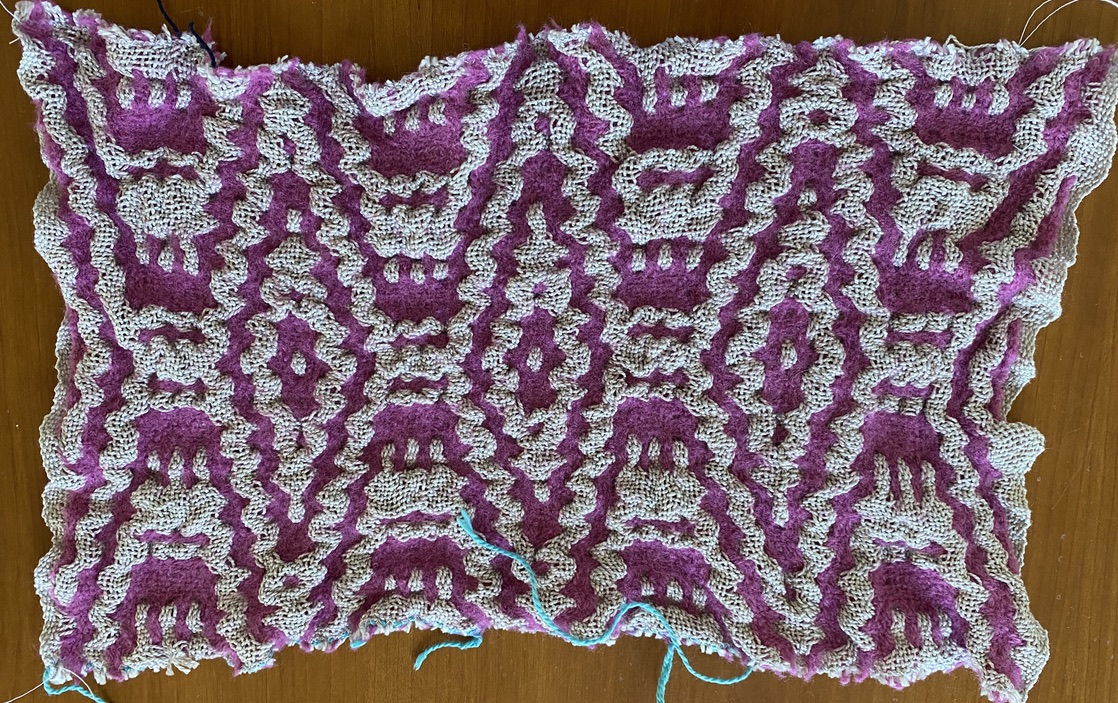
This sample by Jaime Pierce has 10/2 cotton (off-white)
and 18/2 Jagger Spun superfine merino (magenta) in warp and weft.


This is a sample by Eleanor Hartquist shown before finishing.
The gold-colored wefts in the upper horizontal stripe (mostly black) 
will draw the fabric in, creating vertical pleats, after washing.


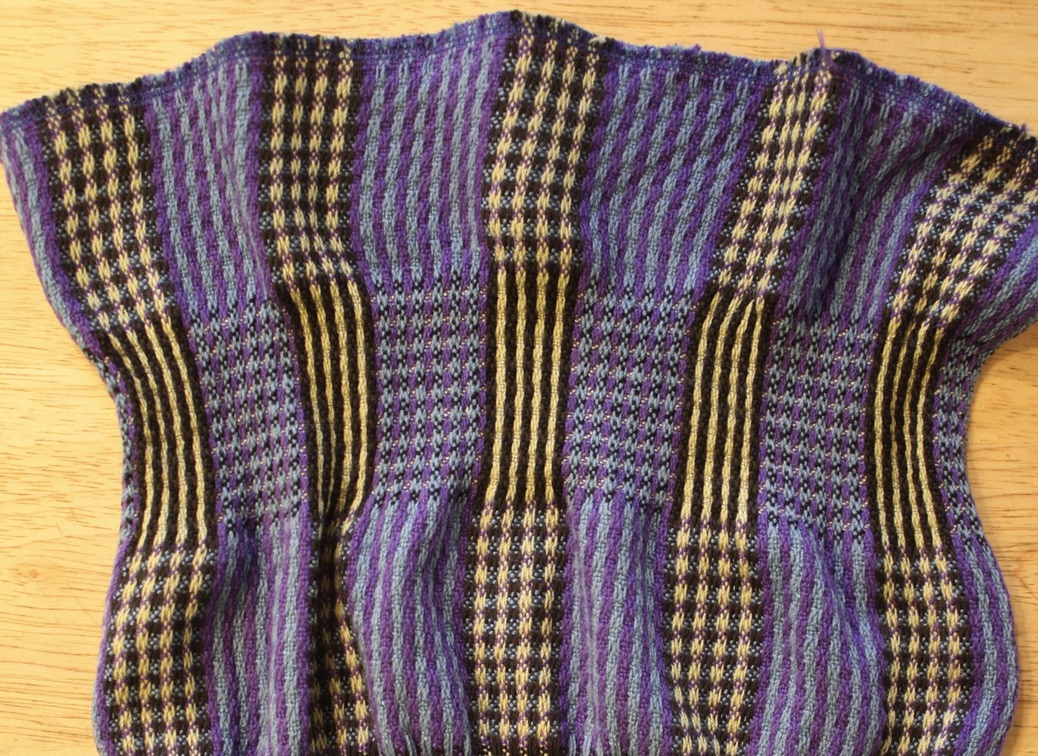
This 4-shaft sample by Marianne Antczak
uses Colcolastic in the weft (in purple/pink) 
to draw the fabric in width-wise.


Cindy Greenfelder wove this 8-shaft swatch 
using 18/2 Jagger Spun superfine merino (in dark purple) 
to create puckers and pleats after finishing.

My takeaway: Despite the pandemic and social distancing, weavers want to keep on learning. And let's face it, weaving can be a solitary pursuit, so we thoroughly enjoy the company of other weavers. It's why we gather.

For anyone considering teaching or taking a Zoom workshop, I have a few lessons. First off, schedule a dress rehearsal within a week before the class. That way, you can iron out all the kinks -- technology problems, questions about the workshop format, questions about the weaving itself -- before the actual work begins. Who wants to waste time with technology when we could be talking weaving, right?

Another point: For teachers, it's useful to have a document camera on your desk so that everyone can see your samples up close, pick by pick, in focus, well lit and not in motion. (For those of you who have tried holding a sample up to the camera on your computer for others to see, you'll know what I'm talking about.)

A third idea, suggested by a weaver in another Zoom workshop, is to set up a Google Drive file dedicated to the workshop. I uploaded handouts, photos, drafts and other resources and, more important, created an individual file for everyone so they could upload their photos and then I could share them with the group. 

One big benefit is that you can have another teacher take over (in Zoom language, they serve as a co-host, meaning that they can share images from their home computer). In our case, we were fortunate to have Joyce Robards (whom I call my "Weaving Mother" even though we are not that far apart in age) give a presentation on Marian Stubenitsky's newest book, Double with a Twist, which has a different approach to drafting designs.

The course evaluations surprised me, with some folks saying that they actually preferred the Zoom format, mostly because they could weave on their own looms (no schlepping everything to the workshop site) and they had plenty of time to absorb information and work on their samples (no rushing to get everything done in the normal format of 2-1/2 days).

To me, this means that, while nothing can replace the learning that comes with an on-site workshop, much can be gained by teaching or taking a workshop over Zoom. Maybe the greatest benefit is that online workshops can bring weavers from around the globe together virtually, building a sense of community and adding another option to learn about our craft.

I'll close with a Deflected Double Weave sample I wove on 12 shafts using Colcolastic in the middle section (black and gold vertical stripes) to achieve width-wise shrinkage. I wove this in 10/2 cotton, using four colors in both warp and weft, substituting the Colcolastic for one of the colors as I wove the mid-section.


Thanks for reading!
 

Thursday, July 19, 2018

What We Wove at Convergence: Echo, Jin, Shadow Weave, Rep, Double Weave, and Even Collapse Fabric

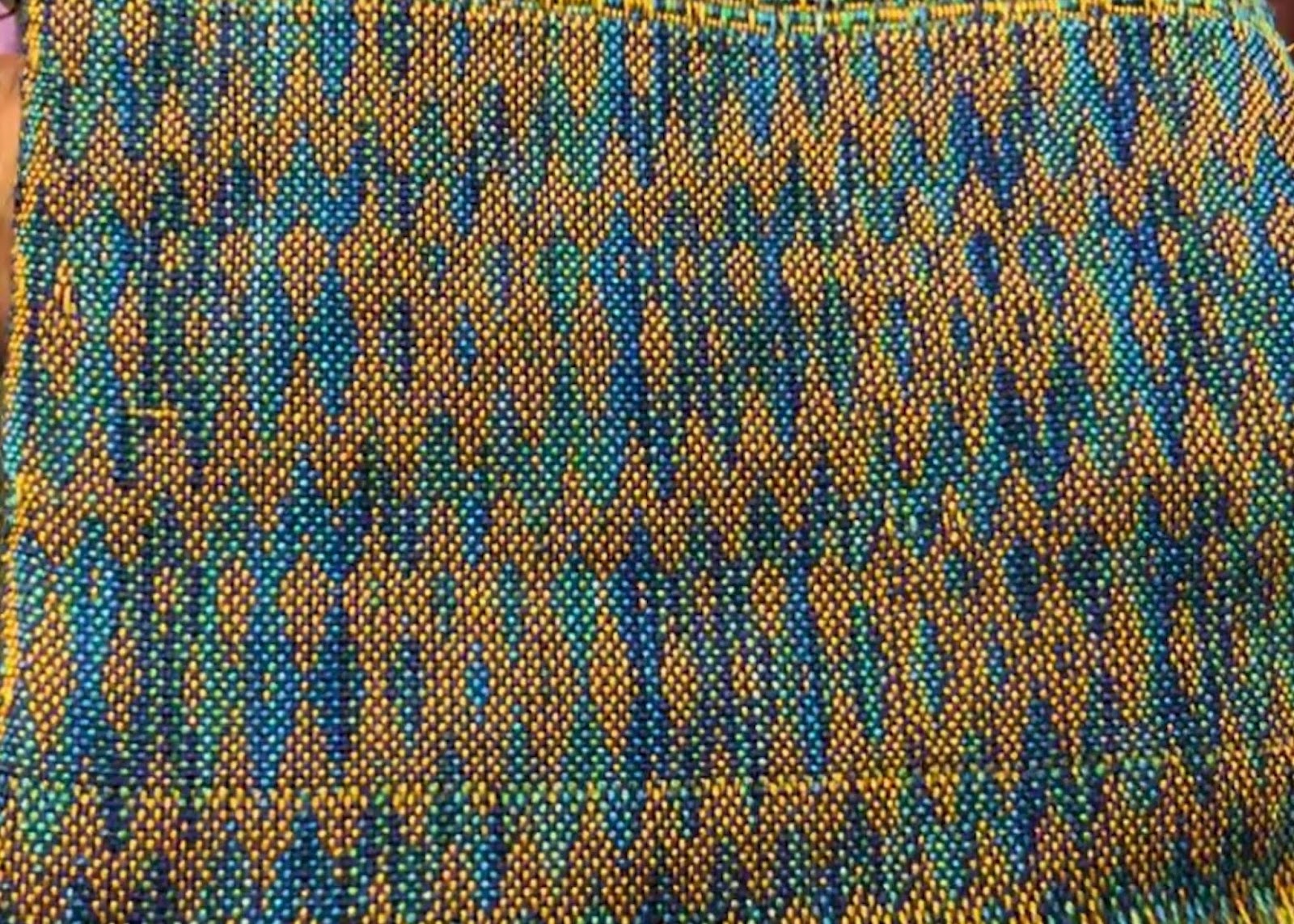
Echo Weave on 8 shafts on a warp of light blue and dark blue 10/2 cotton. 
The weft is 20/2 cotton in golden orange. Woven by Virginia Lee.

You've heard about Echo, which is based on an extended parallel threading that weaves a warp-emphasis fabric with lots of color and strong patterns. But do you know about all the different structures you can weave on the same parallel threading? In addition to Echo, you can weave Jin, Shadow Weave, Rep Weave, Double Weave and even collapse cloth, simply by changing your tieups and treadlings.

I taught a workshop on this subject last week at Convergence, the biennial conference for the Handweavers Guild of America, held this year in Reno, Nevada. "One Warp, Many Structures: An Exploration of Extended Parallel Threading" looked at all the possibilities I mentioned above. To teach this, I designed 9 different patterns -- 3 for 4 shaft looms, 3 for 8 shafts, and 3 for 12 shafts -- and invited students to choose a pattern and wind a warp using two colors of 10/2 pearl cotton. (I also named all of these patterns, using simple descriptions as a mnemonic device -- otherwise I couldn't remember them all!)

Below is a photo essay showing some of the beautiful samples the folks in my workshop created, with brief descriptions for each. It was a visual feast!

Above on left: Echo Weave sample using 8-shaft pattern, "Many Rivers," in light blue and off-white warp yarns. On right: the same pattern, this time in Double Weave, with top layer woven in off-white 10/2 cotton and bottom layer woven in 18/2 merino. The bottom layer fulls with hot water, soap, and agitation, making the top layer collapse and pucker. Woven by Roberta McKinney.


 Echo in the 8-shaft pattern, "Falling Stars," using different colors of weft yarns in 20/2 cotton. 
Note how the the weft color completely changes the color of the fabric. Woven by Teresa Edmisten.

Left to right: Double Weave and Shadow Weave samples woven on 8 shafts in the "Fun House" pattern. 
Woven by Judith Rees.

 Clockwise, starting from top left: Echo,
Double Weave, and Rep Weave on a 4-shaft pattern called "Op Art."  Woven by Diana Abrell.

Rep Weave in the "Fun House" pattern on 8 shafts. Woven by Virginia Lee. 

Shadow Weave on 8 shafts in the "Falling Stars" pattern. I think this was woven 
by Rachelle Weiss -- my apologies for not knowing for certain.

 Above, the 8-shaft "Fun House" pattern on a warp in two shades of blue for warp yarns. 
The red weft creates the impression of 4 different colors in the fabric. Woven by Judith Rees.


The two photos above: front and back of the "Falling Stars" pattern on 8 shafts in Double Weave. 
The warps alternate between a golden yellow and a hand-painted yarn in shades of green and blue. Woven by Sharlet Elms.


The two photos above: front and back of collapse cloth in the 8-shaft "Falling Stars" pattern, woven as Double Weave. The weft alternates between 10/2 cotton in gold (front) and 18/2 merino in purple (back). With washing, soap, and a lot of agitation, the merino fulls on the back, making the layer on the top collapse into pleats. Woven by Sharlet Elms.


"Many Rivers" design woven on 8 shafts. Pictured from top to bottom: 
Echo, Shadow Weave, and Jin. Woven by Virginia Glenn.


Pictured above, clockwise from top left: 8-shaft "Falling Stars" pattern in Shadow Weave, 
Double Weave, Rep Weave, and again in Double Weave. Woven by Ruth Ronan.


Blooming Leaf pattern on 4 shafts woven as Jin. Woven by Sharolene Brunston.


Above, top to bottom: "Fun House" pattern for 8 shafts. The top two samples are woven using a different Echo tieup and treadling from the bottom 4 samples. The bottom 4 samples are all the same tieup and treadling for Echo, but using different colored wefts. The warp yarns are light blue and turquoise. Woven by Carie Kramer.


Thanks for reading! And many thanks to the staff of HGA for putting together another wonderful gathering of the clan!


Wednesday, June 13, 2018

Fishing Line, Gold Gimp, and Wool/Lycra: What a Difference a Weft Makes!


You know what it's like when you're at the end of a warp -- and you decide to just throw something in to see what happens? And you LOVE the results? That's just what happened to me a few days back, as I was weaving up samples for my upcoming workshop at Convergence, "Deflected Double Weave as a Collapse Weave."

Let's start at the beginning of the warp, with a design I created for Deflected Double Weave on 8 shafts. I wove up the first sample with 10/2 cotton in purple and 18/2 merino in red in both warp and weft, aiming for a collapse effect using differential shrinkage. (The wool shrinks in the washing and the cotton doesn't, so it puckers and collapses and creates lots of texture.)

Here's the original draft.


Here's how it wove up, before washing.


I was worried, before I washed this, that it would collapse diagonally. But it didn't, because each diagonal "step," with a vertical line of red connected to a horizontal line of red, actually has two opposing vertical and horizontal lines on the back of the fabric, making a square shape of yarn that will shrink. That's the nature of Deflected Double Weave: not only do individual yarns weave plain weave -- but groups (blocks) of yarns will weave in and out of each other, as warp or weft floats.

Here's how the sample looked after washing with hot water and agitating with dish soap.


So, skipping to the end of my warp -- remember where I threw in an unusual weft yarn just to see what happened? In this case, I chose a lambswool/lycra yarn that would easily collapse. Here's what it looked like before washing.


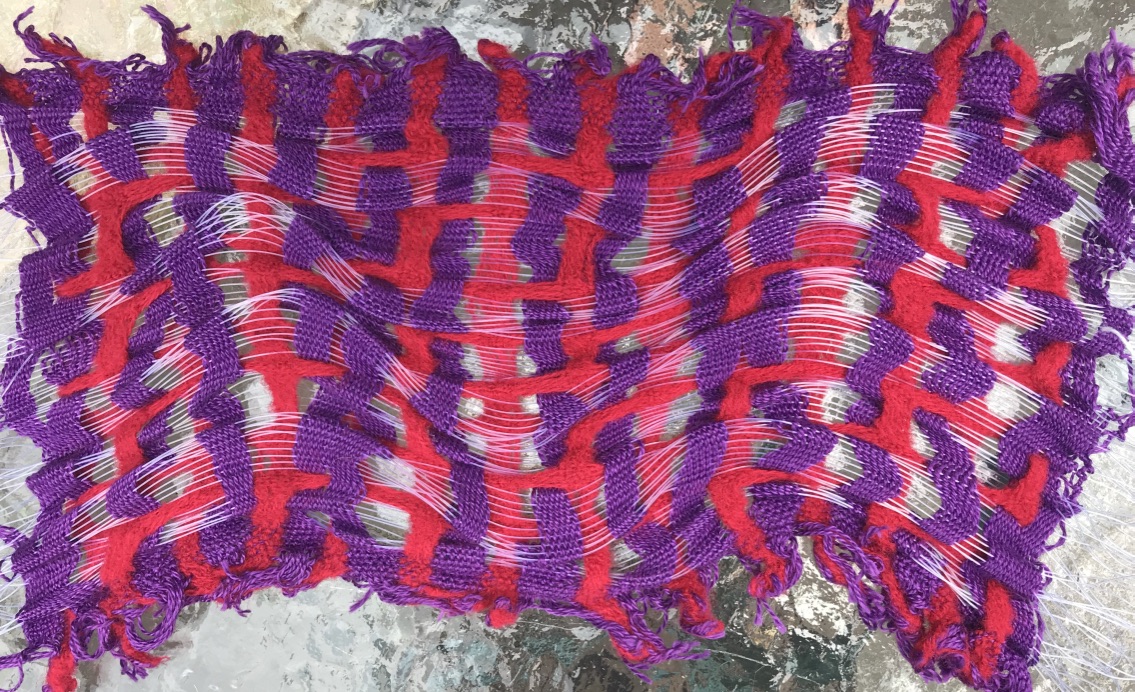
I'm posting this photo extra-large in hopes that you can see the wool/lycra: Looking closely at the squiggly red weft yarns, can you see a bit of white here and there? That's the lycra, very loosely plied with the lambswool. It's hard to imagine it will collapse much -- but it does. A lot, to the extent that the fabric shrinks maybe 50 percent width-wise. And you can stretch it back to its original width! Here's the finished sample.


And what about the fishing line? It's also called "monofilament," and it's a great way to create interesting effects with yarns that DON'T shrink but instead make the fabric curve and undulate.

Here's the original sample, before and after washing, using the 10/2 pearl cotton and 18/2 merino in both warp and weft. (You'll note that I varied the tieup and treadling from the first draft.)


And here's what it looks like, before and after washing, substituting 14-pound fishing line for the 18/2 merino in the weft. (Picture a weaver walking into Gander Mountain to purchase weft yarns....)


Wild, huh? I can see this writ large, for a wall hanging or even a window hanging, much like a stained-glass piece that lets the light shine through. One of my favorite weavers of all time, Liz Williamson, uses monofilament as an accent weft in conjunction with a wool or other collapse weft, which makes her fabrics curve and wind in graceful and unexpected turns.

As for the gold gimp: Here's the original sample, before and after washing.


And here's what happened, shown before and after washing, when I substituted gold gimp yarn for the red merino in the weft.


Gimp is a metallic-looking yarn, typically used as an accent. (Gimp is made of a core, such as cotton, wrapped in a sparkly thread and used in embroidery and trims.)

Still more samples to weave for Convergence. This is why we don't get a lot of housecleaning done these days.... but it's way more fun. Thanks for reading!