Showing posts with label The Earl on 14. Show all posts

Sunday, September 18, 2022

What's on the Loom?


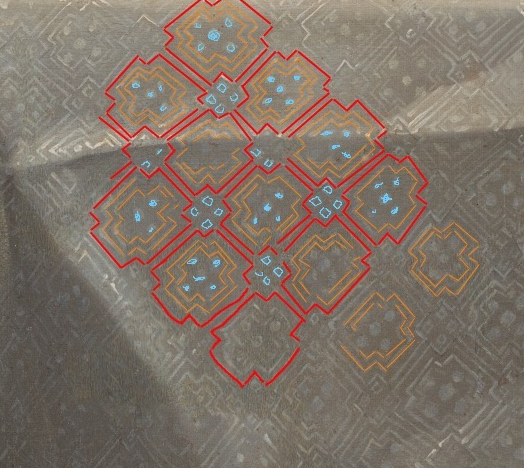
More accurately, what's going on the loom? At this writing, I'm in the process of winding on a painted warp for a Jin design on 28 shafts (one of the versions of the pattern is shown above). Here's where I am at the moment, looking at the back of the loom.


It's kind of an unusual warp: Has anybody heard of 24/3 unmercerized cotton -- with about 1% of black rayon thrown in? Who knew? It was a big cone in natural that I picked up at a guild sale. Figuring that the grist of 24/3 cotton was equivalent or close to that of 16/2 cotton, I wound a warp two ends at a time, alternating between the 24/3 unmercerized cotton in natural and a 16/2 unmercerized cotton in black. 

When I went to paint the warp, I painted the entire warp at once, natural and black together. The dye colors don't affect the black at all, so you get a two-color painted warp, effectively, that you can thread for Echo. I appreciate efficiencies like that.

Back to the design. I love broken twills (most of us do, right?), a category that includes the old German designs known as Gebrochene. I've posted on this subject before, looking at a 16th-century pattern affectionately named "The Earl." Margie Thompson, an expert on historic textiles, shared it with our guild in a talk some time ago, and she was kind enough to send me the original draft, which is for 14 shafts. (For more on "The Earl" and Gebrochene twills, see my blog post of November 17, 2020.)


How did I get from the elegant, almost filigreed 14-shaft design above to the more primitive, tribal-looking 28-shaft design at the beginning of this post? It's a technique that I teach in my parallel-threading classes, using an Ms and Ws twill as a design line for Echo. I start designing by uploading the original Earl drawdown for 14 shafts in Fiberworks. (You need Fiberworks Silver for these functions.) Then, you click on the "Warp" dropdown menu and next you click on "Parallel Repeat" to Echo the original design line with a second threading 14 shafts above it.

Step 2: You see that the original Earl treadling is tromp as writ, for 14 treadles. This would work for a 28-shaft design, but it would give you squashed motifs, not very appealing. All I did (again, to achieve the design at the beginning of this post) was double the number of treadles for the entire treadling (so that treadle one becomes one and two, treadle two becomes three and four, treadle three becomes five and six, and so on). In other words, if the original treadling went from treadle 1 to 14 and down again in a point-twill pattern, I doubled the length of the pattern, so the treadles go from 1 to 28 and down again. 

Step 3: Here's where it gets a bit more complicated. I started by designing Echo using a twill tieup for 28 shafts. This is what I got. Just a detail shot. I really don't like it at all.


What to do? As I like to say, "Keep Calm and Add Tabby."

Of course, Echo has its charms -- but Jin also has a lot going for it: nice drape, one-shuttle weave, floats never longer than 3 in warp or weft, clear pattern definition, the ability to stretch out "squashed" designs, and the potential to play with the tieup to add a bit more color and interest, without risking long floats. That's what you see in the drawdown at the top of this post -- and also in the design below which uses another treadling but a similar tieup. 


I like both designs, the one above and the one at the beginning of this post. What they share are tieups for what Bonnie Inouye calls "Decorated Jin." Below is what a classic Jin tieup looks like, with half the shafts raised and half down in an ascending-twill pattern, with tabby tiedowns in between:


You'll see that the motifs above are simple and distinct, basically two colors, light and dark. This drawdown shows only a detail so that you can see the tieup more easily. Now let's look at a tieup for Decorated Jin.


Here, there are different colors and the motifs have more interest. The difference is that I've broken up the 14 up/14 down ascending-twill tieup, adding a bit of plain weave. Now, I see four different shades: pale blue, medium blue, dark rust/blue, and royal blue. It's all in the details! 

I'm going to sample at least two Decorated Jin designs and, fingers crossed, find at least one I really like. But first, of course, I have to finish dressing my loom....

Thanks for reading!


Wednesday, April 28, 2021

Titian, Caravaggio, El Greco, Velázquez, Rembrandt, Chagall... and Linen Tablecloths


Titian, The Supper at Emmaus, circa 1530


Analysis of the pattern of the tablecloth in the painting,
courtesy of Helena Loermans


A weaving drawdown similar to the tablecloth pattern

A few months ago, I wrote a post about a weaving pattern known as "The Earl's Canvas" -- a 14-shaft Gebrochene design that had been discovered in a 17th-century painting of the second Earl of Mar in Scotland. The painting was of less interest to weavers, actually, than the pattern of the canvas itself, which had been a tablecloth, most likely linen.

A linen tablecloth! I assumed that the poor artist had no choice but to use a table linen instead of a real canvas. Little did I know. 

Recently, through a chance conversation with someone in a workshop I taught, I learned that there are many centuries-old paintings woven on tablecloths in similar patterns -- patterns that are described in weaving terminology as twill diaper design. 

My friend pointed me to the writings of Helena Loermans, who researches these canvases and has a blog devoted to her work: labo.pt. (The full name for the project is the Laboratory for Handwoven Canvas Odemira, based in Odemira, Portugal, where Loermans has lived for some 30 years.)

Her research, to date, has looked at masterpieces by Titian, El Greco, Caravaggio, Velázquez, Rembrandt and Chagall. Weaving on an AVL computer loom, she recreates their canvas patterns in fine linen, emulating and revealing the beauty of the original fabrics.

Reconstructions of canvases used by Titian, woven by Helena Loermans

She also offers gift boxes of her reconstructions for sale, to raise funds for her research -- available by clicking here.

I reached out to Loermans via Zoom and asked her why these masters were using such fabrics for their work. She responded that, while no one yet really knows why, she theorizes that tablecloths were among the few fabrics wide and long enough to serve, without seams, as canvases for large paintings. (Loermans suspects that these linens were in fact seamed, but so expertly that no one can detect it.) 

In a larger sense, the material of the canvas might have been a reflection of the value of the painting. We explored how, just as art deserves a beautiful frame, the culture of the time may have viewed the canvas itself as a statement of luxury and status. Loermans observed that fine linens were often owned by churches, in an age where the church and the nobility were closely linked -- and were perhaps the only groups that could afford great works of art.

An interesting footnote: Loermans told me that the oldest known record of weaving drafts is a collection from 1677 by Marx Ziegler, Weber Kunst un Bild Buch (roughly translated, "The Weaver's Art and Drawing Book"), which is available on Handweaving.net. The collection holds many patterns similar to those she has reproduced.

In conclusion, for your weaving delight, here is a painting by Velázquez, along with a drawdown of the pattern of his canvas.

 Velázquez, Supper at Emmaus, 1599-1600

Weaving drawdown, courtesy of Helena Loermans

Thanks for reading!