Showing posts with label Gebrochene. Show all posts

Wednesday, March 4, 2026

How to 'Downsize' a 14-Shaft Pattern for 8 Shafts... and even 4 Shafts

Let's start with just one draft, because -- while these principles can apply to many designs -- I recently had to downsize a point-twill design, which happens to be one of my favorite weaving patterns.

It's a historic 14-shaft draft, fondly known as "The Earl," derived from a tablecloth that was used as the canvas for a 1626 painting of the Earl of Mar in Scotland. (To read the original 2020 post about "The Earl," click here.)

Above is the original Gebrochene pattern (in German that means "broken," while in English we call it Ms and Ws). Marjie Thompson, master weaver and lover of historical patterns, shared the WIF with me some time ago. Thank you, Marjie!

But not everyone has 14 shafts, right?

"Shaft envy" is what weavers call it. What can you do if you love this design but you have just 8 shafts? The answer is to "downsize" the threading, tieup, and treadling, following the shapes of the original 14-shaft threading but systematically reducing the peaks and valleys as best we can by using a ratio for each twill line (or block, depending on how you want to define your terms). And that ratio may have to vary across the threading. It gets complicated.

In keeping with that explanation, here's what the Earl might look like on 8 shafts. 


Not bad, eh? Not quite as ornate as the original design, of course, which is what happens when you're weaving with fewer shafts. But it's a pretty good adaptation, in my view. 

So how to do this? Since the design is tromp as writ (treadled as threaded), all one has to do is reduce the ups and downs of the threading to fit into 8 shafts, then repeat the threading in the treadling and create a tieup that mimics the original.

Let's start with the first twill line. For the 14-shaft version, you have a descending twill line, from upper right to lower left, which can easily be reduced from 14 to 8 shafts.

Original twill line on 14 shafts

Same twill line reduced to 8 shafts. This is the easy part ;o)

For the second motif, forming a "V," the original threading has a descent and an ascent of 6 shafts each, beginning at shaft 14, descending to shaft 9, and then ascending back to shaft 14. To keep the draft within 8 shafts, I began the "V" at shaft 8 and then descended to shaft 5 and back up to 8. That means the "ratio" is now 6 shafts reduced to 4 shafts -- not quite following the ratio of 14 shafts to 8 shafts, but creating a "V" threading that looks like the original pattern.

The Earl on 14 "V" threading (second motif from the right in original threading).
6 ends going down, then going back up

The "V" motif (aka descending-point-twill block) reduced to 8 shafts

This might not be true for all weavers, but when I downsize a pattern, I'm not looking to maintain an exact ratio for every block in the threading, as if 14 to 8 would be the rule throughout. (Besides, it just won't work out mathematically, because sometimes you would have to round up or down accordingly in your numbers.) More important, in my view, is to try to follow the original silhouette of the draft. So, for the above portion of the threading, a 6-shaft descent in the original 14-shaft threading becomes a 4-shaft descent in the 8-shaft version.

Moving on to the next descending twill motif: the line in the original descends 10 shafts beginning on shaft 14. For 8 shafts, the line begins at shaft 8, the topmost shaft (as with the original design) and descends 6 shafts. Again, the ratio differs from the original 14 to 8 -- in this case, the ratio is 10 to 6. So I'm adhering to the form of the design rather than exactly to the numbers.


On 14 shafts, the third twill block descends from shaft 14 to shaft 5

On 8 shafts, the third twill block descends from shaft 8 to shaft 3

The next twill line, ascending from the right to the left: the design rises 5 shafts in the original and 3 shafts in the 8-shaft adaptation. I could continue describing the pattern adaptations, but I think that you get the idea....

As you can see, there's a method to the madness here. Basically, you want to preserve the overall form of the threading. This means you don't have to be precise as much as you have to be painterly, you might say, creating a simpler line that follows a similar shape of the original, but with shallower ascents and descents.

The bigger challenge is when you want to reduce a complex design on 14 shafts to just 4 shafts. It can be done, certainly, but you lose a lot of detail.

Here's how you might design The Earl on 4 shafts.


It's hardly recognizable, you might say.  

And yet... this is still an Ms and Ws pattern, with interesting motifs throughout, worth weaving into a scarf or a tea towel. (It also might work as a great threading for overshot. But that would be another post.) If you look back at the threading of the original draft, you'll see that this 4-shaft version does follow the hills and valleys of that threading, even though much is lost in the details of the pattern. 

I invite you, dear reader, to share in the comments your own method of adapting a draft to fewer shafts. Someone else might have a more exacting approach, for certain. (Perhaps someone really savvy could use AI, come to think of it.) And certainly some patterns (other than twill) may lend themselves better or worse to a reduction in shafts. In any event, the approach I've outlined works well for me.

Thanks for reading!


Here's to John Erskine, 2nd Earl of Mar, painted by Adam de Colone, 1626.
(Still, we're more interested in the canvas.)


Tuesday, September 24, 2024

Echo... Echo... Echo on 8 Shafts


It all started with Handweaving.net, as I'm guessing it does for many of us. 

One of the easiest ways to create an Echo design is to look on Handweaving.net for patterns with advancing-point-twill threadings, such as Ms and Ws, Gebrochene, or Crackle. These threadings can easily be made into Echo designs, simply by clicking "Parallel Repeat" on the "Warp" drop-down menu in Fiberworks Silver and then interleaving a threading line that's parallel to the original threading, separated by an interval of half the shafts you're using.

A bit of weaving terminology here -- because I remember wondering what in the world "interleave" meant as I was learning to work with parallel threadings. I always thought it meant inserting a page into a book. Actually, in weaving, it's sort of like that: You insert a second threading line above the original threading line -- so that each parallel thread is "interleaved" between two threads in the base threading -- A/B/A/B and so on. 

In other words, if you take a simple 8-shaft point draw like this...

You can interleave it with a parallel threading that is 4 shafts above it....
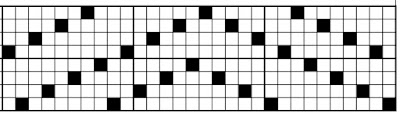

This represents an interleaved threading that is parallel to the original threading (there are lots of variations on this, which I won't go into in this post). Typically in an Echo threading, the parallel threading line is half the number of shafts above the original design, as it is in the diagram above: Threads 1, 2, 3, 4, 5, 6, 7, and 8 have a parallel threading line that is 4 shafts above them on an 8-shaft loom. The overall Echo threading -- a.k.a. parallel threading -- is now 1, 5, 2, 6, 3, 7, and 4, 8. Then, when you reach the base-line thread on shaft 5, the parallel thread "above" it is on shaft 1. The reason: Remember that Echo is a technique based on twill, so, just as with a straight twill -- 1, 2, 3, 4, 5, 6, 7, 8 -- the next thread for a straight draw is 1. (Because we don't have 9 shafts on our loom, you have to corkscrew around to shaft 1 in your threading in order to weave a continuous twill line.) 

Echo calls for two colors in the warp, one for each threading line. (You can also design Echo using 3 or 4 parallel lines, each with a different warp color, but again, we won't get into that.) Another key to this technique: Echo uses a twill tieup and, typically, a sett that is somewhere between that recommended for twill and that recommended for double weave. Also, Echo usually requires a weft that is about half the grist of the warp threads. These are not rules, just recommendations, helping to show off the warp pattern. (Echo designs are warp-emphasis designs.)

So here's where I began, with this lovely 8-shaft advancing-and-descending-point-twill design on Handweaving.net:


I really like the luminous quality of the chartreuse weft, defined by the grass-green color of the warp.

And simply by clicking "Parallel Repeat" on the Warp drop-down menu in Fiberworks (a feature, like networking, that is only available on Fiberworks Silver), I got this variation:


I confess that I tried hard to find the draft on Handweaving.net so that I could give you the number to look it up -- searching under "Twill," "Ms and Ws," "Point Twill," and even "green," but I couldn't find it! The site is so full of treasures, you could spend an entire day looking at drafts and saving the ones you like....

Anyhow, I decided that the above design was too stretched out width-wise, so I created a version in Jin (which is basically Echo with a tabby tiedown in the treadling) in order to balance the motifs.


I like the simple variation of colors in the warp: bright green and turquoise, with a weft of slightly lighter green. And then, while I was shopping at Convergence in July, I came upon a 4 oz. skein of chartreuse Tencel and a 4 oz. skein of hand-painted Tencel in a variety of blues (at the Eugene Textile Center booth, which was full of temptations). Both skeins were 10/2 -- perfect! And here's the result (another version of the photo you saw at the beginning of this blog):


Along with being one of the most environmentally friendly of all the weaving fibers, Tencel also has a great sheen to it, giving the fabric a gloss similar to silk. Plus it has considerable tensile strength (hence the name Tencel, I'm guessing).

Because I didn't feel like plying lots and lots of fringe -- which is a graceful accent to a scarf but takes a lot of work -- I wove a double-weave tube at both ends of the scarf. All you have to do is fold it inwards, iron it flat, and blind-hem-stitch the sides of the tube together. 


Here's the drawdown for weaving a plain-weave tube on an Echo threading:

I'm considering -- that's the operative word, "considering" -- writing a second book, this one about Echo, offering designs for 8 shafts only, as that's the easiest way to learn this technique and 8 shafts seems to be the number of choice for the majority of weavers. This pattern would be one of them and, of course, I will have to weave up another 11 projects before I even start writing the book. So, if this book gets written, it will be a while....

Thanks for reading!


Sunday, December 18, 2022

This Pattern Is More than 400 Years Old... with a Few Changes


 It all starts with a 1626 portrait of John Erskine, 2nd Earl of Mar and Lord High Treasurer of Scotland, painted by Adam de Colone. 


The painting hangs in the National Galleries of Scotland, where researchers have found that the canvas is in fact a linen tablecloth, a practice that was common at the time. The tablecloth was woven on 14 shafts in this Gebrochene pattern.


If you're a frequent reader of this blog, you may recall that I've written about this before -- most recently, on September 18, 2022, in a post that gives you more details on how I altered the pattern but kept the original design line. I learned of it maybe 20 years ago from Marjie Thompson, who calls it "The Earl". 

It was not a stretch to take the threading and create a parallel threading 14 shafts above it, which I did just to see what would happen. I figured it could be woven as Echo or, by adding tabby to the treadling, as Jin (aka Turned Taqueté). The Jin drawdown I designed looks like this.


Here's a detail to give you a better idea of the design.

I really liked the varied geometry of the pattern, so this is what I used for the motifs in the center of the scarf, using two different weft colors, violet and gold. (The gold is in the central section, where the fabric scrunches up into pleats, seen around the neck on the mannikin. That's because the yarn is a combination of silk tram and stainless steel, which has memory.)

The mountain-like motifs at the beginning and end of the scarf -- in purple and orange -- are woven in a doubleweave pattern using what I call a "carved" tieup. (The idea is outlined in Marian Stubenitsky's definitive work, Weaving with Echo and Iris, which provides all number of tieup options for Echo woven as doubleweave.)


When you're weaving four-color doubleweave on an Echo threading, these "carved" variations in the tieup make for lots of color shifts, so that a color first appears on top of the cloth and then shifts to the bottom. This maximizes the potential for color blending.


Adding to the potential for color play: I used a painted warp combined with a black warp for the parallel threading. The technique is quite simple: You wind a two-color warp of natural and black and then paint the entire warp. The natural-colored yarn absorbs the dye and the black does not. 

I love the yarn that I used for the warp, and I doubt I will ever find it again, because I got it at one of those wonderful guild sales. It's a 24/3 unmercerized cotton, so I really didn't have to worry about threads breaking and selvages fraying. For the doubleweave weft, I used 16/2 bamboo in blue, orange, and burgundy, and for the Jin wefts, I used 60/2 silk in deep violet and, as I mentioned, tram-silk/stainless-steel in gold, purchased from Lunatic Fringe, which pleats and bends in the center section.

To me, the motifs look like mountains and the colors remind me of a western sunset. So I've named the piece "Colorado", which means "ruddy" in Spanish. It reminds me of the sunsets over the Sangre de Cristo range, near where my daughter and her family live. The Earl is well traveled indeed.

Thanks for reading!


Sunday, September 18, 2022

What's on the Loom?


More accurately, what's going on the loom? At this writing, I'm in the process of winding on a painted warp for a Jin design on 28 shafts (one of the versions of the pattern is shown above). Here's where I am at the moment, looking at the back of the loom.


It's kind of an unusual warp: Has anybody heard of 24/3 unmercerized cotton -- with about 1% of black rayon thrown in? Who knew? It was a big cone in natural that I picked up at a guild sale. Figuring that the grist of 24/3 cotton was equivalent or close to that of 16/2 cotton, I wound a warp two ends at a time, alternating between the 24/3 unmercerized cotton in natural and a 16/2 unmercerized cotton in black. 

When I went to paint the warp, I painted the entire warp at once, natural and black together. The dye colors don't affect the black at all, so you get a two-color painted warp, effectively, that you can thread for Echo. I appreciate efficiencies like that.

Back to the design. I love broken twills (most of us do, right?), a category that includes the old German designs known as Gebrochene. I've posted on this subject before, looking at a 16th-century pattern affectionately named "The Earl." Margie Thompson, an expert on historic textiles, shared it with our guild in a talk some time ago, and she was kind enough to send me the original draft, which is for 14 shafts. (For more on "The Earl" and Gebrochene twills, see my blog post of November 17, 2020.)


How did I get from the elegant, almost filigreed 14-shaft design above to the more primitive, tribal-looking 28-shaft design at the beginning of this post? It's a technique that I teach in my parallel-threading classes, using an Ms and Ws twill as a design line for Echo. I start designing by uploading the original Earl drawdown for 14 shafts in Fiberworks. (You need Fiberworks Silver for these functions.) Then, you click on the "Warp" dropdown menu and next you click on "Parallel Repeat" to Echo the original design line with a second threading 14 shafts above it.

Step 2: You see that the original Earl treadling is tromp as writ, for 14 treadles. This would work for a 28-shaft design, but it would give you squashed motifs, not very appealing. All I did (again, to achieve the design at the beginning of this post) was double the number of treadles for the entire treadling (so that treadle one becomes one and two, treadle two becomes three and four, treadle three becomes five and six, and so on). In other words, if the original treadling went from treadle 1 to 14 and down again in a point-twill pattern, I doubled the length of the pattern, so the treadles go from 1 to 28 and down again. 

Step 3: Here's where it gets a bit more complicated. I started by designing Echo using a twill tieup for 28 shafts. This is what I got. Just a detail shot. I really don't like it at all.


What to do? As I like to say, "Keep Calm and Add Tabby."


Of course, Echo has its charms -- but Jin also has a lot going for it: nice drape, one-shuttle weave, floats never longer than 3 in warp or weft, clear pattern definition, the ability to stretch out "squashed" designs, and the potential to play with the tieup to add a bit more color and interest, without risking long floats. That's what you see in the drawdown at the top of this post -- and also in the design below which uses another treadling but a similar tieup. 


I like both designs, the one above and the one at the beginning of this post. What they share are tieups for what Bonnie Inouye calls "Decorated Jin." Below is what a classic Jin tieup looks like, with half the shafts raised and half down in an ascending-twill pattern, with tabby tiedowns in between:


You'll see that the motifs above are simple and distinct, basically two colors, light and dark. This drawdown shows only a detail so that you can see the tieup more easily. Now let's look at a tieup for Decorated Jin.


Here, there are different colors and the motifs have more interest. The difference is that I've broken up the 14 up/14 down ascending-twill tieup, adding a bit of plain weave. Now, I see four different shades: pale blue, medium blue, dark rust/blue, and royal blue. It's all in the details! 

I'm going to sample at least two Decorated Jin designs and, fingers crossed, find at least one I really like. But first, of course, I have to finish dressing my loom....

Thanks for reading!


Wednesday, April 28, 2021

Titian, Caravaggio, El Greco, Velázquez, Rembrandt, Chagall... and Linen Tablecloths


Titian, The Supper at Emmaus, circa 1530


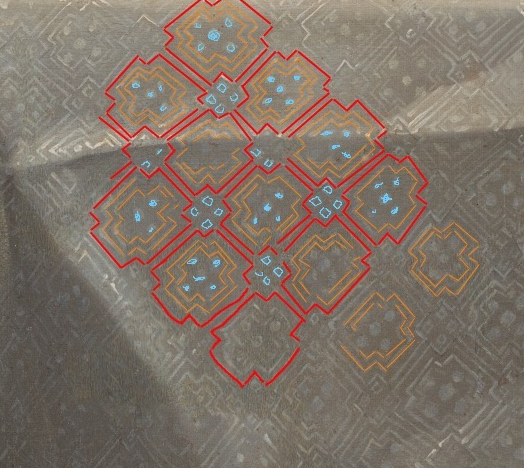
Analysis of the pattern of the tablecloth in the painting,
courtesy of Helena Loermans


A weaving drawdown similar to the tablecloth pattern

A few months ago, I wrote a post about a weaving pattern known as "The Earl's Canvas" -- a 14-shaft Gebrochene design that had been discovered in a 17th-century painting of the second Earl of Mar in Scotland. The painting was of less interest to weavers, actually, than the pattern of the canvas itself, which had been a tablecloth, most likely linen.

A linen tablecloth! I assumed that the poor artist had no choice but to use a table linen instead of a real canvas. Little did I know. 

Recently, through a chance conversation with someone in a workshop I taught, I learned that there are many centuries-old paintings woven on tablecloths in similar patterns -- patterns that are described in weaving terminology as twill diaper design. 

My friend pointed me to the writings of Helena Loermans, who researches these canvases and has a blog devoted to her work: labo.pt. (The full name for the project is the Laboratory for Handwoven Canvas Odemira, based in Odemira, Portugal, where Loermans has lived for some 30 years.)

Her research, to date, has looked at masterpieces by Titian, El Greco, Caravaggio, Velázquez, Rembrandt and Chagall. Weaving on an AVL computer loom, she recreates their canvas patterns in fine linen, emulating and revealing the beauty of the original fabrics.

Reconstructions of canvases used by Titian, woven by Helena Loermans

She also offers gift boxes of her reconstructions for sale, to raise funds for her research -- available by clicking here.

I reached out to Loermans via Zoom and asked her why these masters were using such fabrics for their work. She responded that, while no one yet really knows why, she theorizes that tablecloths were among the few fabrics wide and long enough to serve, without seams, as canvases for large paintings. (Loermans suspects that these linens were in fact seamed, but so expertly that no one can detect it.) 

In a larger sense, the material of the canvas might have been a reflection of the value of the painting. We explored how, just as art deserves a beautiful frame, the culture of the time may have viewed the canvas itself as a statement of luxury and status. Loermans observed that fine linens were often owned by churches, in an age where the church and the nobility were closely linked -- and were perhaps the only groups that could afford great works of art.

An interesting footnote: Loermans told me that the oldest known record of weaving drafts is a collection from 1677 by Marx Ziegler, Weber Kunst un Bild Buch (roughly translated, "The Weaver's Art and Drawing Book"), which is available on Handweaving.net. The collection holds many patterns similar to those she has reproduced.

In conclusion, for your weaving delight, here is a painting by Velázquez, along with a drawdown of the pattern of his canvas.

 Velázquez, Supper at Emmaus, 1599-1600

Weaving drawdown, courtesy of Helena Loermans

Thanks for reading!


Tuesday, November 17, 2020

Gebrochene, Echo and Jin with Fiberworks: Putting 'The Earl' Through His Paces


Ah, the old Weaver's magazine... such an endless source of inspiration! Recently, I was looking at an issue from 1997 and came upon a story by Marjie Thompson about the source of the above draft, "The Earl's Canvas." (Thanks to Thompson for sharing it with me.) She had given a talk to our guild about this years ago and I never forgot the beautiful silk scarf she wove. 

The pattern was discovered in a portrait of John Erskine, second Earl of Mar in Scotland, in the National Portrait Gallery in Edinburgh. Painted in 1626 by Adam de Colone, it features a Jacobean noble with a lace ruff and badge of office. 


What's interesting to weavers, however, isn't the painting itself, but rather the canvas it's painted on. According to Thompson, a museum curator analyzed the pattern in the 1970s and found that it's actually a 14-shaft Gebrochene design that was probably an old tablecloth. 

And what is Gebrochene (pronounced in German "geBROKena")? Literally it means "broken," but to weavers it's basically M's and W's. According to Thompson:

"It's a twill interlacement with an elaborate threading and treadling and a twill tieup. Usually both warp and weft are the same yarn, historically linen. Gebrochene tablecloths are pictured in medieval art and Gebrochene drafts are found in... books from the early 17th century. Patterns can be quite elaborate; one design by Jacob Angstadt shows over 900 ends in one repeat."

At last we get to the point of this blog post, which is: This beautiful draft can easily be translated into an Echo threading. And a Jin design. And Shadow Weave and Rep and Double Weave, all through the magic of Fiberworks.

You start by reducing the "The Earl" threading to 8 shafts (because not everyone has a 16-shaft loom). Next, under the Treadling dropdown menu, select "Weave as drawn in" and then make the treadling tromp as writ. Then select "Draft" and "Thickness" and click on "Exactly as drawn."


Next, using the Warp dropdown menu, click on "Parallel Repeat." In the box that opens, select "Extended Parallel," "Shafts shift by 4" and "Also duplicate colors and spacing." Then click "Apply." (And then "Close.")


Next, still in the Warp dropdown menu, click on "Fill Warp Colors." In the space that says "Single Color A," scroll down and select "AB." Then click "Replace." (Because this is just an exercise, I've simply gone along with the pre-selected colors in boxes A and B in the "Fill Warp Colors" box. You can select your own colors by using your cursor to drag colors from the "Colors" column that appears when you click on "Fill Warp Color.")

Hard to see in the above image, but if you look closely you can find blue and aqua in the boxes above the threading, indicating the colors of the warp threads below.

Next, create a 4/4 ascending twill tieup, which is a classic Echo tieup. The elementary way to do this is to draw it in by clicking on the boxes you want -- but to do it faster, you can just fill in the tieup for the first treadle and then click on the "Tieup" dropdown menu, select "Twill Repeat" and then "Step Up," "Step by 1," "Treadles per group 1" and "Apply."


Yes, it's Echo and yes, the Earl pattern is identifiable -- but it has long floats. (A good rule of thumb, according to Bonnie Inouye, is that floats in Echo should be no longer than 5. This is where the "Float Search" function on the "Tool" dropdown menu in Fiberworks comes in handy.)

Next step, alter the tiedown by breaking it up so that the floats aren't as long. Here's an example.

The motifs are still a bit squashed, right? There are ways to fix that -- one of them being to change the treadling.


Another way to alter the "flattened" Echo draft is to add tabby to the tieup, changing the structure to Jin.


You can alter the Jin design a bit by changing the tieup to create what Bonnie Inouye describes as "decorated Jin" -- changing it from a 4/4 tieup to a 4/2/1/1 tieup (plus tabby, of course).


Now that's a design befitting an Earl, don't you think? At the risk of losing readers, I will show you a few more designs. Here's how the Earl looks as Double Weave (both front and back views).


And here's a Rep version:


And then there's Shadow Weave -- although I'm not sure I like it so much.


So there you have it: "The Earl" as interpreted for extended parallel threadings, 400 years after it was used as the canvas for a nobleman's portrait. 

Thanks for reading!

[For further study: Eva Stossel is a blogger and peerless weaver who wrote about this subject on her blog and in the Complex Weavers Journal in 2012. You can read her blog post by clicking here.]