Showing posts with label Bonnie Inouye. Show all posts

Sunday, September 18, 2022

What's on the Loom?


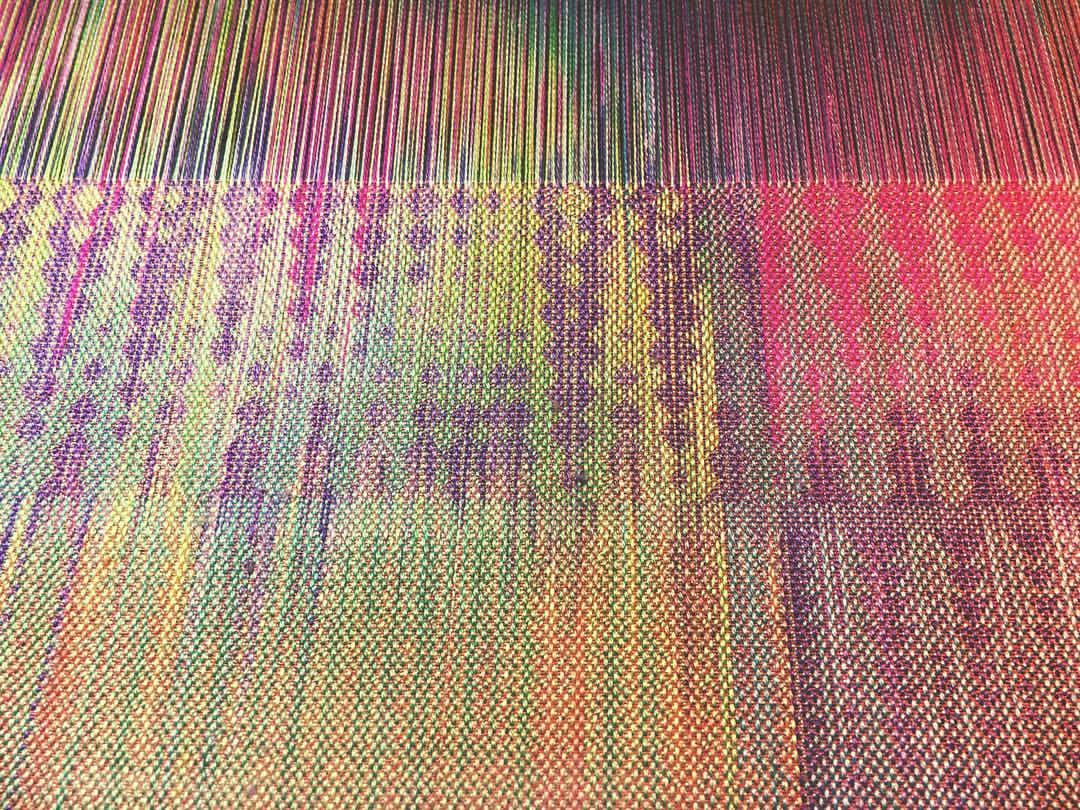
More accurately, what's going on the loom? At this writing, I'm in the process of winding on a painted warp for a Jin design on 28 shafts (one of the versions of the pattern is shown above). Here's where I am at the moment, looking at the back of the loom.


It's kind of an unusual warp: Has anybody heard of 24/3 unmercerized cotton -- with about 1% of black rayon thrown in? Who knew? It was a big cone in natural that I picked up at a guild sale. Figuring that the grist of 24/3 cotton was equivalent or close to that of 16/2 cotton, I wound a warp two ends at a time, alternating between the 24/3 unmercerized cotton in natural and a 16/2 unmercerized cotton in black. 

When I went to paint the warp, I painted the entire warp at once, natural and black together. The dye colors don't affect the black at all, so you get a two-color painted warp, effectively, that you can thread for Echo. I appreciate efficiencies like that.

Back to the design. I love broken twills (most of us do, right?), a category that includes the old German designs known as Gebrochene. I've posted on this subject before, looking at a 16th-century pattern affectionately named "The Earl." Margie Thompson, an expert on historic textiles, shared it with our guild in a talk some time ago, and she was kind enough to send me the original draft, which is for 14 shafts. (For more on "The Earl" and Gebrochene twills, see my blog post of November 17, 2020.)


How did I get from the elegant, almost filigreed 14-shaft design above to the more primitive, tribal-looking 28-shaft design at the beginning of this post? It's a technique that I teach in my parallel-threading classes, using an Ms and Ws twill as a design line for Echo. I start designing by uploading the original Earl drawdown for 14 shafts in Fiberworks. (You need Fiberworks Silver for these functions.) Then, you click on the "Warp" dropdown menu and next you click on "Parallel Repeat" to Echo the original design line with a second threading 14 shafts above it.

Step 2: You see that the original Earl treadling is tromp as writ, for 14 treadles. This would work for a 28-shaft design, but it would give you squashed motifs, not very appealing. All I did (again, to achieve the design at the beginning of this post) was double the number of treadles for the entire treadling (so that treadle one becomes one and two, treadle two becomes three and four, treadle three becomes five and six, and so on). In other words, if the original treadling went from treadle 1 to 14 and down again in a point-twill pattern, I doubled the length of the pattern, so the treadles go from 1 to 28 and down again. 

Step 3: Here's where it gets a bit more complicated. I started by designing Echo using a twill tieup for 28 shafts. This is what I got. Just a detail shot. I really don't like it at all.


What to do? As I like to say, "Keep Calm and Add Tabby."

Of course, Echo has its charms -- but Jin also has a lot going for it: nice drape, one-shuttle weave, floats never longer than 3 in warp or weft, clear pattern definition, the ability to stretch out "squashed" designs, and the potential to play with the tieup to add a bit more color and interest, without risking long floats. That's what you see in the drawdown at the top of this post -- and also in the design below which uses another treadling but a similar tieup. 


I like both designs, the one above and the one at the beginning of this post. What they share are tieups for what Bonnie Inouye calls "Decorated Jin." Below is what a classic Jin tieup looks like, with half the shafts raised and half down in an ascending-twill pattern, with tabby tiedowns in between:


You'll see that the motifs above are simple and distinct, basically two colors, light and dark. This drawdown shows only a detail so that you can see the tieup more easily. Now let's look at a tieup for Decorated Jin.


Here, there are different colors and the motifs have more interest. The difference is that I've broken up the 14 up/14 down ascending-twill tieup, adding a bit of plain weave. Now, I see four different shades: pale blue, medium blue, dark rust/blue, and royal blue. It's all in the details! 

I'm going to sample at least two Decorated Jin designs and, fingers crossed, find at least one I really like. But first, of course, I have to finish dressing my loom....

Thanks for reading!


Monday, December 21, 2020

More Explorations in Extended Parallel Threadings

Pictured here: a 12-shaft design woven on an Echo threading in 20/2 silk. I call this design "Burano" because it has a lacy look, reminding me of the lace-makers on the island off of Venice. 

So let's walk through the steps in creating this design and weaving the different samples in Echo, Jin, Shadow Weave, Rep and Double Weave. (This is exactly what we do in my workshop, "One Warp, Many Structures: An Exploration of Extended Parallel Threading." I must really like the process, because I keep repeating the format on my own, at home....)

First, how to create the design itself? I think I found the original pattern, a twill pattern with elements of a Crackle threading, on Handweaving.net. Can't remember, exactly, because it could also have been on Pinterest. Both are great places to scan weaving drafts for ideas. Here's what the original draft looks like.


Intricate, symmetrical, appealing -- reminds me of a butterfly! I starting playing on Fiberworks, expanding the design to 12 shafts using an extended parallel threading. And this is one of the designs I came up with: an Echo tieup on an advancing and descending twill treadling.


Following one of my other workshops -- "Paint Two, Beam One" -- I hand-painted two warps of 20/2 silk. The first was in a range of blues and the second in purples and rose colors, but I decided I needed more color, so I added two more painted warps in complementary colors, creating four stripes bordered on both sides by two ends of black. And here's how it wove up. 


This sample is the same pattern as in the first photo of this blog post. I used a bronze-colored weft in 20/2 cotton, because the gold tones really warm up the overall tones of the warp. And then I proceeded to weave up samples in Echo, Jin, Shadow Weave, Rep and Double Weave, varying my tieups, treadlings and weft yarns, all on the same extended parallel threading.

I am so grateful to my weaving teachers, particularly Bonnie Inouye and Marian Stubenitsky. I first learned about the potential of extended parallel threadings through a workshop taught by Bonnie, "Opposites Attract," in which she explores the potential of Echo threadings to achieve a broad range of structures. And I also continue to learn from Marian Stubenitsky's definitive work, Weaving with Echo and Iris, in which she took Echo designs and ran with them, showing countless possibilities for variations on 4 to 32 shafts.

Here's how my Jin sample wove up, offering yet another example of why I love Jin so much:


And here's how the threading works with Shadow Weave, shown here in a detail:


As for Rep (below): Well, not so great, but I think it was partly owing to my choice of wefts, where I alternated 20/2 cotton (thin weft) and black rayon chenille (thick weft). I think this sample would have been better if I changed my sett, making it much denser, and chose something thicker and less textured than the chenille for the thicker weft. Nevertheless, I see some potential here!


And then I wove up a double-weave sample, which I also like very much:


Just one more, this one in another variation of Echo:


Subtle, yes, but still I like it -- particularly the way the diamond shapes change in both size and color throughout the stripes.

Weaving at home and teaching weaving on Zoom have both given me great comfort this past year. And we all need comfort, even as we are painfully aware of how others lack food, shelter, health care and health itself. This year has given us hardship and hope in equal doses. Friends and loved ones are farther away and closer in our hearts. May you and yours enjoy the blessings of this season of light, however you may celebrate, and may you take comfort in every way you can in the year to come!


Tuesday, November 17, 2020

Gebrochene, Echo and Jin with Fiberworks: Putting 'The Earl' Through His Paces


Ah, the old Weaver's magazine... such an endless source of inspiration! Recently, I was looking at an issue from 1997 and came upon a story by Marjie Thompson about the source of the above draft, "The Earl's Canvas." (Thanks to Thompson for sharing it with me.) She had given a talk to our guild about this years ago and I never forgot the beautiful silk scarf she wove. 

The pattern was discovered in a portrait of John Erskine, second Earl of Mar in Scotland, in the National Portrait Gallery in Edinburgh. Painted in 1626 by Adam de Colone, it features a Jacobean noble with a lace ruff and badge of office. 


What's interesting to weavers, however, isn't the painting itself, but rather the canvas it's painted on. According to Thompson, a museum curator analyzed the pattern in the 1970s and found that it's actually a 14-shaft Gebrochene design that was probably an old tablecloth. 

And what is Gebrochene (pronounced in German "geBROKena")? Literally it means "broken," but to weavers it's basically M's and W's. According to Thompson:

"It's a twill interlacement with an elaborate threading and treadling and a twill tieup. Usually both warp and weft are the same yarn, historically linen. Gebrochene tablecloths are pictured in medieval art and Gebrochene drafts are found in... books from the early 17th century. Patterns can be quite elaborate; one design by Jacob Angstadt shows over 900 ends in one repeat."

At last we get to the point of this blog post, which is: This beautiful draft can easily be translated into an Echo threading. And a Jin design. And Shadow Weave and Rep and Double Weave, all through the magic of Fiberworks.

You start by reducing the "The Earl" threading to 8 shafts (because not everyone has a 16-shaft loom). Next, under the Treadling dropdown menu, select "Weave as drawn in" and then make the treadling tromp as writ. Then select "Draft" and "Thickness" and click on "Exactly as drawn."


Next, using the Warp dropdown menu, click on "Parallel Repeat." In the box that opens, select "Extended Parallel," "Shafts shift by 4" and "Also duplicate colors and spacing." Then click "Apply." (And then "Close.")


Next, still in the Warp dropdown menu, click on "Fill Warp Colors." In the space that says "Single Color A," scroll down and select "AB." Then click "Replace." (Because this is just an exercise, I've simply gone along with the pre-selected colors in boxes A and B in the "Fill Warp Colors" box. You can select your own colors by using your cursor to drag colors from the "Colors" column that appears when you click on "Fill Warp Color.")

Hard to see in the above image, but if you look closely you can find blue and aqua in the boxes above the threading, indicating the colors of the warp threads below.

Next, create a 4/4 ascending twill tieup, which is a classic Echo tieup. The elementary way to do this is to draw it in by clicking on the boxes you want -- but to do it faster, you can just fill in the tieup for the first treadle and then click on the "Tieup" dropdown menu, select "Twill Repeat" and then "Step Up," "Step by 1," "Treadles per group 1" and "Apply."


Yes, it's Echo and yes, the Earl pattern is identifiable -- but it has long floats. (A good rule of thumb, according to Bonnie Inouye, is that floats in Echo should be no longer than 5. This is where the "Float Search" function on the "Tool" dropdown menu in Fiberworks comes in handy.)

Next step, alter the tiedown by breaking it up so that the floats aren't as long. Here's an example.

The motifs are still a bit squashed, right? There are ways to fix that -- one of them being to change the treadling.


Another way to alter the "flattened" Echo draft is to add tabby to the tieup, changing the structure to Jin.


You can alter the Jin design a bit by changing the tieup to create what Bonnie Inouye describes as "decorated Jin" -- changing it from a 4/4 tieup to a 4/2/1/1 tieup (plus tabby, of course).


Now that's a design befitting an Earl, don't you think? At the risk of losing readers, I will show you a few more designs. Here's how the Earl looks as Double Weave (both front and back views).


And here's a Rep version:


And then there's Shadow Weave -- although I'm not sure I like it so much.


So there you have it: "The Earl" as interpreted for extended parallel threadings, 400 years after it was used as the canvas for a nobleman's portrait. 

Thanks for reading!

[For further study: Eva Stossel is a blogger and peerless weaver who wrote about this subject on her blog and in the Complex Weavers Journal in 2012. You can read her blog post by clicking here.] 


Tuesday, January 17, 2017

The Warp that Keeps on Giving: Echo, Jin, Double Weave, Shadow Weave, and Warp Rep All on One Threading


How do you weave a countless number of structures on one warp? With an extended parallel threading, of course! This particular technique offers a lot of "bang for the buck" for weavers. All you have to do is modify your treadling and, in some cases, change the tie-up. If you're REALLY ambitious, you can change the tie-up and re-sley as well to achieve Double Weave or Shadow Weave.

What is an extended parallel threading? For those who follow the work of Marian Stubenitsky and/or Bonnie Inouye, it needs no introduction. For the rest of us, all it means is that, for starters, you use two colors in your warp, so that you can thread them A-B-A-B, etc. (A being your first color and B being your second). Then, instead of threading a straight draw of 1, 2, 3, 4, 5, 6, 7, 8 (just as an example), you thread your two colors using the same line, but separately, at a set interval. 

For example, if you decide you're going to thread at an interval of 4, for an extended parallel threading on a straight draw, you will thread it this way: 1, 5, 2, 6, 3, 7, 4, 8, 5, 1, 6, 2, 7, 3, 8, 4, alternating between color A and color B. Here's a drawdown, by way of example. (I've posted it before, but it bears repeating.)


So your tie-up allows you to lift every other thread in an ascending twill order. This is the basic idea behind the structures I have been weaving. Because I like to paint warps -- and because I like to paint two separate warps in complementary but different palettes and beam them together and then thread them A-B-A-B in an extended parallel threading -- I decided to create an advancing point-twill using this technique. 

Here are some drafts and photos of what I've weaving. 

Variation #1: Echo

Here is the the drawdown, with a tie-up and treadling for Echo. Note that this is simply an advancing twill treadling.
And here is a photo of the sample I wove. You'll see that I didn't weave the entire treadling, because I was just trying to get an idea of how it would look.


Variation #2: Echo

Next treadling for Echo, same tie-up. This treadling is for an advancing-point twill.


My woven sample, below. I love the way the pattern seems to sparkle, which enhances the color shifts.


Next, I crawled under the treadles to do another tie-up. (Truth be told, I usually make an error when I'm tying up and have to start all over again. Which causes a lot of sweating and cursing, which is not to be written about in a blog post.) 

Variation #3: Doubleweave 

Here is the drawdown for treadling as doubleweave. I will not show you my sample, as I really messed up! I had to re-sley the reed to make the warp ends much denser -- and somewhere along the way my shed got really boggled up. I do have a sample, but again, not for public consumption ;o)


Yes, this would work well with a collapse-cloth technique, with one layer shrinking and pulling in while the other layer would "pouf" and add texture. Even with the poor shed I had -- owing mostly to the fact that I was using two different devices (Texsolv and metal hooks) to tie up my treadles and their lengths varied -- I could tell from my sample that this design has promise.

Variations #4 and #5: Jin

Then I got down under the loom and re-did my tie-up to weave Jin -- one of my favorite structures because it is so versatile. Here's the first treadling I used. If you look at the treadling, you'll see that, if you remove the tabby, it's the same advancing-twill sequence as in variation #1 above.


And here is the second treadling, an advancing point-twill. Again, if you take away the tabby, it's exactly like variation #2 for Echo.


Here is how the two samples wove up. (The first treadling appears at the bottom of the photo and the second is at the top.)


Variation #6: Jin

Here's yet another treadling, the results of which I love!

The sample:


Variation #7: Rep


There are a countless variations for an extended-parallel threading like this. One additional structure I did not mention was shadow weave. Here's a drawdown I came up with.


However, this post is getting way too long and it's taking way too much time! Suffice it to say that I'm hoping to create a workshop out of this. And as for all the samples I have been weaving: I beamed a 12-yard warp, 46" wide, using 20/2 silk sett at 40 ends per inch. The weft is, for the most part, 60/2 silk.  

I'm weaving yardage for a garment. Most likely, I will use four or five different treadlings for Jin -- I might even add a networked treadling in there somewhere -- and alternate them randomly throughout the fabric. I can't choose just one, so I have to weave them all.

And here's the photo that inspired this project to begin with. I can't attribute it to any source, because I found it on the internet long ago. The combination of pinks and greens is irresistible!


Monday, March 23, 2015

12 Harness Turned Taqueté: From Dismal Failure to Success (with a Few Treadling Errors)


First, the success: Finally, after what seemed like hours on the floor fiddling with treadles, I'm able to weave the draft I envisioned in my head (and on Fiberworks): a 12-harness turned taquete adapted from a profile draft for 8 harnesses published by Bonnie Inouye in the Complex Weavers Journal. I fell in love with the circles and curves and have been working on it through several iterations.

Now, the dismal failure.


Right. Not the same draft, but that's not the reason it doesn't look like turned taqueté. The treadling was all wrong (that accounts for the hours under the loom) AND I forgot to check for floats. The pattern is all floats. Although I do acknowledge that it might be interesting if you wove it as an eyelash fabric (cutting the floats so that they became like "eyelashes" on top of the fabric).

Now, for those of you who are better math-heads than I am, this all might seem terribly obvious. For me, I didn't get it until I wove it. And then I got it pretty quickly, as you can see, because I wove about an inch before I cut it off. Stewed about it for quite a while and wondered what the heck was wrong.

Went back to the drawing board -- Fiberworks, that is -- and succeeded in creating a network draft with parallel threading for 12 harnesses based on the profile draft mentioned above. I used two different painted warps of 20/2 silk and combined them, threading them A-B-A-B for the parallel threading. The weft is 60/2 silk in purple from Webs. Snatching success from the jaws of failure!


This is only a sample, aiming for a fabric I would like to weave for a jacket.  Right now, I'm playing with treadlings. And getting the threading right, of course. A careful observer might notice three threading errors in this piece -- but I won't tell you where they are ;o) Suffice it to say that I broke down and bought some repair heddles, because I'm tired of making them out of string. I find that turned taqueté is a challenge to thread, particularly with parallel threading, because it has no regular blocks. It's all over the place and, if your attention lapses for only a second or two, you have to deal with it when you're weaving.

Here's one more view of the sample, with a different treadling and an off-white weft. I think it looks washed out, but it always pays to experiment. You never know!


A post-script: tying up 14 treadles for 12 harnesses is enough to convince me I need to purchase a computer dobby loom....