Wednesday, January 21, 2015

Needed: One More Student for 'Shibori Basics: Itajime, Arashi, and Kumo Techniques'

Arashi shibori pattern, indigo dyed on cotton muslin

If you want to learn more about shibori-resist techniques using cotton and indigo dye, I'll be offering a one-day workshop very soon on this ancient art form.

On Friday, February 6, from 10 a.m. to 4 p.m. at the Weaving and Fiber Arts Center in East Rochester, we'll look at the fundamentals of itajime (shape-resist), arashi (pole-wrapping) and kumo (pleat and bind) shibori with indigo on cotton fabrics. You'll leave with lots of samples and instructions on how to shape, wrap, and fold your way to beautiful patterns in blue on white cotton fabric, along with basic recipes for dyeing with indigo.

For more on this class and others, visit the Weaving and Fiber Arts Center. You may register online or contact me at dkovn@hotmail.com for more information.


Tuesday, January 13, 2015

Echo and Jin: Optimizing Color with Two Painted Warps


The headline is a mouthful, but the photo above says it better. It's an Echo pattern on eight harnesses, designed by Bonnie Inouye and published in the January/February 2008 issue of Handwoven magazine ("Two Patterns for Two Scarves," available by clicking here.)

I wove this sample using 17/2 silk noil for the warps (two separate warps painted in two different color palettes using Pro MX Fiber Reactive Dyes) and 20/2 pearl cotton in navy for the weft. The warp is threaded on opposites, allowing for two different colors to play with (or against, depending on your eye) each other in the pattern. The treadling too provides for wonderful curves and waves in the design.

The beauty part of this Echo draft is that you can also weave Jin by adding tabby. This is the second pattern that Bonnie refers to in the title of her article. Here is the same threading, with tabby, woven as Jin.


Yes! It looks longer, of course, because you've added tabby. But it's equally lovely, in my opinion, and the color shifts are just as interesting, thanks to the painted warp -- warps, really, because (at the risk of repeating myself) you're using two different painted warps together.

(A brief promotional bit here. I'm teaching the technique in July at the MAFA Conference at Millersville University in Lancaster County, Pennsylvania. Providing the course fills, that is. The name of the course: "Paint 2, Beam 1," and the aim is to create an ever-changing color palette for your warp, maximizing visual interest using a range of weaving structures.)

In the Handwoven piece, Bonnie has offered a different tieup and treadling for the Jin, which looks like this.


The drape of this fabric is wonderful, by the way. I wouldn't use it for a scarf, by any means, but it would certainly work for a jacket or coat. One caveat: silk noil in the warp is a bit tricky, as it tends to fray and break easily. The two-ply yarn offered me some surprises, to say the least, but the way it took the dye -- simply gorgeous! Silk never fails to please.

Monday, December 29, 2014

New Warps, New Camera Lens, New Year!


To paraphrase the old cliche: I don't know much about photography, but I know what I like. And I really like my new "Nifty Fifty" lens that my children gave me for Christmas.

All I know about photography, other than a class I took back in the day, is that a digital SLR takes the best photos because it has the most powerful sensor. That and something I learned from Rachel Biel of Rayela Art, founder of TAFA, the Textile and Fiber Art List. When I joined TAFA, she looked at my Etsy page and made a valuable comment: While my photos were good, they could be even better if they had a shallower depth of field. This would highlight the garment and make the background all out of focus, both literally and figuratively.

How to do this? I had no idea, as I had learned about photography back when you manually set your own F stops and shutter speed. On the new digital cameras, I hadn't a clue. So I asked my son, a professional filmmaker and videographer (visit Jake Kovnat at Sons and Daughters in Toronto by clicking here). He told me that all I needed was a "Nifty Fifty" lens, which meant a 50mm lens that you could set at a 1.8 F stop. (Don't ask me; that's all I know.)

So now I'm good to go! Oh yes, about those two warps: They're silk noil, I think a 17/2 weight, that I dyed using WashFast Acid Dyes. The colors are what I call "Chagall," meaning that they derive from one of his wonderful paintings set at midnight with lovers flying through the sky.

The warps are ready to beam for a sample for my upcoming MAFA class, "Paint 2, Beam 1," looking at how to achieve an ever-changing color palette in your weaving by painting two individual warps and beaming and weaving them together as one. (For more on the Mid-Atlantic Fiber Association and its July 2015 conference, click here.)

Here's an example of what you can do with "Paint 2."


Updates to come, as I beam and weave my Chagall warps....

Monday, December 15, 2014

Scenes from a Class on Shibori with Natural Dyes

Two samples of arashi shibori on cotton by Joan Rusitzky, 
using osage orange (gold color) and indigo.

"Sawdust, Leaves, and Bugs: Shibori with Natural Dyes" is the full name of the class, a workshop I taught over the weekend at the Weaving and Fiber Arts Center. Students brought in cellulose fabric (cotton, linen, rayon, and silk) for dyeing in three different vats: osage orange (for golden yellow), cochineal (for magenta) and indigo. We also did some discharging of dyes, using RIT Color Remover.

The results were wonderful. Students went from vat to vat, clamping, tying, stitching, folding, and otherwise creating shibori resists that allowed colors to blend or contrast in a number of patterns.

Above: Barbara Mauger dyed a silk scarf, beginning with a base of osage orange 
(made lemon yellow because it was simmering in a copper pot), 
then clamping with spiral forms and finally dipping in an indigo vat. 
The red color on the lowest spiral comes 
from a bit of old dye that was still on the spiral resist.

We learned that natural dyes could successfully be discharged using RIT Color Remover. I had used this often on man-made dyes but had no practice on natural dyes. Nor could I find anything online to document that it would work. So we found out for ourselves that it was effective, with the vat being hot enough (about 160 degrees Fahrenheit) and enough time elapsing (at least 15 minutes) for the fabric to sit in the vat. Another insight: Michel Garcia recommends that cotton fibers will work better in natural dyes if they are pre-mordanted in aluminum acetate rather than the traditional aluminum sulfate mordant. I looked this up online and found that an over-the-counter pharmaceutical product, commercially named Domeboro, is made of aluminum acetate. That's what we used, at approximately one package of Domeboro per one ounce of fabric. It worked great!

Typically, it's hard to get saturated colors on cotton fabric using natural dyes. I believe (and this is not based on research but rather on my own assessment) that it does help intensify the colors.

Eleanor Hartquist used long cords to scrunch up her fabric, 
which we think was either cotton or linen. Not sure. 
The brown color you see here was a base color, 
achieved by dipping first in osage orange and next in cochineal.

Eleanor's fabric, after immersing in cochineal once again, then opening the fabric, 
 then again folding and clamping it and immersing it in indigo.

On the final day of class, just for fun, I made a vat of onion-skin dye, which produces a lovely golden/rust color. Below is a photo of some silk yarn that Eleanor decided to wrap (an Ikat technique) and immerse in the onion skin dye.

Eleanor's onion-skin-dyed yarn, using Ikat techniques. The color in this photo 
may be skewing a bit toward the red end of the spectrum, but you get the idea! 

Lots of fun and color for a December weekend. I'm thinking of presenting anther workshop along these lines in the future, perhaps using madder, onion skins, and woad. Let's see, that would have to be named "Roots, Peels, and Leaves...." 


Monday, November 10, 2014

November 14-16: Pop Up Art Sale at the Old Pickle Factory, Pittsford


This Thursday at the Old Pickle Factory on Grove Street in the village of Pittsford: 16 awesome artists! Free admission, free parking, and lots of wonderful pieces to choose from.

I will be there selling my handwoven, knitted, dyed and sewn garments and accessories. Among them:


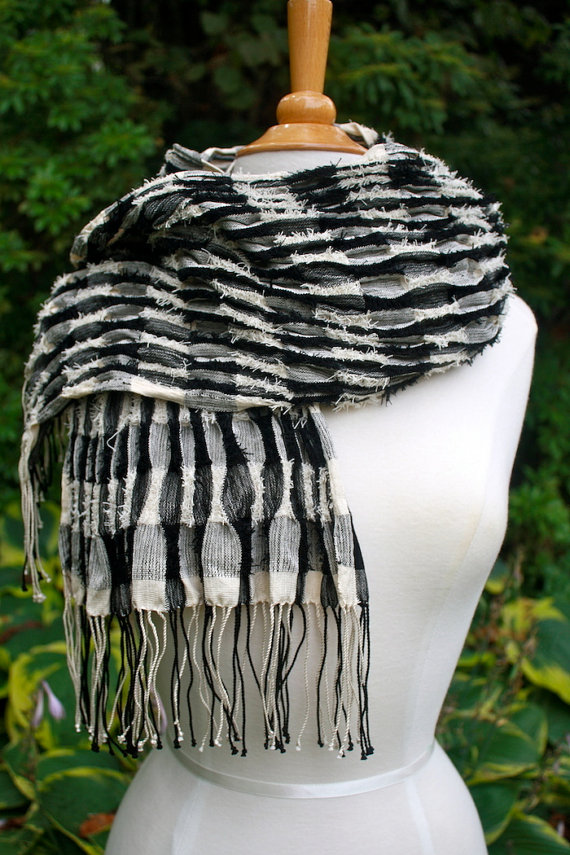
This silk scarf, featuring a collapse-weave structure


This wool coat, also a collapse-weave structure, handwoven in handspun S and Z twist yarns

Grove Street is off of French Road, close to where it ends at East Avenue. The Old Pickle Factory is a big old wooden building, sort of like a warehouse, at 1 Grove Street. The parking lot is on the other side of the building, away from the street. 

Follow the signs with the yellow bows on them. Hope to see you there!

Friday, November 7, 2014

Going Green with Weld and Indigo


The technique is known as "Arashi Shibori" -- that is, using Japanese shibori-resist techniques to achieve patterns on cloth. The arashi version of shibori creates a striped design, because the dyer wraps fabric around a pole, wraps rope around this to secure it, scrunches the fabric down and repeats the process until the entire piece of fabric is wrapped and tied.

The top above was made with a medium weight cotton muslin, which is very inexpensive -- maybe $5 a yard -- and wonderful to work with! I first immersed the fabric in weld, which produced a vivid yellow color, almost neon. (The important thing to remember, when dyeing cotton with natural dyes, is to pre-mordant the cotton with aluminum acetate, NOT aluminum sulfate. I use an over-the-counter topical astringent known as Domeboro, available online and from your local drugstore. I figure about one packet per ounce of fiber and immerse it in the mordant overnight before dyeing.)

After dyeing and drying the fabric in weld, I next immersed it once or twice in an indigo vat, producing the lighter green you seen on the fabric. Finally, I did the arashi wrapping around a PVC pipe that was 8" in diameter -- as large a pipe as I could get my hands on, thanks to my good friend Joy Duskin. Wrapping, typing, scrunching is exhausting work and it took maybe an hour to prepare about two yards of fabric for immersing in the indigo vat. (The entire project took four yards of fabric.)

The result was the dark green horizontal stripes on the fabric. Sort of a forest/jungle/fern feeling, don't you think? I was very happy with the way it turned out -- which isn't always the case with dyeing, I have to confess.


This pattern is from Linda Lee's Sewing Workshop, which is a great source of creative patterns for artists. This is the pattern known as "Kinenbi Top," which is discontinued, but still available on Etsy and other sites. I highly recommend the Sewing Workshop patterns because they are well thought out, easy to understand, and well detailed: finished to a "T" and that's without even mentioning how attractive they are.

If you want to learn more about this pattern and how it worked for me, visit my review at patternreview.com -- another source for people who love to sew.

The piece is for sale this weekend at the Weavers' Guild of Rochester Holiday Show and Sale. If it doesn't sell, I will have another chance at the Pop-Up Art Show and Sale next weekend at the Old Pickle Factory in Pittsford. Maybe I will see you there!

Sunday, October 19, 2014

Come to the Weavers' Guild of Rochester Holiday Sale, November 7-9


This year, we're in a new venue: the Century Club, a beautiful old mansion on East Avenue located across from the Strathallan hotel at the corner of Strathallan Park. Much bigger than our previous site and we will have lots of events!

First, the details: ADMISSION IS FREE. Most important. The sale takes place from noon to 9 p.m. on Friday, November 7; from 10 a.m. till 5 p.m. on Saturday, November 8; and from 11 a.m. till 3 p.m. on Sunday, November 9. Our members have an enormous range of talents, so you will be tempted not only by handwoven pieces, but also by jewelry, pottery, woodworked pieces, baskets, visual art, and handspun yarns. I have probably missed something on this list, but you get the idea.

On Friday evening, we will have a fashion show featuring garments that are for sale. Weavers and handspinners will demonstrate their craft throughout the sale and there will be information on classes at the Weaving and Fiber Arts Center. For more information, here's the link: Weavers' Guild of Rochester Holiday Sale

Every year, our members put on a great display -- and every year, we have a line at the door before we open. The show has continued to grow as more and more people from the Rochester area and beyond have learned about it -- and about the quality of items for sale. Come see for yourself!