Showing posts with label turned taquete. Show all posts

Wednesday, November 14, 2018

Teaching Echo -- and Playing with Echo -- at the Weaving and Fiber Arts Center

This is the playing part: for more on this draft, read on.

Let me start by boasting about my home guild, the Weavers' Guild of Rochester. Mind you, Rochester, New York, is not a big city, with maybe one million people in the entire seven-county region. Nevertheless, we have a large and dynamic weaving community. This includes our guild, with nearly 200 members, and our Weaving and Fiber Arts Center, featuring dozens of classes each year in weaving, knitting, felting, dyeing, lace-making, kumihimo, shibori, and lots of other fiber-art techniques.

The Center, as it's known, began in a small one-room studio in January 2002 and now includes two spacious rooms, one for dozens of looms and one for off-loom classes and meetings. Here are a couple of photos, to give you an idea.


More important are the scores of talented fiber artists who come to learn, create, and share. Give them some tools and some yarn and these folks are good to go!

Case in point: Just this past weekend, I taught a workshop there, "One Warp, Many Structures: An Exploration of Extended Parallel Threading." And sure enough, everybody produced skillful, beautiful samples. Here are some photos.


This above is a 12-shaft Echo design woven by Mary Ann Proia on 10/2 cotton with two colors in the warp, terra cotta and sage green, and three different weft colors. My favorite is the blue on the bottom. This photo shows the sample after it had been washed, which added texture to the pattern.


This is an 8-shaft Echo design woven by Marianne Antczak on a warp of gold and beige. The weft colors changed the appearance of the fabric dramatically: a green weft appears on the top and a soft purple weft is on the bottom.


Above is the same 8-shaft design in Echo (top of the photo) and in Double Weave (bottom) woven by Lee Donely. Her warp yarns were also in brown and tan 10/2 cotton.


Judy Fox wove a 4-shaft Echo design using fuchsia and black 10/2 Tencel as warp yarns. The bottom section uses a turquoise weft and the middle a yellow weft. The top portion, seen only slightly, features a Turned Taquete version of the same threading, woven with a green weft.


The workshop is designed so that you can weave five structures on the same threading: Echo, Turned Taquete, Shadow Weave, Rep Weave, and Double Weave. In the photo above, Nancy Kanniainen has woven Rep Weave on a warp of 10/2 cotton. The center section has warps of olive and teal and the outer borders have warps of teal and sage green.


Above, Amy Parker chose three different color sets for her 8-shaft warp: from left to right, green and navy, beige and purple, and salmon and cranberry. The bottom part of the sample is Rep and the top section is Double Weave.

And then we got to playing, looking at Marian Stubenitsky's book, Weaving with Echo and Iris. Specifically, we wanted to design a pattern of circles, as she shows on page 96, that called for no more than 10 treadles (the design in the book requires 32 treadles because it's Double Weave).

So, this is what we came up with, working together (this is the draft that appears at the beginning of this post, but I've enlarged it). It's not Double Weave, so you need just 8 treadles. (I call this draft "Circles Designed by Amy," because Amy Parker was so good at pointing out just what we needed to do, step by step, as we designed this as a group.)


We started with a profile draft.


Then, using FiberWorks PC, we created an "Advancing Repeat" that repeated 5 times, advancing one shaft up each time, in the "Warp" dropdown menu that listed "Repeat in Threading." It looked like this:


Very cool, yes? Next step, we completed the profile design by adding a straight draw for a tieup and "tromp as writ" (weave as drawn in) for the treadling, but inverted. Using FiberWorks, you can simply draw in (using your mouse) the first curve of the treadling profile, making sure it's exactly like the first curve of the threading profile, but inverted. Now you click on "Repeat in Treadling" under the "Treadling" dropdown menu and in that box, click on "Advancing Repeat" and insert the number 5 in the box that asks for the number of repeats. Here's what we got:

You see the different circle motifs? That's because of the advancing repeat, which shifts the threading patterns up.

Then we decided to do a simple block substitution using FiberWorks. Under the "Tools" menu, we clicked on "Block Substitution." We chose "Classic Weaves" and then "Crackle -- Twill Form." And with that one click, this is what we got.


After changing the warp colors to alternating blue and green (threaded ABABAB, etc.) and then changing the weft color to coral, we had with the colorful design shown at the beginning of this post. Most excellent! We were all very happy!

Except for one problem, immediately noted by Debbie Fister: The motifs are HUGE. Each one is about 170 ends wide. Even if you were threading your loom at 40 epi (not unheard of for 10/2 cotton in an Echo threading), that's more than 4" wide per motif. Something to think about. 

I went home and went back to the drawing board (in this case, the weaving software program) and came up with another, similar design with motifs that were just shy of 120 ends each. So that's 3" wide at 40 epi. And I could show you all the steps in how I got there....

But that's another story for another time ;o) Thanks for reading!


Friday, September 14, 2018

Baby Wrap in 16-Shaft Echo and Jin: On My New Computer Loom!


Echo, which is a border at the beginning and the end of the wrap

A detail

Great news! I have a new (to me) computer dobby loom: a 16-shaft Toika Eeva with a 40 cm weaving width. This Scandinavian beauty came to me by way of my friend and fine weaver Hedy Lyles, who enjoyed this loom but was moving up to 24 shafts.

Here's Eeva, getting dressed. 


A view from the back of the loom

I wound a warp of 10/2 Tencel, 1187 ends, 8 yards long, so that -- at 40 epi -- I would have a weaving width just shy of 30" and plenty of length for sampling before I weave up a 5-yard-long wrap. 

Because I've been teaching a lot of workshops on 4-shaft, 8-shaft, and 12-shaft Echo (and other structures you can weave on the same threading, using different tieups and treadlings), I decided to expand my repertoire to 16 shafts. Here's just a section of the Echo design, based on an advancing point twill in both threading and treadling.

I can't really show you the entire drawdown because it's too large to reproduce on this page. Anyhow, it gives you the idea: I broke up the pattern line in several spots because I like the abrupt shift, almost giving the impression of stripes.

The wrap will be Echo for just 24" on each end, with Jin filling up the center. I did this for two reasons: 1) I love the variations between the two structures and 2) the Echo pattern has warp floats of as many as 5 picks while the Jin design, by definition, never has a float of more than 3 picks. So I figured that the fabric woven in Jin would be just that much stronger and more durable when it comes to supporting an infant.

Here's what the Jin design looks like (again, only a portion of it, as the entire design wouldn't show up well at all in this narrow space). Because I'm showing you just a portion, the design looks asymmetrical -- but the pattern is symmetrical.
And here's what the Jin design looks like on the loom:


The other side of the fabric (maybe a bit harder to see)

I find that there is a bit of a learning curve with a computer loom. For instance, if I have a misstep on the pedal that controls the treadling, it's hard to instruct the weaving program to go back. At least for me it is: sometimes the computer wants to loop around and I find myself right back where I started, having to unweave. And then you have to tell the computer to unweave. It's a tricky conversation, at least until I get the hang of it.

The upside is that the weaving goes much faster and is less physically taxing. This is especially helpful with a 20/2 cotton weft, which I'm weaving at about 30 picks per inch.

And another advantage: those 16 shafts! There is a lot to learn and a lot of designing to do and I'm looking forward to it.

Back to the wrap itself: One of the things I love about Echo and Jin is the color dynamics. I deliberately chose an unlikely combination of warp colors -- burgundy and turquoise -- because I knew from experience that the weft alters the overall color of the fabric in surprising ways, often producing the iridescence that Marian Stubenitsky covers so well in her book, Weaving with Echo and Iris. For the weft I chose an orange/coral color, sort of a cantaloupe, because it warms up the warp, so to speak. Below is a photo of samples of different-colored wefts, with the cantaloupe-colored weft at the very bottom of the photo. 


This is a very special project for a very special new person in our lives: Our first grandchild, Owen, who is now almost 3 months old. I think it will look good on him, don't you?


Thursday, July 19, 2018

What We Wove at Convergence: Echo, Jin, Shadow Weave, Rep, Double Weave, and Even Collapse Fabric

Echo Weave on 8 shafts on a warp of light blue and dark blue 10/2 cotton. 
The weft is 20/2 cotton in golden orange. Woven by Virginia Lee.

You've heard about Echo, which is based on an extended parallel threading that weaves a warp-emphasis fabric with lots of color and strong patterns. But do you know about all the different structures you can weave on the same parallel threading? In addition to Echo, you can weave Jin, Shadow Weave, Rep Weave, Double Weave and even collapse cloth, simply by changing your tieups and treadlings.

I taught a workshop on this subject last week at Convergence, the biennial conference for the Handweavers Guild of America, held this year in Reno, Nevada. "One Warp, Many Structures: An Exploration of Extended Parallel Threading" looked at all the possibilities I mentioned above. To teach this, I designed 9 different patterns -- 3 for 4 shaft looms, 3 for 8 shafts, and 3 for 12 shafts -- and invited students to choose a pattern and wind a warp using two colors of 10/2 pearl cotton. (I also named all of these patterns, using simple descriptions as a mnemonic device -- otherwise I couldn't remember them all!)

Below is a photo essay showing some of the beautiful samples the folks in my workshop created, with brief descriptions for each. It was a visual feast!

Above on left: Echo Weave sample using 8-shaft pattern, "Many Rivers," in light blue and off-white warp yarns. On right: the same pattern, this time in Double Weave, with top layer woven in off-white 10/2 cotton and bottom layer woven in 18/2 merino. The bottom layer fulls with hot water, soap, and agitation, making the top layer collapse and pucker. Woven by Roberta McKinney.


 Echo in the 8-shaft pattern, "Falling Stars," using different colors of weft yarns in 20/2 cotton. 
Note how the the weft color completely changes the color of the fabric. Woven by Teresa Edmisten.

Left to right: Double Weave and Shadow Weave samples woven on 8 shafts in the "Fun House" pattern. 
Woven by Judith Rees.

 Clockwise, starting from top left: Echo,
Double Weave, and Rep Weave on a 4-shaft pattern called "Op Art."  Woven by Diana Abrell.

Rep Weave in the "Fun House" pattern on 8 shafts. Woven by Virginia Lee. 

Shadow Weave on 8 shafts in the "Falling Stars" pattern. I think this was woven 
by Rachelle Weiss -- my apologies for not knowing for certain.

 Above, the 8-shaft "Fun House" pattern on a warp in two shades of blue for warp yarns. 
The red weft creates the impression of 4 different colors in the fabric. Woven by Judith Rees.


The two photos above: front and back of the "Falling Stars" pattern on 8 shafts in Double Weave. 
The warps alternate between a golden yellow and a hand-painted yarn in shades of green and blue. Woven by Sharlet Elms.


The two photos above: front and back of collapse cloth in the 8-shaft "Falling Stars" pattern, woven as Double Weave. The weft alternates between 10/2 cotton in gold (front) and 18/2 merino in purple (back). With washing, soap, and a lot of agitation, the merino fulls on the back, making the layer on the top collapse into pleats. Woven by Sharlet Elms.


"Many Rivers" design woven on 8 shafts. Pictured from top to bottom: 
Echo, Shadow Weave, and Jin. Woven by Virginia Glenn.


Pictured above, clockwise from top left: 8-shaft "Falling Stars" pattern in Shadow Weave, 
Double Weave, Rep Weave, and again in Double Weave. Woven by Ruth Ronan.


Blooming Leaf pattern on 4 shafts woven as Jin. Woven by Sharolene Brunston.


Above, top to bottom: "Fun House" pattern for 8 shafts. The top two samples are woven using a different Echo tieup and treadling from the bottom 4 samples. The bottom 4 samples are all the same tieup and treadling for Echo, but using different colored wefts. The warp yarns are light blue and turquoise. Woven by Carie Kramer.


Thanks for reading! And many thanks to the staff of HGA for putting together another wonderful gathering of the clan!

Wednesday, April 18, 2018

Juried into the Convergence Fashion Show in Reno...


Every two years I set myself a challenge: weave fabric for a garment for submitting to the Convergence fashion show, a biannual conference sponsored by the Handweavers Guild of America. This year, the conference will be held July 6-13 at the Peppermill Resort in Reno, Nevada -- and I'm happy to announce that two garments of mine were juried into the show.


This coat took me two years to complete, from conception to winding warps to dyeing them to weaving the fabric to dyeing the lining and sewing the coat.... It's called "Summer's Lease I," after William Shakespeare's beautiful words, "Summer's lease hath all too short a date" (from his sonnet, "Shall I Compare Thee to a Summer's Day").

I wove the fabric on my 12-shaft Macomber, using a draft I created with extended parallel threading. Then I wound two warps of 20/2 silk, painting one in a range of fuchsia, rose, pink, and lavender and the other in gold, lime green, sage green, and turquoise. The fabric is woven in Echo Weave and Turned Taquete and the weft was 60/2 silk in orange.

Here's the image that inspired my pattern and colors.


I kept it on my computer for years under the title "Paint this Warp." I have no idea where I found it!

For the lining, I purchased yardage of Habotai silk, then dyed it in a range of bright pinks using low-water-immersion dyeing.

I wove about 10 yards of fabric and, having taken Bonnie Inouye's workshop, "Opposites Attract," I began experimenting with other structures, alternating my treadlings for Echo and Turned Taquete and then venturing into Rep and Double Weave. The Double Weave wasn't successful because I did not re-sley my reed for a tighter sett. But the Rep turned out really well, with a weft of hand-dyed Habotai silk ribbon alternating with 60/2 silk.

Here's the second garment that was juried into the fashion show, this one named "Summer's Lease II."


The top is woven in Warp Rep and the skirt is Turned Taquete, cut on the bias. Here's a close-up of the top.


As for patterns: the coat is my own pattern, fashioned after a swing coat I own and love. The skirt and top are my own designs. Photo credits and thanks to Timothy Fuss of Pixelwave, who does a wonderful job photographing handwoven garments.

Hope to see you in Reno!

Saturday, February 17, 2018

How to Design 8-Shaft Echo Using Fiberworks


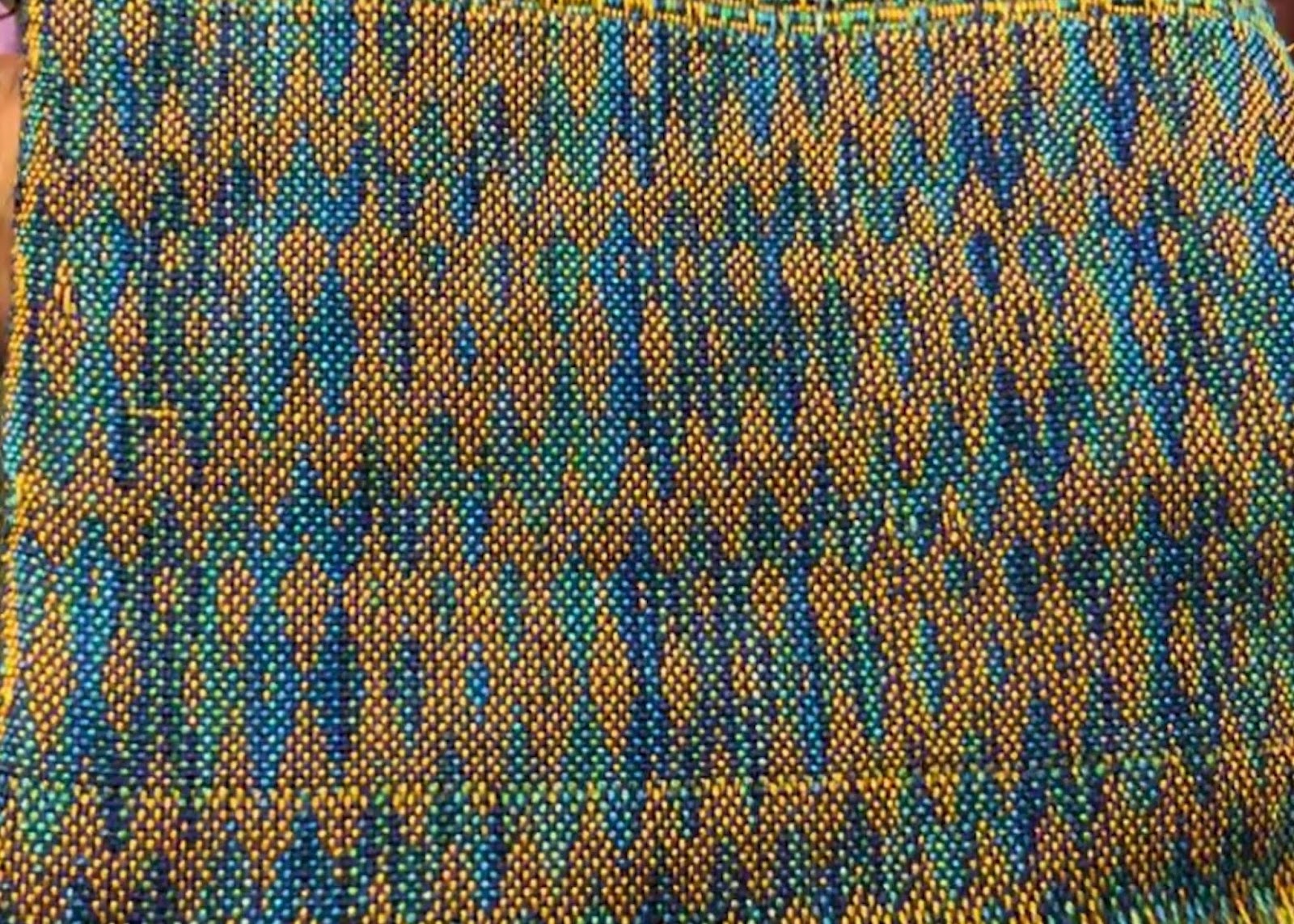
Just finished: this sample above on 8 shafts, in preparation for my workshop at Convergence this July. (For details, click here and scroll down to the eleventh listing.) I'm using 10/2 pearl cotton in the warp, sett at 36 epi, with a 20/2 pearl cotton weft (in black). I like to call it "Many Rivers" because of the vertically flowing design.

In this blog post, I'll try to outline the steps it took to design this in Fiberworks. No easy task, learning how to do this! But it's so worth it: While weaving most any pattern can be a delightful journey, it's a great pleasure to create your own designs and then weave them up to see exactly what happens. I encourage you to try.

So here goes! (Note: I have a Mac, so keep in mind that the commands in Fiberworks may differ slightly for PCs.)

STEP 1: Create a design line


Using the "Draw Freehand" button, I designed curves that change in shape and size. Try it! Any rounded forms will do for starters.

STEP 2: Create a networked threading based on the design line


Click on the drop-down menu under "Warp" and then click "Redraw on network." A box will appear and you want it to have these settings: "No reduction," "Straight Twill" (under "Style of Initial"),  "4" (under "Height of the Initial").  (You do not need to enter anything under "Set Result to X Shafts.") Then click "Apply" and "Accept." Voila! You've created a networked threading.

Notice how the curves in the threading, based on a twill structure, follow the curves of the design line. If you want to learn more about network drafting, the definitive book is written by Alice Schlein.

STEP 3: Create an extended parallel threading


Again in the drop-down menu under "Warp," this time click on "Parallel Repeat," then "Extended Parallel," "Shafts Shift by 4," and then "Apply."

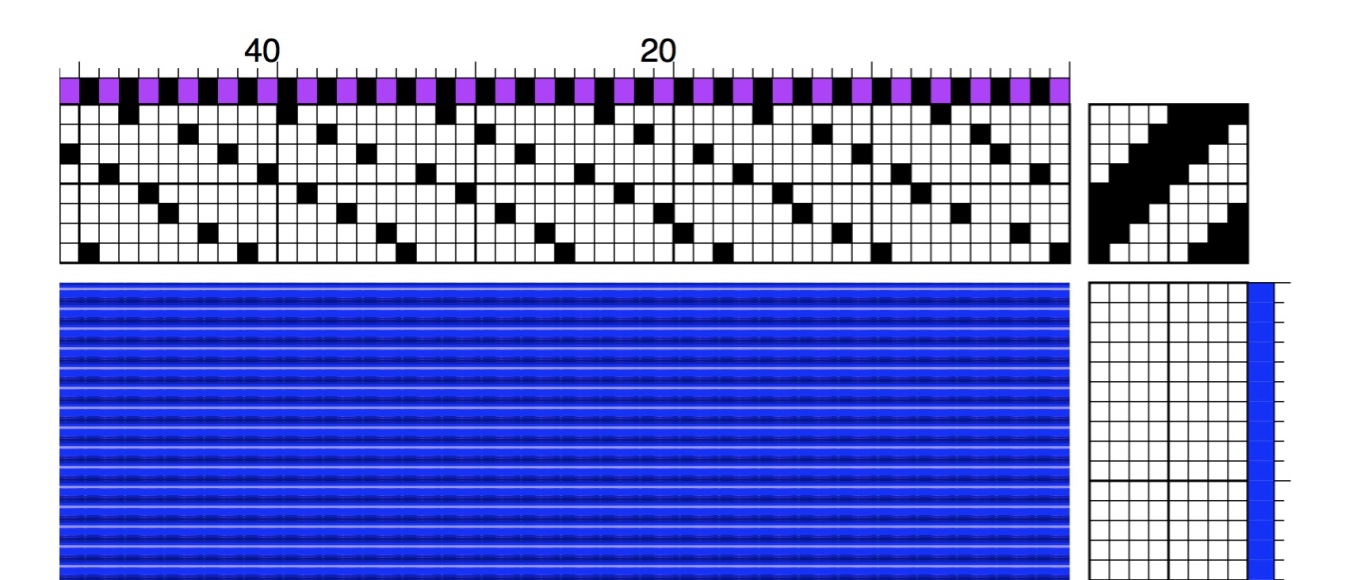
This threading may look at little strange if you're not familiar with extended parallel threadings. (For more on this, read the first four paragraphs of my blog post here.) But look carefully at the threading and compare it with the threading in the previous image: The first and second warp threads in the earlier image are on 1 and 2. In the second image, the extended parallel threading shown above, the first warp end is on 1, followed by its "echo" four shafts higher on 5. The second warp end is on 2, followed by its "echo" four shafts higher on 6. Echo threadings are in two parallel lines. Corkscrew twills are based on this concept as well. The threading goes round and round.

STEP 4: Assign colors to your extended parallel threading


In the "Warp" drop-down, click on "Fill Warp Colors." In the next box, set the colors for "AB," then drag the colors you want from the color panel into boxes A and B. Then click "Replace."

Why use two different colors? As each thread in the original networked draft is followed by its echo or parallel, so you have to distinguish these parallel patterns by using different colors. Otherwise, you wouldn't see the echo! So the colors are always A-B-A-B, etc. (In Marian Stubenitsky's book, Weaving with Echo and Iris, she often designs with as many as four different colors on four parallel threadings, for the beautiful effect that she terms "iridescence.")

STEP 4: Create a twill tieup


That's a simple twill repeat, rising, with 4 shafts up and 4 shafts down. This means that, for any warp thread and its parallel (for any pair of purple and black threads), one is up and one is down at any given time. This is the 4-shaft interval for the parallel threading, allowing the patterns to play one against the other.

STEP 5: Decide on a treadling pattern, based on a twill

For the treadling, I usually "draw" it in by hand, using the "Draw Freehand" button at the top left. There are lots of other ways to do this, but it's my preferred method.

I chose an advancing point twill, with a pattern of 1-2-3-4-5-4-3, 2-3-4-5-6-5-4, etc. I love the way the "points" in the treadling seem to sparkle in the drawdown! But there's a problem: there are long floats in the warp. If you can't tell just by looking at the drawdown, it's a good idea to check: You do this by clicking on the "Tools" menu, and then clicking on "Float Search." You can search for floats of any number in both warp and weft -- but Bonnie Inouye suggests that, with Echo, you don't want floats of more than 5 ends or 5 picks. That's a lot, particularly if you're using threads that are as thick as 10/2 cotton or thicker.

STEP 6: Change the tieup, if needed, to reduce the number of floats

This means that you will have to add more variety in the tieup, so there are more tie-down threads in the warp. You may have to play with the tieup a bit to see how it works and what you like.

So that's the how-to. Hope it's clear enough to get you started. And then, if you're really ambitious, you can begin designing other patterns using different tieups and treadlings. For instance...

STEP 7: Bonus! Add tabby for Turned Jin.

This is a structure that automatically eliminates floats of longer than 3: Jin! Just by adding tabby to a 4/4 tieup for an extended parallel threading, you can create a Jin design. (It's not TRULY tabby, but rather a half-basket weave, but that's another discussion for another time.)

In any event, here's how to do this: Under the "Treadling" drop-down menu, scroll to the end and click on "Insert Tabby." What you'll get is a form of tabby -- but you'll have to adjust it so that treadle 1 lifts shafts 1, 3, 5 and 7 and treadle 2 lifts shafts 2, 4, 6 and 8. It's always a reward to see the design nice and clear and neat -- which is why I love Jin.

Here, in conclusion, is a detail of the back side of my Echo sample, which is quite different from the front, pictured at the beginning of this post. Thanks for reading!