Showing posts with label 60/2 silk. Show all posts

Thursday, May 30, 2019

O Canada!

Lake Louise in the Canadian Rockies, 
viewed from the lakeside trail

I wish that everyone could experience the beauty, friendship, laughter and food (oh the food) that I enjoyed while teaching in Canada over the past three weeks.

Cappuccino made by Dave Connelly, 
some of the amazing food and drink I enjoyed in Alberta

Thanks to Lyn Pflueger, a wet felter, spinner, and weaver who teaches at the Alberta College of Art and Design (and to whom I am forever grateful), I was invited to teach four workshops for the Heritage Weavers and Spinners Guild of Calgary, the Sheep Creek Weavers and Fibre Artists Guild, the Crocus Country Fibre Arts Guild, and the Edmonton Weavers' Guild. 

How to begin to describe the talent and skill of the weavers I met over 21 days? I guess the best way is to start at the beginning....

Above: Lorel Dederer (left) and her sister, Cammy Desjardins

Lorel Dederer shepherded me about and organized everything for the Heritage Guild workshop, "One Warp, Many Structures: An Exploration of Extended Parallel Threading." The 14 weavers who took the class -- from beginners to advanced weavers -- showed an awesome degree of skill and creativity.

Norma Camman talks about her samples of the 4-shaft pattern "Op Art."

Ellen Kovar experimented with collapse techniques 
using the 12-shaft pattern "Pink and Green."

Tracy LaRose painted two warps for her samples 
of the 8-shaft pattern "Falling Stars."

Siri McCormick pretty much knocked it out of the park 
with her warp choices for the pattern "Falling Stars" 
-- even though she insisted she was just using up yarns she had in her stash.

Next stop: Teaching "One Warp, Three Structures: Weaving with 60/2 Silk" at the Sheep Creek Guild. The space was lovely and my accommodations could not be beat: I was staying in the foothills at the timber-frame home of Deb and Stu Turner. Standing in their living room and looking out the front windows, you had a 180-degree view of the Canadian Rockies, the rolling foothills, hundreds of aspens, and the occasional grazing deer. 

The 60/2 silk samples were beautiful as well.

An array of samples: at the top, using hand-dyed bias-cut silk ribbon as weft, 
on the bottom, using 60/2 silk as weft (apologies: can't remember who wove this)

60/2 silk in warp and weft checks, woven by Janine Jones

Sample woven by Brenda Geddes using overtwist wool 
to achieve a collapse effect

After class each day, Deb and I went exploring: She took me to the Leighton Art Center, the former home of landscape artist A. C. Leighton, who started what became the Banff School of Fine Arts... and to the Bluerock Gallery in Black Diamond, where I purchased one of Deb's beautiful scarves... and to the Tin Roof Fibre Studio, where Judy Sysak teaches Saori weaving and dyeing....

Judy Sysak (left) and Deb Turner at the Tin Roof Fibre Studio
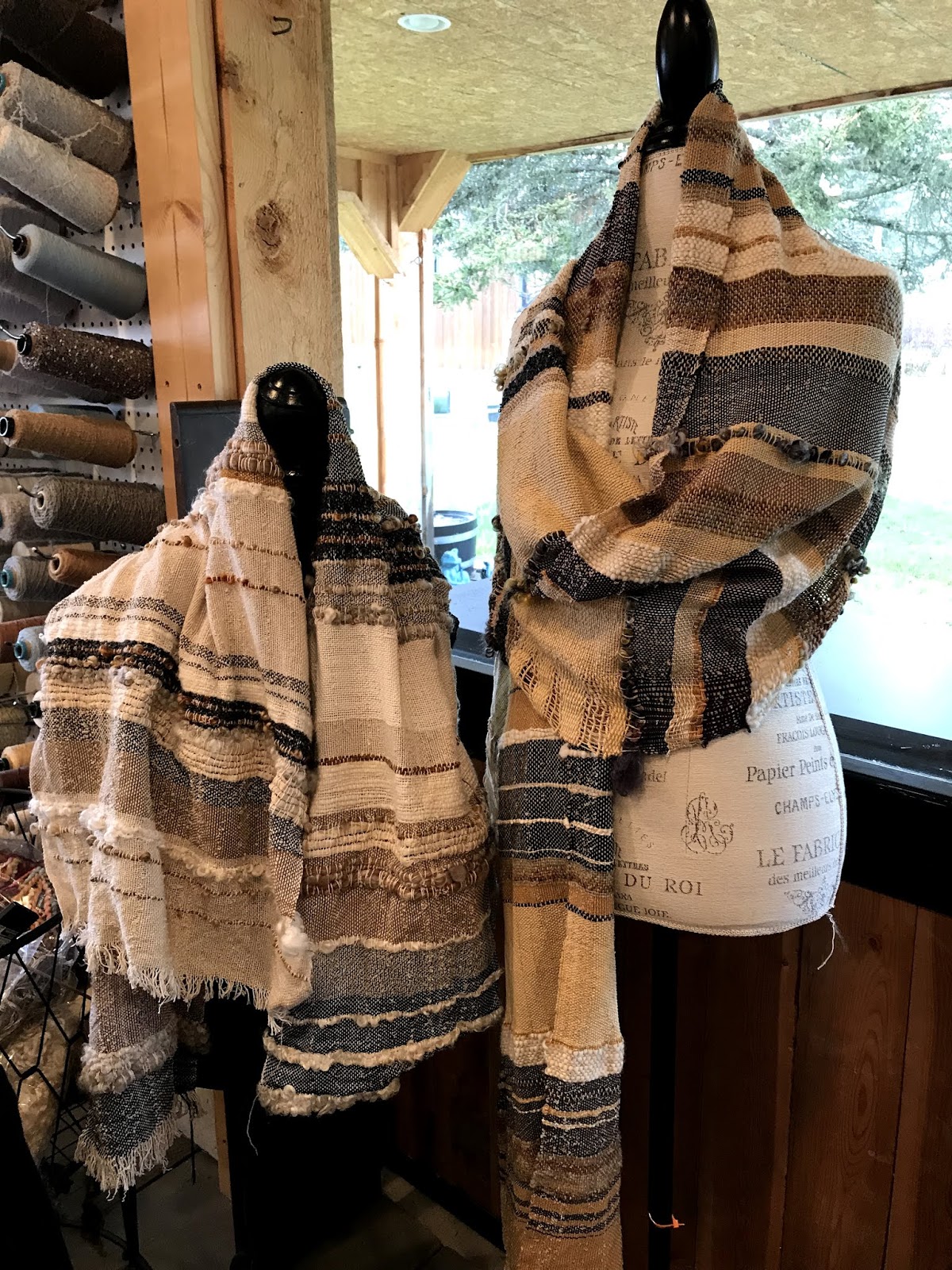
Some of Judy's Saori-woven pieces

So I'm thinking to myself: talented fiber artists seem to be everywhere. Is it the medium? The people? Maybe the fact that fiber itself is so universally compelling that gifted folks around the world always manage to find a way to weave, knit, spin, dye, braid, sew and otherwise manipulate and organize soft twisty cords.....

And on to the next workshop: "Paint One, Beam Two: Painting Two Warps and Beaming Them as One" for the Crocus Country Guild. I stayed with Dave and Jan Connelly -- more five-star hospitality -- and was delighted to learn that they raise and train Shelties for agility competitions. They currently have four running about the house and fields.

Flash, who has placed third in Canada in agility competition

We spent the first day dyeing warps in the barn and the next day rinsing and drying them before beginning to dress our looms.

Warp painting in progress: MX fiber-reactive dyes on cellulose fiber

Warps hanging to dry. Dave pulled out a cooler 
that also works to keep food warm. We cranked it up 
to about 85 degrees Fahrenheit 
-- about 29 Celsius -- to cure the warps overnight.

Beaming in progress

Millie Tsuji's loom, dressed and ready for threading

Sad to say, I can't show you any of the final results, because this 2 1/2-day workshop is designed so that the weaving is done at home. (For any program chairs out there, if you're interested, let's talk about a full five-day workshop! We'd start with dyeing warps, then curing them and dressing looms, then threading and weaving up color samples. I think of this as a real weaving retreat.)

Then it was time to head north to Edmonton, with Robin Nixon kindly driving me some three-and-a-half hours to get there. (Fortunately she also got to visit her son, who lives in Edmonton, so it wasn't just a drive up and back for her.) The workshop there was the same as the first one I taught in Calgary, "One Warp, Many Structures: An Exploration of Extended Parallel Threading." Kyla Fischer was the program chair for the workshop and, once again, made sure I ate and slept well and was otherwise comfortable. Plus, she is a master at organizing people and looms! 

People tell me there is something of a good-natured rivalry between Calgary and Edmonton -- so, for the record, I will say that the weavers in both cities were equally skilled and creative.

Sandra Schulz's 4-shaft Echo sample in the "Blooming Leaf" pattern has a dimensional look.

The 8-shaft "Fun House" pattern woven in Echo by Joan White
had some beautiful variations using different weft colors 
-- particularly using a yellow weft (bottom section).

I love the weft-color choices in this Echo sampler in the 8-shaft Falling Stars pattern (readers, if you can remember who wove this, please let me know).

Double Weave sample using the 4-shaft "Blooming Leaf" pattern, 
woven by Bonnie Watt

Kyla Fischer discusses her samples of 8-shaft "Fun House" in Echo and Jin.

Shadow Weave sample woven in the 12-shaft "Lake Water" pattern 
by Catherine Melnychuk

Differential shrinkage sample woven by Kathy Buse 
on 12-shafts in Double Weave using the "Fish Tank" pattern

8-shaft "Many Rivers" pattern woven in Rep by Mary Ann Jackson

8-shaft "Falling Stars" pattern woven in Double Weave by Maryanne Hawryluk. 
Notice the warp colors and how the fabric colors are changed completely by the wefts.


For the record: here are the weft colors used in the sample above.

So much more to say... but I would have to spend many more hours writing about all that we wove and shared. At this point, all I can say is thanks for reading! 


Wednesday, April 18, 2018

Juried into the Convergence Fashion Show in Reno...


Every two years I set myself a challenge: weave fabric for a garment for submitting to the Convergence fashion show, a biannual conference sponsored by the Handweavers Guild of America. This year, the conference will be held July 6-13 at the Peppermill Resort in Reno, Nevada -- and I'm happy to announce that two garments of mine were juried into the show.


This coat took me two years to complete, from conception to winding warps to dyeing them to weaving the fabric to dyeing the lining and sewing the coat.... It's called "Summer's Lease I," after William Shakespeare's beautiful words, "Summer's lease hath all too short a date" (from his sonnet, "Shall I Compare Thee to a Summer's Day").

I wove the fabric on my 12-shaft Macomber, using a draft I created with extended parallel threading. Then I wound two warps of 20/2 silk, painting one in a range of fuchsia, rose, pink, and lavender and the other in gold, lime green, sage green, and turquoise. The fabric is woven in Echo Weave and Turned Taquete and the weft was 60/2 silk in orange.

Here's the image that inspired my pattern and colors.


I kept it on my computer for years under the title "Paint this Warp." I have no idea where I found it!

For the lining, I purchased yardage of Habotai silk, then dyed it in a range of bright pinks using low-water-immersion dyeing.

I wove about 10 yards of fabric and, having taken Bonnie Inouye's workshop, "Opposites Attract," I began experimenting with other structures, alternating my treadlings for Echo and Turned Taquete and then venturing into Rep and Double Weave. The Double Weave wasn't successful because I did not re-sley my reed for a tighter sett. But the Rep turned out really well, with a weft of hand-dyed Habotai silk ribbon alternating with 60/2 silk.

Here's the second garment that was juried into the fashion show, this one named "Summer's Lease II."


The top is woven in Warp Rep and the skirt is Turned Taquete, cut on the bias. Here's a close-up of the top.


As for patterns: the coat is my own pattern, fashioned after a swing coat I own and love. The skirt and top are my own designs. Photo credits and thanks to Timothy Fuss of Pixelwave, who does a wonderful job photographing handwoven garments.

Hope to see you in Reno!

Monday, October 9, 2017

More Pleats, Please: Collapse Cloth on a 60/2 Silk Warp


Off the plane, out of the box, off the grid – however you phrase it, textural fabrics are three-dimensional and non-rectilinear, unlike any other kind of weaving. In addition to the beauty of color and structure, texture is another pillar of weaving. That's why I love dimensional fabrics so much! I like to describe them as “Tactile Art.”

Studying collapse techniques over the past year, my mantra has been “Sample, sample, sample.” (Never mind that I used to think I just wasn’t a samplin' kinda gal.) Sampling offers so much information, because structures, yarns and finishing can create so many different results. And, to my surprise and delight, just 4 shafts can produce beautiful fabrics that, at first blush, appear very complex.

Which is the case with my latest round of samples, on a warp of 60/2 silk in purple and black stripes. I was in search of pleats – the kind that people weave when they have two back beams that they advance at different intervals, with one layer of a double-weave warp on each of the two back beams. 

Simply put, with this technique, one layer is woven for just a few picks, in a “short” section, and then the second layer is woven as a longer section – many more picks. The shorter layer draws the longer layer in – and after washing, the layer with more picks flattens out into nice neat pleats. Ironing might enhance the effect, depending on what you're going for.

Which is a great technique, except that I don’t have two back beams on my loom. So I set about finding an alternate method. 

Here is my first sample, aiming for horizontal pleats.


No ironing, just washing, although I think ironing might help. The piece was set at 96 epi -- 48 epi per layer -- which sounds grueling, but it's not so bad with a small sample on a table loom.

Here's what it looked like, front and back, before washing.


You see all the floats on the back? That's what draws in the pleats on the front. The back yarns relax because they are not held in by a structure, while the plain weave in the front has to curve because it IS held in by a structure. 

Are these designs all about relaxing? About yarns and structures doing what they want do naturally? I often wonder about the metaphors in there....

Here is the drawdown, as seen from the front.

So then I got to thinking: If the pleats work well with a horizontal structure, they could work well with a vertical structure, using the same yarns. Plus, I would be able to experiment with different wefts, using a variety of exotic and overtwisted yarns. So I recreated the cross, put the lease sticks back in, pulled the threads out of the heddles, and re-threaded them for vertical pleats.

Here's the drawdown. Different shade of purple, I know.... 


Funny thing: You would think that if I wove the exact same structure -- a double weave where the two layers alternate as stripes, one layer weaving plain weave while the other layer floats behind it -- and I just turned it, the results would be the same. 

Right?

No, not at all. The warp threads that draw in vertically with the first structure DO NOT DO THIS when they are weft threads. Take my word for it. I do not know why. (This happens all the time with collapse techniques: When you turn a draft, the yarns do not behave or misbehave the same way.)

Undaunted, I proceeded to try a variety of energized and exotic yarns as weft, weaving double weave and plain weave and playing with floats. For instance, I do not recommend warping with crepe silk from Habu -- it seems to be about the grist of human hair -- but it's wonderful to use as weft. Here are some photos of the results.


Before washing: 60/2 silk warp, 30/1 S-twist wool. Bottom third is woven in plain weave.


Same swatch, after washing, showing double-weave structure


Same swatch, after washing, showing plain-weave structure


After washing: double-weave structure using 60/2 silk/stainless steel in ecru as weft. The first photo in this blog post shows a detail of this swatch. 


After washing: a double weave sample using silk crepe as weft.

It's tough to show the dramatic shrinkage of the sample above. It was 12" in the reed and is now about 3" wide, mainly because the weft is a gossamer-weight silk crepe from Habu Textiles. The grist is roughly 33,000 yards per pound. (Compare that with 60/2 silk, which is 15,000 yards per pound, and you get an idea of how fine this is.) It shrinks up amazingly well, but you have to weave an awful lot of fabric at a shrinkage rate of 75 per cent.

Later this month, I will be teaching a workshop on collapse fabric at the Etobicoke Handweavers and Spinners Guild in Toronto, Ontario. Looking forward to collapsing and relaxing! Thanks for reading.


Saturday, August 19, 2017

More Collapse-Fabric Samples: This Time, Double Weave with 30/2 Silk and 30/1 S and Z Twist Wool


To me, that looks like happy cloth: All crinkled and intricate with blocks in black that remind me of fish swimming upstream.

So often, collapse fabrics mimic nature, with its organic forms and energy. Nothing flat or two dimensional about it, which is why I love it.

The samples I'm sharing in this blog post hark back to a workshop I took in London with Ann Richards, author of Weaving Textiles That Shape Themselves. That workshop was in 2014 and it continues to inspire me.

One of the drafts Ann shared with us was a double-weave structure on 8 shafts using a warp of 30/2 silk and 30/1 Z twist or S twist wool -- your choice -- to create alternating layers of silk and wool. The weft was the same -- and you could again choose either 30/1 S twist or 30/1 Z twist wool for the second layer. (If you chose the same twist for both warp and weft, you would get a more subtle collapse effect after washing. If you used yarns with twist in opposite directions for warp and weft, you would get a greater collapse effect. I used 30/1 Z twist in the warp and 30/1 S twist in the weft.)

Here's Ann's original structure.

Here are my samples.

Front before washing

Back before washing

Front after washing

Back after washing

Pretty cool, huh? As always, I stand in awe of the laser-sharp focus that Ann brings to her designing. I tried my hand at modifying the tie-up and treadling, so see if there were some new forms I could create from this. First I decided to weave linear stripes.

Here's the drawdown, same threading.

And here are my results. In order of appearance: front and back before washing and front and back after washing.


The vertical pleats on the front are crisp, which I like very much -- but the back also has some visual appeal. There's potential here, perhaps to develop a draft that turns the stripes into boxes. More playing with Fiberworks, which I don't mind at all.

(As I write this, I realize that this post is mostly photos. But that's what we do, right? Create visual art that is often hard to describe verbally, although we do the best we can.)

So here's the last drawdown, this time with interrupted lines of black on the front. The finished fabric can be seen in the image I started with in this blog post.

And here's the fabric, again showing front and back before washing and after washing, in that order.


So often for me, weaving samples prompts as many questions as it answers. What can I do next? What kind of garment would this make? Would it work with painted warps? How can I alter this structure to make it appealing in a new way? I never considered myself to be a weaver who follows the code of "Sample, sample, sample" -- but I'm beginning to see the benefits of doing so.

And so, dear reader, beam on! And thanks for visiting.