Showing posts with label S twist wool. Show all posts

Monday, October 9, 2017

More Pleats, Please: Collapse Cloth on a 60/2 Silk Warp


Off the plane, out of the box, off the grid – however you phrase it, textural fabrics are three-dimensional and non-rectilinear, unlike any other kind of weaving. In addition to the beauty of color and structure, texture is another pillar of weaving. That's why I love dimensional fabrics so much! I like to describe them as “Tactile Art.”

Studying collapse techniques over the past year, my mantra has been “Sample, sample, sample.” (Never mind that I used to think I just wasn’t a samplin' kinda gal.) Sampling offers so much information, because structures, yarns and finishing can create so many different results. And, to my surprise and delight, just 4 shafts can produce beautiful fabrics that, at first blush, appear very complex.

Which is the case with my latest round of samples, on a warp of 60/2 silk in purple and black stripes. I was in search of pleats – the kind that people weave when they have two back beams that they advance at different intervals, with one layer of a double-weave warp on each of the two back beams. 

Simply put, with this technique, one layer is woven for just a few picks, in a “short” section, and then the second layer is woven as a longer section – many more picks. The shorter layer draws the longer layer in – and after washing, the layer with more picks flattens out into nice neat pleats. Ironing might enhance the effect, depending on what you're going for.

Which is a great technique, except that I don’t have two back beams on my loom. So I set about finding an alternate method. 

Here is my first sample, aiming for horizontal pleats.


No ironing, just washing, although I think ironing might help. The piece was set at 96 epi -- 48 epi per layer -- which sounds grueling, but it's not so bad with a small sample on a table loom.

Here's what it looked like, front and back, before washing.


You see all the floats on the back? That's what draws in the pleats on the front. The back yarns relax because they are not held in by a structure, while the plain weave in the front has to curve because it IS held in by a structure. 

Are these designs all about relaxing? About yarns and structures doing what they want do naturally? I often wonder about the metaphors in there....

Here is the drawdown, as seen from the front.

So then I got to thinking: If the pleats work well with a horizontal structure, they could work well with a vertical structure, using the same yarns. Plus, I would be able to experiment with different wefts, using a variety of exotic and overtwisted yarns. So I recreated the cross, put the lease sticks back in, pulled the threads out of the heddles, and re-threaded them for vertical pleats.

Here's the drawdown. Different shade of purple, I know.... 


Funny thing: You would think that if I wove the exact same structure -- a double weave where the two layers alternate as stripes, one layer weaving plain weave while the other layer floats behind it -- and I just turned it, the results would be the same. 

Right?

No, not at all. The warp threads that draw in vertically with the first structure DO NOT DO THIS when they are weft threads. Take my word for it. I do not know why. (This happens all the time with collapse techniques: When you turn a draft, the yarns do not behave or misbehave the same way.)

Undaunted, I proceeded to try a variety of energized and exotic yarns as weft, weaving double weave and plain weave and playing with floats. For instance, I do not recommend warping with crepe silk from Habu -- it seems to be about the grist of human hair -- but it's wonderful to use as weft. Here are some photos of the results.


Before washing: 60/2 silk warp, 30/1 S-twist wool. Bottom third is woven in plain weave.


Same swatch, after washing, showing double-weave structure


Same swatch, after washing, showing plain-weave structure


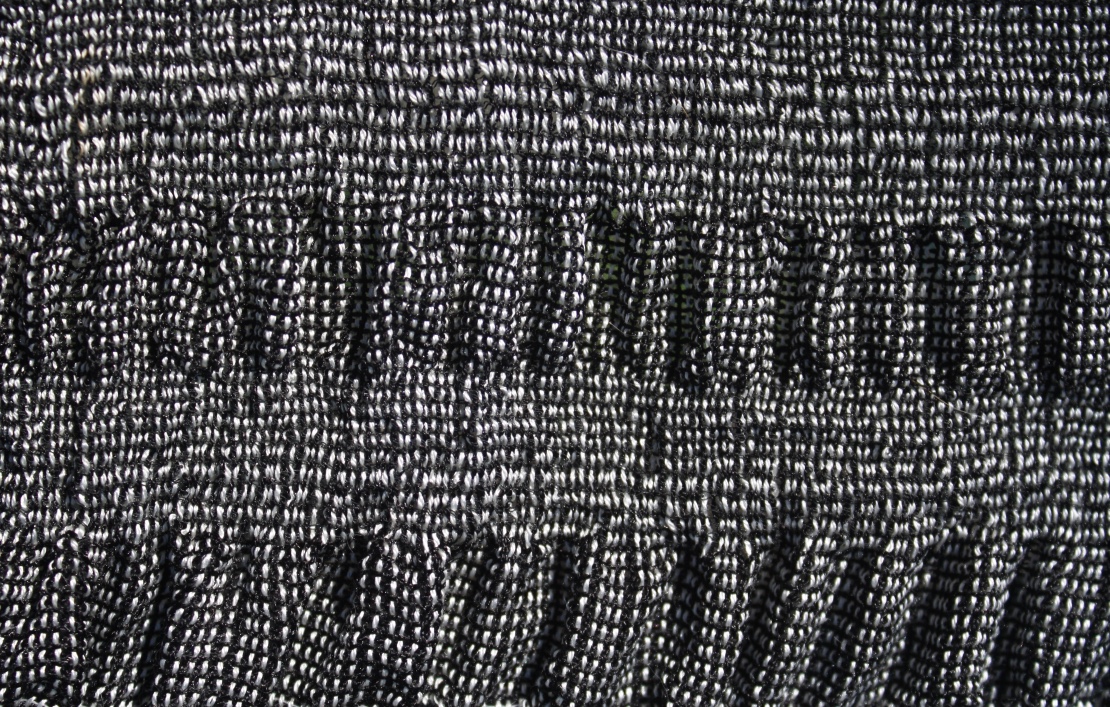
After washing: double-weave structure using 60/2 silk/stainless steel in ecru as weft. The first photo in this blog post shows a detail of this swatch. 


After washing: a double weave sample using silk crepe as weft.

It's tough to show the dramatic shrinkage of the sample above. It was 12" in the reed and is now about 3" wide, mainly because the weft is a gossamer-weight silk crepe from Habu Textiles. The grist is roughly 33,000 yards per pound. (Compare that with 60/2 silk, which is 15,000 yards per pound, and you get an idea of how fine this is.) It shrinks up amazingly well, but you have to weave an awful lot of fabric at a shrinkage rate of 75 per cent.

Later this month, I will be teaching a workshop on collapse fabric at the Etobicoke Handweavers and Spinners Guild in Toronto, Ontario. Looking forward to collapsing and relaxing! Thanks for reading.


Tuesday, August 18, 2015

Collapse Cloth with 60/2 Silk and 30/1 S-Twist Wool


Just off the loom: a one-yard-long sample of vertical pleats in black and white. (Can't get enough of the beauty of simple plain weave in black and white! My inspiration is the work of Ann Richards, author of Weaving Textiles That Shape Themselves.)

This sample is for a coat I hope to make, so I made a warp of 11.5 yards in length. On the loom, this fabric is 45.5" in the reed but, after washing in hot water and dishwashing liquid, it collapses to about 20" wide -- a shrinkage of more than 55%.

The warp is alternating ends of black and white 60/2 silk. For the weft, I wove horizontal stripes, alternating between natural and black 30/1 S-twist wool bordered by a one-inch-long stripe in black 60/2 silk. Because the weave is very open -- at 32 ends per inch and about 30 picks per inch -- the yarns have lots of "wiggle room" to collapse in the wash. This means that the overtwist wool draws in horizontally, making vertical pleats, while the 60/2 silk weft remains the same, creating a seersucker effect.

I made a strategic decision -- you might call it a bad decision -- to start by tying this warp onto the thrums of an identical warp. All 1,456 ends of it.

Why, you ask? Good question! I think I just wanted to see if it could be done. And I thought it would be easier. (It wasn't.) I figured that I had already spent lots of time threading in an 8-shaft straight draw, so why would I want to go through that again? (What I learned: Tying on is a good idea when you have an intricate threading with no inaccuracies already on the loom. And if you want to extend the weaving length of your warp.)

Here's what the warp looked like as I began the process of tying on.


I followed the advice of Joyce Robards -- my weaving mentor -- and created four warp bouts, with lots and lots of choke ties (about every 2 feet or so).  You see in the photo above that I fixed the lease sticks to the breast beam, so that the cross was intact and secure before I began tying on.

Tying knots in all those ends was mind-numbing. And it didn't look that great, either ;o)

'Oh, what a tangled web we weave....'

Seriously, though: It looks like a disaster as you are tying on, because you simply leave all the tied threads loose, one on top of the other. You don't want to touch them -- and you don't want curious creatures like cats or small children to start playing with the threads -- because they sort themselves out just fine in the end. IF you leave them, just letting them drop, as you knot them. It's actually pretty amazing, once you tension the warp again. Everything straightens out!

It's just the relentless tying on of hundreds of ends that makes you feel like Sisyphus. I was reminded of the masterful weavers of oriental rugs, who do this knot-tying thing for a living. The thought of their patience and persistence kept me going.

So, it all got beamed (taking days of combing and tensioning) and tied on the breast beam. The fabric looked like this on the loom.


Very neat and orderly, right? That's not the way I like it. To me, the beauty is in the alternating of randomness and order that you see in the final product.


Thursday, May 28, 2015

Collapse Cloth in 60/2 silk warp and overtwist weft


Many years ago, there was a wonderful magazine called Weaver's -- and in it, an article by Ann Richards on using crepon yarns for collapse fabrics. I have had it in my files for more than 15 years and FINALLY I wove up some samples. The impetus was the annual sample exchange for the Collapse Weave Study Group in Complex Weavers.

The warp is 60/2 spun silk in black and natural, threaded alternately in a straight draw. The photo at top shows the fabric after washing, with a number of different wefts. A closer look, below.

Here's the fabric on the loom, showing horizontal stripes woven alternately in 60/2 spun silk in natural and 30/1 wool in a Z twist.


And then off the loom, before washing.


Here's what the same fabric looks like, close up, after washing in lukewarm water with a bit of Orvus paste.


And here are two other samples. Below, I have alternated weft stripes of black gossamer-weight silk crepe from Habu with 60/2 spun silk in black. The crepe draws in more than any other energized yarn I have used, so this is a very elastic fabric when you stretch it horizontally.


Finally, a softer collapse fabric, as the weft is just one yarn: 30/1 wool in S overtwist (natural color).


Threading 1,456 ends on the loom at a sett of 32 epi amounted to some 45 1/2 inches in width, which collapsed to roughly 30 inches in width after washing. The length didn't change much, from around 45 inches long to 41 inches after washing. Lots of weaving for a shrinkage of 33%, but it was so worth it!

Thursday, February 19, 2015

Collapse Techniques: Vertical Pleats with S Twist Wool and Linen Singles

I admire so many weavers, near and far, that I can't begin to list them all. But in the area of weaving dimensional fabrcis, it's a short list -- perhaps because there aren't too many who work solely with this technique.

My collapse-cloth honor roll, in no particular order: Liz Williamson of Australia, Ann Richards of Great Britain, Lotte Dalgaard of Denmark, and the late Anne Field of New Zealand. Richards, Field, and Dalgaard have all written books on the subject, and I just finished a project from Dalgaard's book, "Magical Materials to Weave: Blending Traditional and Innovative Yarns."

The beauty of these techniques is that, to paraphrase Yogi Berra, "It ain't over till it's washed." Here's a video I just made, looking at a sample woven from Dalgaard's book, both before and after washing.


And I want to make one more plug for my upcoming course, taking place the weekend of March 13-15 at the Weaving and Fiber Arts Center. To find out more, click here. Ready, set, collapse!