Showing posts with label Habu Textiles. Show all posts

Wednesday, June 22, 2022

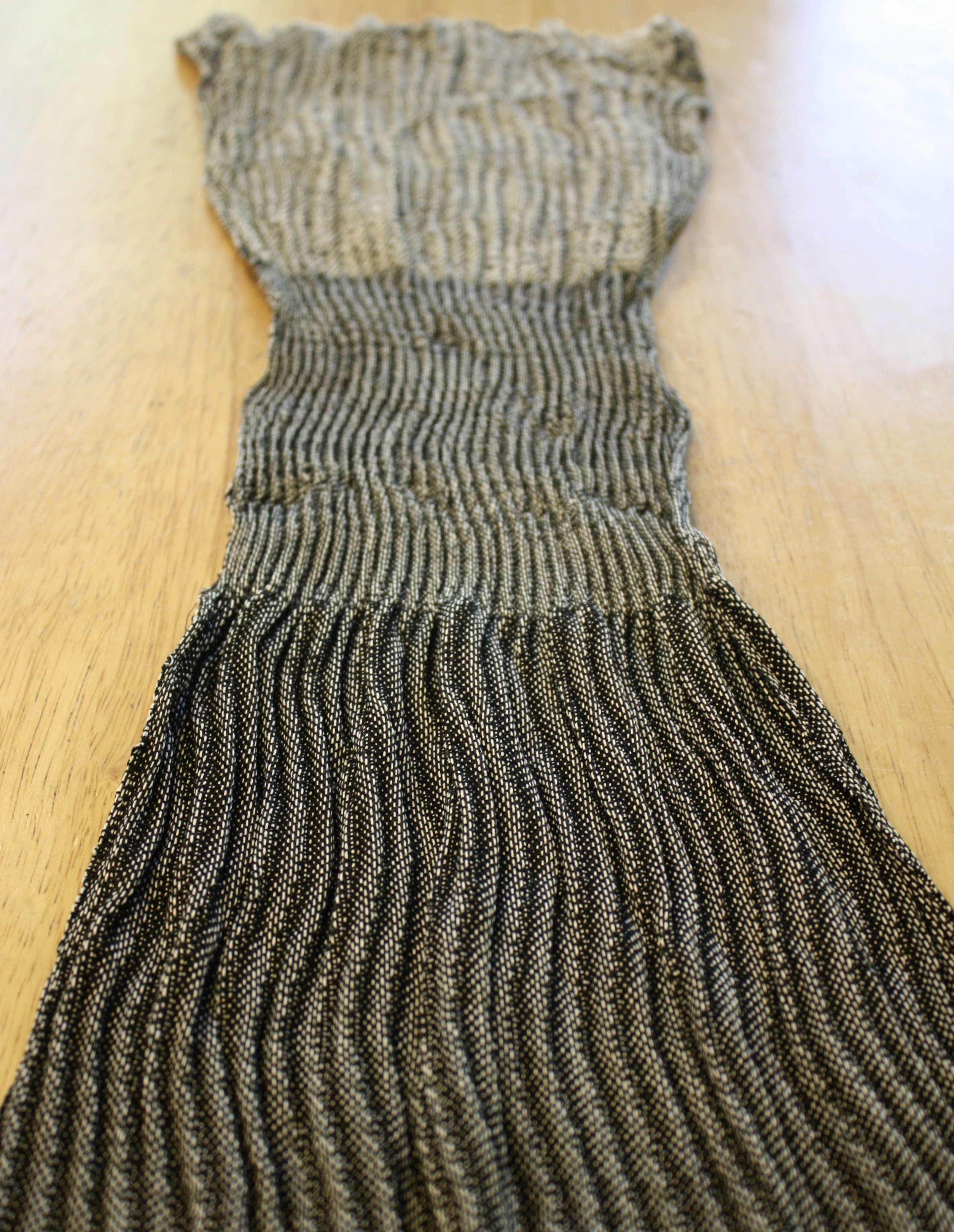
Weaving on the Curve in 20/2 cotton


Sampling on 16 shafts with different wefts (top to bottom): 
S-twist linen crepe, Z-twist silk crepe, 60/2 spun silk

16-shaft sample with 60/2 silk weft after washing (and coaxing the pleats to curve)

Same sample with pleats before washing

Take note: I wove these samples on the end of a black-and-white warp that was left over from another project. Really, I was just curious about how to weave curving pleats. No way would I use black and white yarns if I were weaving this for a garment! 

Anyhow, I'll get to the point. As we all know from that inspiring book, Fabrics That Go Bump, when you weave a turned twill on 8 shafts or more, you can create vertical pleats. The secret lies mainly in the structure, which is basically a turned twill that alternates between weft-emphasis and warp-emphasis blocks.

Here's a look at a design from this book by the late, great Erica de Ruiter. I found it inspiring.


De Ruiter designed her treadling in the liftplan, which looks like this.


I think it's ingenious -- but I decided to use a networked curve instead, which looks like this in the liftplan.


Truthfully, I think de Ruiter's design is better, as there are more warp floats per pleat. But why compare? The important factor is that both designs allow for floats of three in the warp yarns alternating with floats of three in the weft yarns.

How does this structure create pleats? It's the mechanics of how yarns relax after washing, really. The weft floats (in white on both drafts) relax and draw in, creating a concave shape, pulling on the warp floats on the other side (which are vertical, so they align vertically, sort of like Venetian blinds folding up on themselves, and create convex pleats).

The ratio of grists -- warp vs. weft -- can help with this effect, in my experience. In my sample at the beginning of this post, the warp is 20/2 cotton threaded in black and white at 8,400 yards/pound, while the weft at the bottom of the photo is 60/2 silk in black at 14,800 yards per pound. So the ratio in grist of warp to weft is about 5:3. I prefer a ratio of about 2:1, but I didn't have any other yarns in my stash. (You know how that goes.)

Another way to achieve pleats is to use the same design (warp floats alternating with weft floats) with an "energized" or "active" weft, such as crepe or overtwist or elasticized yarn. First, I tried an S-twist linen crepe from Lunatic Fringe. (You'll see this sample, vaguely, at the top of the photo at the beginning of this post.)

Gevolve Yarns linen crepe in S-twist at 10,400 yards/pound

The sample is definitely textured and pleated, but you can't see curves at all.


I don't really have a theory on this, other than that the yarn draws the warp in so much that the curves are lost because they are too subtle.

The same thing happened when I tried silk-crepe yarn from Habu, a Z-twist gossamer-weight yarn that's about 33,000 yards/pound (and not at all fun to wind on a pirn, because it's constantly plying backwards on itself). The photo at the beginning of this post shows this sample in the middle of the fabric.


The spool above has lasted forever: I purchased it back in the day when Habu was based on West 29th Street in Manhattan! This yarn shrank the sample about 50% width-wise -- again, overkill as far as the curves I was looking for.


What did I learn from this? 1) That it's useful to design in the liftplan, especially when you want precise curves and patterns. 2) That you don't necessarily want to use active yarns for collapse effects, especially when you're working with turned twills. 3) That sampling, sampling, and sampling some more always pays off.

Perhaps, like me, you tuned in to "Textiles and Tea" with Kathi Grupp from HGA interviewing Anita Luvera Mayer on Tuesday, June 21. That was a big part of Anita's message: We need to sample and, even if we feel our samples aren't successful, we have learned something, so we've moved forward. I've certainly learned something, even if I'm not thrilled with the results.... But then again, maybe a long scarf with curving pleats, using de Ruiter's liftplan along with a variety of active and inactive yarns in the warp? In beautiful colors?

Thanks for reading!


Thursday, February 10, 2022

Collapse Techniques: Some Active Yarns and How They Work


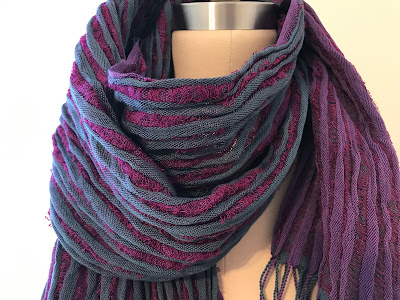
Pictured above: A scarf woven on 4 shafts in deflected double weave. The warp is 20/2 cotton in stripes of teal and purple and the weft uses these yarns plus a wool/stainless-steel yarn (see the floats above, in fuchsia). The scarf looks like gauze on the loom, but when you wash it in gentle soap and lukewarm water, the wool/stainless floats crinkle up and draw in horizontally, creating vertical pleats in the fabric.

I love these surprises in the finishing! And one of the easiest ways to achieve them is by using active or energized or exotic yarns -- a large category that includes yarns that will shrink, twist, collapse, and/or relax after washing.

Right now I'm teaching a Zoom workshop for the Reno Fiber Guild, "Deflected Double Weave for Collapse Fabrics." I put together a short handout on the active yarns we're using and how they work and I thought it was worth sharing in a blog post. Here's the list -- of course, it's not comprehensive -- along with photos and images of the yarns under magnification.

Fine Gold Gimp (Metallic Yarn)


The thicker version of this yarn doesn't work well for creating texture in fabrics, but the finer version can add a lot of interest. It's really 77% polypropylene and 23% metallic. And it's hard to find: The only vendor in the States that sells it is Made in America Yarns, a Philadelphia company that lists it under the name "fine metallic gimp yarn."

This is what a single strand looks like at 60X magnification.

And here's what it looks like after weaving and washing.


The polypropylene shrinks up with warm water and soap, bending and crimping the metallic coils around it. When used as weft, this can create some interesting motifs as it shrinks the fabric width-wise.


Wool/Stainless-Steel Yarn


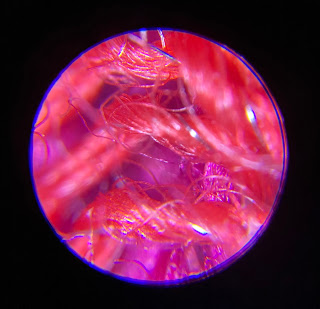
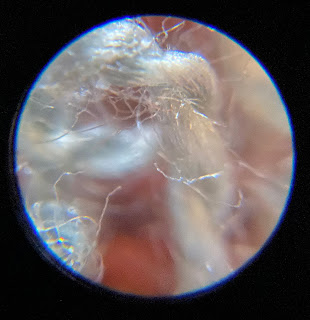
This yarn, available from Habu Textiles, is what I used as weft in the scarf pictured at the beginning of my post. You can achieve similar effects with silk/stainless-steel yarn, available from Lunatic Fringe. Here's what it looks like under 60X magnification, unwoven (first photo) and woven and washed (second photo).


The wool shrinks in the washing and the stainless-steel filament bends with it, so that the sample is drawn in. I find that you can actually shape the garment, either flattening it out or stretching it vertically to create vertical pleats. It all depends on your mood ;o)


Deflected double weave sample on 8 shafts


Deflected double weave sample on 12 shafts

18/2 Merino Wool

Nothing beats wool for differential-shrinkage effects. Combine it with cotton or silk or some other inactive yarn and you'll get pleats and poufs and lots of texture. (Note: I don't recommend using JaggerSpun Zephyr, because the silk component doesn't full in comparison with the 18/2 superfine merino. Also, be careful not to purchase super-wash wool yarn, because these yarns are chemically treated NOT to full or shrink.)

Hand-painted warp of 18/2 JaggerSpun superfine merino


1 strand of 2-ply yarn, before fulling


Magnified image of the yarn after weaving and fulling


16-shaft deflected double weave sample after fulling, using 18/2 merino and 10/2 cotton in both warp and weft (hand-painted warps and wefts)

Venne Colcolastic (and Other Elasticized Yarns)


This yarn has two components: a fine 2-ply mercerized cotton and an elasticized single. Here's what it looks like under magnification:


And here's what it looks like under magnification and after weaving and washing:


My explanation for this effect is that the elastic draws in and the cotton is drawn in with it, crinkling and twisting up as it goes. Below is a sample of a 4-shaft deflected-double-weave piece I wove with long weft floats of the Colcolastic. (You're viewing the warp horizontally.)


This second sample, below, has no floats on the front and narrow floats on the back, simply because there are just 4 warp yarns in the block it floats over. It's a 12-shaft deflected double weave. Colcolastic is used as weft for the middle section only.


Active yarns are just one way to create textured fabrics. You can also achieve dimensional effects just by weaving structures that lend themselves to texture: turned twills, honeycomb, waffle weave, and of course deflected double weave will create curves and pleats even without the aid of active yarns.

Weavers will sometimes get preoccupied with color and structure, forgetting about that third invaluable characteristic of our craft, that of texture. In her definitive book, On Weaving, Anni Albers devotes a chapter to "Tactile Sensibility," focusing on the importance of matière:

"Matière is the word now usually understood to mean the surface appearance of material, such as grain, roughness or smoothness, dullness or gloss, etc., qualities of appearance that can be observed by touch.... Surface quality of material -- that is, matière -- being mainly a quality of appearance, is an aesthetic quality and therefore a medium of the artist...."

Weaving, in her view, brings us back to our ancient tactile sense. Of course, the yarns we use are central to this achievement.

Thanks for reading!


Monday, October 9, 2017

More Pleats, Please: Collapse Cloth on a 60/2 Silk Warp


Off the plane, out of the box, off the grid – however you phrase it, textural fabrics are three-dimensional and non-rectilinear, unlike any other kind of weaving. In addition to the beauty of color and structure, texture is another pillar of weaving. That's why I love dimensional fabrics so much! I like to describe them as “Tactile Art.”

Studying collapse techniques over the past year, my mantra has been “Sample, sample, sample.” (Never mind that I used to think I just wasn’t a samplin' kinda gal.) Sampling offers so much information, because structures, yarns and finishing can create so many different results. And, to my surprise and delight, just 4 shafts can produce beautiful fabrics that, at first blush, appear very complex.

Which is the case with my latest round of samples, on a warp of 60/2 silk in purple and black stripes. I was in search of pleats – the kind that people weave when they have two back beams that they advance at different intervals, with one layer of a double-weave warp on each of the two back beams. 

Simply put, with this technique, one layer is woven for just a few picks, in a “short” section, and then the second layer is woven as a longer section – many more picks. The shorter layer draws the longer layer in – and after washing, the layer with more picks flattens out into nice neat pleats. Ironing might enhance the effect, depending on what you're going for.

Which is a great technique, except that I don’t have two back beams on my loom. So I set about finding an alternate method. 

Here is my first sample, aiming for horizontal pleats.


No ironing, just washing, although I think ironing might help. The piece was set at 96 epi -- 48 epi per layer -- which sounds grueling, but it's not so bad with a small sample on a table loom.

Here's what it looked like, front and back, before washing.


You see all the floats on the back? That's what draws in the pleats on the front. The back yarns relax because they are not held in by a structure, while the plain weave in the front has to curve because it IS held in by a structure. 

Are these designs all about relaxing? About yarns and structures doing what they want do naturally? I often wonder about the metaphors in there....

Here is the drawdown, as seen from the front.

So then I got to thinking: If the pleats work well with a horizontal structure, they could work well with a vertical structure, using the same yarns. Plus, I would be able to experiment with different wefts, using a variety of exotic and overtwisted yarns. So I recreated the cross, put the lease sticks back in, pulled the threads out of the heddles, and re-threaded them for vertical pleats.

Here's the drawdown. Different shade of purple, I know.... 


Funny thing: You would think that if I wove the exact same structure -- a double weave where the two layers alternate as stripes, one layer weaving plain weave while the other layer floats behind it -- and I just turned it, the results would be the same. 

Right?

No, not at all. The warp threads that draw in vertically with the first structure DO NOT DO THIS when they are weft threads. Take my word for it. I do not know why. (This happens all the time with collapse techniques: When you turn a draft, the yarns do not behave or misbehave the same way.)

Undaunted, I proceeded to try a variety of energized and exotic yarns as weft, weaving double weave and plain weave and playing with floats. For instance, I do not recommend warping with crepe silk from Habu -- it seems to be about the grist of human hair -- but it's wonderful to use as weft. Here are some photos of the results.


Before washing: 60/2 silk warp, 30/1 S-twist wool. Bottom third is woven in plain weave.


Same swatch, after washing, showing double-weave structure


Same swatch, after washing, showing plain-weave structure


After washing: double-weave structure using 60/2 silk/stainless steel in ecru as weft. The first photo in this blog post shows a detail of this swatch. 


After washing: a double weave sample using silk crepe as weft.

It's tough to show the dramatic shrinkage of the sample above. It was 12" in the reed and is now about 3" wide, mainly because the weft is a gossamer-weight silk crepe from Habu Textiles. The grist is roughly 33,000 yards per pound. (Compare that with 60/2 silk, which is 15,000 yards per pound, and you get an idea of how fine this is.) It shrinks up amazingly well, but you have to weave an awful lot of fabric at a shrinkage rate of 75 per cent.

Later this month, I will be teaching a workshop on collapse fabric at the Etobicoke Handweavers and Spinners Guild in Toronto, Ontario. Looking forward to collapsing and relaxing! Thanks for reading.


Wednesday, August 20, 2014

Collapse Weave -- on Four Harnesses!


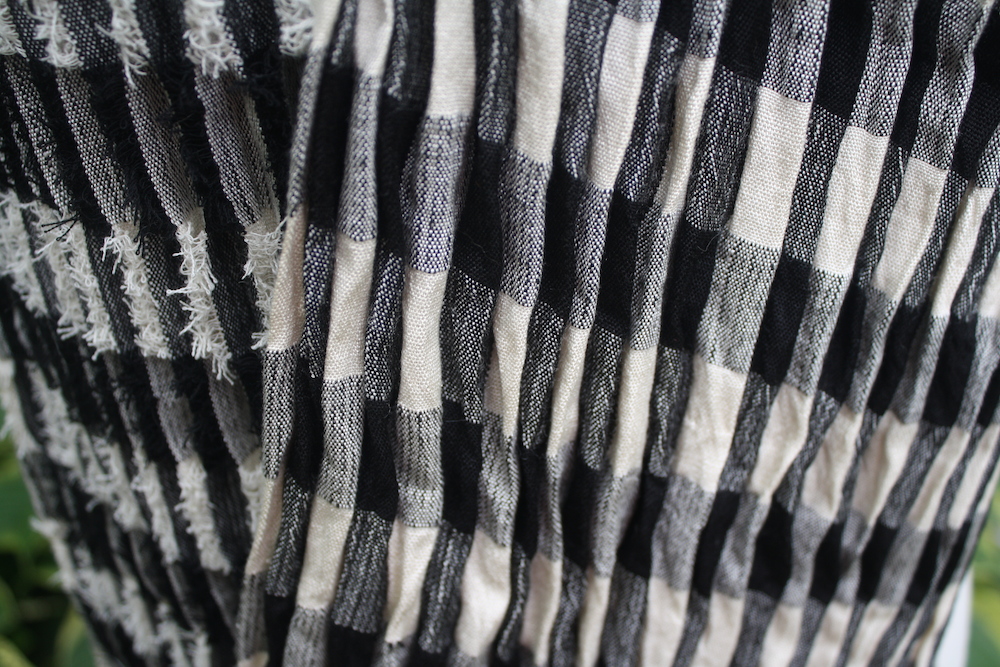
In 16 years of weaving, this may be my favorite piece: a collapse-weave scarf in 60/2 silk and 30/1 overtwist wool. Black and white checkered pattern, with a warp of 60/2 silk stripes and the weft alternating between 60/2 silk and the overtwist wool yarn.

Here's the drawdown.


It's that simple! Understand that, while the weft color is all black on the drawdown, you have to alternate (A-B-A-B) between 60/2 silk in black and 30/1 overtwist wool in black. And while the weft color changes to white, you have to alternate between 60/2 silk in white and 30/1 overtwist wool in white. The weft floats are the overtwist, which pulls the fabric in, making it collapse into a fabric with a soft and cushy hand. The sett is 54 epi, which makes for a high quality fabric with a wonderful hand -- but it takes a long time to weave.


The floats (the wild and twisted yarns you see in the photo) are on the front only. Here, below, is a look at both the front and the back of the scarf.


Most weavers know that 60/2 silk is available from Webs in Northampton, Massachusetts. Few weavers, however, are familiar with where to buy overtwist, crepe, and other specialty yarns. Habu Textiles is one retailer, here in the States, but I purchased my 30/1 overtwist from the Handweavers Studio and Gallery in London. Even with shipping, the prices aren't bad and the yarn is wonderful!

The scarf is for sale now in my Etsy shop, but I'm still thinking I don't want to sell it....