Showing posts with label Echo threading. Show all posts

Sunday, December 18, 2022

This Pattern Is More than 400 Years Old... with a Few Changes


 It all starts with a 1626 portrait of John Erskine, 2nd Earl of Mar and Lord High Treasurer of Scotland, painted by Adam de Colone. 


The painting hangs in the National Galleries of Scotland, where researchers have found that the canvas is in fact a linen tablecloth, a practice that was common at the time. The tablecloth was woven on 14 shafts in this Gebrochene pattern.


If you're a frequent reader of this blog, you may recall that I've written about this before -- most recently, on September 18, 2022, in a post that gives you more details on how I altered the pattern but kept the original design line. I learned of it maybe 20 years ago from Marjie Thompson, who calls it "The Earl". 

It was not a stretch to take the threading and create a parallel threading 14 shafts above it, which I did just to see what would happen. I figured it could be woven as Echo or, by adding tabby to the treadling, as Jin (aka Turned Taqueté). The Jin drawdown I designed looks like this.


Here's a detail to give you a better idea of the design.

I really liked the varied geometry of the pattern, so this is what I used for the motifs in the center of the scarf, using two different weft colors, violet and gold. (The gold is in the central section, where the fabric scrunches up into pleats, seen around the neck on the mannikin. That's because the yarn is a combination of silk tram and stainless steel, which has memory.)

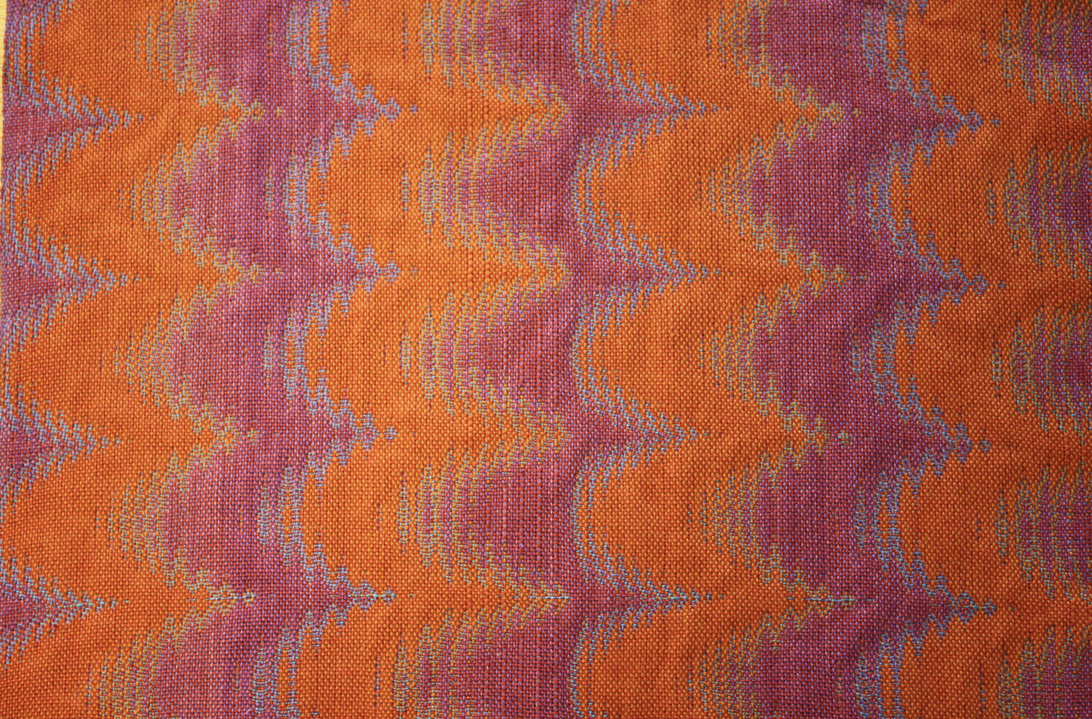
The mountain-like motifs at the beginning and end of the scarf -- in purple and orange -- are woven in a doubleweave pattern using what I call a "carved" tieup. (The idea is outlined in Marian Stubenitsky's definitive work, Weaving with Echo and Iris, which provides all number of tieup options for Echo woven as doubleweave.)


When you're weaving four-color doubleweave on an Echo threading, these "carved" variations in the tieup make for lots of color shifts, so that a color first appears on top of the cloth and then shifts to the bottom. This maximizes the potential for color blending.


Adding to the potential for color play: I used a painted warp combined with a black warp for the parallel threading. The technique is quite simple: You wind a two-color warp of natural and black and then paint the entire warp. The natural-colored yarn absorbs the dye and the black does not. 

I love the yarn that I used for the warp, and I doubt I will ever find it again, because I got it at one of those wonderful guild sales. It's a 24/3 unmercerized cotton, so I really didn't have to worry about threads breaking and selvages fraying. For the doubleweave weft, I used 16/2 bamboo in blue, orange, and burgundy, and for the Jin wefts, I used 60/2 silk in deep violet and, as I mentioned, tram-silk/stainless-steel in gold, purchased from Lunatic Fringe, which pleats and bends in the center section.

To me, the motifs look like mountains and the colors remind me of a western sunset. So I've named the piece "Colorado", which means "ruddy" in Spanish. It reminds me of the sunsets over the Sangre de Cristo range, near where my daughter and her family live. The Earl is well traveled indeed.

Thanks for reading!


Wednesday, August 18, 2021

Shaft Envy, Begone!


You don't need 32 shafts to weave beautiful fabric! I'm on a mission to prove this as I work on designs for a new workshop, "Echo on the Double: 4-Color Double Weave for 4 to 32 shafts." The workshop will include 5 to 6 variations in tieups and treadlings for each pattern, all in double weave, for any kind of treadle loom from 4 to 32 shafts. 

Pictured above, in the first 2 photos: Blooming Leaf design, Echo threading on 4 shafts in 4-color double weave, front and back. Second 2 photos: Falling Stars design, Echo threading on 8 shafts in 4-color double weave, front and back. The warp colors for all 4 designs are lime green and azalea.

Double weave on Echo threadings is endlessly fascinating because of the variety of patterns and color combinations that you can achieve. When you start with 2 colors in the warp (for a 2-end parallel threading) and then add 2 colors in the weft (one for the bottom layer and one for the top layer), you're working with 4 colors in all, which keeps color folks like me happy. And sometimes you'll wind up with the appearance of more than 4 colors, as in these samples below.


I used a sky blue and a beige linen as wefts, with lime green and azalea as warp colors. Look closely and you'll see a bit of the blue weft highlighting the pattern on this 8-shaft design.


The back looks quite different. Here, the sky-blue weft alters the lime-green warp, making it appear more like turquoise. It also alters the azalea warp, making it look more lilac. 
The color differences are more pronounced when you see this piece "in the flesh."

This color-shift effect is called optical mixing. (I also define it as "simultaneous contrast" because the colors of warp and weft appear different depending on which colors they lie next to). Echo as double weave allows you to exploit and play with this effect, regardless of the number of shafts on your loom.


Above, Blooming Leaf design on four shafts. The warp colors are the same as the 8-shaft design in the photos preceding this. The weft yarn for this layer is sky blue, which again softens the lime green, making it appear turquoise, and shifts the azalea to more of a lavender hue.


For the bottom layer, I used a burnt-orange weft color, which pretty much overwhelms the lime-green warp, turning it into a pale gold/bronze, while the azalea warp becomes more of a coral/orange. I like the bold color differences between the front and the back of the fabric.

There are so many other possibilities as well. For instance, I will be weaving some samples using overtwisted yarns as wefts, which cause the fabric to wrinkle and pleat in interesting ways. The key here is that the design has to include "pockets," as Marian Stubenitsky refers to them in her book, Echo and Iris. This is where the two double-weave layers are weaving separately, which doesn't always happen with double weave on Echo threadings. Often, you're weaving "integrated double weave," where the two layers are interlaced.

And then I would like very much to try weaving with copper as one of the warps and as one of the wefts, but that will have to wait until another time. First, I need to weave up a complete sample set for this workshop. Note: I've found that, as confident as I can be when I look at a design in Fiberworks, I still need to weave it up to see how it plays out. There are often surprises!

Then again, the surprises can lead to discoveries, don't you agree? And discovery is one of the reasons we love this craft.

Thanks for reading!


Falling Stars pattern on 8 shafts, Echo threading, double-weave tieup and treadling, 
with overtwisted yarn as one of the wefts.


Monday, June 14, 2021

24-Shaft Four-Color Double Weave Sample Extravaganza Scarf


8 different samples do not a scarf make.

Another name for this could be "The Greedy Weaver Scarf." I've tried so many tieup/treadling/weft yarn variations on this 24-shaft threading that I really couldn't settle on just one sample for a scarf. So I wove a scarf using eight of my favorites -- and even that wasn't enough! But I will wear it with pride.

Also, I will use it as a resource and a teaching tool. I'm getting more and more immersed in the mysteries of four-color double weave: How the colors shift with the patterns, how the colors change depending on what color they're next to (part of the over-arching theory of simultaneous contrast), how the textures change with active yarns in the weft, how the two sides can be quite different, how much latitude this gives for designing. I could go on!

And I will in this blog post ;o) Let's start with the vital statistics: This is a 24-shaft pattern in a two-color extended parallel threading at an interval of 12 shafts. For the warp, I used 16/2 bamboo in rusty orange and a lilac I dyed myself because the color I wanted wasn't available. The sett was 60 epi and there were 816 ends in the warp plus two ends on either side for floating selvages.

Here's what the threading looks like (this shows one repeat out of two):


Because I repeated this once for 816 ends, there's a line right down the middle in some of the designs, which I really don't like, but be that as it may. These are samples! I wanted to play with tieups and treadlings to see what happened.

My first sample -- one of my favorites -- looks like this:


For the wefts, I used a 16/2 cotton in bright turquoise along with a 20/2 cotton in soft yellow, with the following tieup and treadling. (The treadling is just an 11-end advancing point twill.) The result is lots of color -- how many different colors, I can't really count.


Next I tried a tieup that produced a rectilinear design. I learned about it from Mimi Anderson, immediate former president of Complex Weavers, who creates beautiful scarves in four-color double weave. Here's my sample, followed by an image of the tieup and treadling.


Still with me? To keep things moving, I will show you just two more samples with their tieups and treadlings -- my two other favorite patterns.


Another favorite, front


And back


And below, my most favorite (that's a double superlative), which I think I'll use for a garment. The wefts are 16/2 cotton in bright turquoise and a gossamer-fine (20,000 yds./lb.) silk/stainless steel yarn in mint green. The silk/stainless relaxes after washing and makes the cloth pleat randomly thanks to separate "pockets" where the double weave divides into two layers. At other points in the fabric, the two layers are integrated, which allows for a lot of textural interest.


On the top layer of the fabric, the silk/stainless steel weft is so fine 
that you see mostly the warp colors.


On the bottom layer of the fabric, the 16/2 turquoise weft adds a blue cast.


And here's the tieup and treadling.

Thanks for reading! Happy weaving.


Tuesday, September 8, 2020

Designing Echo as Double Weave for 16 Shafts


Pictured above: a drawdown of the front of a 16-shaft 4-color double-weave pattern that I just finished designing. (You'll find the tieup for this, as well as a view of the back of the pattern, at the end of this post. I have to go through all my steps in figuring it out before I reveal it to you!)

My inspiration came from Pinterest, where a while back I came upon a design I really admired. 


It was for 24 shafts and I have just 16 on my Toika, but still I had to figure out what made it so appealing. It was for double weave in an Echo threading and the tieup looked like this:


My first reaction was, "Oh boy, here's one of those irregular double-weave tieups that makes absolutely no sense." And my second reaction was, "How did they DO that?" My third reaction was, "I want to do that!" 

I knew that the original tieup had been modified -- "carved" you might say -- to veer off a straight twill angle for some of the shafts, creating interesting and eccentric patterns in the cloth. So I set about adapting the design to 16 shafts, first by breaking the 24-shaft tieup into two sections, one each for the top and bottom layers of the original 24-shaft draft.

Here's what they look like.

Tieup for the top layer

Tieup for the bottom layer

Back to Stubenitsky's Echo and Iris, of course. On page 89, she lays out her method of designing double weave tieups based on what she terms a "ratio." (Note here: Of all the listings in the index of this book, "Ratio" is cited the most. Something to ponder.)

She begins with what she calls the "ground tie-up." Below is what the ground tieup looks like for a 16-shaft double weave in Echo. For both layers, this ensures that half of the shafts will weave plain weave throughout. (You can't really weave anything with this tieup; it just gives you a stable ground for creating designs using the other half of the shafts.)


It isn't as inscrutable as it may first appear. On treadle 1 (for the top layer, which is treadled with all the odd-numbered treadles), you'll weave plain weave by raising shafts 1, 3, 5 and 7. On treadle 2 (for the bottom layer, which is treadled with all the even-numbered treadles), you'll weave plain weave by lifting shafts 10, 12, 14 and 16. 

An aside: With double weave, the shafts that are "raised" to weave the bottom layer are actually being lowered from the perspective of the bottom layer, because the bottom layer is weaving upside down (from the weaver's perspective). It's helpful to think of the tieup for the bottom layer as a sort of photo negative, where up is down (black is white) and down is up (white is black).

Note that the second half of the tieup for both layers is totally blank. That's where Stubenitsky's ratio comes in. For this, I tried a tieup with a ratio of 4:4, meaning that, in the second half of the treadling above the ground tieup, 4 shafts are raised and 4 shafts are down in an ascending order for both layers (top and bottom layers, on odd and even-numbered treadles).

Here's how that 4:4 ratio looks.

Next I created a tieup with a 5 to 3 ratio, which looks like this.


Here's a 6 to 2 ratio:


And finally I designed a 7 to 1 ratio:

So here is what the drawdowns look like, respectively.


4 to 4 ratio


5 to 3 ratio


6 to 2 ratio


7 to 1 ratio

And here, below, is the grand finale: what I call a "carved" tieup for this pattern on 16 shafts (the pattern that appears in the first image of this post). 


And here's the image of the back of the drawdown for this (again, the front is the first image that appears in this blog post).


I like both sides quite a bit, but the problem is that there are quite a few warp floats of 7 picks. Not great, really, but then again, I'm considering that this is double weave -- so 7 divided by 2 layers is really a float of 3.5 for one layer. Round that up to 4 and it would be acceptable if this were Echo or Jin, so maybe it's not a problem?

More to ponder... Thanks for reading!


Friday, May 15, 2020

Waves of Color: Double Weave with Echo Threadings


"Knit on with confidence and hope through all crises."
Elizabeth Zimmerman

As usual, Elizabeth Zimmerman nailed it: Substitute "weave" for "knit" and that's some of the best advice I can think of in these troubled times. 

So let's look at one of the most beautiful techniques weavers have been focusing on lately (at least judging from Facebook and Instagram and texts I've gotten from friends).

There's this gorgeous piece, from my fellow upstate New Yorker, Amy Parker (first photo shows side one, second photo shows side two):


This is an 8-shaft double-weave fabric woven on 32 treadles with a variety of warp and weft yarns, according to Amy, all around the grist of 10/2 cotton. Each vertical section has 2 colors in the warp and 2 in the weft, so the back side of the piece looks different from the front.

The draft is by Marian Stubenitsky, who generously shared it here on handweaving.net. (It looks a little dark in this reproduction, but hopefully you get the idea.)


Here are some 32-shaft samples by Susan Weigel Balascio, posted recently on Instagram. The samples, using fine threads in the warp, are wonderful. One half of her warp was black merino and pale yellow and the other half was 20/2 Tencel in blues and purples. In the first sample below, she alternated purple merino and a thin red/gold film for her weft yarns. For the second sample, her weft yarns were 38-gauge copper doubled and a 3-ply green silk.


While photos are great for observing color and form, there is no substitute for the sense of touch, to know the hand of a fabric. Susan says the samples are light and lofty, which is ideal for collapse fabrics. Thank you, Susan! 

As for me, sheltering in place with my husband and my looms, I've been weaving up lots of samples with 4-color warps, in preparation for workshops I hope to begin teaching online. The photos below show both the front and back sides.


The thing I like about this last sample is the texture, produced by using 18/2 merino for one of the wefts. The technique is known as differential shrinkage, where one fiber shrinks (the wool) while the other does not (cotton), creating pleats and puckers in the fabric. (Specifically, the double-weave structure divides into two layers in some sections and interlaces in others. Where the layers split, the layer with the wool weft will full and shrink with agitation in hot water and soap, drawing in the cotton layer so that it crinkles and collapses.)

Here are a few more samples, these in just two warp colors, showing how differential-shrinkage techniques will make the fabric collapse -- but again, only where the two layers aren't interlaced.


There are many ways to achieve collapse effects with double weave, but they all require a sett and beat that are more open than normal. So, for instance, if you're working with 10/2 cotton in the warp, you would normally weave this in double weave at a sett of 48 epi (24 epi for plain weave x 2 layers = 48 epi). In the case of all the dimensional samples above, my sett is 36 epi. And I'm thinking it could have been even more open. 

Further, collapse techniques work best with finer yarns, so a 20/2 cotton warp would produce a lighter, softer hand in the fabric. 10/2 cotton in double weave creates a sturdy, less flexible fabric, although it would work well for a jacket.

One last note: Designing these structures isn't easy -- and sampling them doesn't always produce success, at least in my experience. Understanding that nearly all Echo-based double-weave patterns are interlaced double weave, you really have to know that there are large-enough parts of your design where the two layers are weaving separately. 

Remember that double-weave sample in the photo at the beginning of this post? I was SO EXCITED about taking it off the loom and scrubbing it up to produce a collapse fabric. Which didn't really happen...


Yes, that was the result. I suspect that there were really no spaces in the structure where the two layers did not interlace. My bad. I liked the sample better before washing! Which brings me to another quote from Elizabeth Zimmerman:

"Now, let us all take a deep breath and forge on into the future, knitting at the ready."

Knitting, weaving, whatever you choose, forge on! Thanks for reading.