Showing posts with label 16/2 bamboo. Show all posts

Friday, September 17, 2021

Sampling with 'Energized' Yarns, Thanks to Handwoven Magazine and Lunatic Fringe!


It all started with an email from Christina Garton at Handwoven magazine: Lunatic Fringe has a new line of "energized" yarns, called Gevolve, that she would like to feature in a story. (Energized is a broad term referring to yarns that are single-ply, elasticized, overtwisted, or otherwise likely to change shape after washing.) 

I love working with yarns like this because they cause two-dimensional handwoven cloth to pucker, pleat, or pouf in all sorts of organic, unpredictable ways.

Would I be willing to do some samples and write up an article for the Yarn Lab section of the magazine? (The yarns would be free, of course.) Would I be willing? Now what would any self-respecting, full-blooded, stash-loving weaver do?

Also, I'd like to give a shout out to Michele Belson of Lunatic Fringe, who was kind enough to send me more yarn -- MORE YARN -- when I called and said I needed it.

Photo at top: The Gevolve yarns, beginning from the left, are silk elastic in natural and black, linen crepe in Z twist and S twist, and silk crepe in S twist and Z twist. (The S-twist silk crepe is tinted pink to distinguish it from the Z twist. The color washes out after weaving. And the yellow color on the cone on the right is what I call a "yarn bra" -- a plastic mesh sleeve that keeps the yarn from raveling.)

The Yarn Lab piece will appear in the spring 2022 issue of Handwoven, so I'm not to give away any details -- but Christina gave me the OK to share with you some additional samples ahead of time. 

Here's a four-shaft pattern in double weave, using 16/2 bamboo in lime green and magenta in the warp. 


Front of sample: Looks pretty flat, right? On this side of the double-weave cloth, I'm using S-twist silk crepe as the weft. It's drawing in and the effects are seen on the other side.


The weft for this layer is 16/2 bamboo. There are "pockets" in the fabric (openings between the two layers) which crinkle up in response to the draw-in of the active silk-crepe yarn on the other side. The draw-in happens because the 16/2 bamboo is an inactive, non-collapsing yarn.

Here's a closer look at both sides:


Front: Can you see the fine white-ish weft? That's the silk crepe. This yarn is just about 1/3 the grist of the 16/2 bamboo, so it almost disappears in the weaving -- but it has a big impact on the cloth.


Back: The blue weft is 16/2 bamboo. The fabric crinkles where the two layers separate and form "pockets." While the silk crepe draws in, the fabric on the other side collapses because the other yarns are inflexible.

So what are these pockets we're talking about? It's best to start with traditional double weave, which is based on block designs. With double-weave block designs, there are pockets throughout the cloth (if you're using a traditional double-weave tieup and treadling) except for where the layers change places (front layer becomes back and vice versa).

But when you're designing double weave using parallel threadings, you wind up with an integrated double weave (as opposed to block double weave, as mentioned above, or stitched double weave, where the "stitches" uniting the two layers are evenly placed). With integrated double weave, the layers will in some places weave together and interlace. In other places they will separate and form two different layers or pockets. 

Note: This happens with four-color double weave, when you're using two colors in the warp and two colors in the weft. If you weave a four-end parallel threading, using four colors in the warp, you will not get pockets. Just integrated double weave and no chance for collapse effects.

Here are a couple more samples of what energized yarns can do with these structures.


Front of eight-shaft double-weave sample: 16/2 bamboo warps in lime green and magenta and, for this layer, a weft of  Z-twist silk crepe.


Back of eight-shaft double-weave sample: Here, the weft is 16/2 bamboo in lavender. Where the structure forms pockets, you see vertical pleating. The fabric also stretches a bit.


Above, just for fun (because you can't really see the pattern): a four-shaft design using silk-elastic as the weft on this side of the fabric.


This is the other side, which has 16/2 cotton in bright turquoise for the weft. The pockets are long and narrow, but just wide enough to create some interesting texture. The silk-elastic is particularly stretchy and active: It shrinks the cloth to about half its width after washing.

Energized yarns offer so much opportunity for design and function: Think garments that stretch over the body's curves, jackets with self-collars showing the opposite and very different side of the fabric, cloth that pleats and puckers both vertically and horizontally -- or just in certain spots, for added interest.

And also, for the sake of inspiration: How about double-weave cloth that uses fine copper wire as one of the wefts? (I apologize for the small sample, but I ran out of copper wire.) I think of this for a bendable collar or cuffs, as seen in fabrics woven by Lotte Dalgaard.


Front, showing copper wire weft


Back, showing magenta 16/2 bamboo weft

Thanks for reading!


Monday, June 14, 2021

24-Shaft Four-Color Double Weave Sample Extravaganza Scarf


8 different samples do not a scarf make.

Another name for this could be "The Greedy Weaver Scarf." I've tried so many tieup/treadling/weft yarn variations on this 24-shaft threading that I really couldn't settle on just one sample for a scarf. So I wove a scarf using eight of my favorites -- and even that wasn't enough! But I will wear it with pride.

Also, I will use it as a resource and a teaching tool. I'm getting more and more immersed in the mysteries of four-color double weave: How the colors shift with the patterns, how the colors change depending on what color they're next to (part of the over-arching theory of simultaneous contrast), how the textures change with active yarns in the weft, how the two sides can be quite different, how much latitude this gives for designing. I could go on!

And I will in this blog post ;o) Let's start with the vital statistics: This is a 24-shaft pattern in a two-color extended parallel threading at an interval of 12 shafts. For the warp, I used 16/2 bamboo in rusty orange and a lilac I dyed myself because the color I wanted wasn't available. The sett was 60 epi and there were 816 ends in the warp plus two ends on either side for floating selvages.

Here's what the threading looks like (this shows one repeat out of two):


Because I repeated this once for 816 ends, there's a line right down the middle in some of the designs, which I really don't like, but be that as it may. These are samples! I wanted to play with tieups and treadlings to see what happened.

My first sample -- one of my favorites -- looks like this:


For the wefts, I used a 16/2 cotton in bright turquoise along with a 20/2 cotton in soft yellow, with the following tieup and treadling. (The treadling is just an 11-end advancing point twill.) The result is lots of color -- how many different colors, I can't really count.


Next I tried a tieup that produced a rectilinear design. I learned about it from Mimi Anderson, immediate former president of Complex Weavers, who creates beautiful scarves in four-color double weave. Here's my sample, followed by an image of the tieup and treadling.


Still with me? To keep things moving, I will show you just two more samples with their tieups and treadlings -- my two other favorite patterns.


Another favorite, front


And back


And below, my most favorite (that's a double superlative), which I think I'll use for a garment. The wefts are 16/2 cotton in bright turquoise and a gossamer-fine (20,000 yds./lb.) silk/stainless steel yarn in mint green. The silk/stainless relaxes after washing and makes the cloth pleat randomly thanks to separate "pockets" where the double weave divides into two layers. At other points in the fabric, the two layers are integrated, which allows for a lot of textural interest.


On the top layer of the fabric, the silk/stainless steel weft is so fine 
that you see mostly the warp colors.


On the bottom layer of the fabric, the 16/2 turquoise weft adds a blue cast.


And here's the tieup and treadling.

Thanks for reading! Happy weaving.


Monday, May 15, 2017

Still More Collapse Cloth -- This Time on 8 Shafts


This summer, for me, will be all about collapse fabrics: I'm teaching a workshop at MAFA and a workshop at the Hartford Artisans Weaving Center, plus I will give a lecture on the topic to the New York Guild of Handweavers.

To prepare, I have been weaving up lots of samples and learning A LOT from the results. (Re-learning a lot, too -- for example, that sett can make the difference between a good fabric and a wonderful fabric. We all know this, but we need to be reminded, particularly if a project should be re-sleyed at a different sett and we get -- well, lazy....)

Anyhow, the samples I've blogged about to date have all been on 4 shafts, because that's the focus of my first workshop at MAFA. In Hartford, we'll be working on both 4 and 8 shafts, so now I've begun sampling on 8. Here are some photos. 


I call these "Before" and "After" shots. The photo above is a "Before" shot of fabric just off the loom. I got the draft from a workshop I took a few years ago in London with Ann Richards, author of Weaving Textiles that Shape Themselves. The warp in this case uses both wool/stainless-steel yarn (the taupe-colored warp, available from Lion Brand and from Habu) and 16/2 bamboo (in red and orange). The weft is 72/2 linen (to give the fabric stiffness) alternating with the wool/stainless yarn.

Here is the "After" photo:


In this case, you have two elements that make this a dimensional fabric: structure and energized yarns. The structure is plain weave with floats alternating weft-wise and warp-wise, so that the floats make room for the fabric to pleat in and out. The wool/stainless draws in and twists when washed, which encourages the pleats to form. Finally, the stability of the linen weft adds crispness to the fabric. Pretty clever, huh? All thanks to Ann, who approaches her art with the mind of a scientist.

Another fabric, this one an 8-shaft double weave, pictured in its "Before" state, showing both front and back views:


The red sections are 18/2 superfine merino from JaggerSpun, which fulls beautifully when hand-washed. The black is 24/2 superlamb from JaggerSpun, which resists fulling because it's a superwash wool. Here's what it looks like, front and back, after hand washing in warm water and agitating with dishwashing soap:


To be honest, the black squares on the front of the fabric don't "pop" the way I had hoped. I was looking for a real dimensional "pouf" in the cloth -- but still I think it works.

Here's another structure from the same warp, before washing, front and back, same yarns.


And after washing:


This sample had a lot more texture, thanks mostly to the floats on the back. It's very thick, suitable for a warm jacket or coat.

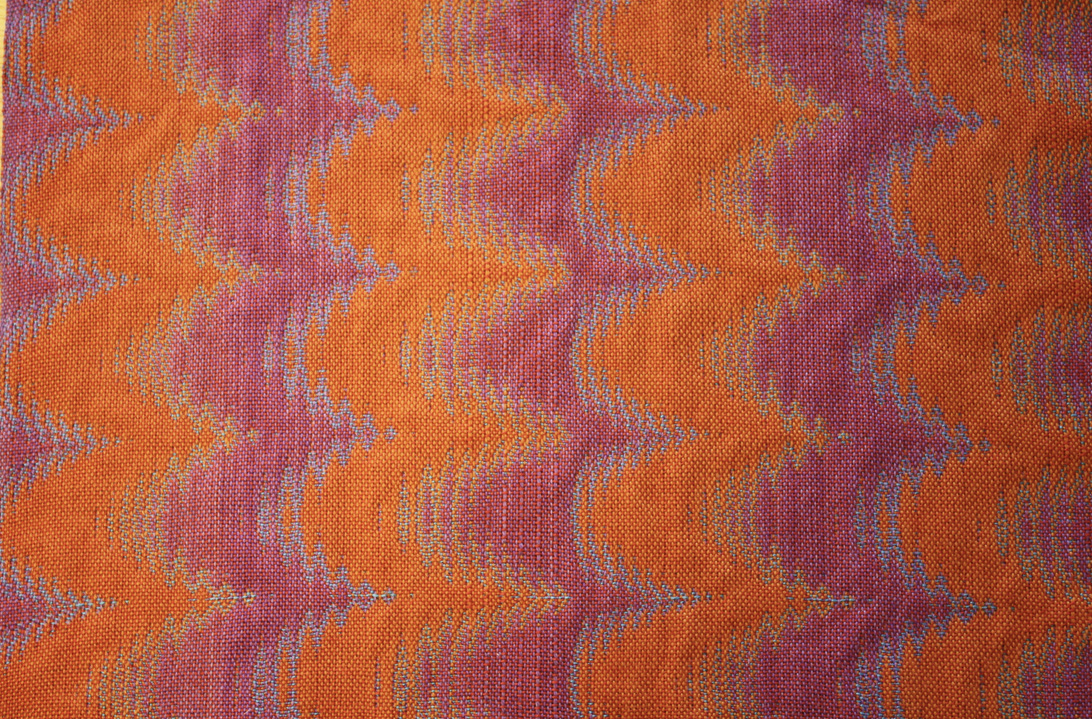
If you're interested in any drafts, let me know. It's great add texture to your fabric! And here's one parting shot, of another sample just completed, using the same warp and weft as the first sample in this post but with a different treadling. (This is the sample that you see in the close-up photo that begins this post.)


Happy shape-shifting, y'all!