Showing posts with label Echo weave. Show all posts

Thursday, July 19, 2018

What We Wove at Convergence: Echo, Jin, Shadow Weave, Rep, Double Weave, and Even Collapse Fabric

Echo Weave on 8 shafts on a warp of light blue and dark blue 10/2 cotton. 
The weft is 20/2 cotton in golden orange. Woven by Virginia Lee.

You've heard about Echo, which is based on an extended parallel threading that weaves a warp-emphasis fabric with lots of color and strong patterns. But do you know about all the different structures you can weave on the same parallel threading? In addition to Echo, you can weave Jin, Shadow Weave, Rep Weave, Double Weave and even collapse cloth, simply by changing your tieups and treadlings.

I taught a workshop on this subject last week at Convergence, the biennial conference for the Handweavers Guild of America, held this year in Reno, Nevada. "One Warp, Many Structures: An Exploration of Extended Parallel Threading" looked at all the possibilities I mentioned above. To teach this, I designed 9 different patterns -- 3 for 4 shaft looms, 3 for 8 shafts, and 3 for 12 shafts -- and invited students to choose a pattern and wind a warp using two colors of 10/2 pearl cotton. (I also named all of these patterns, using simple descriptions as a mnemonic device -- otherwise I couldn't remember them all!)

Below is a photo essay showing some of the beautiful samples the folks in my workshop created, with brief descriptions for each. It was a visual feast!

Above on left: Echo Weave sample using 8-shaft pattern, "Many Rivers," in light blue and off-white warp yarns. On right: the same pattern, this time in Double Weave, with top layer woven in off-white 10/2 cotton and bottom layer woven in 18/2 merino. The bottom layer fulls with hot water, soap, and agitation, making the top layer collapse and pucker. Woven by Roberta McKinney.


 Echo in the 8-shaft pattern, "Falling Stars," using different colors of weft yarns in 20/2 cotton. 
Note how the the weft color completely changes the color of the fabric. Woven by Teresa Edmisten.

Left to right: Double Weave and Shadow Weave samples woven on 8 shafts in the "Fun House" pattern. 
Woven by Judith Rees.

 Clockwise, starting from top left: Echo,
Double Weave, and Rep Weave on a 4-shaft pattern called "Op Art."  Woven by Diana Abrell.

Rep Weave in the "Fun House" pattern on 8 shafts. Woven by Virginia Lee. 

Shadow Weave on 8 shafts in the "Falling Stars" pattern. I think this was woven 
by Rachelle Weiss -- my apologies for not knowing for certain.

 Above, the 8-shaft "Fun House" pattern on a warp in two shades of blue for warp yarns. 
The red weft creates the impression of 4 different colors in the fabric. Woven by Judith Rees.
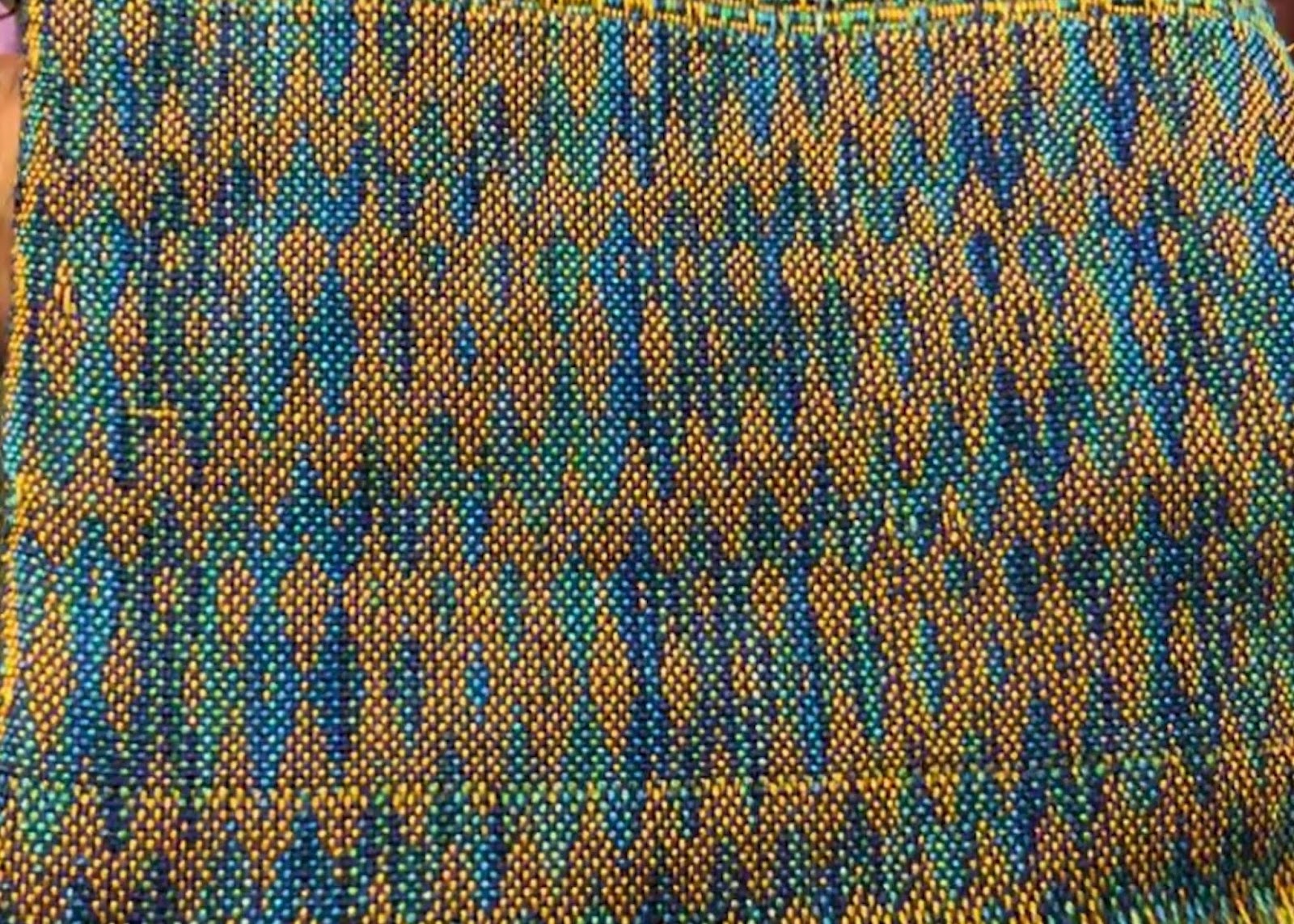

The two photos above: front and back of the "Falling Stars" pattern on 8 shafts in Double Weave. 
The warps alternate between a golden yellow and a hand-painted yarn in shades of green and blue. Woven by Sharlet Elms.


The two photos above: front and back of collapse cloth in the 8-shaft "Falling Stars" pattern, woven as Double Weave. The weft alternates between 10/2 cotton in gold (front) and 18/2 merino in purple (back). With washing, soap, and a lot of agitation, the merino fulls on the back, making the layer on the top collapse into pleats. Woven by Sharlet Elms.


"Many Rivers" design woven on 8 shafts. Pictured from top to bottom: 
Echo, Shadow Weave, and Jin. Woven by Virginia Glenn.


Pictured above, clockwise from top left: 8-shaft "Falling Stars" pattern in Shadow Weave, 
Double Weave, Rep Weave, and again in Double Weave. Woven by Ruth Ronan.


Blooming Leaf pattern on 4 shafts woven as Jin. Woven by Sharolene Brunston.


Above, top to bottom: "Fun House" pattern for 8 shafts. The top two samples are woven using a different Echo tieup and treadling from the bottom 4 samples. The bottom 4 samples are all the same tieup and treadling for Echo, but using different colored wefts. The warp yarns are light blue and turquoise. Woven by Carie Kramer.


Thanks for reading! And many thanks to the staff of HGA for putting together another wonderful gathering of the clan!


Wednesday, April 18, 2018

Juried into the Convergence Fashion Show in Reno...


Every two years I set myself a challenge: weave fabric for a garment for submitting to the Convergence fashion show, a biannual conference sponsored by the Handweavers Guild of America. This year, the conference will be held July 6-13 at the Peppermill Resort in Reno, Nevada -- and I'm happy to announce that two garments of mine were juried into the show.


This coat took me two years to complete, from conception to winding warps to dyeing them to weaving the fabric to dyeing the lining and sewing the coat.... It's called "Summer's Lease I," after William Shakespeare's beautiful words, "Summer's lease hath all too short a date" (from his sonnet, "Shall I Compare Thee to a Summer's Day").

I wove the fabric on my 12-shaft Macomber, using a draft I created with extended parallel threading. Then I wound two warps of 20/2 silk, painting one in a range of fuchsia, rose, pink, and lavender and the other in gold, lime green, sage green, and turquoise. The fabric is woven in Echo Weave and Turned Taquete and the weft was 60/2 silk in orange.

Here's the image that inspired my pattern and colors.


I kept it on my computer for years under the title "Paint this Warp." I have no idea where I found it!

For the lining, I purchased yardage of Habotai silk, then dyed it in a range of bright pinks using low-water-immersion dyeing.

I wove about 10 yards of fabric and, having taken Bonnie Inouye's workshop, "Opposites Attract," I began experimenting with other structures, alternating my treadlings for Echo and Turned Taquete and then venturing into Rep and Double Weave. The Double Weave wasn't successful because I did not re-sley my reed for a tighter sett. But the Rep turned out really well, with a weft of hand-dyed Habotai silk ribbon alternating with 60/2 silk.

Here's the second garment that was juried into the fashion show, this one named "Summer's Lease II."


The top is woven in Warp Rep and the skirt is Turned Taquete, cut on the bias. Here's a close-up of the top.


As for patterns: the coat is my own pattern, fashioned after a swing coat I own and love. The skirt and top are my own designs. Photo credits and thanks to Timothy Fuss of Pixelwave, who does a wonderful job photographing handwoven garments.

Hope to see you in Reno!

Tuesday, January 16, 2018

Sample, Sample, Sample: Echo on 4 Shafts in 10/2 Cotton


The above sample is Echo on 4 shafts in 10/2 cotton, sett at 30 ends per inch. So much to say about the drafts I've been weaving up! If you're a handweaver -- and if you use weaving software -- you know all too well that there can be a world of difference between the drawdown on the screen and the actual handwoven fabric. Which is why we follow the mantra, "Sample, sample, sample."

I started this post with my favorite sample out of some 10 I have woven this month, all in preparation for my workshop this summer at Convergence in Reno. "One Warp, Many Structures" will explore extended parallel threadings and how they allow you to weave a wealth of structures, from Echo to Jin to Rep, Double Weave, and even Shadow Weave and collapse fabric, all on one warp. (Some structures require re-sleying for a denser sett, but all are on the same threading.)

The sample above began with a simple design line which I used as the basis for a twill threading -- which I then turned into a parallel threading with an interval of 2. Red and black warp ends were on an extended parallel threading (that is, every other thread, so that they weave in opposing sheds). I wove it with a 2-2 twill tieup using a 20/2 cotton weft in black.

No drawdowns to show because they are part of the workshop. (I don't want to give everything away beforehand.) But here are a few more samples to give you an idea of what we'll cover.

Another treading in Echo, same warp.


And here are the above two samples treadled as Jin, simply by adding tabby (shown in their respective order).


I really love knowing that this is done on 4 shafts. So many possibilities. The point of the workshop is to broaden your depth and breadth of understanding of how to maximize a warp threaded for Echo (or extended parallel threadings, choose your terminology, as Echo itself is a very big umbrella).

Here is the same structure as Double Weave, re-sleyed at 48 epi and woven on a networked treadling. Because it's a two-shuttle weave, the front and back are quite different.


Then there's Shadow Weave, (which I'm not showing because I haven't yet woven a sample). And finally Rep, which I don't find as appealing, but perhaps it's just because I needed to do a bigger sample:


I have another set of samples, these based on Blooming Leaf. Here's the first of the set:


I have many more samples to do -- at least one more on 4 shafts, 3 more on 8 shafts, and hopefully one or two on 12. Until next post, thanks for reading!


Sunday, December 17, 2017

Looking Ahead to Convergence 2018: Blooming Leaf on 4 Shafts Using an Extended Parallel Threading

Let's start with the Blooming Leaf pattern -- a classic Overshot pattern we all know and love. I hope to use this structure in an Echo Weave workshop I'll teach next summer. 


It's a 2 1/2-day workshop called "One Warp, Many Structures: An Exploration of Extended Parallel Threading," taking place at Convergence July 6-12 in Reno, Nevada. (Some background: Every two years, the Handweavers' Guild of America sponsors Convergence, a week-long conference that draws weavers and fiber artists from North America and beyond. Go if you can!)

We'll be working on 4 and 8 shafts -- and more, if people wish. For this blog post, I'm focusing on a 4-shaft extended parallel threading, just to give you a taste of what the workshop involves. (Extended Parallel Threading is the key to Echo Weave.)

Here's the basic drawdown we're starting with, based on the Blooming Leaf pattern from Marguerite Porter Davison.


I left out the tabby because we are not weaving Overshot -- but otherwise the 2/2 twill treadling remains the same.

To create an extended parallel threading, you have to double the number of warp ends. (In Fiberworks Silver, which is the program I use, you click on the heading that says "Warp" and then "Parallel Repeat" in the drop-down menu. Then you click on "Extended Parallel," shafts shift by 2, and "Apply.") This way, the threading for 4, 3, 2, 1 becomes 4, 2, 3, 1, 2, 4, 1, 3 -- that is, every thread has its "parallel" in a pattern that is 2 shafts above it. (The secret is that, on just 4 shafts, the parallel for shaft 3 is shaft 1 -- because there is no shaft 5. Because there is no shaft 5, the next shaft "up" after shaft 4 is shaft 1, and so on.)

This is what you get with a parallel threading for Blooming Leaf, with the shafts shifting by 2.

You can still see the Blooming Leaf -- but there are long warp floats and the pattern looks squished vertically. That's because we are using the original treadling from Davison. To design a treadling, I look at the original treadling as a design line -- really, as a profile for the treadling we want to use in our weaving. For each pick, I substituted a 4-pick Crackle block. So the first pick -- treadle 4 on our drawdown -- becomes 4 picks: 4, 3, 2, 3. The next pick -- treadle 3 on the drawdown -- becomes 3, 2, 1, 2. Treadle 2 becomes 2, 1, 4, 1. And so on. Here's the result, which I describe as the Blooming Leaf pattern in Echo Weave treadled as Crackle.

Really, this is where the workshop begins! I just wanted to show you how you get there. (Please rest assured that, at least for me, these designs do not come easily. I spend way too much time, it seems, clicking and changing and correcting errors in Fiberworks before I can begin to wrap my head around what is going on and how to come up with a good design.)

There is lots more to the workshop, because everyone will start with a drawdown using an extended parallel threading and then weave Turned Taquete, rep, Shadow Weave and Double Weave -- all on the same threading. That's the beauty of extended parallel threadings: you can use two colors (or more) in the warp for a stunning interplay of color and form and structure.

So here's what the Blooming Leaf pattern looks like in Turned Taquete. There are no floats longer than 3 ends (while there are 4-end-long floats in the Echo Weave) and you get a very tidy, drapey fabric, which is why I like this structure.


And here it is in Shadow Weave. Pretty subtle, but you see the leaf as kind of embossed pattern.

There will be lots more designs to come, as I begin sampling what we will weave in the workshop. Thanks for reading, and see you in Reno!


Saturday, September 16, 2017

Echo... Echo... Echo...


12-shaft Jin currently on the loom, 
woven on an Echo threading. 20/2 handpainted silk warp 
(really two handpainted warps) and 60/2 silk weft, 
advancing point twill threading and treadling.

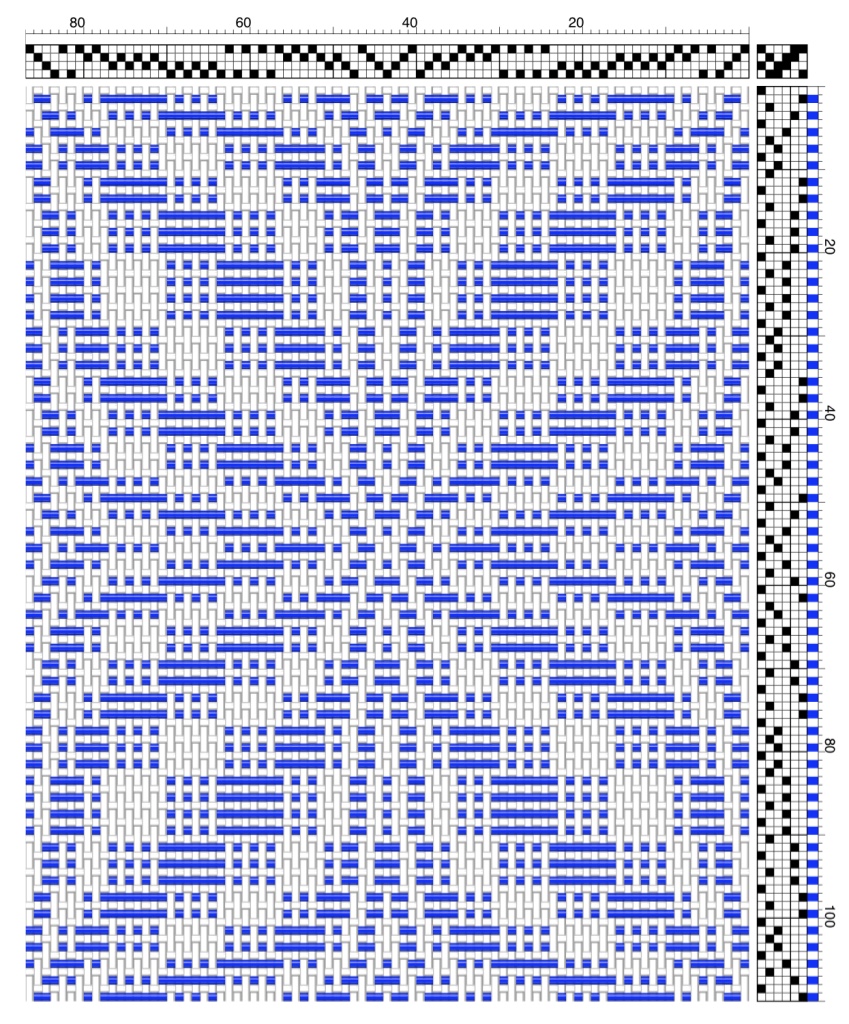
The drawdown for the above pattern (the treadling has a long repeat)

Echo enjoys so much popularity these days, thanks to Marian Stubenitsky's wonderful book, Weaving with Echo and Iris.

Above and beyond this groundbreaking book, however, is the beauty and potential of Echo techniques themselves. Because you're weaving on an extended parallel threading, the possibilities are pretty much endless. You can change the treadling and tie-up in myriad ways that will alter the pattern and still weave Echo. Or you can add plain weave to the treadling and weave Jin -- which again can be woven in a variety of patterns. Or you can weave Double Weave. Or Shadow Weave. Or Rep. And you can change to a networked treadling. And on and on.

Looking ahead to Convergence in Reno next summer: I am scheduled to teach a 3-day workshop on "One Warp, Many Structures: An Exploration of Extended Parallel Threading." (For more information, please take a look at the course description here.) Weavers will come to the workshop with their looms threaded in a two-color warp in an extended parallel threading, with enough weft to weave a range of structures using different tie-ups and treadlings. If there's time, we may even cut off and re-sley to weave double weave and shadow weave. As I've experienced myself with the 12-shaft structure above, it's a process of endless discovery.

Preparing for the workshop, I've been playing with drafts for 4-shaft and 8-shaft looms. Below are some of the designs I'm working on to date. Woven samples will come later.

 A 4-shaft advancing twill on an Echo threading, 
advancing point-twill treadling
 An 8-shaft networked design on an Echo threading
A traditional point-twill design known as the Earl on 8 using an Echo threading

4-shaft Cat Tracks and Snail Trails (also known as Wandering Vine), 
woven as Jin on an Echo threading

Comments, questions, ideas welcome! Much work to be done and lots of discoveries in the making. Thanks for reading!


Sunday, February 12, 2017

More from the Warp That Keeps on Giving: Turned Taqueté


At this point, the problem is making a decision -- ANY decision, for crying out loud! I have been able to weave so many patterns on this warp -- an extended parallel threading -- that it's hard to choose which one I like the best.

So far, I have woven maybe maybe 10 different patterns, using two different tie-ups and lots of different treadlings. I've finally decided on the two in the photo above. (Not one, but two -- but that's OK, because I like the way they work together.)

Both patterns are treadled as Turned Taqueté, which I've blogged about extensively because it's such a beautiful structure. The diamond-shaped pattern is created with a simple advancing point twill treadling. Here's how it looks close up:


And here's the drawdown:
For the other pattern, I created a networked treadling based on an initial of 2. Here's the drawdown for that.


So now I have about 8 yards left to weave, which is hopefully enough to make a garment. Lots of keeping track of complicated treadlings -- once again, an argument for purchasing a computerized loom....

And here's one more image, this one of Echo Weave woven on the same warp using a point-twill treadling. My thinking is that this pattern looks good close up, but from a distance of a yard away or more -- which is the kind of distance I like for viewing a garment -- it doesn't show up as well.


Thanks for reading! More to come as I begin creating collapse-weave samples on my table loom, in preparation for workshops I'm teaching in the summer.

Monday, July 21, 2014

An Entirely Arbitrary Look at Convergence 2014

From a very biased viewpoint: Mine! A group of Rochester Guild members -- including two "Convirgins," as weavers affectionately call those who are attending the convention for the first time -- journeyed to Providence on Wednesday, July 16, to see the fashion show and the exhibits. And, of course, the vendors.

For those who aren't familiar with what Convergence is: this is the biennial convention of the Handweavers Guild of America, held somewhere in the continental United States and drawing a couple of thousand weavers, teachers, exhibitors, and vendors from all over the world. It is an inspiring event and -- because it's usually held on the West Coast -- I was not about to miss it.

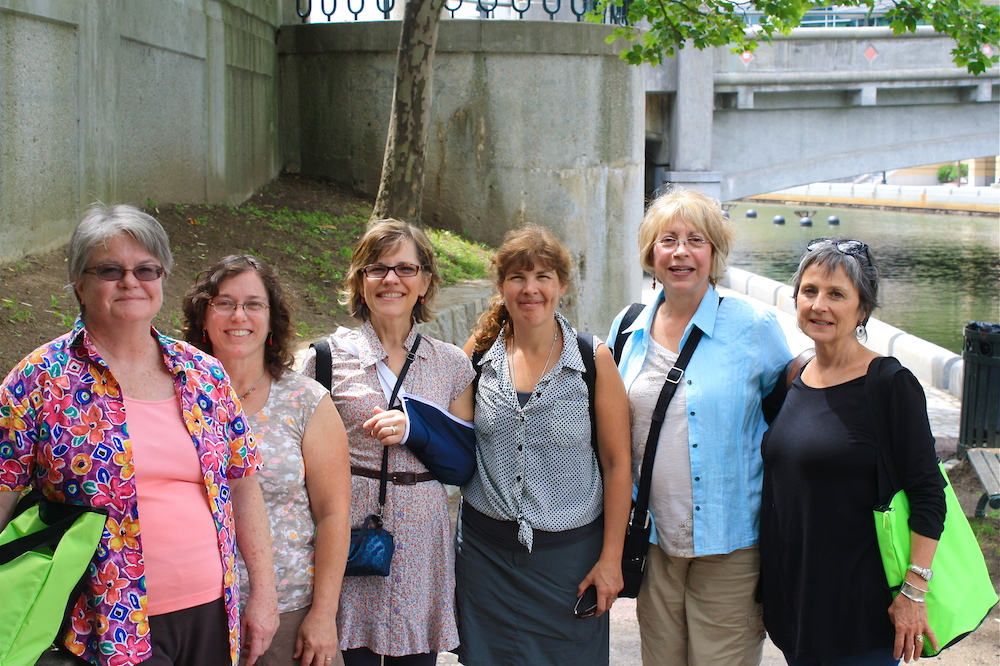
My traveling companions (left to right): Leslie Mendelson, Karen Berk, Hope Herting, Jenn Snyder, Teri Silsby, and me. Jenn, a Rhode Island native, was our wonderful hostess AND tour guide.

Among the many tempting vendors: Master weaver Randy Darwall, 
whose scarves are pictured above

The Glimakra booth, which to me is pretty much 
the weaving equivalent of Disneyworld....

None of us took classes, but instead visited the exhibits and toured the Providence area -- again, guided by Jenn Snyder. The fashion show was a highlight and spurred a lot of discussion. The first-place winner was not a weaver, for instance, but the garment itself was masterful and showed great skill in surface design, couture sewing, and garment design.

(I had an item juried into the show -- but found out at the last minute that my garment had been disqualified because there was a tear in the back seam. I was told that they had received the garment that way, but there is no way on earth I would have shipped it like that. Most likely, it tore when a model tried it on. Still, quite honestly, the fabric was fragile and I had not reinforced the seam. I learned NOT to do that again, for sure. A painful experience but also a lesson.)

Moving on: the Complex Weavers exhibit, named "Complexity," was a highlight of the conference for me. Again, for those who don't know, Complex Weavers is an international organization of handweavers who are interested in working with more than four harnesses -- although four-harness weaving is also explored by this group, as it can offer many challenges for advanced weavers. 

A dimensional wall hanging by Susie Taylor,
double woven on 10 shafts with an origami layer 

Bonnie Inouye, whose work I admire greatly, wove this Echo weave piece
with looped and interlocked strings on 24 shafts

A detail of a Jacquard-woven piece by Lois Bryant,
in weft-backed 8-shaft twills and 16-shaft satin

One of my personal favorites: a scarf by Lesley Willcock 
created from network threading, woven on 32 shafts 
in a treadling range of 8-end satins

The first-place winner was another piece by Lesley Willcock: a 4-color double weave
using an extended parallel on a network threading and woven on 32 shafts

Another personal favorite: a fancy twill scarf by Carol Wooten woven on 32 shafts

This scarf is by Elizabeth Calnan, woven on 32 shafts 
in a double-weave point threading

So much to see, so much to learn! With all the conversations, reading, and viewing, my head was fit to burst. The ideas will last me for at least two years -- until the next Convergence, just about....