Showing posts with label Handweavers Studio and Gallery. Show all posts

Sunday, November 21, 2021

A New Book from Ann Richards: 'Weaving Structure and Substance'


This is a case where you can judge a book by its cover: One, it's written by Ann Richards, a weaver who for decades has achieved a singular beauty in her work. And two, the photo itself captures you, presenting a detailed image of her elegantly constructed "origami" cloth.

The text and photos do not disappoint. Richards, who trained as a biologist before studying weaving at the West Surrey College of Art and Design (now the University for the Creative Arts, Farnham), brings her skills of scientific analysis and her love of nature to bear on her art. In Chapter 1, "Endless Forms Most Beautiful," next to sketches of a dragonfly wing detail and a cross section of its edge, she shares a photo of one of her pleated fabrics. (All photos and images are provided courtesy of Ann Richards.)


Sketch, detail of a dragonfly wing

Cross-section, the front part of the wing


Detail of a pleated fabric woven by Richards, with the caption:
"Warp: Linen. Weft: Crepe silk and hard silk, 
with picks of linen at intervals 
serving as 'struts' to stiffen the pleating."

If you were to look at a cross-section of the woven fabric, you would delight in seeing that the pleats are quite similar to those of the dragonfly wing. 

"Weaving Structure and Substance" is not a how-to book, although it does offer instructions for designing, materials, and finishing. Foremost, it's a discussion and analysis of how Richards and other weavers she admires create their work. The book has four parts: "Nature as Designer," "Resources for Design," "Designing for Fabric Qualities," and "Designing Through Making." There are chapters devoted to fibers and yarns, structures, the quest for textural qualities and forms, sampling, and the notion of "reflective practice." Further, there is an extensive bibliography as well as a list of online resources and suppliers.

The photos are inspirational. Below is a piece she calls "Soft Pleat Scarf," showing both the front and the back. She offers these details: "This silk and linen scarf has a striped effect created by the reversal of the pleats. The weft colour remains the same throughout so this is a 'structural' stripe that disappears when the fabric is stretched to its full width. Warp; Linen 77 lea, 72 epi and spun silk 60/2 Nm, 54 epi. Weft: Spun silk 210/2Nm, 48 ppi."


The delicacy, refinement, and simplicity of this piece represents the highest level of planning, design, and resolution. And yet the concept is easy to grasp: The shifting blocks -- seen in the thin horizontal white and black stripes -- are achieved by reversing the structure from the back to the front, requiring two blocks in the threading.

It is her depth of understanding and ability to exploit the unique potential of her materials that produce such inimitable designs. Appropriately, she quotes Darwin: "Whilst this planet has gone cycling on according to the fixed law of gravity, from so simple a beginning endless forms most beautiful and most wonderful have been, and are being evolved."

Richards's signature pieces are necklaces, collars, and bracelets with origami folds.
Her caption: "These triple spiral bracelets are assembled 
from offset sections of pleated fabric. Warp: Silk/steel 82/2 Nm (pleats) 
and spun silk 60/2 Nm cords). Weft: Crepe silk and polyester reflective yarn."

This is Richards's second book from Crowood Press, her first being the best-selling Weaving Textiles that Shape Themselves. As with the first, her new book includes lavish photos of her work and that of Wendy Morris, Stacey Harvey-Brown, the late Junichi Arai (founder of Nuno), and many others (including me, I'm proud to say). 

Note: I think by now you can guess I'm a huge fan -- to the point that about six years ago I traveled to London to study with her at the Handweavers Studio and Gallery. Her cordiality and relaxed demeanor belied the energy, observation, and creativity she brings to her work.

Dimensional, tactile weaving is a sub-category of weaving that spans broadly, from fulled fabrics to Leno gauze to exploiting the properties of specialized yarns such as crepe, overtwist, and elastic, to name a few. I highly recommend this book to weavers who are interested in what can broadly be termed "dimensional weaving" -- and also to those who are keen to learn more about how attention to materials and structure can improve their work.

WEAVING STRUCTURE AND SUBSTANCE by Ann Richards. The Crowood Press, Ramsbury, Marlborough, Wiltshire, SN8 2HR, United Kingdom. Hardcover. 175 pages. $32.45.

Oh yes, and if you happen to be in London between now and February 2, 2022, be sure to stop by the Handweavers Studio and Gallery at 140 Seven Sisters Road. There, you'll be able to see first-hand what these techniques can achieve. 


Wednesday, November 16, 2016

How Do You Weave This Collapse Scarf? There's a Surprise at the End....


Sometimes when you see something beautiful, you can't get it out of your mind. Which is the case for me with this silk scarf woven by British weaver Sally Weatherill (shown above in detail). I came upon it maybe 3 years ago when I took a workshop with Ann Richards at the Handweavers Studio and Gallery in London.

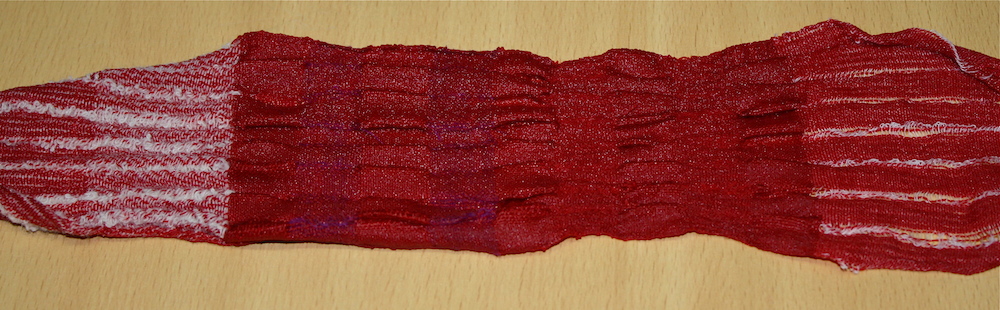
Here's what I gathered from the photo. Simple fact: It's silk, probably 60/2 silk, in double weave. With two different blocks -- one threading for the blue/green horizontal stripes and one threading for the red/purple. A twill threading, probably a 3/1 tieup.

Too many shafts for my loom, as I have only 12 (a large Macomber and a Leclerc Voyageur table loom). So, for starters, I can't weave a sample in 3/1 twill blocks. Fine with me; I will weave plain weave instead.

Second problem: There is no way I can achieve that small blue/green block in the center of the fabric without adding another block of threading. (That's because the wefts in the red/purple block are discontinuous, right? That weft would have to go in between the middle blue/green block.)

So here's what I came up with.


I used 20/2 cotton on shafts 1 through 4 and 9 through 12 and then 18/2 merino on shafts 5 through 8. I did not like the sample at all (so I won't even post a photo). The weft was 20/2 cotton. The sett was too loose -- so loose that, even after fulling in soap and hot water, the cotton looked like cheesecloth underneath the section where the wool shrank.

Next sample. I decided to tighten up the sett and eliminate the middle block of the warp -- thereby reducing the sample to 8 shafts.


Getting there! Here's how the sample looked.


Still not working well, however. Too messy where the wool warp floats over the merino weft. So I tried weaving the wool block in plain weave right along with the blocks of cotton. Here's the altered draft.

Here are the results. Much better.


I still didn't like the way the cotton plain weave cloth looked after finishing. Maybe it was the matte finish (even though it's pearl cotton). I decided to try superwash wool along with the 18/2 merino, so that the merino would shrink while the superwash wouldn't. I looked at my JaggerSpun color samples and found a red that looked the same in both superwash and merino. The blacks in both yarns matched fine, as you might expect. Here's what the sample looked like before and after finishing.


I like this, but some tweaking is still in order. In any event, I promised a surprise at the end of this post. So, going back to the source of inspiration: the gorgeous silk scarf in blue/green and red/purple double weave stripes.

Remember how I set out to figure out the structure? And it took me three different samples to find something even remotely pleasing -- not to mention the fact that I didn't really figure out the original structure?

Well, through the Complex Weavers Collapse Weave Study Group I have been in touch with Wendy Morris -- a gifted weaver who, at the time I visited the Handweavers Studio and Gallery in London, owned and managed the place. I wrote an article for our study group newsletter discussing the scarf and my efforts to copy it and she wrote me back with this surprise: The scarf was woven SIDEWAYS. Those beautiful red/purple layers are woven horizontally. THAT'S how the weaver achieved the gap in the middle.

Thinking out of the box. I will try always to remember to look at something from a different angle! Thank you, Wendy -- and thanks to Sally Weatherill for designing and weaving the gorgeous piece that got me started on this quest. Here's the draft, for your weaving wonderment.


Monday, June 22, 2015

Deflected Double Weave/Collapse Cloth: Exploring Different Treadlings


One year after taking a collapse-technique workshop with Ann Richards at the Handweavers Studio and Gallery in London -- I continue to try new structures, sampling and sampling to learn what works. And what doesn't work.

Deflected double weave has lots of possibilities as a dimensional weave structure when you use two different kinds of yarns -- wool and silk, for example -- so that one layer shrinks and the other doesn't. Cloqué (lye shrinkage using cellulose fibers) is another wonderful technique to use with deflected double weave. More on that in the year to come, I hope!

With these samples, I used an 8-harness structure of my own design, derived from other patterns I've seen and lots of reading. My yarns were 18/2 Superfine Merino from JaggerSpun and 20/2 spun silk, both sett at 36 ends per inch. I tried five different treadlings. Pictured above are comparative photos of the first sample: on the top, before washing and agitating with mild soap in warm water, and on the bottom, after washing.

In this case, I definitely like the first sample better! It shows all the patterns clearly. The second photo gives you an idea of how differently the patterns shrink up, with some drawing in more than others. Not a good idea for a handwoven fabric. Also, the silk selvages (in white) were bumpy and uneven and did nothing to enhance the piece.

Still, I learned a lot. So, for the second sample, I tried a technique I had seen other weavers use with differential shrinkage: Add a fairly wide selvage in plain weave using yarns that don't shrink (in this case, silk). For this sample, I used the third treadling on the above samples, the one that creates a "W" shape in the pattern.

The idea is that, when the wool shrinks up, the selvages will pucker and ruffle. I liked these results quite a bit. Again, the first photo shows the sample before washing (shrinking) and the second shows it afterwards.


This sample has lots of potential, I think, as a fulled fabric. The downside is that it's very firm and thick, which would not work well at all for a scarf. Great for a coat or jacket, however, with the ruffled edge used as an accent at the neck, placket, or wrist.

Another try. (Thank goodness for my Leclerc Voyager table loom, which allows for easy adjustments on a short, narrow warp.) For the third sample, I wanted to see what happened when the wool was the selvage, so that you had a much firmer, fulled edge. I also wanted to make sure that the width of the fabric didn't vary with the pattern after shrinking. So I used only two different treadlings, both of which I figured would draw in at pretty much the same percentage. (Top and bottom photos are before and after washing, respectively.)


Another good sample, in my opinion. I particularly like the way the first treadling (the pattern on the bottom part of the sample) shrinks up, so that it looks like vertical rows of beads and chains, to my eye. These are the results I'm looking for, where the appearance of the pattern after washing is unique and eye-catching -- giving you shapes that you wouldn't achieve with "regular" weaving.

I guess that's what we all look for: the surprise, the "aha" moment, the serendipitous results. Those are the invaluable rewards. Thanks for reading!


Wednesday, August 20, 2014

Collapse Weave -- on Four Harnesses!


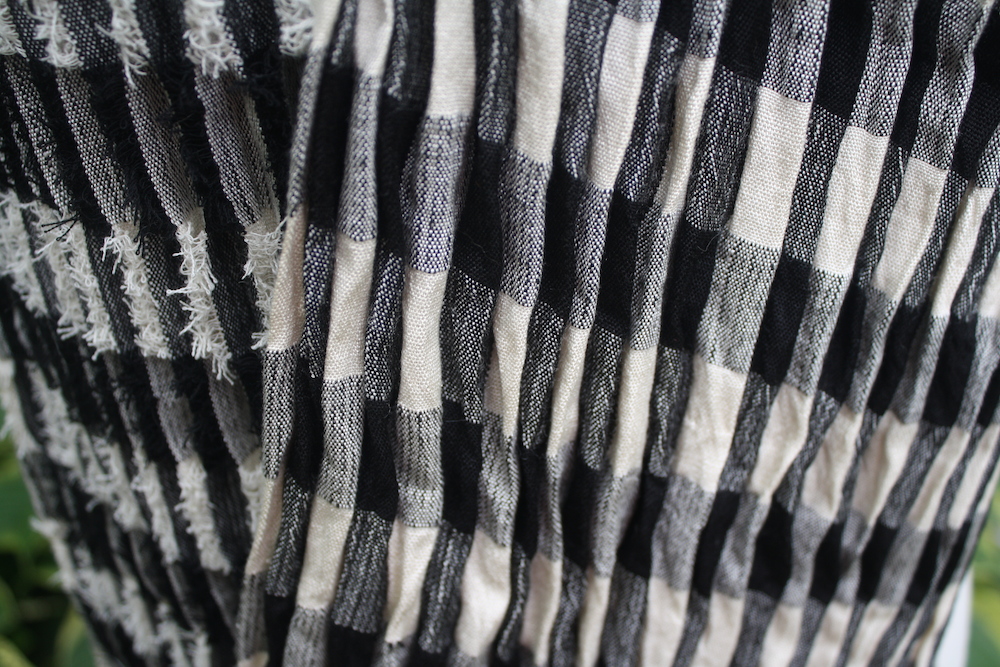
In 16 years of weaving, this may be my favorite piece: a collapse-weave scarf in 60/2 silk and 30/1 overtwist wool. Black and white checkered pattern, with a warp of 60/2 silk stripes and the weft alternating between 60/2 silk and the overtwist wool yarn.

Here's the drawdown.


It's that simple! Understand that, while the weft color is all black on the drawdown, you have to alternate (A-B-A-B) between 60/2 silk in black and 30/1 overtwist wool in black. And while the weft color changes to white, you have to alternate between 60/2 silk in white and 30/1 overtwist wool in white. The weft floats are the overtwist, which pulls the fabric in, making it collapse into a fabric with a soft and cushy hand. The sett is 54 epi, which makes for a high quality fabric with a wonderful hand -- but it takes a long time to weave.


The floats (the wild and twisted yarns you see in the photo) are on the front only. Here, below, is a look at both the front and the back of the scarf.


Most weavers know that 60/2 silk is available from Webs in Northampton, Massachusetts. Few weavers, however, are familiar with where to buy overtwist, crepe, and other specialty yarns. Habu Textiles is one retailer, here in the States, but I purchased my 30/1 overtwist from the Handweavers Studio and Gallery in London. Even with shipping, the prices aren't bad and the yarn is wonderful!

The scarf is for sale now in my Etsy shop, but I'm still thinking I don't want to sell it....


Friday, June 13, 2014

Journey to London: A Class with Ann Richards, author of "Textiles That Shape Themselves"


For me, it was a trip to Mecca! Traveling from Rochester to Toronto to Heathrow to the Islington section of London -- all for a three-day workshop at the Handweavers Studio and Gallery with Ann Richards. This British weaver creates meticulous, fascinating pleats, crimps, bubbles, wriggles, and bumps in fabric woven with seemingly ordinary yarns. The secret is the potential energy of the yarns, which is released when they relax and move about in warm water. Thus the workshop title, "Just Add Water."

I have long admired Richards' work -- lo, since the turn of the millenium, ever since I saw a piece by her in the venerable but no longer published "Weaver's" magazine. Then, a couple of years ago, she produced a gorgeous book, "Weaving Textiles that Shape Themselves" -- and, thanks to Google, I found an upcoming workshop with her. (For more on the book, click here. Thanks also to my guild, the Weavers' Guild of Rochester, for giving me a scholarship to cover the cost of tuition.)

The book

Ann on the left with a fellow student, Sue Wright

For anyone who knows her work, you'll understand why I made the effort to get there. For those who don't know her work, here are some examples.

The pleats are achieved through structure and washing, not by ironing!

A scarf on exhibit at the Handweavers Studio

A doubleweave sample she brought to the workshop

Here's the other side

Over the course of three days, we explored the use of Z twist and S twist yarns; overtwisted wool, silk, and cotton; silk/stainless blend yarn; bamboo; silk crepe; linen; wool crepe -- dozens of fibers from Japan and Italy, primarily. The weave structures varied widely, too, from plain weave to doubleweave to Han damask to Swedish Lace to Leno to plain weave using simple "cram and space" techniques in the sleying -- to the extent that I felt that I was learning a lot about weave structures as well. Then, into the water they went, which produced the effects we were there for.

Before washing: plain weave in vertical and horizontal stripes of S and Z twist

After washing

Before washing: "Cram and space" warp of 60/2 silk, 
plain weave with a variety of overtwisted and normal weft yarns

Same fabric after washing


Leno gauze collapse weave after washing

Plain weave that makes a curved fabric, due to progressively narrower warp stripes
of Z and S twist creating a gradual transition from crepon to crepe 

If the purpose of a workshop is to motivate and inspire -- and to take home new tools to achieve new aims -- then this one delivered for sure. Many thanks to Wendy Morris, owner of the Handweavers Studio and a great weaver herself, for sponsoring this event. My gratitude also to Ann Richards for the energy, intelligence, and artistry she shared with all of us.