Showing posts with label pleats. Show all posts

Monday, October 9, 2017

More Pleats, Please: Collapse Cloth on a 60/2 Silk Warp


Off the plane, out of the box, off the grid – however you phrase it, textural fabrics are three-dimensional and non-rectilinear, unlike any other kind of weaving. In addition to the beauty of color and structure, texture is another pillar of weaving. That's why I love dimensional fabrics so much! I like to describe them as “Tactile Art.”

Studying collapse techniques over the past year, my mantra has been “Sample, sample, sample.” (Never mind that I used to think I just wasn’t a samplin' kinda gal.) Sampling offers so much information, because structures, yarns and finishing can create so many different results. And, to my surprise and delight, just 4 shafts can produce beautiful fabrics that, at first blush, appear very complex.

Which is the case with my latest round of samples, on a warp of 60/2 silk in purple and black stripes. I was in search of pleats – the kind that people weave when they have two back beams that they advance at different intervals, with one layer of a double-weave warp on each of the two back beams. 

Simply put, with this technique, one layer is woven for just a few picks, in a “short” section, and then the second layer is woven as a longer section – many more picks. The shorter layer draws the longer layer in – and after washing, the layer with more picks flattens out into nice neat pleats. Ironing might enhance the effect, depending on what you're going for.

Which is a great technique, except that I don’t have two back beams on my loom. So I set about finding an alternate method. 

Here is my first sample, aiming for horizontal pleats.


No ironing, just washing, although I think ironing might help. The piece was set at 96 epi -- 48 epi per layer -- which sounds grueling, but it's not so bad with a small sample on a table loom.

Here's what it looked like, front and back, before washing.


You see all the floats on the back? That's what draws in the pleats on the front. The back yarns relax because they are not held in by a structure, while the plain weave in the front has to curve because it IS held in by a structure. 

Are these designs all about relaxing? About yarns and structures doing what they want do naturally? I often wonder about the metaphors in there....

Here is the drawdown, as seen from the front.

So then I got to thinking: If the pleats work well with a horizontal structure, they could work well with a vertical structure, using the same yarns. Plus, I would be able to experiment with different wefts, using a variety of exotic and overtwisted yarns. So I recreated the cross, put the lease sticks back in, pulled the threads out of the heddles, and re-threaded them for vertical pleats.

Here's the drawdown. Different shade of purple, I know.... 


Funny thing: You would think that if I wove the exact same structure -- a double weave where the two layers alternate as stripes, one layer weaving plain weave while the other layer floats behind it -- and I just turned it, the results would be the same. 

Right?

No, not at all. The warp threads that draw in vertically with the first structure DO NOT DO THIS when they are weft threads. Take my word for it. I do not know why. (This happens all the time with collapse techniques: When you turn a draft, the yarns do not behave or misbehave the same way.)

Undaunted, I proceeded to try a variety of energized and exotic yarns as weft, weaving double weave and plain weave and playing with floats. For instance, I do not recommend warping with crepe silk from Habu -- it seems to be about the grist of human hair -- but it's wonderful to use as weft. Here are some photos of the results.


Before washing: 60/2 silk warp, 30/1 S-twist wool. Bottom third is woven in plain weave.


Same swatch, after washing, showing double-weave structure


Same swatch, after washing, showing plain-weave structure


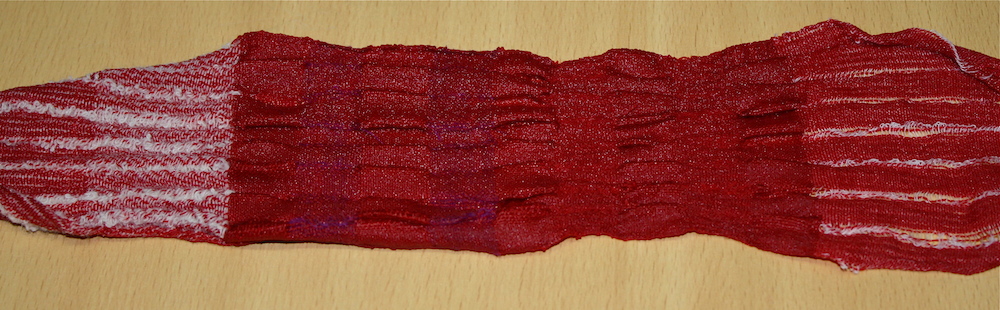
After washing: double-weave structure using 60/2 silk/stainless steel in ecru as weft. The first photo in this blog post shows a detail of this swatch. 


After washing: a double weave sample using silk crepe as weft.

It's tough to show the dramatic shrinkage of the sample above. It was 12" in the reed and is now about 3" wide, mainly because the weft is a gossamer-weight silk crepe from Habu Textiles. The grist is roughly 33,000 yards per pound. (Compare that with 60/2 silk, which is 15,000 yards per pound, and you get an idea of how fine this is.) It shrinks up amazingly well, but you have to weave an awful lot of fabric at a shrinkage rate of 75 per cent.

Later this month, I will be teaching a workshop on collapse fabric at the Etobicoke Handweavers and Spinners Guild in Toronto, Ontario. Looking forward to collapsing and relaxing! Thanks for reading.


Monday, May 15, 2017

Still More Collapse Cloth -- This Time on 8 Shafts


This summer, for me, will be all about collapse fabrics: I'm teaching a workshop at MAFA and a workshop at the Hartford Artisans Weaving Center, plus I will give a lecture on the topic to the New York Guild of Handweavers.

To prepare, I have been weaving up lots of samples and learning A LOT from the results. (Re-learning a lot, too -- for example, that sett can make the difference between a good fabric and a wonderful fabric. We all know this, but we need to be reminded, particularly if a project should be re-sleyed at a different sett and we get -- well, lazy....)

Anyhow, the samples I've blogged about to date have all been on 4 shafts, because that's the focus of my first workshop at MAFA. In Hartford, we'll be working on both 4 and 8 shafts, so now I've begun sampling on 8. Here are some photos. 


I call these "Before" and "After" shots. The photo above is a "Before" shot of fabric just off the loom. I got the draft from a workshop I took a few years ago in London with Ann Richards, author of Weaving Textiles that Shape Themselves. The warp in this case uses both wool/stainless-steel yarn (the taupe-colored warp, available from Lion Brand and from Habu) and 16/2 bamboo (in red and orange). The weft is 72/2 linen (to give the fabric stiffness) alternating with the wool/stainless yarn.

Here is the "After" photo:


In this case, you have two elements that make this a dimensional fabric: structure and energized yarns. The structure is plain weave with floats alternating weft-wise and warp-wise, so that the floats make room for the fabric to pleat in and out. The wool/stainless draws in and twists when washed, which encourages the pleats to form. Finally, the stability of the linen weft adds crispness to the fabric. Pretty clever, huh? All thanks to Ann, who approaches her art with the mind of a scientist.

Another fabric, this one an 8-shaft double weave, pictured in its "Before" state, showing both front and back views:


The red sections are 18/2 superfine merino from JaggerSpun, which fulls beautifully when hand-washed. The black is 24/2 superlamb from JaggerSpun, which resists fulling because it's a superwash wool. Here's what it looks like, front and back, after hand washing in warm water and agitating with dishwashing soap:


To be honest, the black squares on the front of the fabric don't "pop" the way I had hoped. I was looking for a real dimensional "pouf" in the cloth -- but still I think it works.

Here's another structure from the same warp, before washing, front and back, same yarns.


And after washing:


This sample had a lot more texture, thanks mostly to the floats on the back. It's very thick, suitable for a warm jacket or coat.

If you're interested in any drafts, let me know. It's great add texture to your fabric! And here's one parting shot, of another sample just completed, using the same warp and weft as the first sample in this post but with a different treadling. (This is the sample that you see in the close-up photo that begins this post.)


Happy shape-shifting, y'all!


Friday, June 13, 2014

Journey to London: A Class with Ann Richards, author of "Textiles That Shape Themselves"


For me, it was a trip to Mecca! Traveling from Rochester to Toronto to Heathrow to the Islington section of London -- all for a three-day workshop at the Handweavers Studio and Gallery with Ann Richards. This British weaver creates meticulous, fascinating pleats, crimps, bubbles, wriggles, and bumps in fabric woven with seemingly ordinary yarns. The secret is the potential energy of the yarns, which is released when they relax and move about in warm water. Thus the workshop title, "Just Add Water."

I have long admired Richards' work -- lo, since the turn of the millenium, ever since I saw a piece by her in the venerable but no longer published "Weaver's" magazine. Then, a couple of years ago, she produced a gorgeous book, "Weaving Textiles that Shape Themselves" -- and, thanks to Google, I found an upcoming workshop with her. (For more on the book, click here. Thanks also to my guild, the Weavers' Guild of Rochester, for giving me a scholarship to cover the cost of tuition.)

The book

Ann on the left with a fellow student, Sue Wright

For anyone who knows her work, you'll understand why I made the effort to get there. For those who don't know her work, here are some examples.

The pleats are achieved through structure and washing, not by ironing!

A scarf on exhibit at the Handweavers Studio

A doubleweave sample she brought to the workshop

Here's the other side

Over the course of three days, we explored the use of Z twist and S twist yarns; overtwisted wool, silk, and cotton; silk/stainless blend yarn; bamboo; silk crepe; linen; wool crepe -- dozens of fibers from Japan and Italy, primarily. The weave structures varied widely, too, from plain weave to doubleweave to Han damask to Swedish Lace to Leno to plain weave using simple "cram and space" techniques in the sleying -- to the extent that I felt that I was learning a lot about weave structures as well. Then, into the water they went, which produced the effects we were there for.

Before washing: plain weave in vertical and horizontal stripes of S and Z twist

After washing

Before washing: "Cram and space" warp of 60/2 silk, 
plain weave with a variety of overtwisted and normal weft yarns

Same fabric after washing


Leno gauze collapse weave after washing

Plain weave that makes a curved fabric, due to progressively narrower warp stripes
of Z and S twist creating a gradual transition from crepon to crepe 

If the purpose of a workshop is to motivate and inspire -- and to take home new tools to achieve new aims -- then this one delivered for sure. Many thanks to Wendy Morris, owner of the Handweavers Studio and a great weaver herself, for sponsoring this event. My gratitude also to Ann Richards for the energy, intelligence, and artistry she shared with all of us.