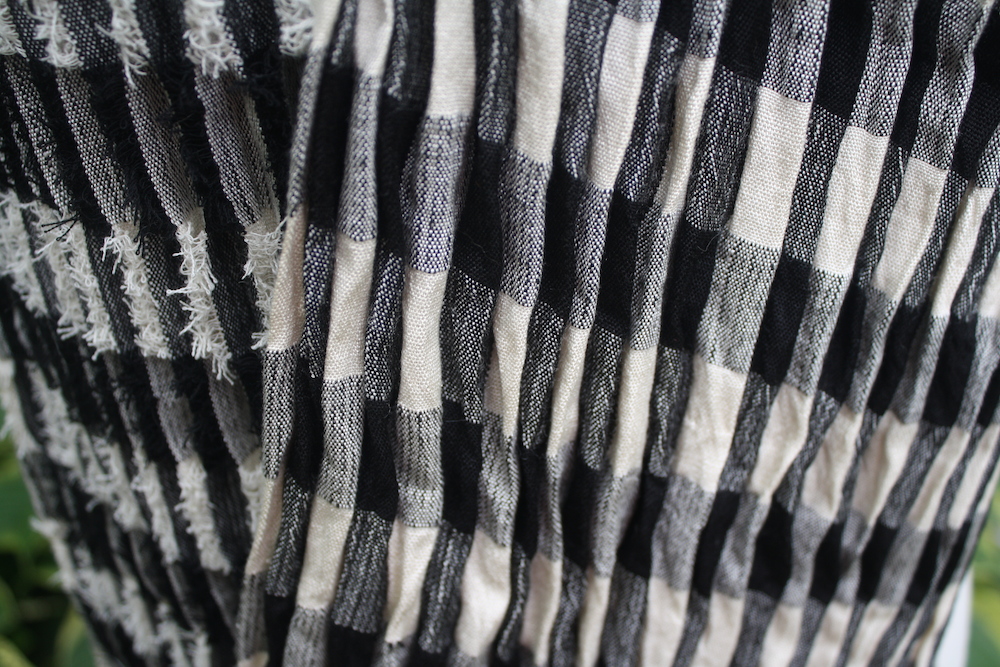
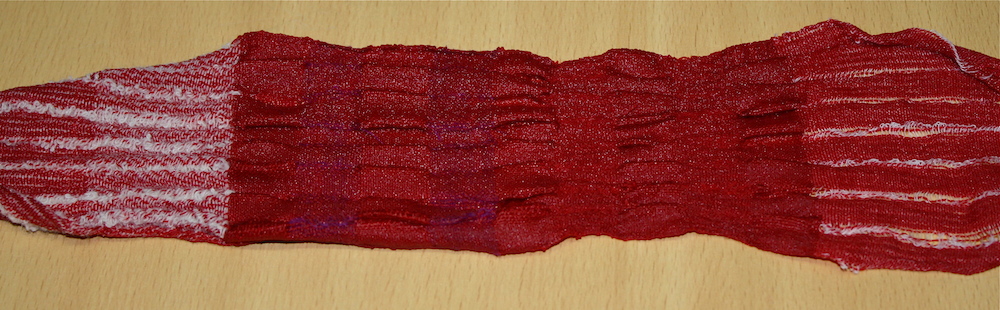
For me, it was a trip to Mecca! Traveling from Rochester to Toronto to Heathrow to the Islington section of London -- all for a three-day workshop at the Handweavers Studio and Gallery with Ann Richards. This British weaver creates meticulous, fascinating pleats, crimps, bubbles, wriggles, and bumps in fabric woven with seemingly ordinary yarns. The secret is the potential energy of the yarns, which is released when they relax and move about in warm water. Thus the workshop title, "Just Add Water."
I have long admired Richards' work -- lo, since the turn of the millenium, ever since I saw a piece by her in the venerable but no longer published "Weaver's" magazine. Then, a couple of years ago, she produced a gorgeous book, "Weaving Textiles that Shape Themselves" -- and, thanks to Google, I found an upcoming workshop with her. (For more on the book, click
here. Thanks also to my guild, the
Weavers' Guild of Rochester, for giving me a scholarship to cover the cost of tuition.)
The book
Ann on the left with a fellow student, Sue Wright
For anyone who knows her work, you'll understand why I made the effort to get there. For those who don't know her work, here are some examples.
The pleats are achieved through structure and washing, not by ironing!
A scarf on exhibit at the Handweavers Studio
A doubleweave sample she brought to the workshop
Here's the other side
Over the course of three days, we explored the use of Z twist and S twist yarns; overtwisted wool, silk, and cotton; silk/stainless blend yarn; bamboo; silk crepe; linen; wool crepe -- dozens of fibers from Japan and Italy, primarily. The weave structures varied widely, too, from plain weave to doubleweave to Han damask to Swedish Lace to Leno to plain weave using simple "cram and space" techniques in the sleying -- to the extent that I felt that I was learning a lot about weave structures as well. Then, into the water they went, which produced the effects we were there for.
Before washing: plain weave in vertical and horizontal stripes of S and Z twist
After washing
Before washing: "Cram and space" warp of 60/2 silk,
plain weave with a variety of overtwisted and normal weft yarns
Same fabric after washing
Leno gauze collapse weave after washing
Plain weave that makes a curved fabric, due to progressively narrower warp stripes
of Z and S twist creating a gradual transition from crepon to crepe
If the purpose of a workshop is to motivate and inspire -- and to take home new tools to achieve new aims -- then this one delivered for sure. Many thanks to Wendy Morris, owner of the Handweavers Studio and a great weaver herself, for sponsoring this event. My gratitude also to Ann Richards for the energy, intelligence, and artistry she shared with all of us.