Showing posts with label Liz Williamson. Show all posts

Thursday, August 22, 2024

Seasons of the Finger Lakes: Sampling, But Not There Yet


Summer -- my favorite design and the sample that has the most errors, darn it.

Autumn -- my favorite sample so far. This photo has more blue in it than the cloth itself.

Winter, which my spouse thinks looks like summer, but I see it as cool and icy.
Again, the photo is bluer than the real cloth. 
Maybe it needs a thicker, grayer weft. 
(Note to self: Do not ask spouse's opinion if they are not weavers.)

Spring. This one is inarguably spring.

I don't know where this one fits in but I love periwinkle. 
So maybe it's bluebell season, something like that.

So. It all started on an airplane a year or two ago. I was flying from my home in Rochester, NY, to teach a workshop. Looking out the window, I could see laterally east across the Finger Lakes and the bordering hills, with the lakes stretched like blue/green ribbons north to south across the land, fading into the distance.

An aerial view of the Finger Lakes, courtesy of NASA. I figure this is fair use, because it's NASA and this blog is definitely non-profit ;o)

Canandaigua and Keuka are my favorite lakes, with Keuka having a slight edge. I have spent many happy sunlit hours swimming, boating, water-skiing, throwing sticks for dogs, making sure everybody has their life-jackets on, eating burnt marshmallows, walking on dirt roads, looking for fossils and lake glass, and generally mucking about on the shore and in the water. 

The image outside the airplane window, the memories... why not weave my impressions? I had grand visions of maybe 11 long panels as a series (because there are 11 Finger Lakes, from west to east: Conesus, Hemlock, Canadice, Honeoye, Canandaigua, Keuka, Seneca, Cayuga, Owasco, Skaneateles, and Otisco)....

For many reasons, some discussed in previous posts, including a flood in our house (ironic? I think so), that plan for 11 panels got reduced to a plan for four. 

Perhaps the four seasons? I began weaving. Long, long story short, I made errors. You understand. Still, I finished my four seasons, cut them off, serged the edges, washed and ironed them, and bravely brought them to lunch with two friends who just happen to be esteemed weavers: Susie Taylor and Ruth Manning. You can look them up, I am telling you they're GOOD.

Weavers who lunch, left to right: Susie Taylor, me, and Ruth Manning

I showed them the results and, in between bites of salad and Mandarin oranges, quickly came to realize that these are not finished pieces, definitely not ready for prime time, but good samples that give me a sense of direction and at least the beginning of a plan. They are studies, the templates for something, with more work ahead if I want to weave something special.

(The details, for those who are interested: My samples are all variations on a 32-shaft threading in four-color Echo, using 16/2 cotton in burgundy, turquoise, chartreuse, and Provence blue, with wefts in 16/2 rayon and, for the winter sample, very fine silver thread.)

And so, as always, the moral of my tale? Sample, sample, sample.

Thanks for reading!


Post script: This piece is dedicated to Australian weaver Liz Williamson, who died this week at the age of 75. I was fortunate enough to take a workshop with her at Convergence in Vancouver in 2002, which inspired me to pursue dimensional weaving. She was one of a kind -- and she was a kind teacher.




Wednesday, June 13, 2018

Fishing Line, Gold Gimp, and Wool/Lycra: What a Difference a Weft Makes!


You know what it's like when you're at the end of a warp -- and you decide to just throw something in to see what happens? And you LOVE the results? That's just what happened to me a few days back, as I was weaving up samples for my upcoming workshop at Convergence, "Deflected Double Weave as a Collapse Weave."

Let's start at the beginning of the warp, with a design I created for Deflected Double Weave on 8 shafts. I wove up the first sample with 10/2 cotton in purple and 18/2 merino in red in both warp and weft, aiming for a collapse effect using differential shrinkage. (The wool shrinks in the washing and the cotton doesn't, so it puckers and collapses and creates lots of texture.)

Here's the original draft.


Here's how it wove up, before washing.


I was worried, before I washed this, that it would collapse diagonally. But it didn't, because each diagonal "step," with a vertical line of red connected to a horizontal line of red, actually has two opposing vertical and horizontal lines on the back of the fabric, making a square shape of yarn that will shrink. That's the nature of Deflected Double Weave: not only do individual yarns weave plain weave -- but groups (blocks) of yarns will weave in and out of each other, as warp or weft floats.

Here's how the sample looked after washing with hot water and agitating with dish soap.


So, skipping to the end of my warp -- remember where I threw in an unusual weft yarn just to see what happened? In this case, I chose a lambswool/lycra yarn that would easily collapse. Here's what it looked like before washing.


I'm posting this photo extra-large in hopes that you can see the wool/lycra: Looking closely at the squiggly red weft yarns, can you see a bit of white here and there? That's the lycra, very loosely plied with the lambswool. It's hard to imagine it will collapse much -- but it does. A lot, to the extent that the fabric shrinks maybe 50 percent width-wise. And you can stretch it back to its original width! Here's the finished sample.


And what about the fishing line? It's also called "monofilament," and it's a great way to create interesting effects with yarns that DON'T shrink but instead make the fabric curve and undulate.

Here's the original sample, before and after washing, using the 10/2 pearl cotton and 18/2 merino in both warp and weft. (You'll note that I varied the tieup and treadling from the first draft.)


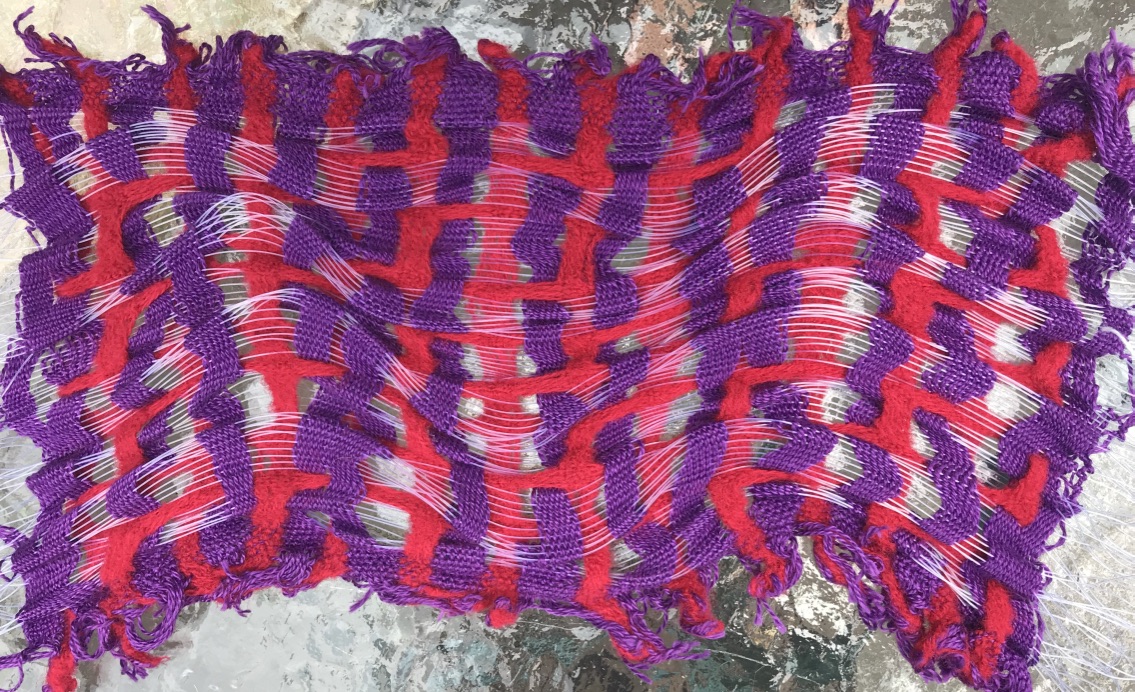
And here's what it looks like, before and after washing, substituting 14-pound fishing line for the 18/2 merino in the weft. (Picture a weaver walking into Gander Mountain to purchase weft yarns....)


Wild, huh? I can see this writ large, for a wall hanging or even a window hanging, much like a stained-glass piece that lets the light shine through. One of my favorite weavers of all time, Liz Williamson, uses monofilament as an accent weft in conjunction with a wool or other collapse weft, which makes her fabrics curve and wind in graceful and unexpected turns.

As for the gold gimp: Here's the original sample, before and after washing.


And here's what happened, shown before and after washing, when I substituted gold gimp yarn for the red merino in the weft.


Gimp is a metallic-looking yarn, typically used as an accent. (Gimp is made of a core, such as cotton, wrapped in a sparkly thread and used in embroidery and trims.)

Still more samples to weave for Convergence. This is why we don't get a lot of housecleaning done these days.... but it's way more fun. Thanks for reading!


Thursday, February 19, 2015

Collapse Techniques: Vertical Pleats with S Twist Wool and Linen Singles

I admire so many weavers, near and far, that I can't begin to list them all. But in the area of weaving dimensional fabrcis, it's a short list -- perhaps because there aren't too many who work solely with this technique.

My collapse-cloth honor roll, in no particular order: Liz Williamson of Australia, Ann Richards of Great Britain, Lotte Dalgaard of Denmark, and the late Anne Field of New Zealand. Richards, Field, and Dalgaard have all written books on the subject, and I just finished a project from Dalgaard's book, "Magical Materials to Weave: Blending Traditional and Innovative Yarns."

The beauty of these techniques is that, to paraphrase Yogi Berra, "It ain't over till it's washed." Here's a video I just made, looking at a sample woven from Dalgaard's book, both before and after washing.


And I want to make one more plug for my upcoming course, taking place the weekend of March 13-15 at the Weaving and Fiber Arts Center. To find out more, click here. Ready, set, collapse!