Saturday, July 18, 2020

Zooming Ahead with Deflected Double Weave


8-shaft Deflected Double Weave sample by Karen Berk. 
Warp and weft yarns are 10/2 Tencel/cotton (in fuchsia) 
and 18/2 Jagger Spun superfine merino.


Like many of us these days, I've been Zooming a lot with friends and family. All of my workshops through January have been cancelled, so I've begun teaching on Zoom -- in some cases, to replace my cancelled on-site workshops and in other cases because guilds are scrambling to offer remote workshops for this fall.

While Zoom workshops can't replace face-to-face communication and hands-on learning -- not to mention the joy of actually touching a handwoven sample -- online workshops can offer a worthwhile learning experience. It all depends on the investment of the students, in my view. And I can't say enough about the investment of the weavers who took my recent workshop, "Deflected Double Weave for Collapse Fabrics."

It served as a fundraiser for the Weaving and Fiber Arts Center here in Rochester, NY (the teaching arm of the Weavers' Guild of Rochester) and also helped test-drive the Zoom format for both the center and our guild. Weavers joined us from near and far -- from California to Canada to Michigan to Virginia to Delaware -- with the bulk of us coming from the Rochester area. 

Over the course of eight sessions in 2 1/2 days -- June 22, June 29 and July 6 -- we gathered on Zoom to study handouts and samples, to analyze drafts in Fiberworks, to view PowerPoints and, thanks to Google Drive, to survey everyone's work. In between sessions, we communicated largely via email and sometimes on the phone. 

Here are more samples:

 
12-shaft Deflected Double Weave sample by Lillian Whipple.
Warp and weft yarns are 10/2 cotton and lace-weight wool/silk.
The gold yarn is the black motifs is real gold.


4-shaft Deflected Double Weave sample by Barbara Mauger.
Her warp and weft yarns are 8/4 Tencel. 
The gray weft yarns are wool crepe.
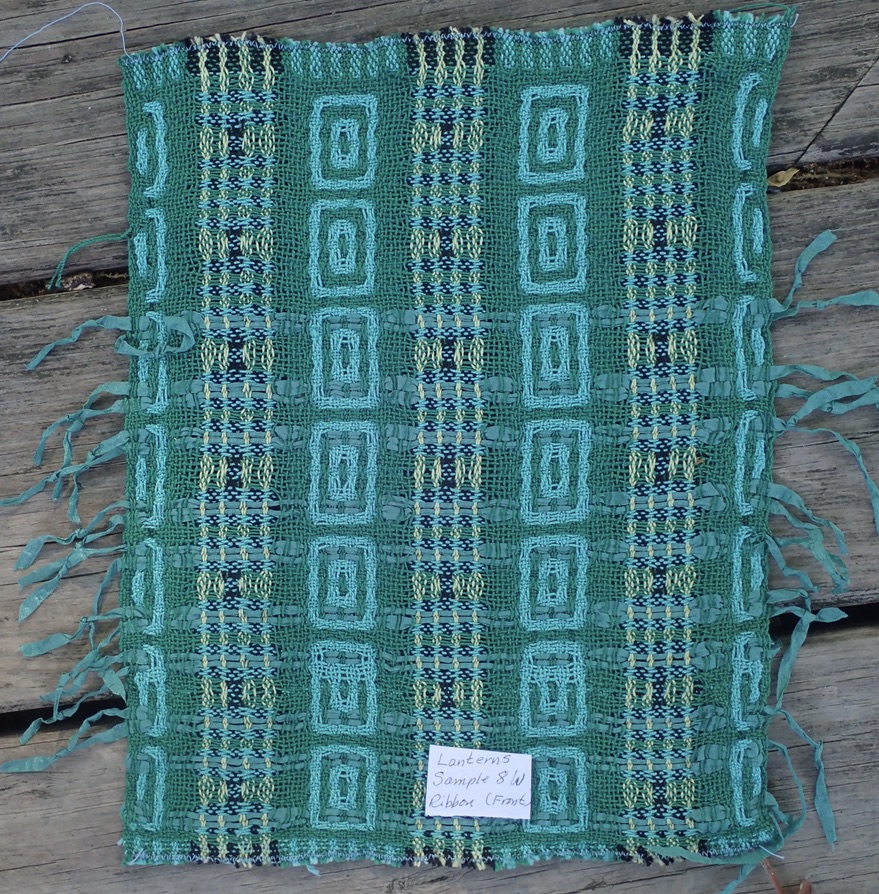

12-shaft Deflected Double Weave sample by Linn Sadjak.
Her warp and weft yarns are 10/2 cotton. 
In this sample, she added picks of rayon-tape yarn.
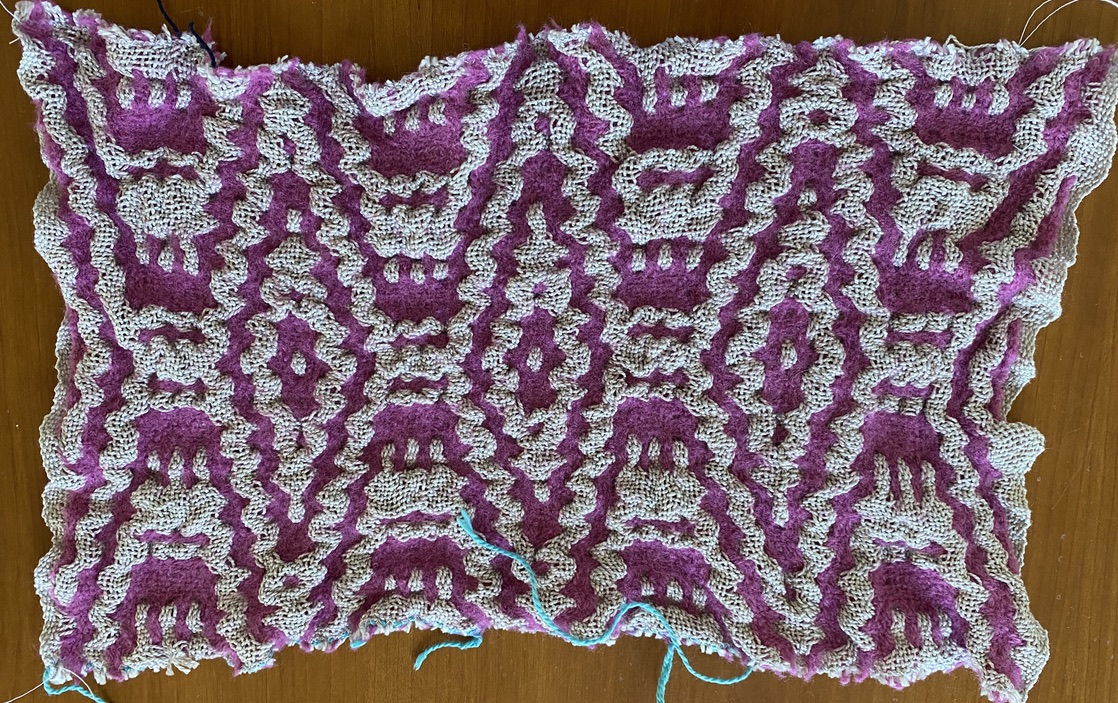

This sample by Jaime Pierce has 10/2 cotton (off-white)
and 18/2 Jagger Spun superfine merino (magenta) in warp and weft.


This is a sample by Eleanor Hartquist shown before finishing.
The gold-colored wefts in the upper horizontal stripe (mostly black) 
will draw the fabric in, creating vertical pleats, after washing.


This 4-shaft sample by Marianne Antczak
uses Colcolastic in the weft (in purple/pink) 
to draw the fabric in width-wise.


Cindy Greenfelder wove this 8-shaft swatch 
using 18/2 Jagger Spun superfine merino (in dark purple) 
to create puckers and pleats after finishing.

My takeaway: Despite the pandemic and social distancing, weavers want to keep on learning. And let's face it, weaving can be a solitary pursuit, so we thoroughly enjoy the company of other weavers. It's why we gather.

For anyone considering teaching or taking a Zoom workshop, I have a few lessons. First off, schedule a dress rehearsal within a week before the class. That way, you can iron out all the kinks -- technology problems, questions about the workshop format, questions about the weaving itself -- before the actual work begins. Who wants to waste time with technology when we could be talking weaving, right?

Another point: For teachers, it's useful to have a document camera on your desk so that everyone can see your samples up close, pick by pick, in focus, well lit and not in motion. (For those of you who have tried holding a sample up to the camera on your computer for others to see, you'll know what I'm talking about.)

A third idea, suggested by a weaver in another Zoom workshop, is to set up a Google Drive file dedicated to the workshop. I uploaded handouts, photos, drafts and other resources and, more important, created an individual file for everyone so they could upload their photos and then I could share them with the group. 

One big benefit is that you can have another teacher take over (in Zoom language, they serve as a co-host, meaning that they can share images from their home computer). In our case, we were fortunate to have Joyce Robards (whom I call my "Weaving Mother" even though we are not that far apart in age) give a presentation on Marian Stubenitsky's newest book, Double with a Twist, which has a different approach to drafting designs.

The course evaluations surprised me, with some folks saying that they actually preferred the Zoom format, mostly because they could weave on their own looms (no schlepping everything to the workshop site) and they had plenty of time to absorb information and work on their samples (no rushing to get everything done in the normal format of 2-1/2 days).

To me, this means that, while nothing can replace the learning that comes with an on-site workshop, much can be gained by teaching or taking a workshop over Zoom. Maybe the greatest benefit is that online workshops can bring weavers from around the globe together virtually, building a sense of community and adding another option to learn about our craft.

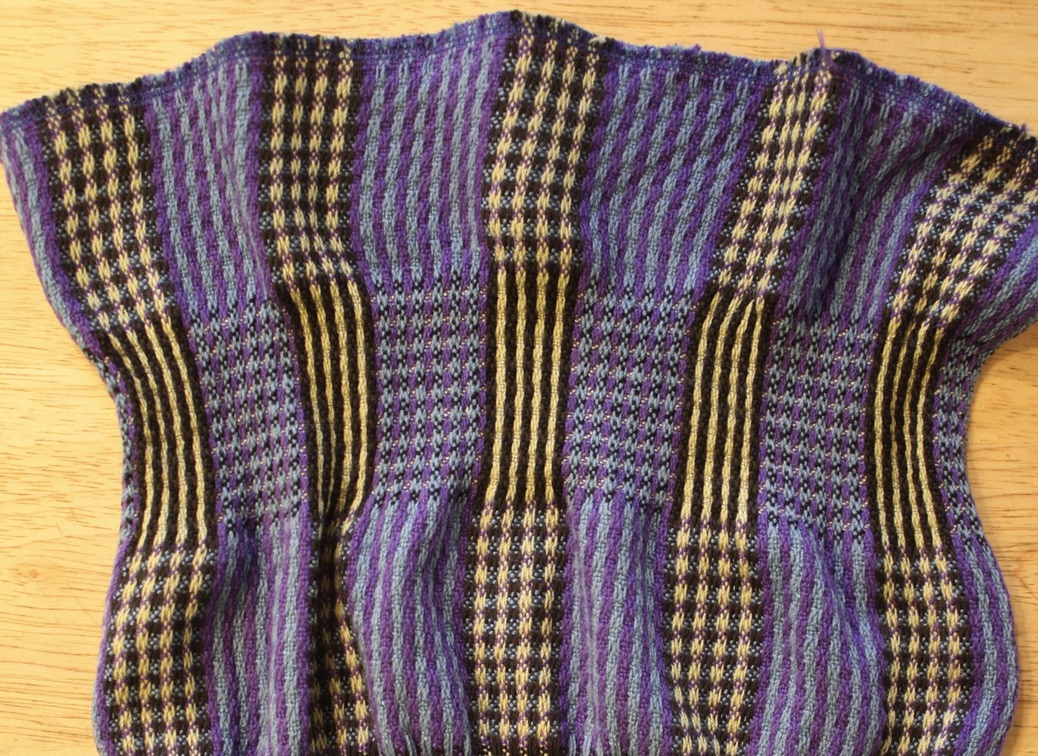
I'll close with a Deflected Double Weave sample I wove on 12 shafts using Colcolastic in the middle section (black and gold vertical stripes) to achieve width-wise shrinkage. I wove this in 10/2 cotton, using four colors in both warp and weft, substituting the Colcolastic for one of the colors as I wove the mid-section.

Thanks for reading!
 

Thursday, June 18, 2020

Weaving Psychology: The End of the Warp Phenomenon


I’d like to make an observation – there's a question in there, too – about something you may have experienced in your own weaving practice. I certainly have.


Why is it that, so often, something we weave at the end of a warp comes out really, really well? Sometimes even better than the first part of the warp that we planned and wove so carefully?


The photo above shows you one of my favorite end-of-the-warp toss-offs. I'm being honest -- and I hope it doesn't sound boastful -- when I say I love it! And it just sort of happened, with less than a yard to spare at the end of my warp.


I was weaving the fabric below, with Echo and Jin treadlings on 12 shafts. I had planned the colors for months, painting two warps of 20/2 silk and beaming them together on the loom; carefully designing the threading, tieups and treadlings; and dutifully weaving it all up on about 12 yards of warp, using a 60/2 silk weft.


So at the end of the warp, I had maybe a yard left over and I got a little lazy. I wanted to weave it off quickly -- so I threw in some hand-dyed silk ribbon, just to see what happened, using a Rep-style treadling that alternated the ribbon weft with 60/2 silk for the thick-and-thin effect of Rep.


And here's what I got, which I did not expect at all and liked immensely:


So there I was, with one yard of fabric that I wish had been 10 yards! Thank you, Robert Burns, for reminding us...


The best laid schemes o' Mice an' Men

Gang aft agley,

An' lea'e us nought but grief an' pain,

For promis'd joy!


This kind of thing happens to me often enough that I have given a name to it: "The End of the Warp Phenomenon." Honest, I could go on and on about projects like these, snatching (unplanned) success from the jaws of (carefully planned) mediocrity. So I will show you just one more example.


It's another piece that came from the end of the warp and it was so short that I could make only a poncho from it. (The beautiful model is our future daughter-in-law, Catherine Demmer.)


Same principle as the first piece I showed you: At the end of the warp, I had only a yard or so to weave, so I thought I would just try some metallic gold gimp as weft. (I was looking for a collapse fabric that I hadn't quite achieved with the rest of the warp.) Below is what it looks like up close. I was happy with the results, a Deflected Double Weave design with lots of texture on a ground layer of alpaca (lavender) that I worked hard to full. The turquoise warp is silk noil, which doesn't full. So that weft of gold gimp, alternating with the lavender alpaca, just wrinkled and curled in all sorts of interesting ways. 


I mentioned this stumble-bumble achievement to a friend of mine and she observed, "Now you see what happens when you just throw cares to the wind!" Which she seems to be able to do all the time. (Laurie, are you listening?) 


My frustration is, I can’t seem to make this happen all the time. The weaving goddesses have to be with me, you might say. Or, to put it another way: You win some, you lose some, some are tied and some get rained out. 


Which brings me to the subject of psychology, because I think there are sound principles that apply to my End of the Warp Phenomenon. Psychologist and author Art Hochberg has said,


"The best way to do something is to do it without thought. That's real concentration."


Athletes do it all the time, simply because their reactions have to be faster than thought. So sports psychology comes into play here. Here's an observation about the flow state in athletic performance, written by sports psychologist Mike Edger:


"Many athletes who have achieved breakthrough performances say that it was 'effortless,' or that 'everything else disappeared.' This feeling that some call 'flow' and others call 'the zone' is a state where the athlete acts without thinking."


Of course, if athletes -- or weavers, for that matter -- acted without thinking all the time, we would not be productive or creative or focused at all. So, it's a matter of being prepared and being open to opportunity and being ready to take chances. To offer yet another quote, this one from Louis Pasteur:


"Chance favors the prepared mind."


Pictured above, yet one more chance success, in my view: This scarf began as a 60/2 silk warp that was just hanging around my studio. I took it to a warp-painting workshop on natural dyes, just to see what happened. And I really like what happened. And it could very easily have gone the other way. I know, because it happens; I just don't post my goof-ups on my blog ;o)

Thanks for reading!


Friday, May 15, 2020

Waves of Color: Double Weave with Echo Threadings


"Knit on with confidence and hope through all crises."
Elizabeth Zimmerman

As usual, Elizabeth Zimmerman nailed it: Substitute "weave" for "knit" and that's some of the best advice I can think of in these troubled times. 

So let's look at one of the most beautiful techniques weavers have been focusing on lately (at least judging from Facebook and Instagram and texts I've gotten from friends).

There's this gorgeous piece, from my fellow upstate New Yorker, Amy Parker (first photo shows side one, second photo shows side two):


This is an 8-shaft double-weave fabric woven on 32 treadles with a variety of warp and weft yarns, according to Amy, all around the grist of 10/2 cotton. Each vertical section has 2 colors in the warp and 2 in the weft, so the back side of the piece looks different from the front.

The draft is by Marian Stubenitsky, who generously shared it here on handweaving.net. (It looks a little dark in this reproduction, but hopefully you get the idea.)


Here are some 32-shaft samples by Susan Weigel Balascio, posted recently on Instagram. The samples, using fine threads in the warp, are wonderful. One half of her warp was black merino and pale yellow and the other half was 20/2 Tencel in blues and purples. In the first sample below, she alternated purple merino and a thin red/gold film for her weft yarns. For the second sample, her weft yarns were 38-gauge copper doubled and a 3-ply green silk.


While photos are great for observing color and form, there is no substitute for the sense of touch, to know the hand of a fabric. Susan says the samples are light and lofty, which is ideal for collapse fabrics. Thank you, Susan! 

As for me, sheltering in place with my husband and my looms, I've been weaving up lots of samples with 4-color warps, in preparation for workshops I hope to begin teaching online. The photos below show both the front and back sides.


The thing I like about this last sample is the texture, produced by using 18/2 merino for one of the wefts. The technique is known as differential shrinkage, where one fiber shrinks (the wool) while the other does not (cotton), creating pleats and puckers in the fabric. (Specifically, the double-weave structure divides into two layers in some sections and interlaces in others. Where the layers split, the layer with the wool weft will full and shrink with agitation in hot water and soap, drawing in the cotton layer so that it crinkles and collapses.)

Here are a few more samples, these in just two warp colors, showing how differential-shrinkage techniques will make the fabric collapse -- but again, only where the two layers aren't interlaced.


There are many ways to achieve collapse effects with double weave, but they all require a sett and beat that are more open than normal. So, for instance, if you're working with 10/2 cotton in the warp, you would normally weave this in double weave at a sett of 48 epi (24 epi for plain weave x 2 layers = 48 epi). In the case of all the dimensional samples above, my sett is 36 epi. And I'm thinking it could have been even more open. 

Further, collapse techniques work best with finer yarns, so a 20/2 cotton warp would produce a lighter, softer hand in the fabric. 10/2 cotton in double weave creates a sturdy, less flexible fabric, although it would work well for a jacket.

One last note: Designing these structures isn't easy -- and sampling them doesn't always produce success, at least in my experience. Understanding that nearly all Echo-based double-weave patterns are interlaced double weave, you really have to know that there are large-enough parts of your design where the two layers are weaving separately. 

Remember that double-weave sample in the photo at the beginning of this post? I was SO EXCITED about taking it off the loom and scrubbing it up to produce a collapse fabric. Which didn't really happen...


Yes, that was the result. I suspect that there were really no spaces in the structure where the two layers did not interlace. My bad. I liked the sample better before washing! Which brings me to another quote from Elizabeth Zimmerman:

"Now, let us all take a deep breath and forge on into the future, knitting at the ready."

Knitting, weaving, whatever you choose, forge on! Thanks for reading.


Sunday, April 19, 2020

'A time to rend, a time to sew...'


To everything there is a season -- and in this season of coronavirus, many of us are busy sewing face masks.

I'm selling my "fashion mask" pictured above -- using cotton that's hand-dyed with indigo using shibori-resist techniques -- on my Etsy page, with all proceeds going to benefit Feeding America, a national organization that works with food banks, food pantries and meal programs all across the country. (You can check them out at feedingamerica.org.)

The main reasons I've heard for distributing home-made masks is 1) to protect those who need them, such as first responders, hospital workers and essential-service employees and 2) in order to save the N95 masks for those on the front lines, such as doctors and nurses in the emergency rooms and ICUs, where they are needed most. Also, here in New York State, Governor Cuomo has mandated that everyone wear one, starting now (effective April 17).

I first learned about the idea from the folks at Sew Creative, a sewing shop in nearby Fairport, NY. Lisa Swisher and her army of volunteers have, last count, sewn some 10,000 masks for the Rochester community, including the Rochester Police Force. She has bins outside the shop where you can leave your pre-cut fabric and/or your hand-made masks.

For a news story on Lisa and her effort, click here. And I've started a Facebook fundraiser to help the shop out with their purchases: To donate, click here.

Finally, here's the link to mask-making instructions: https://www.roccovid19masks.org/


These masks aren't as easy to make as one might think. You want a mask that fits securely, that can be washed, that has a good filter and that won't fall apart. And then there is the overriding responsibility of doing the best job possible, including the placing of the filter so it goes over the nose and the mouth.

Lisa bought some MERV-13 furnace-filter material, which is supposed to work well to filter out the micro-droplets that COVID-19 is known for. It goes in here, through an opening at the top in the back of the mask.


But I don't have access to that material and I wasn't quite sure how to put it inside the mask. (Lisa does this in her shop rather than have her volunteers do it and, since no one goes inside the shop these days, I have no idea how she does it.) So I did some research and learned that nonwoven polypropylene is the fabric that's used for the really top-quality hospital-mask filters. Turns out, this is the same material you will find in recycled grocery bags and tote bags, although it's a different weave.


So there is some research to back this up, and some websites are recommending it. Here's a link to some great information on what's been scientifically tested and found to work: https://www.popsci.com/story/diy/make-diy-face-masks/

I cut up some tote bags and devised my own filters to insert into my masks, cutting each one to a 4" x 4" shape.


And guess what? They seem to work and they are washable. In fact, I boiled my masks for two minutes -- indigo-dyed cotton, elastic, filter and all -- and they held up! Which means they can be sanitized over and over.

Just let me know if you want more information And above all, stay home and stay healthy. Thanks for reading.

Update on April 20: One day after I posted this, my masks sold out on Etsy! Thanks to all!

Friday, April 3, 2020

'Weave on with confidence and hope through all crises'


I've paraphrased the words of the beloved knitting-writer and teacher Elizabeth Zimmermann, who famously said, "Knit on with confidence and hope through all crises." I adore her, as do most all knitters.

Some other Zimmermann quotes that resonate now more than ever:

"Properly practiced, knitting soothes the troubled spirit, and it doesn't hurt the untroubled spirit either."

"Now, let us all take a deep breath and forge on into the future; knitting at the ready."

So, taking a deep breath, here's what I've been weaving.

And so I weave, despite worrying that it's not feeding anybody, but knowing that it feeds my spirit. And hoping too that it feeds others in some wordless way.


Monday, March 16, 2020

Weaving in a Time of COVID-19: How About an Online Show and Tell?

My show and tell piece: a 16-shaft Echo design using a 4-color parallel repeat. 
10/2 cotton warp sett at 36 epi. 20/2 cotton weft.

Well, here we are: Confined to our homes for the most part, working online, washing our hands, even avoiding friends and family during this crazy time. Others are working in health care or serving the public or daily taking health risks in order to keep food on the table and because they are good people who believe in what they do. Hardship and worry. Toilet-paper shortages, even!

And yet... So many of us have much to be thankful for. I, for one, am able to wind warps and plan projects that I had no time for just last week. I'm communicating with weaving friends online rather than face to face, but it's better than no communication at all. Weaving matters to me and so do my weaving friends wherever they are!

Which brings me to the subject of this post. Because of social distancing, those of us in the weaving community aren't able to share and talk about what we do, as guild meetings and classes and workshops and gatherings at friends' homes have been shuttered. I miss that already!

So, how about an online show and tell? If you're game, please send me a photo of what's on your loom or what yarns you're planning to use -- or just send me an email about what you're working on or what you're planning. It doesn't have to be weaving: It could also be knitting or spinning or dyeing or sewing or felting or beading or crocheting or any other wonderful technique that falls under the loose heading, "Fiber Art."

My email is under my "Contact" page just under the heading of this blog. Thanks in advance for sharing!

So, to begin, I will do an online show and tell on what I just finished. Looking ahead to Convergence 2020 -- and even that may not take place -- I am teaching an advanced course on Echo and Jin for 8, 12 and 16 shafts. As always, I'm weaving up a lot of samples.

The photo at the top of this post shows one of my favorite samples to date. I've named it "Perfect" because it's symmetrical and, quite honestly, because I created so many poor designs before I came up with this one -- so finally one was perfect!

Here's the drawdown.


Let me know if you're interested and I will send it to you! Here's how it looked woven up.

This is my first sample, treadled as Echo. 

Believe it or not, the colors of the warp are turquoise, red, lime green, and purple. The weft color makes all the difference, even though is a light 20/2 cotton. The weft in the above sample is a teal blue. 

I'll spare you all of the variations among my samples -- unless someone really wants to see them and lets me know -- but I will share two of my favorites.

This one is the same threading, but treadled as Jin. 
Bonus: I was able to name this "Perfect Jin." Get it? Perfection? 


And this version is treadled as Double Weave. I had to re-sley it to 48 epi, 
but it was surprisingly easy to weave.

So there you have it: My online show and tell in this time of social distancing. I hope to hear from you -- but if not, I do understand! Thanks for reading.


Monday, February 10, 2020

Jin Is a Tonic


Actually, you can't weave true tabby when you're weaving Jin on an Echo threading. It's more of a half-basket weave, but anyhow....

This post talks about the rewards of Jin, also known as Turned Taqueté, and why it's such a popular structure to weave with, especially when it's woven on an Echo threading.

[First, however, a few credits to share. Kathi Grupp, advertising and marketing manager for the Handweavers Guild of America, deserves applause for starting the meme above, because she was the one who came up with it during a workshop I taught in Atlanta. Thank you, Kathi!

And, since we're talking about Echo and Jin, let's extend thanks also to Marian Stubenitsky, Bonnie Inouye and Margaret Coe, all of whom have made enormous contributions to the storehouse of knowledge in this area -- ever since Alice Schlein first introduced and named the design known as Echo in Weaver's magazine back in the 1990s. To be clear, Jin is an ancient structure, dating back thousands of years, as discussed by Becker in his seminal book, Pattern and Loom. But right now I'm focusing on the gorgeous waving multicolored designs that weavers are creating today.]

So, in Atlanta with Kathi Grupp and members of the Chattahoochee Handweavers Guild, we were discussing the popular weave structure known as Jin and how it solves all kinds of float problems when you want to design a viable fabric on an Echo threading.

Let's start with Echo, because that's the threading many folks use in designing Jin. Working with weaving software to design an Echo pattern, often you'll "test" your design with an ascending twill tieup, where half of the shafts are down and half are raised (meaning that when any warp thread in the design is up, its parallel will be down). Your pattern will show on either side, but in different colors. Brilliant! So many weavers love Echo designs, because they offer lots of freedom in creating curves.

Sometimes the test tieup for Echo works beautifully, depending on the threading. But, more often than not, it creates lots of long floats. Like this:


Bonnie Inouye's rule of thumb is that, when you're weaving Echo, you don't want warp floats that are longer than 5 picks (or weft floats that are wider than 5 warp ends). So this design fails by that standard.

What to do? Keep calm and add tabby -- to weave Jin -- which, by definition, will never give you warp floats of more than 3 picks. For that reason alone, Jin is a tonic. Plus, with two or three or four colors in the warp (using an extended parallel threading) and with the right color in the weft, you'll often get iridescence and, sometimes, new and unpredictable colors that are created by combinations of your basic colors in the warp and weft.

Further, I like to say that Jin is a very tidy structure, because of the uniformity of the 3-pick-long warp floats.


Another way to deal with the warp floats in an Echo design, rather than weaving Jin, is to break up the tieup. (I sometimes jokingly say that we are "tabbifying" the tieup, which is another way to "Keep Calm and Add Tabby.")


With this tieup, you're still weaving Echo, but you are limiting your warp floats to no more than 3 picks (and limiting your weft floats to no more than 3 warp ends). I like the way the advancing point twill treadling works to create strong black and purple zig-zagging lines in the design. The colors really dance on the screen, which tells me that it would be worth trying to weave, maybe using similar colors.

Talking about tabby: To repeat, you can't weave true tabby with Jin on an Echo threading. As I mentioned, you wind up with something like a half-basket weave, where one weft floats over two warps. 

Jin is described by John Becker in his book Pattern and Loom as "warp-faced compound tabby." It's warp-faced because of the 3-pick-long warp floats on both sides of the fabric. And it's a compound structure (as is Overshot, for example) because if you remove the pattern wefts, you will still have some kind of ground cloth (made up of the tabby weft shots). A compound weave structure has two things going on at once, as I understand it.

Terminology is a challenge in weaving, almost like another language. That's one of the reasons I write these blog posts: They help me to understand the language of weaving.

Hope this helps you, too. Thanks for reading!