Thursday, October 14, 2021

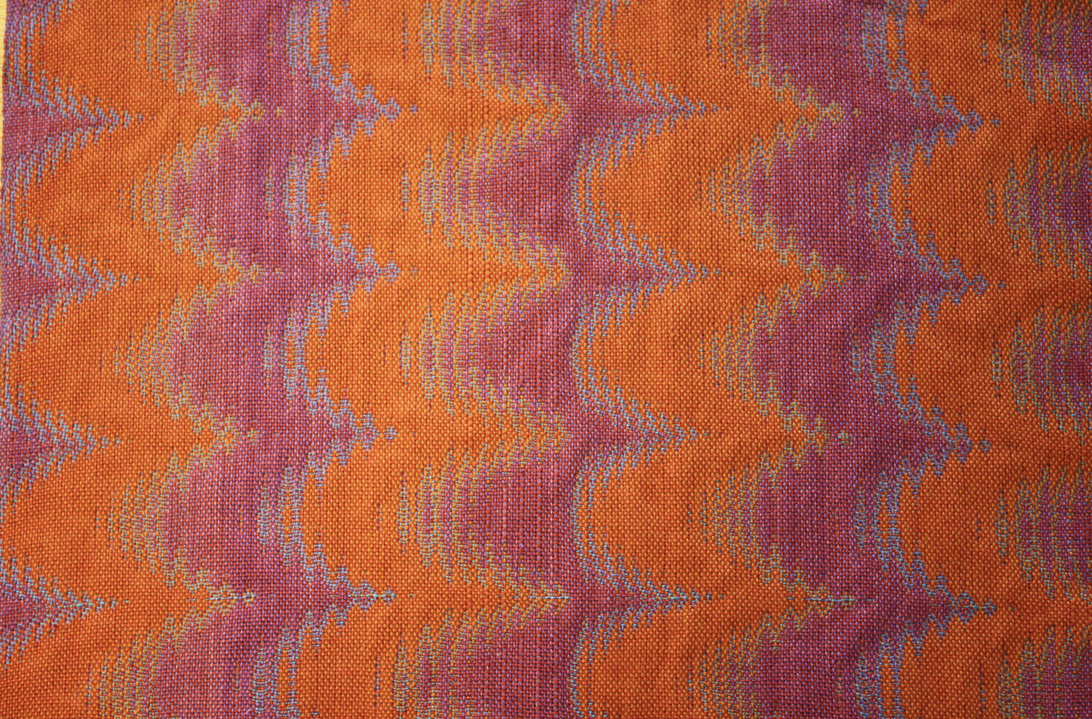
Cloqué for Differential Shrinkage: Thanks to the French!


Years ago -- in the summer 1999 issue of  Weaver's magazine -- Holly Brackmann wrote an article on "Cloqué and Deflected Double Weave." I wove the sample above on 8 shafts based on this article, using a deflected-double-weave pattern with alternating blocks of 30/2 silk (pictured above in white) and 20/2 cotton (seen above in navy). 

The sample on the left and bottom parts of the photo is before finishing; the sample on the upper right is after finishing using the lye-shrinkage process known as cloqué. The other samples were equally beautiful and intriguing and I've been interested in weaving a cloqué project ever since.

As Brackmann writes, "This is a dangerous process and should be used with extreme caution. Fabrics are immersed in a 20-33% lye-to-water solution. Lye is extremely caustic and great care must be taken to protect eyes, hair, skin, and nails. Wear goggles, an apron, respirator, and gloves."

I followed her directions to the "T" and was pleased with the results. 

Another treadling

Using gold gimp as weft


Using Habotai silk in weft

I first heard about the technique from a weaver-friend of mine, Pam Carr, when we were in a workshop together at Convergence in Vancouver, studying differential shrinkage with Liz Williamson. We were weaving double-weave and deflected-double-weave samples with 20/2 cotton and 18/2 merino, which collapses after washing because the wool fulls and the cotton puffs and pleats as a result of this shrinkage. Pam spoke up about using cloqué as a differential-shrinkage technique and I was really intrigued. 

That was back in 2002 -- so, jump ahead 19 years and Pam and I meet up in my hometown of    Rochester, NY. She brought along a couple of her cloqué samples from a workshop she took with Joy Boutrup back in the day.


Double-weave in cotton and silk, finished with lye-shrinkage technique, 
with permission from Pam Carr

Another sample from Pam, from the same workshop

Here I am, almost two decades after hearing about this technique, planning a double-weave project on 16 shafts, threaded for Echo, and finished with cloqué.


Drawdown of the design, showing just a portion of the treadling

Cloqué is related to mercerization: Invented by John Mercer in 1844 and still used today to treat cellulose fibers, mercerization also uses caustic soda (lye), in this case to give cotton yarn greater thickness and strength and to give it increased dyeing capacity.

Years later, in 1884, plissé crepe was created in Lyons for the first time by the firm of Garnier and Depouilly. Plissé has a seersucker effect, produced by the alternating application of caustic soda and a resist chemical that prevents the caustic soda from shrinking the fabric where applied.

My fibers are 30/2 silk, dyed with osage orange and cochineal to achieve a copper color, and 18/2 unmercerized cotton, dyed with osage orange, cochineal, and indigo to achieve a dark gray color.

30/2 silk


18/2 cotton

I plan on calling the piece "Corona Burnout" because the motifs in the pattern look like microscopic images of the Coronavirus -- and heaven knows we are all burned out from the tragedies and troubles it's created.

And what happens if I don't like the samples? Well, I will move on to trying another French technique, devoré -- which literally means burnout.

More to come... Thanks for reading!

Friday, September 17, 2021

Sampling with 'Energized' Yarns, Thanks to Handwoven Magazine and Lunatic Fringe!


It all started with an email from Christina Garton at Handwoven magazine: Lunatic Fringe has a new line of "energized" yarns, called Gevolve, that she would like to feature in a story. (Energized is a broad term referring to yarns that are single-ply, elasticized, overtwisted, or otherwise likely to change shape after washing.) 

I love working with yarns like this because they cause two-dimensional handwoven cloth to pucker, pleat, or pouf in all sorts of organic, unpredictable ways.

Would I be willing to do some samples and write up an article for the Yarn Lab section of the magazine? (The yarns would be free, of course.) Would I be willing? Now what would any self-respecting, full-blooded, stash-loving weaver do?

Also, I'd like to give a shout out to Michele Belson of Lunatic Fringe, who was kind enough to send me more yarn -- MORE YARN -- when I called and said I needed it.

Photo at top: The Gevolve yarns, beginning from the left, are silk elastic in natural and black, linen crepe in Z twist and S twist, and silk crepe in S twist and Z twist. (The S-twist silk crepe is tinted pink to distinguish it from the Z twist. The color washes out after weaving. And the yellow color on the cone on the right is what I call a "yarn bra" -- a plastic mesh sleeve that keeps the yarn from raveling.)

The Yarn Lab piece will appear in the spring 2022 issue of Handwoven, so I'm not to give away any details -- but Christina gave me the OK to share with you some additional samples ahead of time. 

Here's a four-shaft pattern in double weave, using 16/2 bamboo in lime green and magenta in the warp. 


Front of sample: Looks pretty flat, right? On this side of the double-weave cloth, I'm using S-twist silk crepe as the weft. It's drawing in and the effects are seen on the other side.


The weft for this layer is 16/2 bamboo. There are "pockets" in the fabric (openings between the two layers) which crinkle up in response to the draw-in of the active silk-crepe yarn on the other side. The draw-in happens because the 16/2 bamboo is an inactive, non-collapsing yarn.

Here's a closer look at both sides:


Front: Can you see the fine white-ish weft? That's the silk crepe. This yarn is just about 1/3 the grist of the 16/2 bamboo, so it almost disappears in the weaving -- but it has a big impact on the cloth.


Back: The blue weft is 16/2 bamboo. The fabric crinkles where the two layers separate and form "pockets." While the silk crepe draws in, the fabric on the other side collapses because the other yarns are inflexible.

So what are these pockets we're talking about? It's best to start with traditional double weave, which is based on block designs. With double-weave block designs, there are pockets throughout the cloth (if you're using a traditional double-weave tieup and treadling) except for where the layers change places (front layer becomes back and vice versa).

But when you're designing double weave using parallel threadings, you wind up with an integrated double weave (as opposed to block double weave, as mentioned above, or stitched double weave, where the "stitches" uniting the two layers are evenly placed). With integrated double weave, the layers will in some places weave together and interlace. In other places they will separate and form two different layers or pockets. 

Note: This happens with four-color double weave, when you're using two colors in the warp and two colors in the weft. If you weave a four-end parallel threading, using four colors in the warp, you will not get pockets. Just integrated double weave and no chance for collapse effects.

Here are a couple more samples of what energized yarns can do with these structures.


Front of eight-shaft double-weave sample: 16/2 bamboo warps in lime green and magenta and, for this layer, a weft of  Z-twist silk crepe.


Back of eight-shaft double-weave sample: Here, the weft is 16/2 bamboo in lavender. Where the structure forms pockets, you see vertical pleating. The fabric also stretches a bit.


Above, just for fun (because you can't really see the pattern): a four-shaft design using silk-elastic as the weft on this side of the fabric.


This is the other side, which has 16/2 cotton in bright turquoise for the weft. The pockets are long and narrow, but just wide enough to create some interesting texture. The silk-elastic is particularly stretchy and active: It shrinks the cloth to about half its width after washing.

Energized yarns offer so much opportunity for design and function: Think garments that stretch over the body's curves, jackets with self-collars showing the opposite and very different side of the fabric, cloth that pleats and puckers both vertically and horizontally -- or just in certain spots, for added interest.

And also, for the sake of inspiration: How about double-weave cloth that uses fine copper wire as one of the wefts? (I apologize for the small sample, but I ran out of copper wire.) I think of this for a bendable collar or cuffs, as seen in fabrics woven by Lotte Dalgaard.


Front, showing copper wire weft


Back, showing magenta 16/2 bamboo weft

Thanks for reading!


Wednesday, August 18, 2021

Shaft Envy, Begone!


You don't need 32 shafts to weave beautiful fabric! I'm on a mission to prove this as I work on designs for a new workshop, "Echo on the Double: 4-Color Double Weave for 4 to 32 shafts." The workshop will include 5 to 6 variations in tieups and treadlings for each pattern, all in double weave, for any kind of treadle loom from 4 to 32 shafts. 

Pictured above, in the first 2 photos: Blooming Leaf design, Echo threading on 4 shafts in 4-color double weave, front and back. Second 2 photos: Falling Stars design, Echo threading on 8 shafts in 4-color double weave, front and back. The warp colors for all 4 designs are lime green and azalea.

Double weave on Echo threadings is endlessly fascinating because of the variety of patterns and color combinations that you can achieve. When you start with 2 colors in the warp (for a 2-end parallel threading) and then add 2 colors in the weft (one for the bottom layer and one for the top layer), you're working with 4 colors in all, which keeps color folks like me happy. And sometimes you'll wind up with the appearance of more than 4 colors, as in these samples below.


I used a sky blue and a beige linen as wefts, with lime green and azalea as warp colors. Look closely and you'll see a bit of the blue weft highlighting the pattern on this 8-shaft design.


The back looks quite different. Here, the sky-blue weft alters the lime-green warp, making it appear more like turquoise. It also alters the azalea warp, making it look more lilac. 
The color differences are more pronounced when you see this piece "in the flesh."

This color-shift effect is called optical mixing. (I also define it as "simultaneous contrast" because the colors of warp and weft appear different depending on which colors they lie next to). Echo as double weave allows you to exploit and play with this effect, regardless of the number of shafts on your loom.


Above, Blooming Leaf design on four shafts. The warp colors are the same as the 8-shaft design in the photos preceding this. The weft yarn for this layer is sky blue, which again softens the lime green, making it appear turquoise, and shifts the azalea to more of a lavender hue.


For the bottom layer, I used a burnt-orange weft color, which pretty much overwhelms the lime-green warp, turning it into a pale gold/bronze, while the azalea warp becomes more of a coral/orange. I like the bold color differences between the front and the back of the fabric.

There are so many other possibilities as well. For instance, I will be weaving some samples using overtwisted yarns as wefts, which cause the fabric to wrinkle and pleat in interesting ways. The key here is that the design has to include "pockets," as Marian Stubenitsky refers to them in her book, Echo and Iris. This is where the two double-weave layers are weaving separately, which doesn't always happen with double weave on Echo threadings. Often, you're weaving "integrated double weave," where the two layers are interlaced.

And then I would like very much to try weaving with copper as one of the warps and as one of the wefts, but that will have to wait until another time. First, I need to weave up a complete sample set for this workshop. Note: I've found that, as confident as I can be when I look at a design in Fiberworks, I still need to weave it up to see how it plays out. There are often surprises!

Then again, the surprises can lead to discoveries, don't you agree? And discovery is one of the reasons we love this craft.

Thanks for reading!


Falling Stars pattern on 8 shafts, Echo threading, double-weave tieup and treadling, 
with overtwisted yarn as one of the wefts.


Wednesday, July 14, 2021

Work in Progress: A Future Class on Double Weave for Echo Threadings


Above is a detail of a 32-shaft design I'm working on called "Dreaming in Color." It has a 4-color Echo threading and uses 2 additional colors in the weft. I guess that makes it 6-color double weave.

Anyhow, that's the beauty of designing for double weave on Echo threadings: With the right tieup, you can create a magical array of shifting colors. And, if you want to take your creation a step further, you can add a weft with a crepe or shrinking yarn to achieve a dimensional weave.

In order to achieve texture with these designs, you have to look for "pockets" in the structure. (With some tieups and treadlings, you'll get integrated double weave rather than pockets, meaning that the two layers are interlaced.) To see these pockets and/or interlacements, you have to look at the "structure view" in Fiberworks. Here's what the first design looks like in that simulation.

This is kind of a dizzying array of black and white graphics -- but if you look at it closely, you'll see stair-like lines in two sections. These indicate "pockets" in your cloth, meaning that in these sections you'll be weaving two layers of double weave. Also, the sections of both upside down and rightside up "T" shapes indicate pockets as well. (These patterns are discussed on page 170 of Marian Stubenitsky's book, Echo and Iris. As far as I'm concerned, this book has a lifetime's worth of learning in it, not to mention the beauty of the patterns themselves.)

And what about that unusual tieup?

This is the same tieup, in reverse, that Stubenitsky uses on page 175 of Echo and Iris. 


To understand what is happening, it's helpful to divide it into upper and lower layers, like this:

Top layer at left, bottom layer at right

Remember that, with double-weave tieups, the bottom layer has to be a photo negative of a "normal" tieup -- because in order to weave on the bottom layer, which is weaving upside down, the treadles that are lowered work like treadles that would normally be lifted. Likewise, the treadles that are raised perform as if they are lowered. 

As I say when I'm teaching, for the bottom layer in double weave, what's down is up and what's up is down. 

Anyhow, you can see that the tieups have changing "ratios," to use Stubenitsky's term, with sections of each layer all up or all down in an ascending pattern. On shafts where the top layer weaves plain weave, the treadling for the bottom layer is "lifting" (lowering) all of the same shafts -- and vice versa. The rectangles of lifted and lowered shafts create interacting designs in the cloth.

As far as good designs are concerned: I'm not sure I'm there yet, wherever that may be, but I think I'm moving in the right direction.

Detail of another design

All of this is in preparation for a new workshop I'm developing, "Echo on the Double," that will focus solely on 4-color and 6-color double-weave designs on Echo threadings. For people who love to play with color, as I do, these techniques have great possibilities.

Putting it all together is a challenge, of course: combining a strong design line with an interesting tieup and treadling, learning how colors blend and play out, taking care to get the right sett and beat and, ultimately, winding up with a good hand for the cloth. 

I hesitate to admit how many designs I create before achieving one that really works! Here's one, below, that I'm on the fence about. It uses the same design line for the treadling as for the threading -- not quite tromp as writ, because the threading is a 4-end parallel while the treadling is a 2-end parallel.


I kind of like the eccentricity of this pattern. The quirky, linear motifs kind of remind me of cave columns, where stalactites and stalagmites meet. Can you detect them?

Photo: Alex Demas, USGS, public domain

Unlike many of my blog posts, this one is more just thinking out loud or, as I call this design I'm working on, "Dreaming in Color." There will be many variations and probably many more patterns before anything goes on the loom....

Thanks for reading!


Monday, June 14, 2021

24-Shaft Four-Color Double Weave Sample Extravaganza Scarf


8 different samples do not a scarf make.

Another name for this could be "The Greedy Weaver Scarf." I've tried so many tieup/treadling/weft yarn variations on this 24-shaft threading that I really couldn't settle on just one sample for a scarf. So I wove a scarf using eight of my favorites -- and even that wasn't enough! But I will wear it with pride.

Also, I will use it as a resource and a teaching tool. I'm getting more and more immersed in the mysteries of four-color double weave: How the colors shift with the patterns, how the colors change depending on what color they're next to (part of the over-arching theory of simultaneous contrast), how the textures change with active yarns in the weft, how the two sides can be quite different, how much latitude this gives for designing. I could go on!

And I will in this blog post ;o) Let's start with the vital statistics: This is a 24-shaft pattern in a two-color extended parallel threading at an interval of 12 shafts. For the warp, I used 16/2 bamboo in rusty orange and a lilac I dyed myself because the color I wanted wasn't available. The sett was 60 epi and there were 816 ends in the warp plus two ends on either side for floating selvages.

Here's what the threading looks like (this shows one repeat out of two):


Because I repeated this once for 816 ends, there's a line right down the middle in some of the designs, which I really don't like, but be that as it may. These are samples! I wanted to play with tieups and treadlings to see what happened.

My first sample -- one of my favorites -- looks like this:


For the wefts, I used a 16/2 cotton in bright turquoise along with a 20/2 cotton in soft yellow, with the following tieup and treadling. (The treadling is just an 11-end advancing point twill.) The result is lots of color -- how many different colors, I can't really count.


Next I tried a tieup that produced a rectilinear design. I learned about it from Mimi Anderson, immediate former president of Complex Weavers, who creates beautiful scarves in four-color double weave. Here's my sample, followed by an image of the tieup and treadling.


Still with me? To keep things moving, I will show you just two more samples with their tieups and treadlings -- my two other favorite patterns.


Another favorite, front


And back


And below, my most favorite (that's a double superlative), which I think I'll use for a garment. The wefts are 16/2 cotton in bright turquoise and a gossamer-fine (20,000 yds./lb.) silk/stainless steel yarn in mint green. The silk/stainless relaxes after washing and makes the cloth pleat randomly thanks to separate "pockets" where the double weave divides into two layers. At other points in the fabric, the two layers are integrated, which allows for a lot of textural interest.


On the top layer of the fabric, the silk/stainless steel weft is so fine 
that you see mostly the warp colors.


On the bottom layer of the fabric, the 16/2 turquoise weft adds a blue cast.


And here's the tieup and treadling.

Thanks for reading! Happy weaving.