Showing posts with label Lunatic Fringe. Show all posts

Wednesday, June 22, 2022

Weaving on the Curve in 20/2 cotton


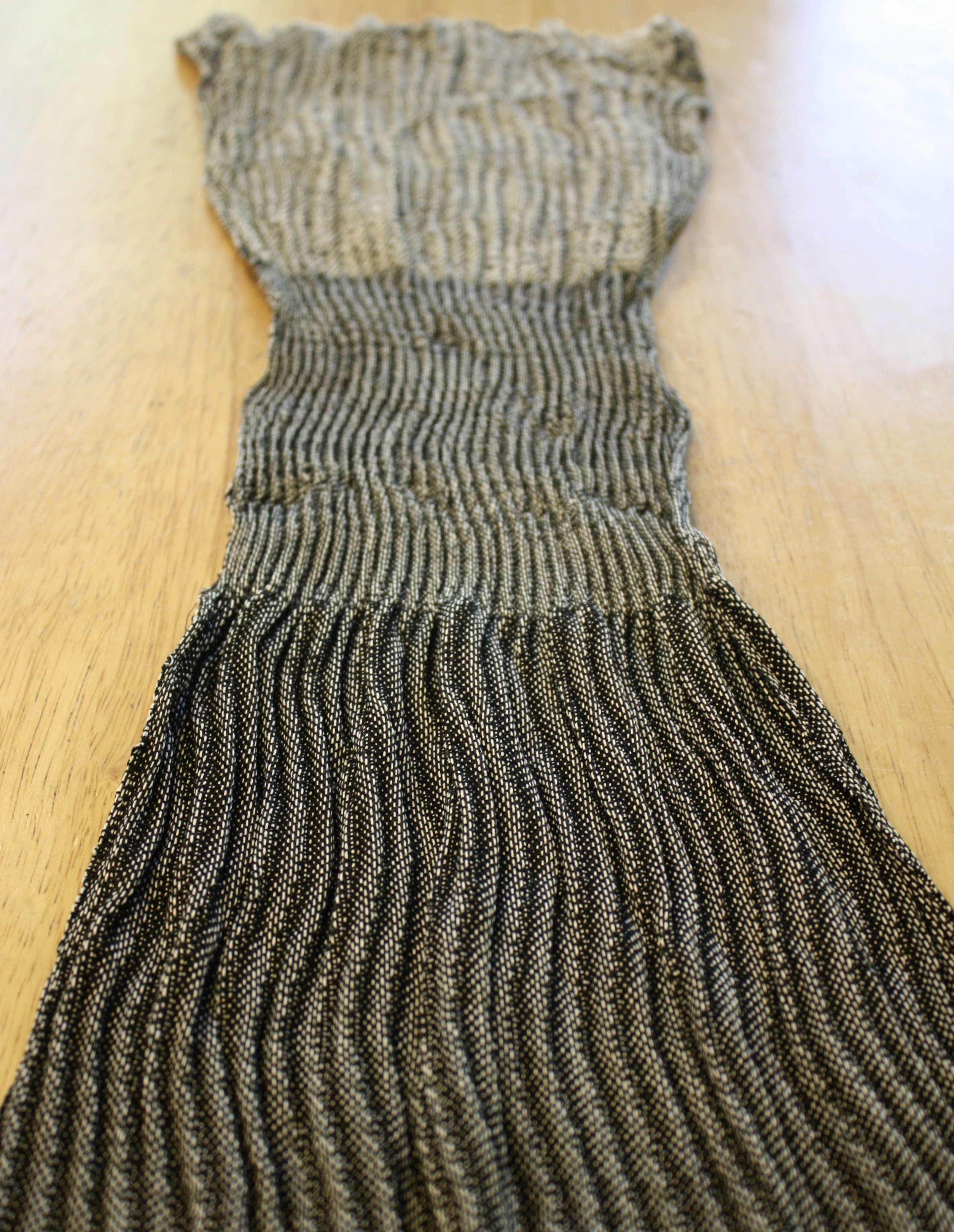
Sampling on 16 shafts with different wefts (top to bottom): 
S-twist linen crepe, Z-twist silk crepe, 60/2 spun silk

16-shaft sample with 60/2 silk weft after washing (and coaxing the pleats to curve)

Same sample with pleats before washing

Take note: I wove these samples on the end of a black-and-white warp that was left over from another project. Really, I was just curious about how to weave curving pleats. No way would I use black and white yarns if I were weaving this for a garment! 

Anyhow, I'll get to the point. As we all know from that inspiring book, Fabrics That Go Bump, when you weave a turned twill on 8 shafts or more, you can create vertical pleats. The secret lies mainly in the structure, which is basically a turned twill that alternates between weft-emphasis and warp-emphasis blocks.

Here's a look at a design from this book by the late, great Erica de Ruiter. I found it inspiring.


De Ruiter designed her treadling in the liftplan, which looks like this.


I think it's ingenious -- but I decided to use a networked curve instead, which looks like this in the liftplan.


Truthfully, I think de Ruiter's design is better, as there are more warp floats per pleat. But why compare? The important factor is that both designs allow for floats of three in the warp yarns alternating with floats of three in the weft yarns.

How does this structure create pleats? It's the mechanics of how yarns relax after washing, really. The weft floats (in white on both drafts) relax and draw in, creating a concave shape, pulling on the warp floats on the other side (which are vertical, so they align vertically, sort of like Venetian blinds folding up on themselves, and create convex pleats).

The ratio of grists -- warp vs. weft -- can help with this effect, in my experience. In my sample at the beginning of this post, the warp is 20/2 cotton threaded in black and white at 8,400 yards/pound, while the weft at the bottom of the photo is 60/2 silk in black at 14,800 yards per pound. So the ratio in grist of warp to weft is about 5:3. I prefer a ratio of about 2:1, but I didn't have any other yarns in my stash. (You know how that goes.)

Another way to achieve pleats is to use the same design (warp floats alternating with weft floats) with an "energized" or "active" weft, such as crepe or overtwist or elasticized yarn. First, I tried an S-twist linen crepe from Lunatic Fringe. (You'll see this sample, vaguely, at the top of the photo at the beginning of this post.)

Gevolve Yarns linen crepe in S-twist at 10,400 yards/pound

The sample is definitely textured and pleated, but you can't see curves at all.


I don't really have a theory on this, other than that the yarn draws the warp in so much that the curves are lost because they are too subtle.

The same thing happened when I tried silk-crepe yarn from Habu, a Z-twist gossamer-weight yarn that's about 33,000 yards/pound (and not at all fun to wind on a pirn, because it's constantly plying backwards on itself). The photo at the beginning of this post shows this sample in the middle of the fabric.


The spool above has lasted forever: I purchased it back in the day when Habu was based on West 29th Street in Manhattan! This yarn shrank the sample about 50% width-wise -- again, overkill as far as the curves I was looking for.


What did I learn from this? 1) That it's useful to design in the liftplan, especially when you want precise curves and patterns. 2) That you don't necessarily want to use active yarns for collapse effects, especially when you're working with turned twills. 3) That sampling, sampling, and sampling some more always pays off.

Perhaps, like me, you tuned in to "Textiles and Tea" with Kathi Grupp from HGA interviewing Anita Luvera Mayer on Tuesday, June 21. That was a big part of Anita's message: We need to sample and, even if we feel our samples aren't successful, we have learned something, so we've moved forward. I've certainly learned something, even if I'm not thrilled with the results.... But then again, maybe a long scarf with curving pleats, using de Ruiter's liftplan along with a variety of active and inactive yarns in the warp? In beautiful colors?

Thanks for reading!


Friday, September 17, 2021

Sampling with 'Energized' Yarns, Thanks to Handwoven Magazine and Lunatic Fringe!


It all started with an email from Christina Garton at Handwoven magazine: Lunatic Fringe has a new line of "energized" yarns, called Gevolve, that she would like to feature in a story. (Energized is a broad term referring to yarns that are single-ply, elasticized, overtwisted, or otherwise likely to change shape after washing.) 

I love working with yarns like this because they cause two-dimensional handwoven cloth to pucker, pleat, or pouf in all sorts of organic, unpredictable ways.

Would I be willing to do some samples and write up an article for the Yarn Lab section of the magazine? (The yarns would be free, of course.) Would I be willing? Now what would any self-respecting, full-blooded, stash-loving weaver do?

Also, I'd like to give a shout out to Michele Belson of Lunatic Fringe, who was kind enough to send me more yarn -- MORE YARN -- when I called and said I needed it.

Photo at top: The Gevolve yarns, beginning from the left, are silk elastic in natural and black, linen crepe in Z twist and S twist, and silk crepe in S twist and Z twist. (The S-twist silk crepe is tinted pink to distinguish it from the Z twist. The color washes out after weaving. And the yellow color on the cone on the right is what I call a "yarn bra" -- a plastic mesh sleeve that keeps the yarn from raveling.)

The Yarn Lab piece will appear in the spring 2022 issue of Handwoven, so I'm not to give away any details -- but Christina gave me the OK to share with you some additional samples ahead of time. 

Here's a four-shaft pattern in double weave, using 16/2 bamboo in lime green and magenta in the warp. 


Front of sample: Looks pretty flat, right? On this side of the double-weave cloth, I'm using S-twist silk crepe as the weft. It's drawing in and the effects are seen on the other side.


The weft for this layer is 16/2 bamboo. There are "pockets" in the fabric (openings between the two layers) which crinkle up in response to the draw-in of the active silk-crepe yarn on the other side. The draw-in happens because the 16/2 bamboo is an inactive, non-collapsing yarn.

Here's a closer look at both sides:


Front: Can you see the fine white-ish weft? That's the silk crepe. This yarn is just about 1/3 the grist of the 16/2 bamboo, so it almost disappears in the weaving -- but it has a big impact on the cloth.


Back: The blue weft is 16/2 bamboo. The fabric crinkles where the two layers separate and form "pockets." While the silk crepe draws in, the fabric on the other side collapses because the other yarns are inflexible.

So what are these pockets we're talking about? It's best to start with traditional double weave, which is based on block designs. With double-weave block designs, there are pockets throughout the cloth (if you're using a traditional double-weave tieup and treadling) except for where the layers change places (front layer becomes back and vice versa).

But when you're designing double weave using parallel threadings, you wind up with an integrated double weave (as opposed to block double weave, as mentioned above, or stitched double weave, where the "stitches" uniting the two layers are evenly placed). With integrated double weave, the layers will in some places weave together and interlace. In other places they will separate and form two different layers or pockets. 

Note: This happens with four-color double weave, when you're using two colors in the warp and two colors in the weft. If you weave a four-end parallel threading, using four colors in the warp, you will not get pockets. Just integrated double weave and no chance for collapse effects.

Here are a couple more samples of what energized yarns can do with these structures.


Front of eight-shaft double-weave sample: 16/2 bamboo warps in lime green and magenta and, for this layer, a weft of  Z-twist silk crepe.


Back of eight-shaft double-weave sample: Here, the weft is 16/2 bamboo in lavender. Where the structure forms pockets, you see vertical pleating. The fabric also stretches a bit.


Above, just for fun (because you can't really see the pattern): a four-shaft design using silk-elastic as the weft on this side of the fabric.


This is the other side, which has 16/2 cotton in bright turquoise for the weft. The pockets are long and narrow, but just wide enough to create some interesting texture. The silk-elastic is particularly stretchy and active: It shrinks the cloth to about half its width after washing.

Energized yarns offer so much opportunity for design and function: Think garments that stretch over the body's curves, jackets with self-collars showing the opposite and very different side of the fabric, cloth that pleats and puckers both vertically and horizontally -- or just in certain spots, for added interest.

And also, for the sake of inspiration: How about double-weave cloth that uses fine copper wire as one of the wefts? (I apologize for the small sample, but I ran out of copper wire.) I think of this for a bendable collar or cuffs, as seen in fabrics woven by Lotte Dalgaard.


Front, showing copper wire weft


Back, showing magenta 16/2 bamboo weft

Thanks for reading!