Thursday, March 17, 2022

More Explorations in Parallel Threading: Playing with Strickler #728


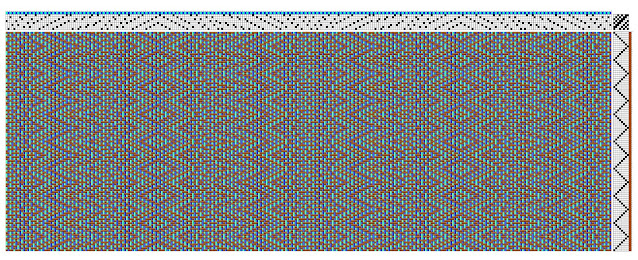
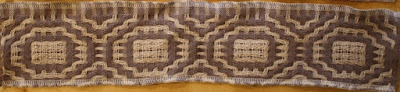
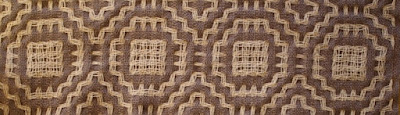
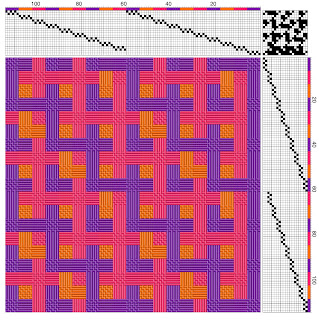
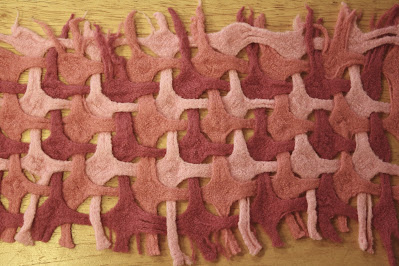
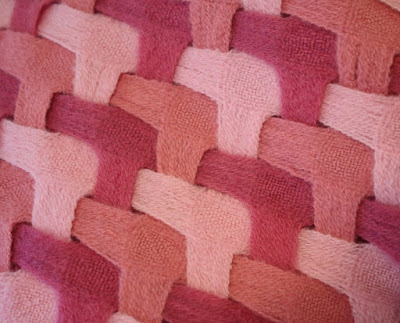
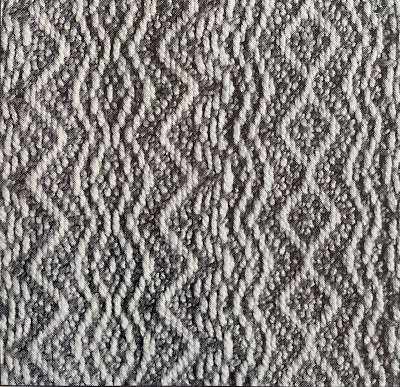
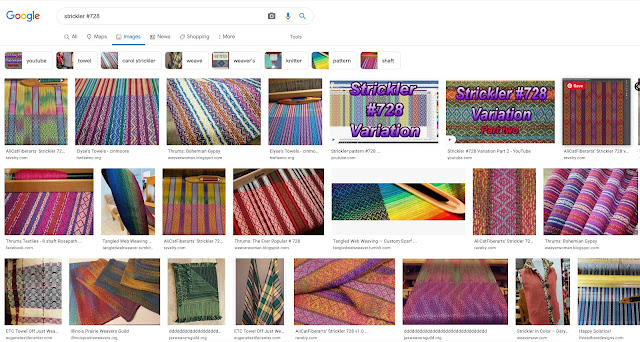
Among the 10 or 20 most popular contemporary weaving patterns, Strickler #728 (first photo) is among them, I would guess. I've seen many iterations on Facebook and it never fails to dazzle. And if you "Google" the pattern, the variations go on and on, as you can see in this screen shot from my computer....

Credit goes to Joan McCullough, who designed this intricate, ornate gem -- a Rosepath motif in multiple tabby, which is one of the favorite structures of my "weaving mother," Joyce Robards. (Shout out to Joyce, whose "Many Friends" design appears on the facing page in Strickler.)

It's the endless possibilities for interactions of color and pattern, I believe, that entice most weavers. But for this post, I would like to play with the design potential of #728 using an extended parallel threading, otherwise known as an Echo threading. Once again, McCullough's pattern shines!
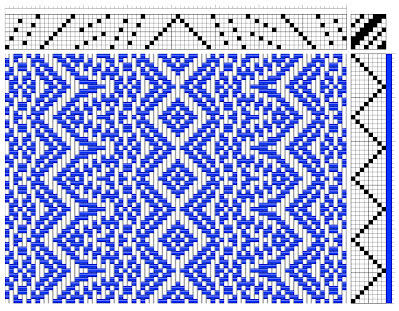
The original draft of #728

Above is the original threading, tieup, and treadling you find in Strickler. To create the same pattern in Echo, all you need to do is click on the "Warp" dropdown menu in Fiberworks, choose "Parallel Repeat," then "Overlapping Repeats Shifted by 4," and then "Apply." (Please note that the "Parallel Repeat" command is available only with Fiberworks Silver. Also, I am using a Mac, which has slightly different commands from a PC.)

Here's what you get:


Yes, there are some threading issues: above, you see there are eight sections where two sequential warps are threaded on the same shaft. My answer is simply to alter those threads by moving one of each pair up a shaft, reflecting the pattern below them (on the right) and above them (on the left). Here is the result:


Now we have a viable Echo design, using the same tieup and treadling as the original twill pattern.


I could see using different-colored stripes in the warp as weavers love to do with the original twill design, so that the linear motifs are outlined and clarified.

What about Jin? Using the same parallel threading, all you need to do is create a 4/4 descending twill tieup and add tabby shots in between. (Note that I changed the weft color to black to emphasize the patterns.)
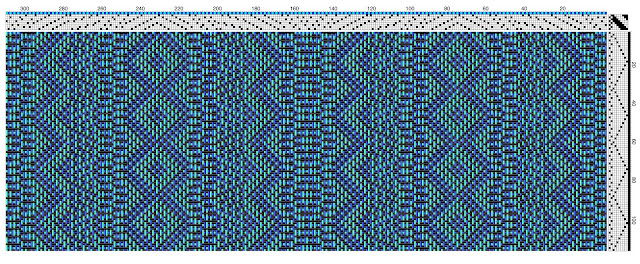
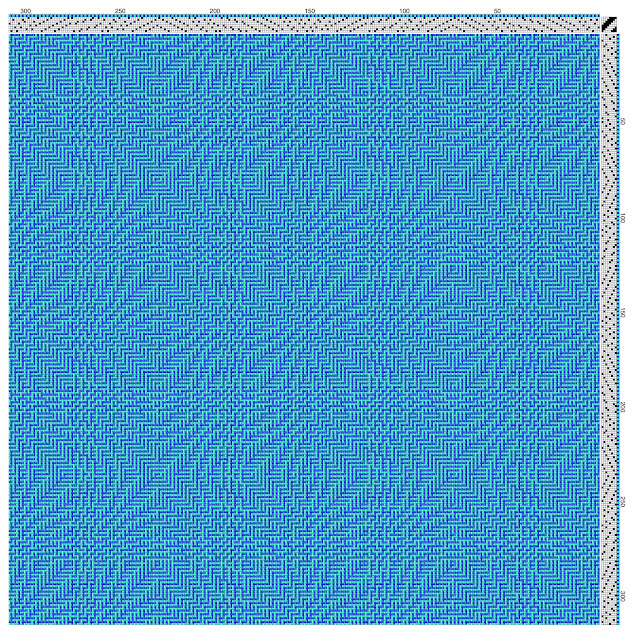
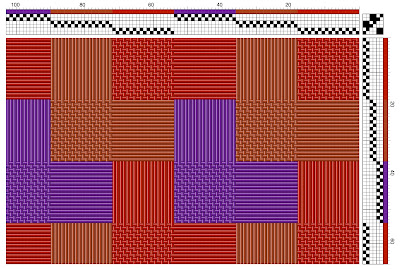
The appeal of 728 continues. So let's try Shadow Weave, which is also on a parallel threading -- as well as a parallel treadling, with a 4/4 ascending-twill tieup.

"Instrestring," as my son used to say when he was a toddler. This may be a bit dizzying, but then again, it all depends on the colors you choose and the function of the piece.

Not much different from Shadow Weave is Rep: same threading, tieup, and treadling. The only changes are that the sett goes from plain weave to denser than double weave and the weft has alternating thick-and-thin yarns.
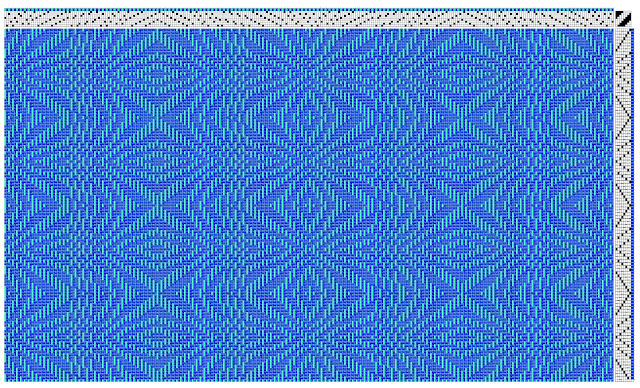

I like this. Again, I see a lot of potential for playing with different-colored stripes in the warp. 

Last, there's double weave, yet another structure that can be designed on an extended parallel threading. 
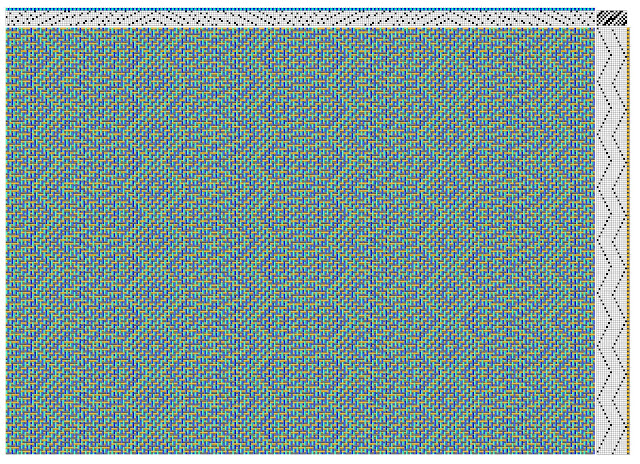
728 in double weave, front
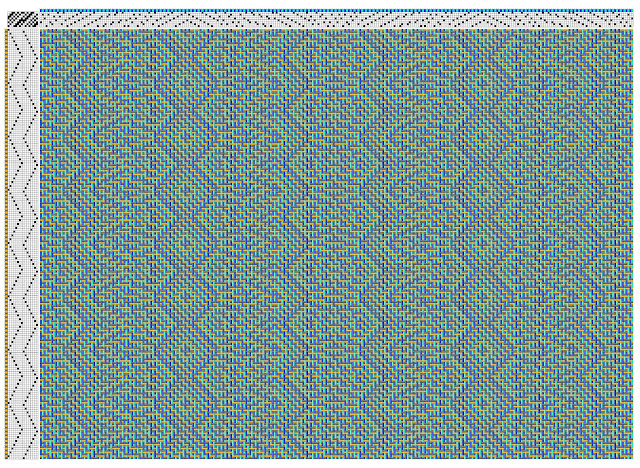
And back, although not much different

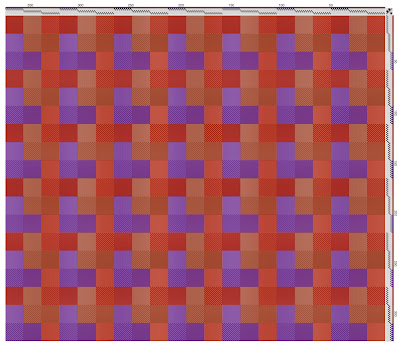
McCullough's design comes through in so many variations -- and on just 8 shafts! I got to thinking: I have a 32-shaft Megado, so I wonder what would happen if I expanded the threading to 32 shafts, using a 4-color, 4-end parallel threading?
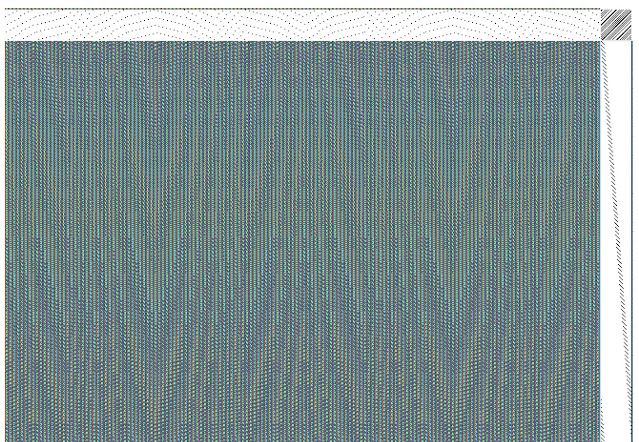

The way I see it, this pattern is something like Beethoven's Ode to Joy, endlessly pleasing, whether it's performed as a piano solo or with a full symphony and chorus. 

And who knows? Maybe I could develop a workshop on this? From Echo to Jin to Shadow Weave to Rep to Double Weave, from 8 shafts all the way to 32...

Thanks for reading!


Thursday, February 10, 2022

Collapse Techniques: Some Active Yarns and How They Work


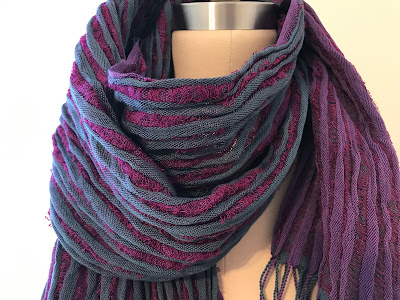
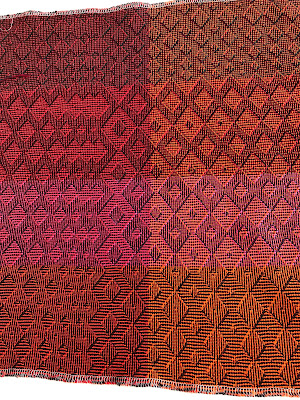
Pictured above: A scarf woven on 4 shafts in deflected double weave. The warp is 20/2 cotton in stripes of teal and purple and the weft uses these yarns plus a wool/stainless-steel yarn (see the floats above, in fuchsia). The scarf looks like gauze on the loom, but when you wash it in gentle soap and lukewarm water, the wool/stainless floats crinkle up and draw in horizontally, creating vertical pleats in the fabric.

I love these surprises in the finishing! And one of the easiest ways to achieve them is by using active or energized or exotic yarns -- a large category that includes yarns that will shrink, twist, collapse, and/or relax after washing.

Right now I'm teaching a Zoom workshop for the Reno Fiber Guild, "Deflected Double Weave for Collapse Fabrics." I put together a short handout on the active yarns we're using and how they work and I thought it was worth sharing in a blog post. Here's the list -- of course, it's not comprehensive -- along with photos and images of the yarns under magnification.

Fine Gold Gimp (Metallic Yarn)


The thicker version of this yarn doesn't work well for creating texture in fabrics, but the finer version can add a lot of interest. It's really 77% polypropylene and 23% metallic. And it's hard to find: The only vendor in the States that sells it is Made in America Yarns, a Philadelphia company that lists it under the name "fine metallic gimp yarn."

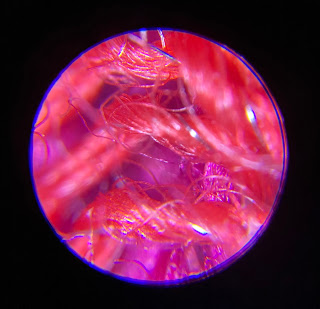
This is what a single strand looks like at 60X magnification.

And here's what it looks like after weaving and washing.


The polypropylene shrinks up with warm water and soap, bending and crimping the metallic coils around it. When used as weft, this can create some interesting motifs as it shrinks the fabric width-wise.


Wool/Stainless-Steel Yarn


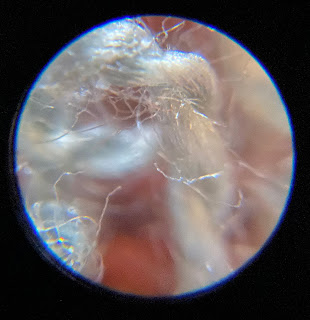
This yarn, available from Habu Textiles, is what I used as weft in the scarf pictured at the beginning of my post. You can achieve similar effects with silk/stainless-steel yarn, available from Lunatic Fringe. Here's what it looks like under 60X magnification, unwoven (first photo) and woven and washed (second photo).


The wool shrinks in the washing and the stainless-steel filament bends with it, so that the sample is drawn in. I find that you can actually shape the garment, either flattening it out or stretching it vertically to create vertical pleats. It all depends on your mood ;o)


Deflected double weave sample on 8 shafts


Deflected double weave sample on 12 shafts

18/2 Merino Wool

Nothing beats wool for differential-shrinkage effects. Combine it with cotton or silk or some other inactive yarn and you'll get pleats and poufs and lots of texture. (Note: I don't recommend using JaggerSpun Zephyr, because the silk component doesn't full in comparison with the 18/2 superfine merino. Also, be careful not to purchase super-wash wool yarn, because these yarns are chemically treated NOT to full or shrink.)

Hand-painted warp of 18/2 JaggerSpun superfine merino


1 strand of 2-ply yarn, before fulling


Magnified image of the yarn after weaving and fulling


16-shaft deflected double weave sample after fulling, using 18/2 merino and 10/2 cotton in both warp and weft (hand-painted warps and wefts)

Venne Colcolastic (and Other Elasticized Yarns)


This yarn has two components: a fine 2-ply mercerized cotton and an elasticized single. Here's what it looks like under magnification:


And here's what it looks like under magnification and after weaving and washing:


My explanation for this effect is that the elastic draws in and the cotton is drawn in with it, crinkling and twisting up as it goes. Below is a sample of a 4-shaft deflected-double-weave piece I wove with long weft floats of the Colcolastic. (You're viewing the warp horizontally.)


This second sample, below, has no floats on the front and narrow floats on the back, simply because there are just 4 warp yarns in the block it floats over. It's a 12-shaft deflected double weave. Colcolastic is used as weft for the middle section only.


Active yarns are just one way to create textured fabrics. You can also achieve dimensional effects just by weaving structures that lend themselves to texture: turned twills, honeycomb, waffle weave, and of course deflected double weave will create curves and pleats even without the aid of active yarns.

Weavers will sometimes get preoccupied with color and structure, forgetting about that third invaluable characteristic of our craft, that of texture. In her definitive book, On Weaving, Anni Albers devotes a chapter to "Tactile Sensibility," focusing on the importance of matière:

"Matière is the word now usually understood to mean the surface appearance of material, such as grain, roughness or smoothness, dullness or gloss, etc., qualities of appearance that can be observed by touch.... Surface quality of material -- that is, matière -- being mainly a quality of appearance, is an aesthetic quality and therefore a medium of the artist...."

Weaving, in her view, brings us back to our ancient tactile sense. Of course, the yarns we use are central to this achievement.

Thanks for reading!


Monday, January 17, 2022

Through the Weaving Glass: Some Thoughts on Counting Picks...


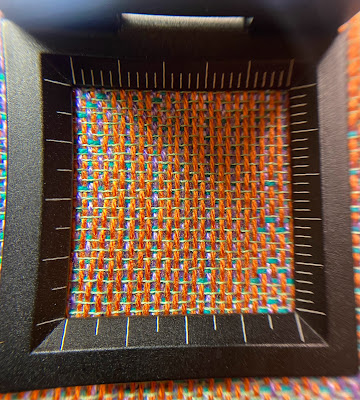
The photo above shows a "pick-glass," outlining a square inch of cloth. I took the photo with my iPhone, shooting through the lens of the pick glass, and the image is surprisingly clear.

(OK, I have to confess here that I always thought it was spelled "pic" -- until I looked up "pick-glass" on Google. Yes, it's true. Now I know.)

If you're thinking this is a useful device and you want one, you can find them on Amazon, of course, by searching for "counting glass" or "thread counting glass" or "pick counting glass." I'm sure they're used all the time in the textile industry. For weavers, it's a very handy device. 

In the photo above, I have woven what looks like a 24 picks per inch on a warp sett at 24 warp ends per inch -- which would be a balanced weave, except that I'm using different weights of yarn in the warp and the weft. (The orange warp ends are 16/2 bamboo and the pale green weft yarns are silk/stainless steel at an unknown grist, something like 20,000 yards per pound.)

Also, this is double weave, so there are another 24 warp ends and 24 weft picks on the back side of the cloth. You can see some of the warp and weft peering out in lilac and turquoise, respectively. So we're really talking about 48 epi and 48 ppi total. I decided to use my pick glass to reassure myself that I wasn't beating the gossamer-fine weft too hard.

Because weavers are persnickety, right? And rightfully so, as we want our cloth to have a good hand and our weave structures to look just so, whether it's plain weave or satin or twill or whatever. For that reason, weaving patterns will often specify ends per inch and picks per inch along with the type of yarns to be used.

If we're not paying attention, we wind up with this:

Deflected double weave with squashed motifs, woven by me when I wasn't thinking

Instead of this:

Deflected double weave with balanced motifs, after I started beating gentler

Here is another sample, a well-balanced 12-shaft shadow-weave design of mine, woven by Maryann Ariizumi:


Shadow weave should be sett and beat as a balanced weave, because the structure is essentially plain weave, with floats of 2 ends or picks here and there. Warp and weft yarns are identical, typically.

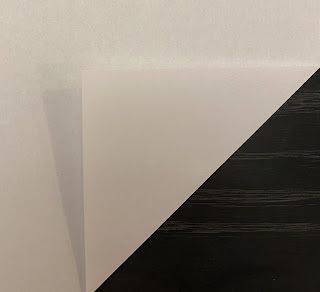
One way to achieve this kind of balance in your weaving is to simply eyeball the pattern. Twills, for instance, should rise at a 45-degree angle. Another way is to take a piece of paper and fold it in at the corner, like this: 


If you fold it carefully, so that the top of the fold falls along the horizontal and the side of the fold falls along the vertical, you'll get a 45-degree angle, which you can just place on top of your fabric to compare it with what you've woven. Works great!

But other times, when you're weaving with a fine warp and/or weft and you're aiming for a specific number of picks per inch, you will definitely want to count threads. 


A pick glass also helps in analyzing structures and trying to check out errors or the direction of yarn twist (S or Z). It's very comforting to know for certain what's going on.

In fact, I carry mine in my purse, along with a 6" ruler. How's THAT for the definition of a weaving nerd?

Same fabric as in the first photo, through the camera lens

Thanks for reading!


Thursday, December 16, 2021

Three-Layer Puzzle Scarf: Less Complex Than It Looks!


I have been working on this piece for lo, these many years, ever since I saw a photo on Pinterest with a draft that I still can't figure out. Perhaps it involves actually cutting out some of the warp blocks -- I'm talking scissors here -- to achieve the difference between the upper and lower sections of the fabric.


I know how to design the top portion of the fabric and I know how to design the bottom portion of the fabric. But how do you weave a design that incorporates both? If you look closely, you will see at the top of the photo that some of the warp blocks just disappear. I love the ingenuity of this, but I'm not prepared to weave the many, many samples required to get it right.

Around the same time, I came upon a couple of photos of work by the late, great Sandra Rude. 


Above scarves woven by Sandra Rude

I spent a long time working out the threading, tieup, and treadling for the second piece and, long story short, here is what I came up with. It calls for 20 shafts.


Although I have a loom with 32 shafts, I didn't want to replicate Rude's lovely design -- rather, I wanted to create one of my own, hopefully as interesting, but with a clearer pattern. So here is my version of a deflected-double-weave puzzle, calling for just 6 shafts:


Here's what the full drawdown looks like:


It looks quite simple to weave, right? 

Absolutely not, especially if you want to full the fabric, as I did (to reduce problems with the long floats and make the layers more distinct). I won't give you the long list of my missteps, but here's just one of the samples that didn't work.


Note that there are two warp blocks on each selvage that appear to be spaced farther away from the other blocks. Actually, the sett is the same throughout: 18 epi for 18/2 merino. The problem lies with the process of fulling itself, which stretches the outer layers away from the others. 

Details: The warp blocks were 18 ends each. The sett was 2 ends per dent in a 12-dent reed for 9 dents and then leave 3 dents empty and repeat. I had to weave the weft blocks in a similar fashion, which called for a very careful, gentle beat.

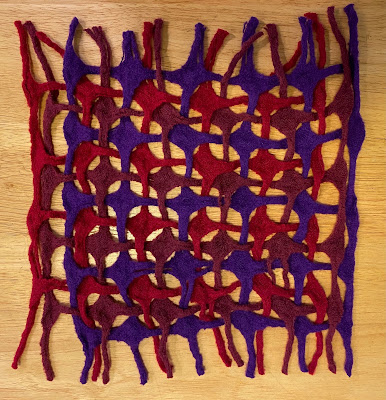
In my view, the above sample looks like some kind of netting. So I put on another, longer warp and decided that I would first create more samples and then weave a long scarf once I got it right. For this next set of samples, I spaced the two warp blocks on either selvage just one dent apart, leaving the remainder of the blocks 3 dents apart as I did with the first sample. 

Here's how that looked (you can't really see the blocks at the selvages -- but they're better, trust me):


Better, yes, but still not what I was going for. I wanted a softer, flatter appearance, somewhere between the gauzy fabric you'd get if you didn't full it at all and the rope-like, corded fabric you see above. Finally it dawned on me: I needed to talk to a felter! Felters know a lot about what you might call the Goldlilocks Effect, making sure their fabric is not too stiff yet not too gauzy.

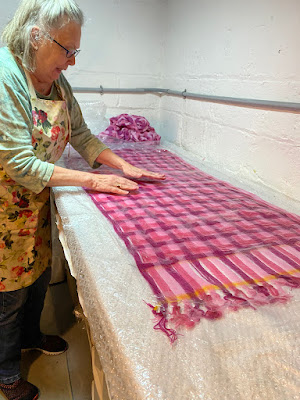
And this is what fiber friends are for. So I called up Marie Brate, a talented felter in our guild, and asked her to give me some pointers. Marie brought over some bubble wrap and showed me how to keep the fabric flat and add just enough soapy water to encourage fulling.


Marie Brate to the rescue!

Sometimes I feel like it takes me a long time to figure things out -- to realize that this shawl called for skillful weaving AND skillful fulling. Prior to having this seemingly obvious insight, I would simply agitate a piece like this in the washing machine or by hand. I've learned that this creates a much denser look. There is a place for that, but not for a scarf that I want to wear.

Turns out the finishing was harder than the weaving itself. It took hours, mainly because I wanted the details to be just right, which included separating every layer at every juncture by hand.


I went through this entire process once and saw that the fabric truly needed more fulling. So I washed and fulled it again -- and then I had to separate each and every layer again, by hand.

It was worth it, however, because I'm happy with the results. 


Thanks for reading!


Sunday, November 21, 2021

A New Book from Ann Richards: 'Weaving Structure and Substance'


This is a case where you can judge a book by its cover: One, it's written by Ann Richards, a weaver who for decades has achieved a singular beauty in her work. And two, the photo itself captures you, presenting a detailed image of her elegantly constructed "origami" cloth.

The text and photos do not disappoint. Richards, who trained as a biologist before studying weaving at the West Surrey College of Art and Design (now the University for the Creative Arts, Farnham), brings her skills of scientific analysis and her love of nature to bear on her art. In Chapter 1, "Endless Forms Most Beautiful," next to sketches of a dragonfly wing detail and a cross section of its edge, she shares a photo of one of her pleated fabrics. (All photos and images are provided courtesy of Ann Richards.)


Sketch, detail of a dragonfly wing

Cross-section, the front part of the wing


Detail of a pleated fabric woven by Richards, with the caption:
"Warp: Linen. Weft: Crepe silk and hard silk, 
with picks of linen at intervals 
serving as 'struts' to stiffen the pleating."

If you were to look at a cross-section of the woven fabric, you would delight in seeing that the pleats are quite similar to those of the dragonfly wing. 

"Weaving Structure and Substance" is not a how-to book, although it does offer instructions for designing, materials, and finishing. Foremost, it's a discussion and analysis of how Richards and other weavers she admires create their work. The book has four parts: "Nature as Designer," "Resources for Design," "Designing for Fabric Qualities," and "Designing Through Making." There are chapters devoted to fibers and yarns, structures, the quest for textural qualities and forms, sampling, and the notion of "reflective practice." Further, there is an extensive bibliography as well as a list of online resources and suppliers.

The photos are inspirational. Below is a piece she calls "Soft Pleat Scarf," showing both the front and the back. She offers these details: "This silk and linen scarf has a striped effect created by the reversal of the pleats. The weft colour remains the same throughout so this is a 'structural' stripe that disappears when the fabric is stretched to its full width. Warp; Linen 77 lea, 72 epi and spun silk 60/2 Nm, 54 epi. Weft: Spun silk 210/2Nm, 48 ppi."


The delicacy, refinement, and simplicity of this piece represents the highest level of planning, design, and resolution. And yet the concept is easy to grasp: The shifting blocks -- seen in the thin horizontal white and black stripes -- are achieved by reversing the structure from the back to the front, requiring two blocks in the threading.

It is her depth of understanding and ability to exploit the unique potential of her materials that produce such inimitable designs. Appropriately, she quotes Darwin: "Whilst this planet has gone cycling on according to the fixed law of gravity, from so simple a beginning endless forms most beautiful and most wonderful have been, and are being evolved."

Richards's signature pieces are necklaces, collars, and bracelets with origami folds.
Her caption: "These triple spiral bracelets are assembled 
from offset sections of pleated fabric. Warp: Silk/steel 82/2 Nm (pleats) 
and spun silk 60/2 Nm cords). Weft: Crepe silk and polyester reflective yarn."

This is Richards's second book from Crowood Press, her first being the best-selling Weaving Textiles that Shape Themselves. As with the first, her new book includes lavish photos of her work and that of Wendy Morris, Stacey Harvey-Brown, the late Junichi Arai (founder of Nuno), and many others (including me, I'm proud to say). 

Note: I think by now you can guess I'm a huge fan -- to the point that about six years ago I traveled to London to study with her at the Handweavers Studio and Gallery. Her cordiality and relaxed demeanor belied the energy, observation, and creativity she brings to her work.

Dimensional, tactile weaving is a sub-category of weaving that spans broadly, from fulled fabrics to Leno gauze to exploiting the properties of specialized yarns such as crepe, overtwist, and elastic, to name a few. I highly recommend this book to weavers who are interested in what can broadly be termed "dimensional weaving" -- and also to those who are keen to learn more about how attention to materials and structure can improve their work.

WEAVING STRUCTURE AND SUBSTANCE by Ann Richards. The Crowood Press, Ramsbury, Marlborough, Wiltshire, SN8 2HR, United Kingdom. Hardcover. 175 pages. $32.45.

Oh yes, and if you happen to be in London between now and February 2, 2022, be sure to stop by the Handweavers Studio and Gallery at 140 Seven Sisters Road. There, you'll be able to see first-hand what these techniques can achieve.