Showing posts with label 10/2 Tencel. Show all posts

Saturday, July 18, 2020

Zooming Ahead with Deflected Double Weave


8-shaft Deflected Double Weave sample by Karen Berk. 
Warp and weft yarns are 10/2 Tencel/cotton (in fuchsia) 
and 18/2 Jagger Spun superfine merino.


Like many of us these days, I've been Zooming a lot with friends and family. All of my workshops through January have been cancelled, so I've begun teaching on Zoom -- in some cases, to replace my cancelled on-site workshops and in other cases because guilds are scrambling to offer remote workshops for this fall.

While Zoom workshops can't replace face-to-face communication and hands-on learning -- not to mention the joy of actually touching a handwoven sample -- online workshops can offer a worthwhile learning experience. It all depends on the investment of the students, in my view. And I can't say enough about the investment of the weavers who took my recent workshop, "Deflected Double Weave for Collapse Fabrics."

It served as a fundraiser for the Weaving and Fiber Arts Center here in Rochester, NY (the teaching arm of the Weavers' Guild of Rochester) and also helped test-drive the Zoom format for both the center and our guild. Weavers joined us from near and far -- from California to Canada to Michigan to Virginia to Delaware -- with the bulk of us coming from the Rochester area. 

Over the course of eight sessions in 2 1/2 days -- June 22, June 29 and July 6 -- we gathered on Zoom to study handouts and samples, to analyze drafts in Fiberworks, to view PowerPoints and, thanks to Google Drive, to survey everyone's work. In between sessions, we communicated largely via email and sometimes on the phone. 

Here are more samples:

 
12-shaft Deflected Double Weave sample by Lillian Whipple.
Warp and weft yarns are 10/2 cotton and lace-weight wool/silk.
The gold yarn is the black motifs is real gold.


4-shaft Deflected Double Weave sample by Barbara Mauger.
Her warp and weft yarns are 8/4 Tencel. 
The gray weft yarns are wool crepe.
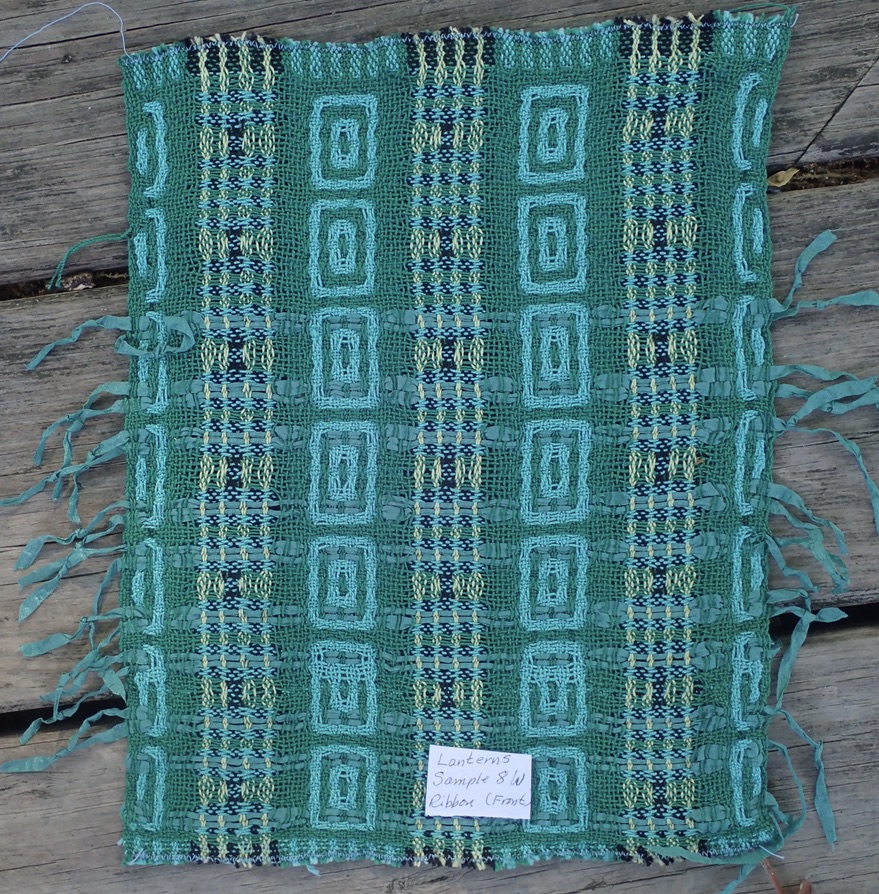

12-shaft Deflected Double Weave sample by Linn Sadjak.
Her warp and weft yarns are 10/2 cotton. 
In this sample, she added picks of rayon-tape yarn.
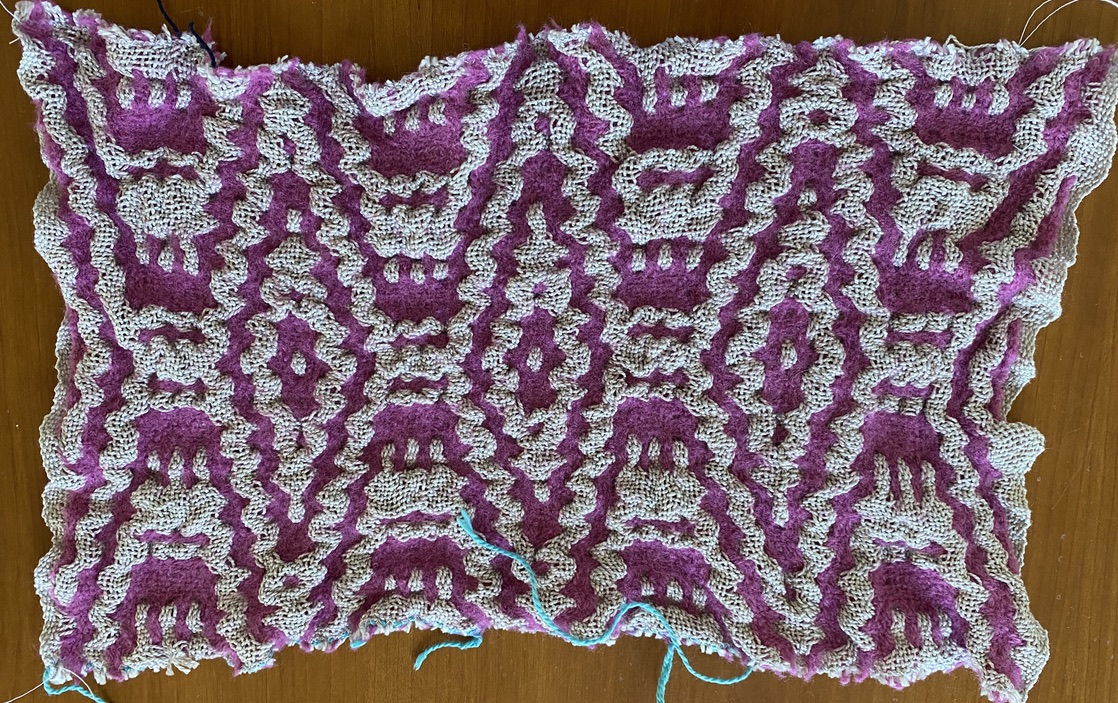

This sample by Jaime Pierce has 10/2 cotton (off-white)
and 18/2 Jagger Spun superfine merino (magenta) in warp and weft.


This is a sample by Eleanor Hartquist shown before finishing.
The gold-colored wefts in the upper horizontal stripe (mostly black) 
will draw the fabric in, creating vertical pleats, after washing.


This 4-shaft sample by Marianne Antczak
uses Colcolastic in the weft (in purple/pink) 
to draw the fabric in width-wise.


Cindy Greenfelder wove this 8-shaft swatch 
using 18/2 Jagger Spun superfine merino (in dark purple) 
to create puckers and pleats after finishing.

My takeaway: Despite the pandemic and social distancing, weavers want to keep on learning. And let's face it, weaving can be a solitary pursuit, so we thoroughly enjoy the company of other weavers. It's why we gather.

For anyone considering teaching or taking a Zoom workshop, I have a few lessons. First off, schedule a dress rehearsal within a week before the class. That way, you can iron out all the kinks -- technology problems, questions about the workshop format, questions about the weaving itself -- before the actual work begins. Who wants to waste time with technology when we could be talking weaving, right?

Another point: For teachers, it's useful to have a document camera on your desk so that everyone can see your samples up close, pick by pick, in focus, well lit and not in motion. (For those of you who have tried holding a sample up to the camera on your computer for others to see, you'll know what I'm talking about.)

A third idea, suggested by a weaver in another Zoom workshop, is to set up a Google Drive file dedicated to the workshop. I uploaded handouts, photos, drafts and other resources and, more important, created an individual file for everyone so they could upload their photos and then I could share them with the group. 

One big benefit is that you can have another teacher take over (in Zoom language, they serve as a co-host, meaning that they can share images from their home computer). In our case, we were fortunate to have Joyce Robards (whom I call my "Weaving Mother" even though we are not that far apart in age) give a presentation on Marian Stubenitsky's newest book, Double with a Twist, which has a different approach to drafting designs.

The course evaluations surprised me, with some folks saying that they actually preferred the Zoom format, mostly because they could weave on their own looms (no schlepping everything to the workshop site) and they had plenty of time to absorb information and work on their samples (no rushing to get everything done in the normal format of 2-1/2 days).

To me, this means that, while nothing can replace the learning that comes with an on-site workshop, much can be gained by teaching or taking a workshop over Zoom. Maybe the greatest benefit is that online workshops can bring weavers from around the globe together virtually, building a sense of community and adding another option to learn about our craft.

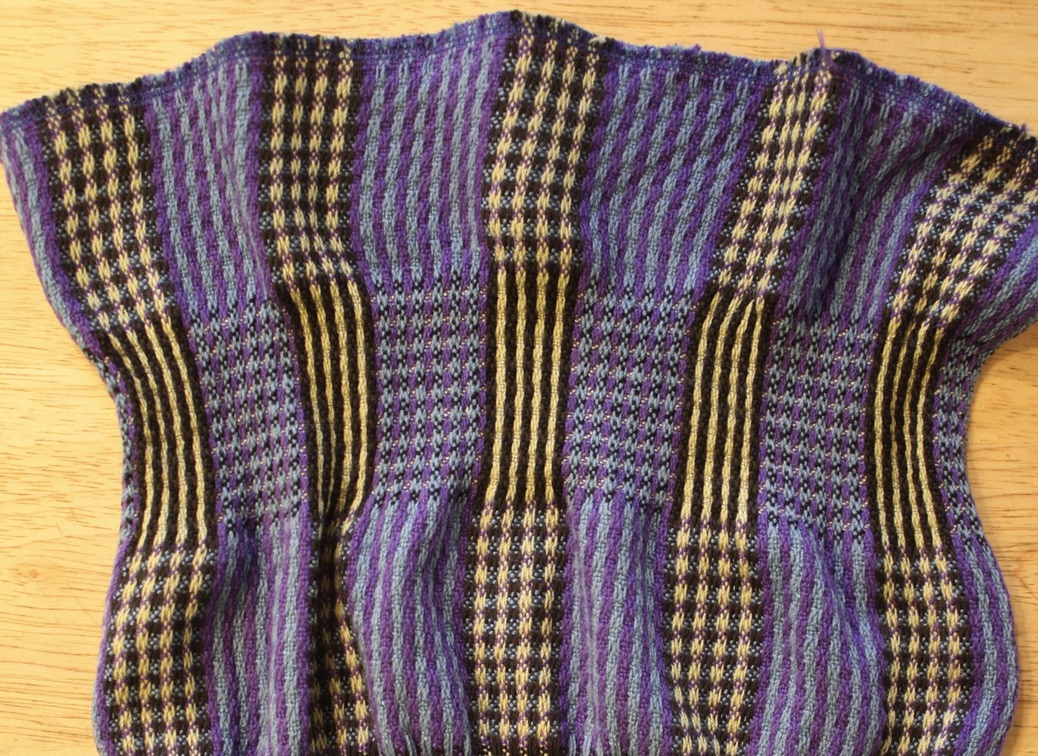
I'll close with a Deflected Double Weave sample I wove on 12 shafts using Colcolastic in the middle section (black and gold vertical stripes) to achieve width-wise shrinkage. I wove this in 10/2 cotton, using four colors in both warp and weft, substituting the Colcolastic for one of the colors as I wove the mid-section.

Thanks for reading!
 

Thursday, February 14, 2019

Weaving Heartfully: Happy Valentine's Day!


"heartfully." en.oxforddictionaries.com. With the whole heart; with enthusiasm, conviction, or intense feeling; warmly, cordially; devotedly.

What a great word! And what a great draft. I found it online, probably on Pinterest, and I have no idea where it came from, unfortunately. (Update: Thanks to Janice Jones, who kindly sent me an email about this, it comes from Oelsner's Handbook of Weaves, also available as a download from Handweaving.net.) Here's what it looks like in Fiberworks.


16 shafts, a 36-treadle repeat -- perfect for my Toika compu-dobby. I had a 10/2 Tencel warp on hand (wound from hand-dyed yarns by Teresa Ruch, with a solid purple yarn and a variegated red and purple yarn, purchased at Convergence 2018) and I sett it at 28 epi (for twill). The weft is 10/2 pearl cotton in red. Judging from the hand of the fabric on the loom, it's a bit too dense and heavy for a scarf. Perhaps it would work for a purse or a bag for my yoga mat? Then again, the hand might change substantially in the washing....

And then I got to thinking: Valentine's Day is here. So why not take this design and turn it into heart shapes, just by altering the tieup?  

Take a look at the scallop shapes in the tieup above. It's a damask weave, so the tieup is warp-emphasis for the purple sections in the drawdown and weft-emphasis for the turquoise sections. [Damask is defined as a fabric formed from satin (warp yarns floating over 4 or more wefts) and sateen (weft yarns floating over 4 or more warps) weaves, used to create reversible figured designs.] And the motif is split in half, because when you thread a point draw (shafts 1 to 16 and back down to 1), the motif reverses itself, creating the second half of the scallop shape.

I played around quite a bit, working to create a warp-emphasis heart shape against a weft-emphasis background, which required tie-down warps and wefts placed strategically. I had to keep in mind that there would be floats, because you really can't expect to have tie-downs in total symmetry. What's more important is the silhouette of the heart shape.


So here's what the draft looks like now.


I haven't woven it yet, because the original design is still on the loom -- but I could change that easily, right? That's the beauty part of having a computer loom. 

So there you have it, a heartful draft for Valentine's Day! Thanks for reading.

Oh and one note before I close: Google Plus will be shutting down in March, which means that people who subscribe to this blog through Google Plus will no longer get my posts. So please change your method of receiving posts by clicking "Follow" in the blue rectangular box below all the miniaturized photos on the left-hand margin of my home page. Or you can click on the red box under "FeedBurner Subscribers." 

Either way, I hope you'll continue as a follower. I appreciate you being a part of my online community.


Friday, September 14, 2018

Baby Wrap in 16-Shaft Echo and Jin: On My New Computer Loom!


Echo, which is a border at the beginning and the end of the wrap

A detail

Great news! I have a new (to me) computer dobby loom: a 16-shaft Toika Eeva with a 40 cm weaving width. This Scandinavian beauty came to me by way of my friend and fine weaver Hedy Lyles, who enjoyed this loom but was moving up to 24 shafts.

Here's Eeva, getting dressed. 


A view from the back of the loom

I wound a warp of 10/2 Tencel, 1187 ends, 8 yards long, so that -- at 40 epi -- I would have a weaving width just shy of 30" and plenty of length for sampling before I weave up a 5-yard-long wrap. 

Because I've been teaching a lot of workshops on 4-shaft, 8-shaft, and 12-shaft Echo (and other structures you can weave on the same threading, using different tieups and treadlings), I decided to expand my repertoire to 16 shafts. Here's just a section of the Echo design, based on an advancing point twill in both threading and treadling.

I can't really show you the entire drawdown because it's too large to reproduce on this page. Anyhow, it gives you the idea: I broke up the pattern line in several spots because I like the abrupt shift, almost giving the impression of stripes.

The wrap will be Echo for just 24" on each end, with Jin filling up the center. I did this for two reasons: 1) I love the variations between the two structures and 2) the Echo pattern has warp floats of as many as 5 picks while the Jin design, by definition, never has a float of more than 3 picks. So I figured that the fabric woven in Jin would be just that much stronger and more durable when it comes to supporting an infant.

Here's what the Jin design looks like (again, only a portion of it, as the entire design wouldn't show up well at all in this narrow space). Because I'm showing you just a portion, the design looks asymmetrical -- but the pattern is symmetrical.
And here's what the Jin design looks like on the loom:


The other side of the fabric (maybe a bit harder to see)

I find that there is a bit of a learning curve with a computer loom. For instance, if I have a misstep on the pedal that controls the treadling, it's hard to instruct the weaving program to go back. At least for me it is: sometimes the computer wants to loop around and I find myself right back where I started, having to unweave. And then you have to tell the computer to unweave. It's a tricky conversation, at least until I get the hang of it.

The upside is that the weaving goes much faster and is less physically taxing. This is especially helpful with a 20/2 cotton weft, which I'm weaving at about 30 picks per inch.

And another advantage: those 16 shafts! There is a lot to learn and a lot of designing to do and I'm looking forward to it.

Back to the wrap itself: One of the things I love about Echo and Jin is the color dynamics. I deliberately chose an unlikely combination of warp colors -- burgundy and turquoise -- because I knew from experience that the weft alters the overall color of the fabric in surprising ways, often producing the iridescence that Marian Stubenitsky covers so well in her book, Weaving with Echo and Iris. For the weft I chose an orange/coral color, sort of a cantaloupe, because it warms up the warp, so to speak. Below is a photo of samples of different-colored wefts, with the cantaloupe-colored weft at the very bottom of the photo. 


This is a very special project for a very special new person in our lives: Our first grandchild, Owen, who is now almost 3 months old. I think it will look good on him, don't you?