Showing posts with label Colcolastic. Show all posts

Sunday, April 28, 2024

Notes from CNCH, the Conference of Northern California Handweavers


Let's start with the photo above: a series of samples woven on eight shafts in deflected doubleweave by Marta Shannon. It's just one picture of dozens of interesting, colorful, and always original samples created by weavers in my workshop this past weekend: "Deflected Doubleweave for Collapse Fabrics."

The goal of my workshop was twofold: 1) to teach weavers to recognize and even design deflected doubleweave patterns and 2) to push the already tactile, off-the-grid quality of DDW by using "energized" yarns such as Colcolastic, metallic gimp, wool-stainless steel, silk-stainless steel, overtwisted linen singles in S and Z twist, overtwisted wool singles in S and Z twist, and, of course, the ever-reliable Jaggerspun 18/2 superfine merino, which fulls beautifully when you give it some wiggle room in the cloth. (Bottom line: plain weave resists fulling and other collapse techniques, because it's the most stable, firm structure of all, while DDW encourages pleating, poufing, and billowing of your fabric because it has warp and weft floats built in, by design,)

That's a lot of words, so here are some photos to give you a better idea of what we were working on.

Some four-shaft samples woven with wefts of both active and inactive yarns. Weaver Rusti Icenogle points to the bottom sample, which pleats vertically because the rose-colored weft is wool/stainless-steel yarn, which fulls and draws the fabric in after it's washed and agitated with hot water and soap.

You know that famous quote, I think it's from Laura Fry, "It ain't finished until it's finished"? We spent a lot of time at the sinks in the ladies' room scrubbing away at our samples, using regular hand soap....

Above, a series of samples woven by Autumn Barr, who was weaving on her brand new eight-shaft loom for the first time. Her warp was 10/2 cotton (brown) and 18/2 merino (white) and she alternated these two yarns as weft also. It's hard to see in this photo, but the sample at the bottom shows lots of horizontal pleats in the brown stripes, which are drawn in as the white wool fulls in the washing.

This sample belongs to Denise Lee, who wove an eight-shaft pattern I call Mardi Gras. For this sample, she alternated green Colcolastic and 10/2 cotton in the weft. The Colcolastic yarn, brand name Venne, has a 20/2 cotton strand combined with a strand of elastic, which shrinks up immediately when washed.

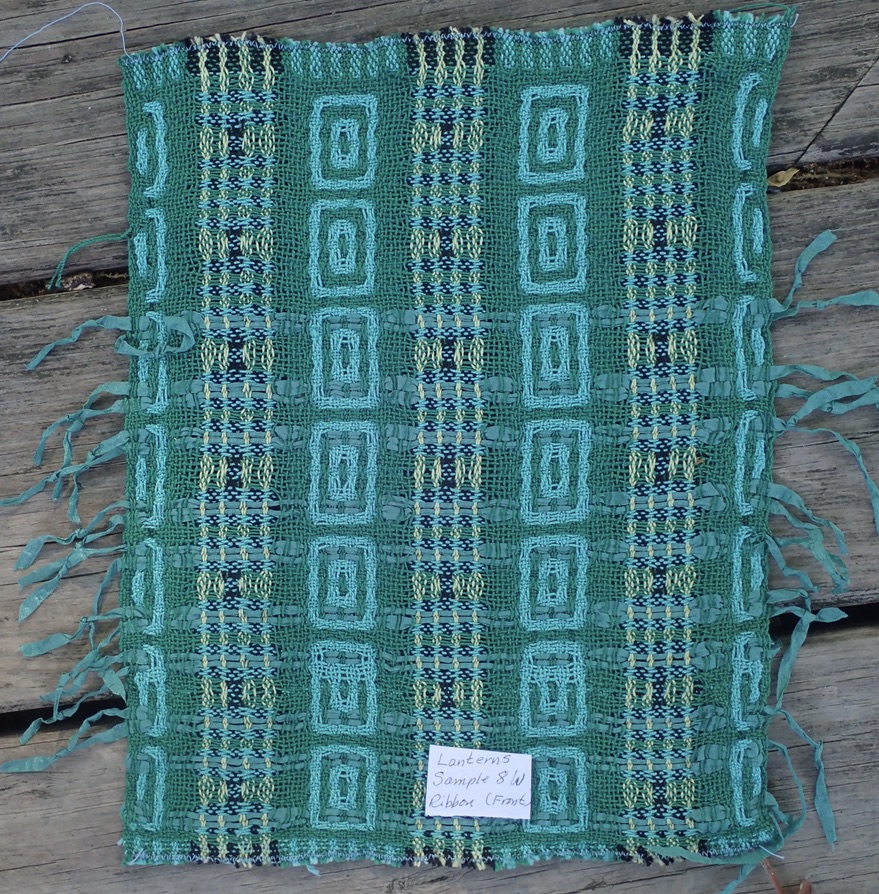
These samples are woven on eight shafts by Colleen Harvey-Arrison. The larger blocks in teal are 18/2 merino, which fulls and draws in the magenta cotton blocks, adding texture and making them curve and flow over the fabric.

The CNCH conference, affectionately known as "Cinch," is held every year in a different area of northern California. It's well worth attending, with exhibits, vendors (including Lunatic Fringe Yarns, Dharma Trading, and Eugene Textile Center), a keynote speech (this year by tapestry artist Susan Iverson), terrific meals, and lots of friendly fiber artists.

Take Sara Lamb, for instance, who is a well-known author, teacher, spinner, dyer, and weaver.


Sara wears a jacket she wove and sewed, of course! Plus the yarns are handspun silk that she dyed, all plain weave in structure -- showing off those yarns to the maximum.


The cloth is warp-emphasis (and is displayed horizontally in this photo).

I got to rub shoulders with other weaving royalty as well: seen below, Ana Lisa Hedstrom and Peggy Osterkamp. I had dinner with Peggy -- during which at least two weavers came up to our table to thank her for her many books that helped them build their weaving skills.


I fell in love with this tapestry on exhibit, shown below, titled "Pandemic Oasis" and woven by Nancy Isaac of the Loom and Shuttle Guild in San Francisco.


I also fell in love with this tatted piece, a work in progress by Nancy Alegria, in which she is recording the temperature and the sunlight (encoded in colors) of every day in 2024.


Even after the conference, I'm still taking it all in. Lots of learning, too many purchases (I won't list them, but there was yarn involved), and great camaraderie. 

Here's to next year!


Saturday, October 21, 2023

'Weaving Outside the Box' with Katherine Luhring of Lunatic Fringe Yarns

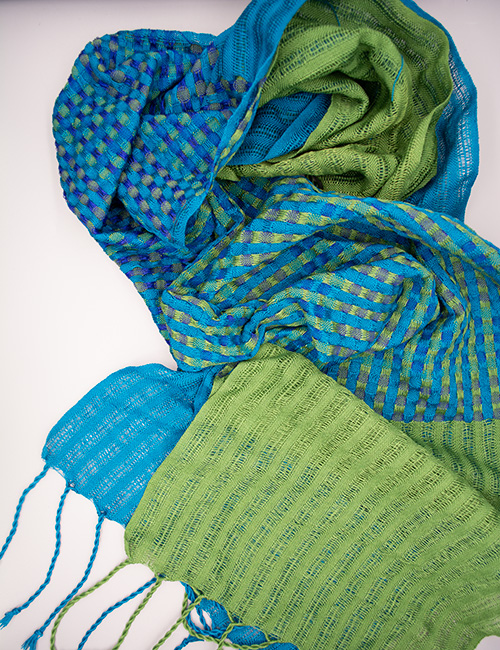
Deflected doubleweave scarf woven by Katherine Luhring from my workshop, 
"Weaving Outside the Box"

This month I'd like to share an essay by "Katzy" (pronounced "KAHtzee") Luhring, one of the managers at Lunatic Fringe Yarns. Some background: Over the summer, I taught "Weaving Outside the Box: 12 Projects for Creating Dimensional Cloth" at the Intermountain Weavers Conference in Logan, Utah, a workshop based on my book of the same name. We were lucky to have Katzy in our class, as she brought a lot of knowledge and information about some of the special yarns that are sold by Lunatic Fringe. 

Here's a post she wrote for the Lunatic Fringe blog, starting with an introductory paragraph about her weaving adventures. Thank you, Katzy!

_____________________________________________________

We Lunatics have gone to a lot of conferences over the 30-plus years that we have been in business.  However, it isn’t very often that we give ourselves the time to participate in the classes offered at the conferences. This year at IWC in Logan Utah, we sprang our fearless leader, Katzy, from booth duty so she could take Denise Kovnat’s dimensional-cloth workshop. Let her tell you about a few of the wonderful things she learned along the way.

By Katzy Luhring

Denise Kovnat’s dimensional-cloth workshop at IWC was a fabulous opportunity to experiment with interesting yarns and learn some new things! Denise asked all the class participants to choose a project from her book,  "Weaving Outside the Box, 12 Projects for Creating Dimensional Cloth." I chose project #1, the Deflected-Doubleweave Scarf on four shafts.  To be perfectly honest, I chose it because the project didn’t have too many ends, it used 10/2 mercerized cotton yarns, and it would fit on the 4-shaft Wolf Pup Loom that we had room to take with us to Logan. Seemed like a perfect fit all the way around!


I wanted to spend the workshop time making samples and learn more about elastic yarn during the workshop.  To give myself plenty of warp for playing, I wound a six-yard warp of 10/2 Tubular Spectrum Thyme and 5 Blue. This was twice the warp length that Denise recommends in her book. I knew I would have plenty of warp to experiment to my heart's desire.

What Is Colcolastic Cotton Yarn?

Denise's instructions call for Colcolastic cotton yarn for one of the weft yarns. This is a yarn that I was unfamiliar with, but after a quick Internet search, I found it at Lone Star Loom Room. When I received the yarn (in a very short amount of time), I discovered that the yarn is a two-stranded yarn: One strand is 20/2 cotton and one strand is a thin elastic, and these two yarns are wound together onto the spool. I could make my own yarn by using one strand of 20/2 Tubular Spectrum mercerized cotton yarn and combining it with any of our thin elastic yarns: ramie, cotton, silk. The color possibilities are endless!

And how did these two yarns wind onto a bobbin? No problem there. I have since used both a hand winder and an electric bobbin winder to wind the spools from two cones and have not had any trouble with the yarns getting tangled either as I wound onto the spools or while I was weaving. 


Play Time!

Three days of class trying different yarns and learning how the weave structure works and interacts with the weft yarns. It was heavenly! I tried elastic ramie, elastic silk, elastic cotton, both by themselves and with cotton yarns. I experimented with weft yarn colors to see how the two layers interacted. So much experimenting and so many things to try!


Not So Plain Weave.

Denise designed an interesting project: The first 18" is doubleweave with a top layer and a bottom layer. When I first warped the loom and sleyed the reed, I couldn't understand how we were going to get a functional fabric in those first 18" from the big spaces that are in between the yarns on each layer. There are gaps of about 1/4 inch! I trusted Denise's instructions and wove the fabric with the weft yarn floating across those gaps. When the fabric is washed, the warp yarn shifts over to fill the gaps and you can an interesting, almost plain-weave fabric with lots of drape.

Plain-weave section before washing

Plain-weave section after washing

Splash! Now to Make Things Go Bump!

The center section of the scarf contains the elastic and cotton weft. There is a nice texture to the fabric while on the loom, but it is relatively flat.  And the fabric remains flat when you take it off the loom.  The magic really happens when the fabric gets wet! When washed, the elastic in the weft shrinks up and takes the warp yarns along for a ride, creating ridges in the fabrics.  The 20/2 weft yarns bubble up and make a loopy texture on one side of the fabric.  You can stretch the fabric out to see how it originally looked, but when you let it go, the pleats reappear. Magical!

Center section before washing

Center section after washing

To the Loom!

When I left Logan, my brain was bursting with new ideas and I have been spending lots of time at the loom finishing up the first batch of scarves and working on new ones.  Thanks Denise for a wonderful workshop!

Finished scarf before washing


Saturday, July 18, 2020

Zooming Ahead with Deflected Double Weave


8-shaft Deflected Double Weave sample by Karen Berk. 
Warp and weft yarns are 10/2 Tencel/cotton (in fuchsia) 
and 18/2 Jagger Spun superfine merino.


Like many of us these days, I've been Zooming a lot with friends and family. All of my workshops through January have been cancelled, so I've begun teaching on Zoom -- in some cases, to replace my cancelled on-site workshops and in other cases because guilds are scrambling to offer remote workshops for this fall.

While Zoom workshops can't replace face-to-face communication and hands-on learning -- not to mention the joy of actually touching a handwoven sample -- online workshops can offer a worthwhile learning experience. It all depends on the investment of the students, in my view. And I can't say enough about the investment of the weavers who took my recent workshop, "Deflected Double Weave for Collapse Fabrics."

It served as a fundraiser for the Weaving and Fiber Arts Center here in Rochester, NY (the teaching arm of the Weavers' Guild of Rochester) and also helped test-drive the Zoom format for both the center and our guild. Weavers joined us from near and far -- from California to Canada to Michigan to Virginia to Delaware -- with the bulk of us coming from the Rochester area. 

Over the course of eight sessions in 2 1/2 days -- June 22, June 29 and July 6 -- we gathered on Zoom to study handouts and samples, to analyze drafts in Fiberworks, to view PowerPoints and, thanks to Google Drive, to survey everyone's work. In between sessions, we communicated largely via email and sometimes on the phone. 

Here are more samples:

 
12-shaft Deflected Double Weave sample by Lillian Whipple.
Warp and weft yarns are 10/2 cotton and lace-weight wool/silk.
The gold yarn is the black motifs is real gold.


4-shaft Deflected Double Weave sample by Barbara Mauger.
Her warp and weft yarns are 8/4 Tencel. 
The gray weft yarns are wool crepe.


12-shaft Deflected Double Weave sample by Linn Sadjak.
Her warp and weft yarns are 10/2 cotton. 
In this sample, she added picks of rayon-tape yarn.


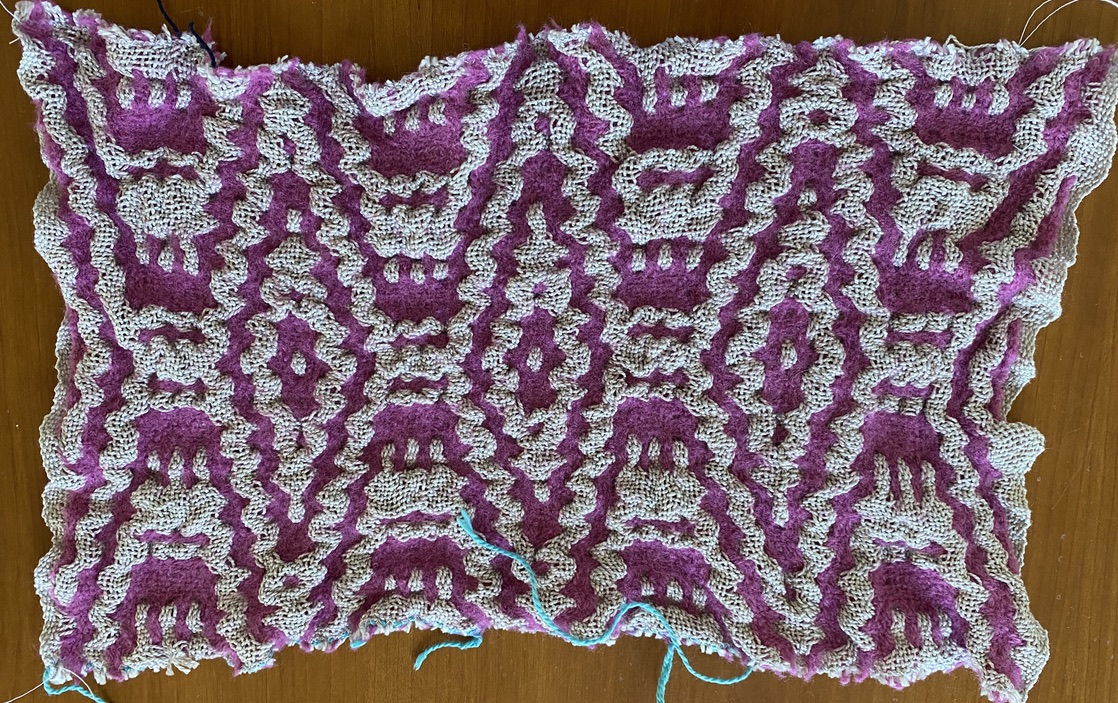
This sample by Jaime Pierce has 10/2 cotton (off-white)
and 18/2 Jagger Spun superfine merino (magenta) in warp and weft.


This is a sample by Eleanor Hartquist shown before finishing.
The gold-colored wefts in the upper horizontal stripe (mostly black) 
will draw the fabric in, creating vertical pleats, after washing.


This 4-shaft sample by Marianne Antczak
uses Colcolastic in the weft (in purple/pink) 
to draw the fabric in width-wise.


Cindy Greenfelder wove this 8-shaft swatch 
using 18/2 Jagger Spun superfine merino (in dark purple) 
to create puckers and pleats after finishing.

My takeaway: Despite the pandemic and social distancing, weavers want to keep on learning. And let's face it, weaving can be a solitary pursuit, so we thoroughly enjoy the company of other weavers. It's why we gather.

For anyone considering teaching or taking a Zoom workshop, I have a few lessons. First off, schedule a dress rehearsal within a week before the class. That way, you can iron out all the kinks -- technology problems, questions about the workshop format, questions about the weaving itself -- before the actual work begins. Who wants to waste time with technology when we could be talking weaving, right?

Another point: For teachers, it's useful to have a document camera on your desk so that everyone can see your samples up close, pick by pick, in focus, well lit and not in motion. (For those of you who have tried holding a sample up to the camera on your computer for others to see, you'll know what I'm talking about.)

A third idea, suggested by a weaver in another Zoom workshop, is to set up a Google Drive file dedicated to the workshop. I uploaded handouts, photos, drafts and other resources and, more important, created an individual file for everyone so they could upload their photos and then I could share them with the group. 

One big benefit is that you can have another teacher take over (in Zoom language, they serve as a co-host, meaning that they can share images from their home computer). In our case, we were fortunate to have Joyce Robards (whom I call my "Weaving Mother" even though we are not that far apart in age) give a presentation on Marian Stubenitsky's newest book, Double with a Twist, which has a different approach to drafting designs.

The course evaluations surprised me, with some folks saying that they actually preferred the Zoom format, mostly because they could weave on their own looms (no schlepping everything to the workshop site) and they had plenty of time to absorb information and work on their samples (no rushing to get everything done in the normal format of 2-1/2 days).

To me, this means that, while nothing can replace the learning that comes with an on-site workshop, much can be gained by teaching or taking a workshop over Zoom. Maybe the greatest benefit is that online workshops can bring weavers from around the globe together virtually, building a sense of community and adding another option to learn about our craft.

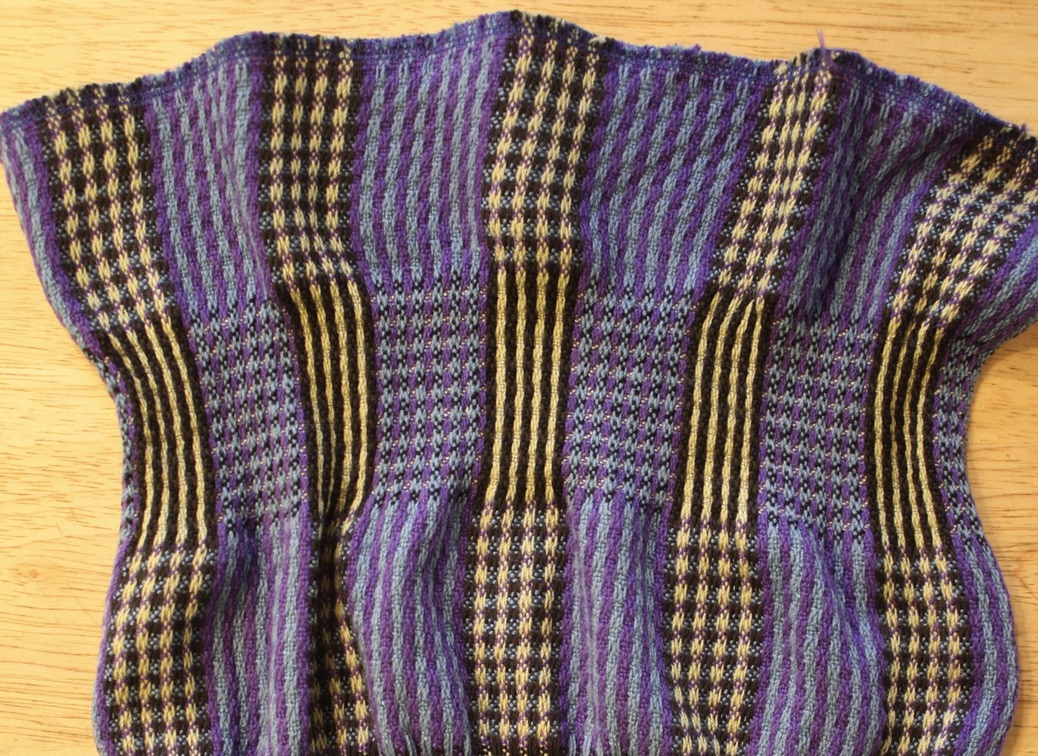
I'll close with a Deflected Double Weave sample I wove on 12 shafts using Colcolastic in the middle section (black and gold vertical stripes) to achieve width-wise shrinkage. I wove this in 10/2 cotton, using four colors in both warp and weft, substituting the Colcolastic for one of the colors as I wove the mid-section.


Thanks for reading!
 

Friday, January 17, 2020

Sampling with Deflected Double Weave -- and Loving It!


Above is a 12-shaft Deflected Double Weave pattern using 10/2 pearl cotton in three colors in both warp and weft: blue, purple, and sage green. An unlikely combination, yes, but that's what I had in my stash -- and I tend to like unlikely combinations.

I've been weaving away on my 16-shaft Toika Eeva, which is a joy to work on because it's a compudobby and I can change the tieup and treadling with a click of a button for every sample I want to weave. This is all in preparation for a workshop for the TeleraƱa Fiber Arts Guild -- and boy did they do me a favor! I'm not just talking about inviting me. It's really about the request they made: I tend to use wool with Deflected Double Weave and the program chairs gently asked me not to do that. Fact is, they don't have much use for wool in Arizona, other than for rugs ;o)

So I had to wrap my head around designing Deflected Double Weave patterns that could be woven with cellulose fibers and silk, with a lot of pizazz in the design and the option to weave as collapse fabrics. I decided to substitute Colcolastic (a combination of cotton and Lycra that shrinks up immediately in water), woven ribbon (which compresses and moves about when used as weft), wool/stainless steel yarn (all right, it's wool, but just a teeny bit) and gold gimp, which crinkles up and draws fabric in, creating some interesting textures.

Here's the drawdown I used for the sample above.


As I went about sampling, I changed the tieup and the treadling as well as the weft yarns, because the name of the workshop is "Designing with Deflected Double Weave." It's all about experimenting and seeing what happens. Here are some of the samples I wove up.


This is one of my favorites, using this drawdown.


The photo shows you the back side of the draft, which I like better. The collapse effect comes from using a sage-green-colored Colcolastic yarn in the weft for the portion that has the green and black stripes. 

Here's another design sample:


The magenta horizontal stripes are four picks of hand-dyed rayon ribbon, which compresses vertically. Here's what the same sample looks like without the ribbon weft.


As you can see, the rayon ribbon makes a big difference, adding both color and texture. Here's the drawdown for that sample.


Note that the tieup is the same as for the first drawdown in this post. The only variation is the treadling and the use of just two colors in the weft (rather than 4).

So yes, Eeva and I had a lot of fun with these samples! We wove this, using another variation in the tieup and treadling:


And this, using wool/stainless steel yarn as one of the wefts...


And this, using gold gimp as one of the wefts. My theory for why this yarn collapses: because it has a polymer core wound up in a shiny material that includes metal (for the gold color), the polymer curls up a bit when you wash the sample in hot water, while the gold wrapping gets clunky and bends. That's my theory, anyway.


And just because I had so much fun with this pattern, I want to share with you some of the color variations I came up with as I created the original design in Fiberworks. No accompanying text, just lots of color! Remember that these are all the same draft -- demonstrating that Deflected Double Weave is a color-and-effect weave (meaning that the pattern you see is formed by the colors and is quite different from the weave structure itself). There is much fun to be had in choosing colors.

I'm thinking I would like to weave up yardage incorporating all of these colorways across the warp, as almost a color gamp. Which one is your favorite? 


Thanks for reading!