Showing posts with label Lunatic Fringe Yarns. Show all posts

Saturday, October 21, 2023

'Weaving Outside the Box' with Katherine Luhring of Lunatic Fringe Yarns

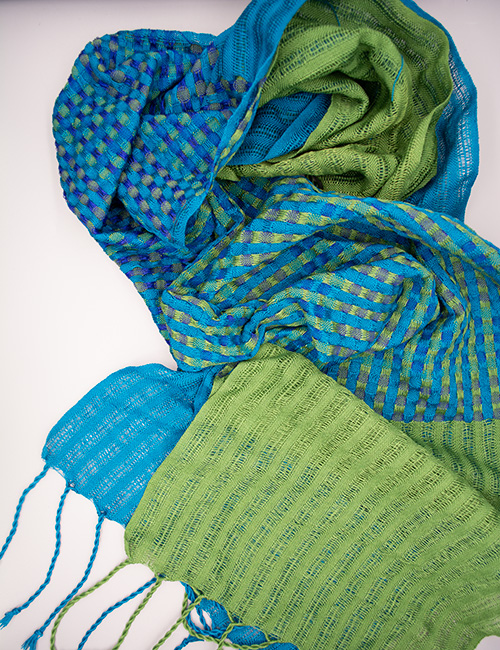
Deflected doubleweave scarf woven by Katherine Luhring from my workshop, 
"Weaving Outside the Box"

This month I'd like to share an essay by "Katzy" (pronounced "KAHtzee") Luhring, one of the managers at Lunatic Fringe Yarns. Some background: Over the summer, I taught "Weaving Outside the Box: 12 Projects for Creating Dimensional Cloth" at the Intermountain Weavers Conference in Logan, Utah, a workshop based on my book of the same name. We were lucky to have Katzy in our class, as she brought a lot of knowledge and information about some of the special yarns that are sold by Lunatic Fringe. 

Here's a post she wrote for the Lunatic Fringe blog, starting with an introductory paragraph about her weaving adventures. Thank you, Katzy!

_____________________________________________________

We Lunatics have gone to a lot of conferences over the 30-plus years that we have been in business.  However, it isn’t very often that we give ourselves the time to participate in the classes offered at the conferences. This year at IWC in Logan Utah, we sprang our fearless leader, Katzy, from booth duty so she could take Denise Kovnat’s dimensional-cloth workshop. Let her tell you about a few of the wonderful things she learned along the way.

By Katzy Luhring

Denise Kovnat’s dimensional-cloth workshop at IWC was a fabulous opportunity to experiment with interesting yarns and learn some new things! Denise asked all the class participants to choose a project from her book,  "Weaving Outside the Box, 12 Projects for Creating Dimensional Cloth." I chose project #1, the Deflected-Doubleweave Scarf on four shafts.  To be perfectly honest, I chose it because the project didn’t have too many ends, it used 10/2 mercerized cotton yarns, and it would fit on the 4-shaft Wolf Pup Loom that we had room to take with us to Logan. Seemed like a perfect fit all the way around!


I wanted to spend the workshop time making samples and learn more about elastic yarn during the workshop.  To give myself plenty of warp for playing, I wound a six-yard warp of 10/2 Tubular Spectrum Thyme and 5 Blue. This was twice the warp length that Denise recommends in her book. I knew I would have plenty of warp to experiment to my heart's desire.

What Is Colcolastic Cotton Yarn?

Denise's instructions call for Colcolastic cotton yarn for one of the weft yarns. This is a yarn that I was unfamiliar with, but after a quick Internet search, I found it at Lone Star Loom Room. When I received the yarn (in a very short amount of time), I discovered that the yarn is a two-stranded yarn: One strand is 20/2 cotton and one strand is a thin elastic, and these two yarns are wound together onto the spool. I could make my own yarn by using one strand of 20/2 Tubular Spectrum mercerized cotton yarn and combining it with any of our thin elastic yarns: ramie, cotton, silk. The color possibilities are endless!

And how did these two yarns wind onto a bobbin? No problem there. I have since used both a hand winder and an electric bobbin winder to wind the spools from two cones and have not had any trouble with the yarns getting tangled either as I wound onto the spools or while I was weaving. 


Play Time!

Three days of class trying different yarns and learning how the weave structure works and interacts with the weft yarns. It was heavenly! I tried elastic ramie, elastic silk, elastic cotton, both by themselves and with cotton yarns. I experimented with weft yarn colors to see how the two layers interacted. So much experimenting and so many things to try!


Not So Plain Weave.

Denise designed an interesting project: The first 18" is doubleweave with a top layer and a bottom layer. When I first warped the loom and sleyed the reed, I couldn't understand how we were going to get a functional fabric in those first 18" from the big spaces that are in between the yarns on each layer. There are gaps of about 1/4 inch! I trusted Denise's instructions and wove the fabric with the weft yarn floating across those gaps. When the fabric is washed, the warp yarn shifts over to fill the gaps and you can an interesting, almost plain-weave fabric with lots of drape.

Plain-weave section before washing

Plain-weave section after washing

Splash! Now to Make Things Go Bump!

The center section of the scarf contains the elastic and cotton weft. There is a nice texture to the fabric while on the loom, but it is relatively flat.  And the fabric remains flat when you take it off the loom.  The magic really happens when the fabric gets wet! When washed, the elastic in the weft shrinks up and takes the warp yarns along for a ride, creating ridges in the fabrics.  The 20/2 weft yarns bubble up and make a loopy texture on one side of the fabric.  You can stretch the fabric out to see how it originally looked, but when you let it go, the pleats reappear. Magical!

Center section before washing

Center section after washing

To the Loom!

When I left Logan, my brain was bursting with new ideas and I have been spending lots of time at the loom finishing up the first batch of scarves and working on new ones.  Thanks Denise for a wonderful workshop!

Finished scarf before washing


Saturday, August 19, 2023

New Zoom Workshop Beginning October 14: 'Weaving Outside the Box: 12 Projects for Creating Dimensional Cloth'


Based on my book of the same name, this workshop is being offered for the first time online -- thanks to MAFA, the Mid-Atlantic Fiber Association, which is offering Zoom workshops this fall for weavers near and far.

For three Saturdays in October, you'll weave a project of your choice from the book, on 4, 6, 8, 12, or 16 shafts. The photo above, woven on 4 shafts, is one of the projects you can choose from. 

Here's the link to register: https://www.lessonface.com/apply/Weaving-Outside-Box-12-Projects-Creating-Dimensional-Cloth

And here are photos of a few more of the projects you can weave at home, on your own time.

"Ruffles Scarf," 8 shaft doubleweave using differential-shrinkage

Shawl on 6 shafts, detail, deflected doubleweave and fulling techniques

Scarf from the book cover, 4 shafts, wool/stainless-steel and 20/2 cotton yarns

8-shaft scarf in 60/2 silk, pleats in turned twill

4-shaft scarf in deflected doubleweave, using Colcolastic (cotton/elastic yarn) 
to create shrinkage in center

Woven-shibori scarf on 4 shafts, differential-shrinkage techniques

Participants will learn how to optimize the effects of structure, energized yarns, and finishing techniques to achieve three-dimensional texture in their cloth. The goal is to venture off the rectilinear grid of handwoven cloth, exploiting texture to work with color and form, adding interest and tactile appeal to your woven creations. It all happens in the wash and the results are often surprising!

A summary of the focus of this workshop, taken from the back of the book:

Color and structure are key elements in weaving, of course. But we often overlook the importance of texture. Dimensional fabrics, with their pleats, puffs, and curves, take us off the grid, reflecting the organic forms of nature. We can both see and feel the tactile quality of dimensional cloth, which adds much to the beauty of handwoven fabric.

If you're interested or if you have questions, please send me an email (click on the "About Me" section on the front page of this blog, at the right, then click on "Email" underneath my photo). And yes, one enticement: Lunatic Fringe Yarns is offering participants a coupon on the special yarns that are used on several of the projects.

Thanks for reading!


Sunday, December 18, 2022

This Pattern Is More than 400 Years Old... with a Few Changes


 It all starts with a 1626 portrait of John Erskine, 2nd Earl of Mar and Lord High Treasurer of Scotland, painted by Adam de Colone. 


The painting hangs in the National Galleries of Scotland, where researchers have found that the canvas is in fact a linen tablecloth, a practice that was common at the time. The tablecloth was woven on 14 shafts in this Gebrochene pattern.


If you're a frequent reader of this blog, you may recall that I've written about this before -- most recently, on September 18, 2022, in a post that gives you more details on how I altered the pattern but kept the original design line. I learned of it maybe 20 years ago from Marjie Thompson, who calls it "The Earl". 

It was not a stretch to take the threading and create a parallel threading 14 shafts above it, which I did just to see what would happen. I figured it could be woven as Echo or, by adding tabby to the treadling, as Jin (aka Turned Taqueté). The Jin drawdown I designed looks like this.


Here's a detail to give you a better idea of the design.

I really liked the varied geometry of the pattern, so this is what I used for the motifs in the center of the scarf, using two different weft colors, violet and gold. (The gold is in the central section, where the fabric scrunches up into pleats, seen around the neck on the mannikin. That's because the yarn is a combination of silk tram and stainless steel, which has memory.)

The mountain-like motifs at the beginning and end of the scarf -- in purple and orange -- are woven in a doubleweave pattern using what I call a "carved" tieup. (The idea is outlined in Marian Stubenitsky's definitive work, Weaving with Echo and Iris, which provides all number of tieup options for Echo woven as doubleweave.)


When you're weaving four-color doubleweave on an Echo threading, these "carved" variations in the tieup make for lots of color shifts, so that a color first appears on top of the cloth and then shifts to the bottom. This maximizes the potential for color blending.


Adding to the potential for color play: I used a painted warp combined with a black warp for the parallel threading. The technique is quite simple: You wind a two-color warp of natural and black and then paint the entire warp. The natural-colored yarn absorbs the dye and the black does not. 

I love the yarn that I used for the warp, and I doubt I will ever find it again, because I got it at one of those wonderful guild sales. It's a 24/3 unmercerized cotton, so I really didn't have to worry about threads breaking and selvages fraying. For the doubleweave weft, I used 16/2 bamboo in blue, orange, and burgundy, and for the Jin wefts, I used 60/2 silk in deep violet and, as I mentioned, tram-silk/stainless-steel in gold, purchased from Lunatic Fringe, which pleats and bends in the center section.

To me, the motifs look like mountains and the colors remind me of a western sunset. So I've named the piece "Colorado", which means "ruddy" in Spanish. It reminds me of the sunsets over the Sangre de Cristo range, near where my daughter and her family live. The Earl is well traveled indeed.

Thanks for reading!


Wednesday, August 24, 2022

Summer Is the Time to Play... with Yarn


A friend of the late, great Kay Faulkner remembered how Kay would phone her and begin with the words, "I've been playing...."

My reaction was, if that's "playing," then I need to do more! But seriously: Creativity and play are related, if not joined at the hip. Allowing our mind to roam when we're making something -- or even walking away from the work altogether -- lets our imagination roam, without pressure. Taking a shower, going to sleep, daydreaming, lolling about in bed as we wake up -- or playing the violin, in the case of Einstein and the Theory of Relativity -- gives our subconscious the time and space to explore.

So I've been playing, as you can see in the photo above. The structure is four-color double weave, with 16/2 bamboo for the two warps and one of the wefts and 28-gauge wire as the other weft. It was definitely tough to weave with (and my selvages show it), but I think there's an idea in there. What if I wove yardage like this? Could it be a sculpture? Or what if I used wire in random picks in the weft, as Liz Williamson has done with her dimensional scarves and shawls? What if? Why not?

Maybe my subconscious can work on that. I'll let the weaving goddesses make the decisions. (Some days they're with me, some days they're not.)

I wove this sample en route to weaving a garment on the same warp, one that I hope becomes a dress or a mantle of some kind. But instead of using wire as one of the wefts, I used Gevolve S-twist linen crepe from Lunatic Fringe Yarns. Using this in double weave that has pockets (as Marian Stubenitsky describes the separate layers you sometimes find in four-color double weave), it crimps the fabric up nicely, creating a kind of natural stretch in the bodice, with no darts necessary. And if you switch out the active weft for an inactive weft (in this case, so that all the yarns are 16/2 bamboo), you can achieve gentle ruffles where the textured  fabric meets the flat fabric.

Here's a photo.

And here's a detail.


Finally, this is what the fabric looked like before washing, which allows the overtwist linen to draw the fabric in, creating vertical pleating on the opposite layer (that's woven with the inactive 16/bamboo in both warp and weft).


That dress would certainly work for someone more slender than I but maybe I could put gores in the side seams of the skirt... or maybe it's for an exhibit or a fashion show.... I'll just keep playing.

I've been messing about with beads also, ever since my friend Deborah Pope taught me how to make fabric beads.


Not exactly sure what they're going to become; most likely a bracelet. I used to think that any finished project, however humble, is infinitely better than any unfinished piece, however beautiful. Now I'm not so sure. What's wrong with an unfinished work, with finding out that you don't want to follow that trail anymore?

Questions to ponder. Thanks for reading!

Thursday, February 10, 2022

Collapse Techniques: Some Active Yarns and How They Work


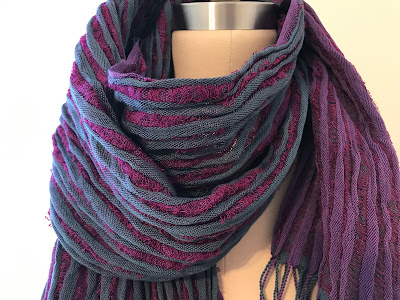
Pictured above: A scarf woven on 4 shafts in deflected double weave. The warp is 20/2 cotton in stripes of teal and purple and the weft uses these yarns plus a wool/stainless-steel yarn (see the floats above, in fuchsia). The scarf looks like gauze on the loom, but when you wash it in gentle soap and lukewarm water, the wool/stainless floats crinkle up and draw in horizontally, creating vertical pleats in the fabric.

I love these surprises in the finishing! And one of the easiest ways to achieve them is by using active or energized or exotic yarns -- a large category that includes yarns that will shrink, twist, collapse, and/or relax after washing.

Right now I'm teaching a Zoom workshop for the Reno Fiber Guild, "Deflected Double Weave for Collapse Fabrics." I put together a short handout on the active yarns we're using and how they work and I thought it was worth sharing in a blog post. Here's the list -- of course, it's not comprehensive -- along with photos and images of the yarns under magnification.

Fine Gold Gimp (Metallic Yarn)


The thicker version of this yarn doesn't work well for creating texture in fabrics, but the finer version can add a lot of interest. It's really 77% polypropylene and 23% metallic. And it's hard to find: The only vendor in the States that sells it is Made in America Yarns, a Philadelphia company that lists it under the name "fine metallic gimp yarn."

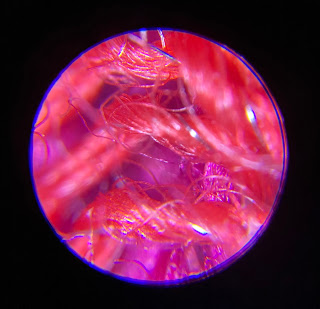
This is what a single strand looks like at 60X magnification.

And here's what it looks like after weaving and washing.


The polypropylene shrinks up with warm water and soap, bending and crimping the metallic coils around it. When used as weft, this can create some interesting motifs as it shrinks the fabric width-wise.


Wool/Stainless-Steel Yarn


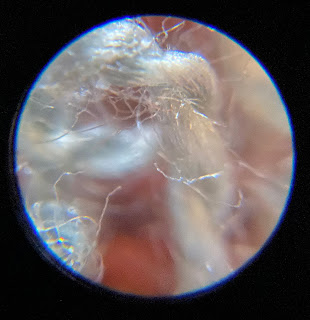
This yarn, available from Habu Textiles, is what I used as weft in the scarf pictured at the beginning of my post. You can achieve similar effects with silk/stainless-steel yarn, available from Lunatic Fringe. Here's what it looks like under 60X magnification, unwoven (first photo) and woven and washed (second photo).


The wool shrinks in the washing and the stainless-steel filament bends with it, so that the sample is drawn in. I find that you can actually shape the garment, either flattening it out or stretching it vertically to create vertical pleats. It all depends on your mood ;o)


Deflected double weave sample on 8 shafts


Deflected double weave sample on 12 shafts

18/2 Merino Wool

Nothing beats wool for differential-shrinkage effects. Combine it with cotton or silk or some other inactive yarn and you'll get pleats and poufs and lots of texture. (Note: I don't recommend using JaggerSpun Zephyr, because the silk component doesn't full in comparison with the 18/2 superfine merino. Also, be careful not to purchase super-wash wool yarn, because these yarns are chemically treated NOT to full or shrink.)

Hand-painted warp of 18/2 JaggerSpun superfine merino


1 strand of 2-ply yarn, before fulling


Magnified image of the yarn after weaving and fulling


16-shaft deflected double weave sample after fulling, using 18/2 merino and 10/2 cotton in both warp and weft (hand-painted warps and wefts)

Venne Colcolastic (and Other Elasticized Yarns)


This yarn has two components: a fine 2-ply mercerized cotton and an elasticized single. Here's what it looks like under magnification:


And here's what it looks like under magnification and after weaving and washing:


My explanation for this effect is that the elastic draws in and the cotton is drawn in with it, crinkling and twisting up as it goes. Below is a sample of a 4-shaft deflected-double-weave piece I wove with long weft floats of the Colcolastic. (You're viewing the warp horizontally.)


This second sample, below, has no floats on the front and narrow floats on the back, simply because there are just 4 warp yarns in the block it floats over. It's a 12-shaft deflected double weave. Colcolastic is used as weft for the middle section only.


Active yarns are just one way to create textured fabrics. You can also achieve dimensional effects just by weaving structures that lend themselves to texture: turned twills, honeycomb, waffle weave, and of course deflected double weave will create curves and pleats even without the aid of active yarns.

Weavers will sometimes get preoccupied with color and structure, forgetting about that third invaluable characteristic of our craft, that of texture. In her definitive book, On Weaving, Anni Albers devotes a chapter to "Tactile Sensibility," focusing on the importance of matière:

"Matière is the word now usually understood to mean the surface appearance of material, such as grain, roughness or smoothness, dullness or gloss, etc., qualities of appearance that can be observed by touch.... Surface quality of material -- that is, matière -- being mainly a quality of appearance, is an aesthetic quality and therefore a medium of the artist...."

Weaving, in her view, brings us back to our ancient tactile sense. Of course, the yarns we use are central to this achievement.

Thanks for reading!