Showing posts with label energized yarns. Show all posts

Wednesday, June 14, 2023

It's Conference Season!


I write this as I'm sitting in the airport in Grand Rapids, MI, waiting for a much-delayed flight to Detroit and then home. What better time to post about the just-finished Michigan Handweavers Conference in Holland, MI? And why not start with a classic conference photo -- that of a group of weaver-friends going out to dinner after a long day in the classroom?

Pictured above, from left to right: Cathy McCarthy, Janney Simpson, Martha Town, Susan Moran, Nancy Riele, Martina Celerin, Nadine Cloutier, and me. Everyone in the photo is either a teacher, a conference organizer, a student at the conference, or any combination of the three. You can imagine what we talked about -- for instance, the exhibits....


There are some 19 guilds in Michigan, and one exhibit featured collected works from many of these guilds -- including this beautiful series of blue vertical panels created by members of Woodland Weavers. Whether they were woven, knitted, felted, printed, quilted, or hand-dyed, these vertical panels all related to the exhibit's focus on the lakes and landscape of Michigan. Here's a closeup of one of the pieces, which included cyanotype prints and painted images of white-pine needles. (I apologize for not crediting the artist, as I did not take down the name.)


Here's an image from a rug-hooked piece by Nadine Cloutier, using hand-dyed wool strips to create a sun-soaked lake view. I love the tactile quality and the varying directions of the wool strips.


Martina Celerin was the keynote speaker, who spoke about her dimensional weavings. They all begin with a simple frame loom she builds herself for warping and weaving tapestry-like backdrops of natural scenes. She then uses a number of techniques, including felting and weaving, to extend her pieces beyond the plane of the the loom outward as much as 12 inches. It's difficult for a photo to portray the depth of her creations, but here is an image of one of her recent pieces, featuring a trail meandering through the forest. (The bright blue color in the upper righthand side of the image is from paper bags in the background, unfortunately, that you can see through the open yarns on the loom.)


You can find out more about Celerin by clicking here.

So much to see -- and touch! Speaking of touch, the workshop I taught was based on my book, Weaving Outside the Box: 12 Projects for Creating Dimensional Cloth. To my surprise and delight, people in the workshop took off with their versions of the projects in the book -- in some cases, improving upon them, in my view. 

This sample by Nancy Riele, using the ancient weave technique known as Rippenköper, had whimsical, flowing horizontal lines. It's woven in 8/2 Tencel on a warp of 60/2 silk in a turned-twill design. I consider her sample way better than the piece I wove for the book ;o)


Among the takeaways from this workshop is that textured weaves call for either specialized (energized) yarns, fulling and differential shrinkage, and/or structure -- any one of these or varied combinations of the three. Finishing is key. Below is a photo of the work of Cory Zann, showing the difference between her fabric on the loom and after washing. Again, this is a turned-twill structure on a 60/2 warp, in her case using a silk/stainless-steel yarn for the weft.


Cindy Root, president of the Michigan League of Handweavers, chose to weave a 4-shaft project on a gradient warp of 16/2 bamboo, using a weft of 18/2 Jagger Spun merino and a supplemental weft of embroidery cotton. The supplemental weft is used to draw the fabric in horizontally, compressing it so that only portions of the wool are exposed in finishing. This means that only some portions of the wool will full, creating pleats where the weft yarns have shrunk and gathered the warp yarns together densely. Here's Cindy's shibori-tightened fabric before it's washed with warm water and agitated with soap. After it's dried a bit, but still damp, she will remove the shibori ties and have a permanently pleated scarf.


Gail Pilgrim was also working on the Rippenköper structure -- but weaving it in on a 20/2 cotton warp using 8/2 cotton in the weft. She's doing research for a story planned for Heddlecraft magazine looking at hand towels in a variety of structures. In addition to working with cotton wefts, she decided to try a weft of 18/2 Jagger Spun merino, just to see whether the results were worthy of weaving a scarf somewhere down the line (or down the warp). Here's that sample, below.


As it is with many workshops, not every project is complete at the end. And since this workshop emphasized the importance of using specific finishing techniques, some weavers chose to finish their projects at home, after the workshop -- as with this 4-shaft deflected doubleweave scarf by Naomi Fletcher, woven with 10/2 cotton in the warp and weft, with a mid-section that includes Colcolastic yarn by Venne, drawing the mid-section in dramatically. I'm hoping she'll send me some photos of her results that I can then share with the group.


Some samples were finished, however (finished meaning washed with warm water and soap and then rinsed), as with this sample below by Martha Town. She wove it on a hand-painted warp of 60/2 silk with navy stripes and jewel-tone-painted stripes and a weft of 120/2 silk, using a turned-twill structure that pleats naturally. Note the subtle yellow accents in the weft every few inches, which add interest to the sample.


Thanks to MLH for a wonderful conference -- and to everyone in my workshop for an experience that I didn't want to end! And finally, thanks to you for reading.




Wednesday, October 19, 2022

Coming December 1: My Book on Texture in Weaving


You're looking at the cover of my soon-to-be-published book on texture in weaving! I've been working on it for, lo, these past five years and it's almost ready for publication.

I plan to begin offering it on Lulu on December 1. And after that, I might celebrate with a good brew or two ;o)

Why did it take so long? Mainly because it includes 12 projects for 4, 8, 6, and 16 shafts, which meant I had to weave them all and document every single detail. And check and double check -- 80 versions and revisions to date, which isn't all that surprising. Plus, with some of the projects, there was much sampling involved, meaning lots of warps and dressing of looms until I got it right.

The title, "Weaving Outside the Box," has two meanings: first, I'm referring to creativity in design and process, "thinking out of the box" about what and how we weave. Second, I'm referring to the rectilinear, two-dimensional plane of weaving -- "the box" that we are typically confined to in our craft -- and how we can begin to break those boundaries. Textural weaving is all about ripples and pleats and buckles and poufs, about bends in the road and reflections on the organic curves of nature herself. Take, for instance, this image of lateral curves of fungi on a tree trunk:

I see a reflection of these lines in a double-weave sample I wove on four shafts, in the style of Liz Williamson:


Different colors, of course, and less nuanced, but the two images share flowing horizontal lines, staggered randomly. I love the unpredictability of how the patterns shift and bend -- much of which takes place in the finishing. After washing these fabrics, the results are  always surprising, which makes it so rewarding to me.

The book is about 120 pages long, with 90 full-color photos and diagrams that aid in understanding the hows and whys of dimensional weaving. It includes a long bibliography to aid in further study, an index (to me that's a big deal, for some reason), and three beginning chapters on the theory of texture in weaving, its history, and some of the overriding techniques involved.

Here is a peek at some of the projects in the book.

Antelope Canyon Shawl in point twill on 4 shafts, 
16/2 bamboo gradient warp, silk/stainless-steel weft

Detail of 'Puzzle Shawl' in deflected double weave 
on 6 shafts, 18/2 merino in warp and weft

60/2 silk striped scarf in plain weave and turned twill 
on 8 shafts, with soft pleats in the middle

Deflected-double-weave infinity scarf on 16 shafts,
using hand-painted warps and wefts in 18/2 merino and 10/2 cotton

Right now, the final draft of the book is with a group of first readers, in alphabetical order, Marianne Antczak, Leslie Mendelson, Ann Richards, Joyce Robards, Sarah Saulson, and Linda Schultz. All of them are wonderful weavers who have generously agreed to serve as fact-checkers and goalies, you might say, to keep any errors from appearing in print. It's good to have smart friends!

As I mentioned, I will offer the book on Lulu, a print-on-demand site used by several folks I know. I will also offer an e-version at a slightly lower cost (and no shipping charges, of course). 

If you're interested in pre-ordering, please click on the "Downloads for Purchase" section of this site, where you'll find a link. I will be in touch as soon as it ships on December 1.

Let me know if you have any questions, of course. My email address is in the "Contact Information" page on this blog. 

Thanks for reading!

Front and back covers, ready for printing


Wednesday, June 22, 2022

Weaving on the Curve in 20/2 cotton


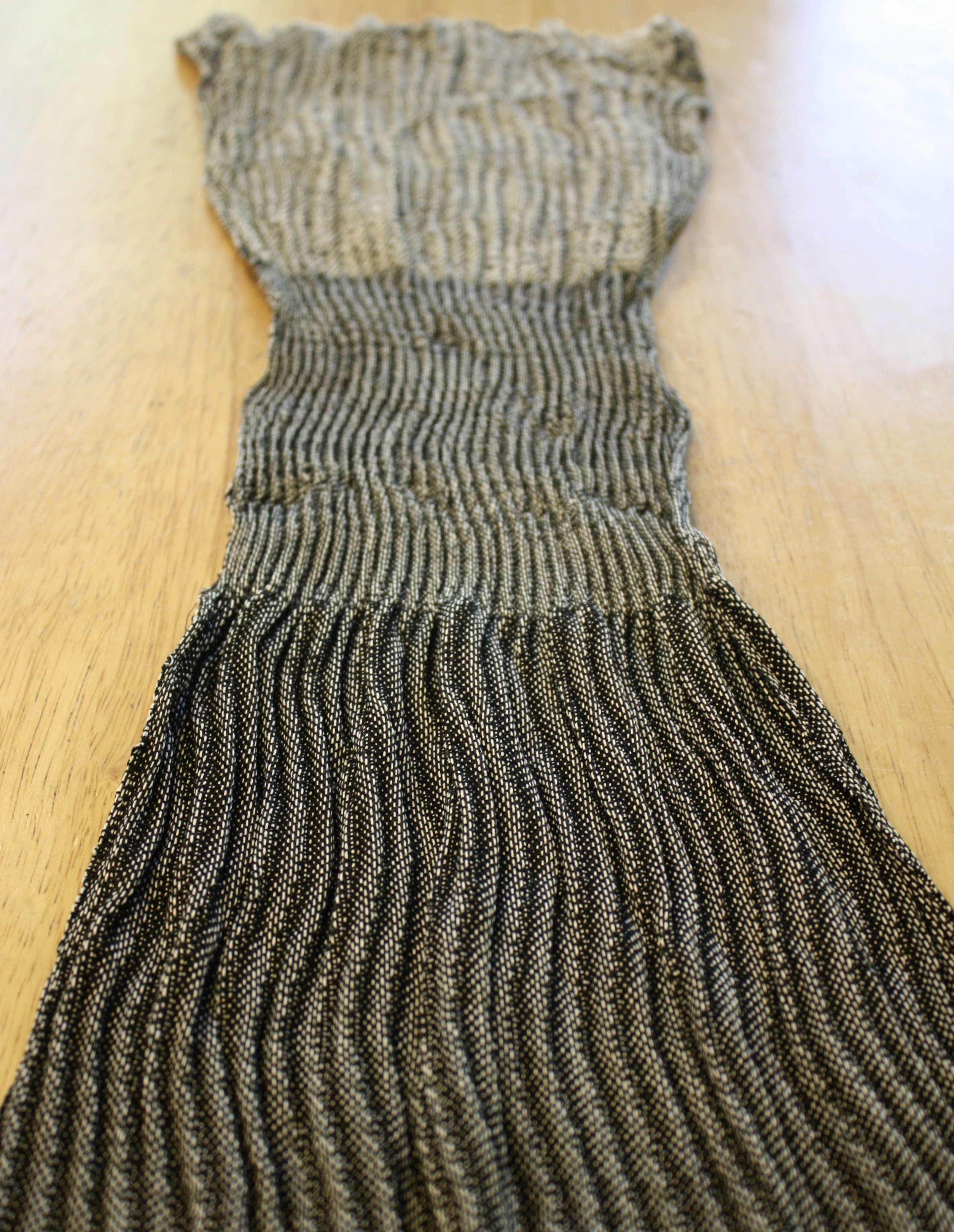
Sampling on 16 shafts with different wefts (top to bottom): 
S-twist linen crepe, Z-twist silk crepe, 60/2 spun silk

16-shaft sample with 60/2 silk weft after washing (and coaxing the pleats to curve)

Same sample with pleats before washing

Take note: I wove these samples on the end of a black-and-white warp that was left over from another project. Really, I was just curious about how to weave curving pleats. No way would I use black and white yarns if I were weaving this for a garment! 

Anyhow, I'll get to the point. As we all know from that inspiring book, Fabrics That Go Bump, when you weave a turned twill on 8 shafts or more, you can create vertical pleats. The secret lies mainly in the structure, which is basically a turned twill that alternates between weft-emphasis and warp-emphasis blocks.

Here's a look at a design from this book by the late, great Erica de Ruiter. I found it inspiring.


De Ruiter designed her treadling in the liftplan, which looks like this.


I think it's ingenious -- but I decided to use a networked curve instead, which looks like this in the liftplan.


Truthfully, I think de Ruiter's design is better, as there are more warp floats per pleat. But why compare? The important factor is that both designs allow for floats of three in the warp yarns alternating with floats of three in the weft yarns.

How does this structure create pleats? It's the mechanics of how yarns relax after washing, really. The weft floats (in white on both drafts) relax and draw in, creating a concave shape, pulling on the warp floats on the other side (which are vertical, so they align vertically, sort of like Venetian blinds folding up on themselves, and create convex pleats).

The ratio of grists -- warp vs. weft -- can help with this effect, in my experience. In my sample at the beginning of this post, the warp is 20/2 cotton threaded in black and white at 8,400 yards/pound, while the weft at the bottom of the photo is 60/2 silk in black at 14,800 yards per pound. So the ratio in grist of warp to weft is about 5:3. I prefer a ratio of about 2:1, but I didn't have any other yarns in my stash. (You know how that goes.)

Another way to achieve pleats is to use the same design (warp floats alternating with weft floats) with an "energized" or "active" weft, such as crepe or overtwist or elasticized yarn. First, I tried an S-twist linen crepe from Lunatic Fringe. (You'll see this sample, vaguely, at the top of the photo at the beginning of this post.)

Gevolve Yarns linen crepe in S-twist at 10,400 yards/pound

The sample is definitely textured and pleated, but you can't see curves at all.


I don't really have a theory on this, other than that the yarn draws the warp in so much that the curves are lost because they are too subtle.

The same thing happened when I tried silk-crepe yarn from Habu, a Z-twist gossamer-weight yarn that's about 33,000 yards/pound (and not at all fun to wind on a pirn, because it's constantly plying backwards on itself). The photo at the beginning of this post shows this sample in the middle of the fabric.


The spool above has lasted forever: I purchased it back in the day when Habu was based on West 29th Street in Manhattan! This yarn shrank the sample about 50% width-wise -- again, overkill as far as the curves I was looking for.


What did I learn from this? 1) That it's useful to design in the liftplan, especially when you want precise curves and patterns. 2) That you don't necessarily want to use active yarns for collapse effects, especially when you're working with turned twills. 3) That sampling, sampling, and sampling some more always pays off.

Perhaps, like me, you tuned in to "Textiles and Tea" with Kathi Grupp from HGA interviewing Anita Luvera Mayer on Tuesday, June 21. That was a big part of Anita's message: We need to sample and, even if we feel our samples aren't successful, we have learned something, so we've moved forward. I've certainly learned something, even if I'm not thrilled with the results.... But then again, maybe a long scarf with curving pleats, using de Ruiter's liftplan along with a variety of active and inactive yarns in the warp? In beautiful colors?

Thanks for reading!


Monday, May 15, 2017

Still More Collapse Cloth -- This Time on 8 Shafts


This summer, for me, will be all about collapse fabrics: I'm teaching a workshop at MAFA and a workshop at the Hartford Artisans Weaving Center, plus I will give a lecture on the topic to the New York Guild of Handweavers.

To prepare, I have been weaving up lots of samples and learning A LOT from the results. (Re-learning a lot, too -- for example, that sett can make the difference between a good fabric and a wonderful fabric. We all know this, but we need to be reminded, particularly if a project should be re-sleyed at a different sett and we get -- well, lazy....)

Anyhow, the samples I've blogged about to date have all been on 4 shafts, because that's the focus of my first workshop at MAFA. In Hartford, we'll be working on both 4 and 8 shafts, so now I've begun sampling on 8. Here are some photos. 


I call these "Before" and "After" shots. The photo above is a "Before" shot of fabric just off the loom. I got the draft from a workshop I took a few years ago in London with Ann Richards, author of Weaving Textiles that Shape Themselves. The warp in this case uses both wool/stainless-steel yarn (the taupe-colored warp, available from Lion Brand and from Habu) and 16/2 bamboo (in red and orange). The weft is 72/2 linen (to give the fabric stiffness) alternating with the wool/stainless yarn.

Here is the "After" photo:


In this case, you have two elements that make this a dimensional fabric: structure and energized yarns. The structure is plain weave with floats alternating weft-wise and warp-wise, so that the floats make room for the fabric to pleat in and out. The wool/stainless draws in and twists when washed, which encourages the pleats to form. Finally, the stability of the linen weft adds crispness to the fabric. Pretty clever, huh? All thanks to Ann, who approaches her art with the mind of a scientist.

Another fabric, this one an 8-shaft double weave, pictured in its "Before" state, showing both front and back views:


The red sections are 18/2 superfine merino from JaggerSpun, which fulls beautifully when hand-washed. The black is 24/2 superlamb from JaggerSpun, which resists fulling because it's a superwash wool. Here's what it looks like, front and back, after hand washing in warm water and agitating with dishwashing soap:


To be honest, the black squares on the front of the fabric don't "pop" the way I had hoped. I was looking for a real dimensional "pouf" in the cloth -- but still I think it works.

Here's another structure from the same warp, before washing, front and back, same yarns.


And after washing:


This sample had a lot more texture, thanks mostly to the floats on the back. It's very thick, suitable for a warm jacket or coat.

If you're interested in any drafts, let me know. It's great add texture to your fabric! And here's one parting shot, of another sample just completed, using the same warp and weft as the first sample in this post but with a different treadling. (This is the sample that you see in the close-up photo that begins this post.)


Happy shape-shifting, y'all!