Showing posts with label overtwist yarns. Show all posts

Wednesday, October 19, 2022

Coming December 1: My Book on Texture in Weaving


You're looking at the cover of my soon-to-be-published book on texture in weaving! I've been working on it for, lo, these past five years and it's almost ready for publication.

I plan to begin offering it on Lulu on December 1. And after that, I might celebrate with a good brew or two ;o)

Why did it take so long? Mainly because it includes 12 projects for 4, 8, 6, and 16 shafts, which meant I had to weave them all and document every single detail. And check and double check -- 80 versions and revisions to date, which isn't all that surprising. Plus, with some of the projects, there was much sampling involved, meaning lots of warps and dressing of looms until I got it right.

The title, "Weaving Outside the Box," has two meanings: first, I'm referring to creativity in design and process, "thinking out of the box" about what and how we weave. Second, I'm referring to the rectilinear, two-dimensional plane of weaving -- "the box" that we are typically confined to in our craft -- and how we can begin to break those boundaries. Textural weaving is all about ripples and pleats and buckles and poufs, about bends in the road and reflections on the organic curves of nature herself. Take, for instance, this image of lateral curves of fungi on a tree trunk:

I see a reflection of these lines in a double-weave sample I wove on four shafts, in the style of Liz Williamson:


Different colors, of course, and less nuanced, but the two images share flowing horizontal lines, staggered randomly. I love the unpredictability of how the patterns shift and bend -- much of which takes place in the finishing. After washing these fabrics, the results are  always surprising, which makes it so rewarding to me.

The book is about 120 pages long, with 90 full-color photos and diagrams that aid in understanding the hows and whys of dimensional weaving. It includes a long bibliography to aid in further study, an index (to me that's a big deal, for some reason), and three beginning chapters on the theory of texture in weaving, its history, and some of the overriding techniques involved.

Here is a peek at some of the projects in the book.

Antelope Canyon Shawl in point twill on 4 shafts, 
16/2 bamboo gradient warp, silk/stainless-steel weft

Detail of 'Puzzle Shawl' in deflected double weave 
on 6 shafts, 18/2 merino in warp and weft

60/2 silk striped scarf in plain weave and turned twill 
on 8 shafts, with soft pleats in the middle

Deflected-double-weave infinity scarf on 16 shafts,
using hand-painted warps and wefts in 18/2 merino and 10/2 cotton

Right now, the final draft of the book is with a group of first readers, in alphabetical order, Marianne Antczak, Leslie Mendelson, Ann Richards, Joyce Robards, Sarah Saulson, and Linda Schultz. All of them are wonderful weavers who have generously agreed to serve as fact-checkers and goalies, you might say, to keep any errors from appearing in print. It's good to have smart friends!

As I mentioned, I will offer the book on Lulu, a print-on-demand site used by several folks I know. I will also offer an e-version at a slightly lower cost (and no shipping charges, of course). 

If you're interested in pre-ordering, please click on the "Downloads for Purchase" section of this site, where you'll find a link. I will be in touch as soon as it ships on December 1.

Let me know if you have any questions, of course. My email address is in the "Contact Information" page on this blog. 

Thanks for reading!

Front and back covers, ready for printing


Tuesday, February 17, 2015

Coming in March: 3-Day Collapse Techniques Workshop at the Weaving and Fiber Arts Center


Above: scarf woven in cotton and wool using differential-shrinkage techniques,
deflected double-weave sample after cloque shrinkage,
pleated scarf woven in twill blocks with overtwist weft

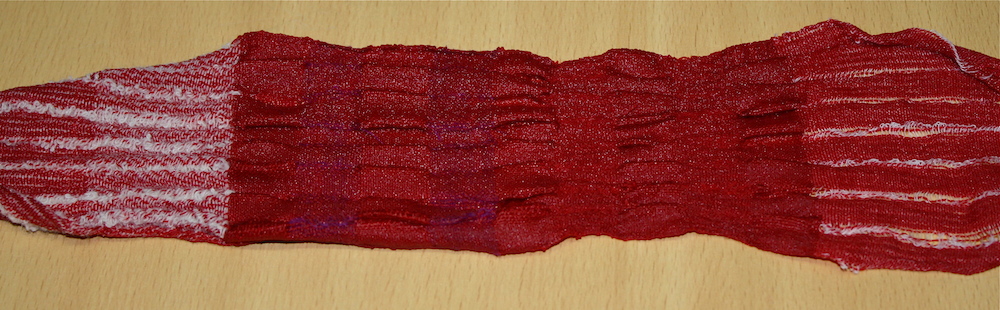
There's still time to register for my three-day workshop on collapse weave, March 13-15 at the Weaving and Fiber Arts Center in East Rochester. We'll be weaving samples on our own looms, in a round-robin setup, so that everyone will go home with fabric in number of collapse techniques. Topics will include differential shrinkage and cloqué, deflected double weave, weaving with S and Z twist yarns, weaving with crepe and overtwist yarns, weaving with stainless-steel-blend and other specialty yarns, and using weave structures to achieve a collapse fabric.

You can register on the Weaving Center website, available here. 

Friday, June 13, 2014

Journey to London: A Class with Ann Richards, author of "Textiles That Shape Themselves"


For me, it was a trip to Mecca! Traveling from Rochester to Toronto to Heathrow to the Islington section of London -- all for a three-day workshop at the Handweavers Studio and Gallery with Ann Richards. This British weaver creates meticulous, fascinating pleats, crimps, bubbles, wriggles, and bumps in fabric woven with seemingly ordinary yarns. The secret is the potential energy of the yarns, which is released when they relax and move about in warm water. Thus the workshop title, "Just Add Water."

I have long admired Richards' work -- lo, since the turn of the millenium, ever since I saw a piece by her in the venerable but no longer published "Weaver's" magazine. Then, a couple of years ago, she produced a gorgeous book, "Weaving Textiles that Shape Themselves" -- and, thanks to Google, I found an upcoming workshop with her. (For more on the book, click here. Thanks also to my guild, the Weavers' Guild of Rochester, for giving me a scholarship to cover the cost of tuition.)

The book

Ann on the left with a fellow student, Sue Wright

For anyone who knows her work, you'll understand why I made the effort to get there. For those who don't know her work, here are some examples.

The pleats are achieved through structure and washing, not by ironing!

A scarf on exhibit at the Handweavers Studio

A doubleweave sample she brought to the workshop

Here's the other side

Over the course of three days, we explored the use of Z twist and S twist yarns; overtwisted wool, silk, and cotton; silk/stainless blend yarn; bamboo; silk crepe; linen; wool crepe -- dozens of fibers from Japan and Italy, primarily. The weave structures varied widely, too, from plain weave to doubleweave to Han damask to Swedish Lace to Leno to plain weave using simple "cram and space" techniques in the sleying -- to the extent that I felt that I was learning a lot about weave structures as well. Then, into the water they went, which produced the effects we were there for.

Before washing: plain weave in vertical and horizontal stripes of S and Z twist

After washing

Before washing: "Cram and space" warp of 60/2 silk, 
plain weave with a variety of overtwisted and normal weft yarns

Same fabric after washing


Leno gauze collapse weave after washing

Plain weave that makes a curved fabric, due to progressively narrower warp stripes
of Z and S twist creating a gradual transition from crepon to crepe 

If the purpose of a workshop is to motivate and inspire -- and to take home new tools to achieve new aims -- then this one delivered for sure. Many thanks to Wendy Morris, owner of the Handweavers Studio and a great weaver herself, for sponsoring this event. My gratitude also to Ann Richards for the energy, intelligence, and artistry she shared with all of us.