Showing posts with label turned twill. Show all posts

Saturday, August 19, 2023

New Zoom Workshop Beginning October 14: 'Weaving Outside the Box: 12 Projects for Creating Dimensional Cloth'


Based on my book of the same name, this workshop is being offered for the first time online -- thanks to MAFA, the Mid-Atlantic Fiber Association, which is offering Zoom workshops this fall for weavers near and far.

For three Saturdays in October, you'll weave a project of your choice from the book, on 4, 6, 8, 12, or 16 shafts. The photo above, woven on 4 shafts, is one of the projects you can choose from. 

Here's the link to register: https://www.lessonface.com/apply/Weaving-Outside-Box-12-Projects-Creating-Dimensional-Cloth

And here are photos of a few more of the projects you can weave at home, on your own time.

"Ruffles Scarf," 8 shaft doubleweave using differential-shrinkage

Shawl on 6 shafts, detail, deflected doubleweave and fulling techniques

Scarf from the book cover, 4 shafts, wool/stainless-steel and 20/2 cotton yarns

8-shaft scarf in 60/2 silk, pleats in turned twill

4-shaft scarf in deflected doubleweave, using Colcolastic (cotton/elastic yarn) 
to create shrinkage in center

Woven-shibori scarf on 4 shafts, differential-shrinkage techniques

Participants will learn how to optimize the effects of structure, energized yarns, and finishing techniques to achieve three-dimensional texture in their cloth. The goal is to venture off the rectilinear grid of handwoven cloth, exploiting texture to work with color and form, adding interest and tactile appeal to your woven creations. It all happens in the wash and the results are often surprising!

A summary of the focus of this workshop, taken from the back of the book:

Color and structure are key elements in weaving, of course. But we often overlook the importance of texture. Dimensional fabrics, with their pleats, puffs, and curves, take us off the grid, reflecting the organic forms of nature. We can both see and feel the tactile quality of dimensional cloth, which adds much to the beauty of handwoven fabric.

If you're interested or if you have questions, please send me an email (click on the "About Me" section on the front page of this blog, at the right, then click on "Email" underneath my photo). And yes, one enticement: Lunatic Fringe Yarns is offering participants a coupon on the special yarns that are used on several of the projects.

Thanks for reading!


Wednesday, June 14, 2023

It's Conference Season!


I write this as I'm sitting in the airport in Grand Rapids, MI, waiting for a much-delayed flight to Detroit and then home. What better time to post about the just-finished Michigan Handweavers Conference in Holland, MI? And why not start with a classic conference photo -- that of a group of weaver-friends going out to dinner after a long day in the classroom?

Pictured above, from left to right: Cathy McCarthy, Janney Simpson, Martha Town, Susan Moran, Nancy Riele, Martina Celerin, Nadine Cloutier, and me. Everyone in the photo is either a teacher, a conference organizer, a student at the conference, or any combination of the three. You can imagine what we talked about -- for instance, the exhibits....


There are some 19 guilds in Michigan, and one exhibit featured collected works from many of these guilds -- including this beautiful series of blue vertical panels created by members of Woodland Weavers. Whether they were woven, knitted, felted, printed, quilted, or hand-dyed, these vertical panels all related to the exhibit's focus on the lakes and landscape of Michigan. Here's a closeup of one of the pieces, which included cyanotype prints and painted images of white-pine needles. (I apologize for not crediting the artist, as I did not take down the name.)


Here's an image from a rug-hooked piece by Nadine Cloutier, using hand-dyed wool strips to create a sun-soaked lake view. I love the tactile quality and the varying directions of the wool strips.


Martina Celerin was the keynote speaker, who spoke about her dimensional weavings. They all begin with a simple frame loom she builds herself for warping and weaving tapestry-like backdrops of natural scenes. She then uses a number of techniques, including felting and weaving, to extend her pieces beyond the plane of the the loom outward as much as 12 inches. It's difficult for a photo to portray the depth of her creations, but here is an image of one of her recent pieces, featuring a trail meandering through the forest. (The bright blue color in the upper righthand side of the image is from paper bags in the background, unfortunately, that you can see through the open yarns on the loom.)


You can find out more about Celerin by clicking here.

So much to see -- and touch! Speaking of touch, the workshop I taught was based on my book, Weaving Outside the Box: 12 Projects for Creating Dimensional Cloth. To my surprise and delight, people in the workshop took off with their versions of the projects in the book -- in some cases, improving upon them, in my view. 

This sample by Nancy Riele, using the ancient weave technique known as Rippenköper, had whimsical, flowing horizontal lines. It's woven in 8/2 Tencel on a warp of 60/2 silk in a turned-twill design. I consider her sample way better than the piece I wove for the book ;o)


Among the takeaways from this workshop is that textured weaves call for either specialized (energized) yarns, fulling and differential shrinkage, and/or structure -- any one of these or varied combinations of the three. Finishing is key. Below is a photo of the work of Cory Zann, showing the difference between her fabric on the loom and after washing. Again, this is a turned-twill structure on a 60/2 warp, in her case using a silk/stainless-steel yarn for the weft.
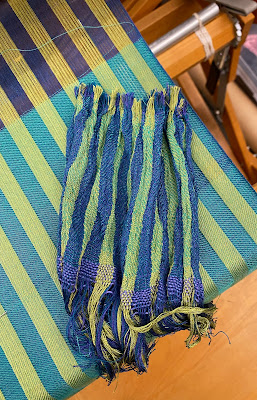

Cindy Root, president of the Michigan League of Handweavers, chose to weave a 4-shaft project on a gradient warp of 16/2 bamboo, using a weft of 18/2 Jagger Spun merino and a supplemental weft of embroidery cotton. The supplemental weft is used to draw the fabric in horizontally, compressing it so that only portions of the wool are exposed in finishing. This means that only some portions of the wool will full, creating pleats where the weft yarns have shrunk and gathered the warp yarns together densely. Here's Cindy's shibori-tightened fabric before it's washed with warm water and agitated with soap. After it's dried a bit, but still damp, she will remove the shibori ties and have a permanently pleated scarf.
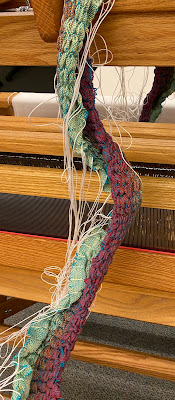

Gail Pilgrim was also working on the Rippenköper structure -- but weaving it in on a 20/2 cotton warp using 8/2 cotton in the weft. She's doing research for a story planned for Heddlecraft magazine looking at hand towels in a variety of structures. In addition to working with cotton wefts, she decided to try a weft of 18/2 Jagger Spun merino, just to see whether the results were worthy of weaving a scarf somewhere down the line (or down the warp). Here's that sample, below.
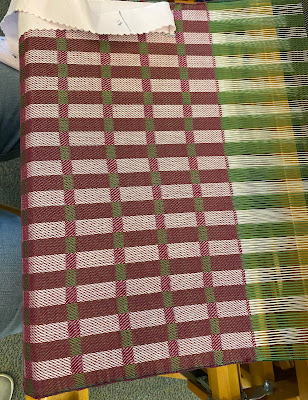

As it is with many workshops, not every project is complete at the end. And since this workshop emphasized the importance of using specific finishing techniques, some weavers chose to finish their projects at home, after the workshop -- as with this 4-shaft deflected doubleweave scarf by Naomi Fletcher, woven with 10/2 cotton in the warp and weft, with a mid-section that includes Colcolastic yarn by Venne, drawing the mid-section in dramatically. I'm hoping she'll send me some photos of her results that I can then share with the group.


Some samples were finished, however (finished meaning washed with warm water and soap and then rinsed), as with this sample below by Martha Town. She wove it on a hand-painted warp of 60/2 silk with navy stripes and jewel-tone-painted stripes and a weft of 120/2 silk, using a turned-twill structure that pleats naturally. Note the subtle yellow accents in the weft every few inches, which add interest to the sample.


Thanks to MLH for a wonderful conference -- and to everyone in my workshop for an experience that I didn't want to end! And finally, thanks to you for reading.


Wednesday, October 19, 2022

Coming December 1: My Book on Texture in Weaving


You're looking at the cover of my soon-to-be-published book on texture in weaving! I've been working on it for, lo, these past five years and it's almost ready for publication.

I plan to begin offering it on Lulu on December 1. And after that, I might celebrate with a good brew or two ;o)

Why did it take so long? Mainly because it includes 12 projects for 4, 8, 6, and 16 shafts, which meant I had to weave them all and document every single detail. And check and double check -- 80 versions and revisions to date, which isn't all that surprising. Plus, with some of the projects, there was much sampling involved, meaning lots of warps and dressing of looms until I got it right.

The title, "Weaving Outside the Box," has two meanings: first, I'm referring to creativity in design and process, "thinking out of the box" about what and how we weave. Second, I'm referring to the rectilinear, two-dimensional plane of weaving -- "the box" that we are typically confined to in our craft -- and how we can begin to break those boundaries. Textural weaving is all about ripples and pleats and buckles and poufs, about bends in the road and reflections on the organic curves of nature herself. Take, for instance, this image of lateral curves of fungi on a tree trunk:

I see a reflection of these lines in a double-weave sample I wove on four shafts, in the style of Liz Williamson:


Different colors, of course, and less nuanced, but the two images share flowing horizontal lines, staggered randomly. I love the unpredictability of how the patterns shift and bend -- much of which takes place in the finishing. After washing these fabrics, the results are  always surprising, which makes it so rewarding to me.

The book is about 120 pages long, with 90 full-color photos and diagrams that aid in understanding the hows and whys of dimensional weaving. It includes a long bibliography to aid in further study, an index (to me that's a big deal, for some reason), and three beginning chapters on the theory of texture in weaving, its history, and some of the overriding techniques involved.

Here is a peek at some of the projects in the book.

Antelope Canyon Shawl in point twill on 4 shafts, 
16/2 bamboo gradient warp, silk/stainless-steel weft

Detail of 'Puzzle Shawl' in deflected double weave 
on 6 shafts, 18/2 merino in warp and weft

60/2 silk striped scarf in plain weave and turned twill 
on 8 shafts, with soft pleats in the middle

Deflected-double-weave infinity scarf on 16 shafts,
using hand-painted warps and wefts in 18/2 merino and 10/2 cotton

Right now, the final draft of the book is with a group of first readers, in alphabetical order, Marianne Antczak, Leslie Mendelson, Ann Richards, Joyce Robards, Sarah Saulson, and Linda Schultz. All of them are wonderful weavers who have generously agreed to serve as fact-checkers and goalies, you might say, to keep any errors from appearing in print. It's good to have smart friends!

As I mentioned, I will offer the book on Lulu, a print-on-demand site used by several folks I know. I will also offer an e-version at a slightly lower cost (and no shipping charges, of course). 

If you're interested in pre-ordering, please click on the "Downloads for Purchase" section of this site, where you'll find a link. I will be in touch as soon as it ships on December 1.

Let me know if you have any questions, of course. My email address is in the "Contact Information" page on this blog. 

Thanks for reading!

Front and back covers, ready for printing