Showing posts with label active yarns. Show all posts

Thursday, January 1, 2026

Interested in an Upcoming Workshop in Bucks County, PA?


This shawl, pictured above, is a tribute to Harriet Tubman, who guided some 70 slaves to freedom, through wilderness in the dark of night, chased by bounty hunters, guided only her instincts, her visions, and the North Star. She reportedly made 19 trips back to the South and notably never lost anyone.

I called it "Harriet's Shawl" because in her later years she was often pictured weaving a large wrap around her shoulders. (By the way, she spent her later years in Auburn, NY, near my hometown of Rochester. It never ceases to amaze me to feel so close to greatness.)

Why did I dedicate it to Tubman? Because the motifs remind me of the forest, of darkness, of the stars she followed. And I did my best to make it beautiful, because her courage and strength are worthy of the best work I can create. (Not-so-humble brag: The scarf did win first prize at the faculty show at NEWS a few years ago, which makes me very proud.)

So what does this have to do with a weaving workshop? A dear friend, Hedy Lyles of Willow Grove, PA, passed away a short time ago and she had planned this workshop. We're doing it for the love of Hedy. Here she is at the loom she sold me, a 16-shaft Toika that I really like. (Except when it's hot and humid and the shafts stick, but that's another story.) Here, she's painstakingly showing me how to put the loom together.


She was also a terrific weaver, as you can see by this photo of her work:


So the workshop must go on, honoring both Tubman and Hedy. Here are the details:

GUILD: Handweavers of Bucks County

DATES: April 8-10, 2026

VENUE: Trinity Buckingham Church, 231 Durham Road, Buckingham, PA

WORKSHOP DESCRIPTION: For anyone who can read a draft and warp a loom. For looms from 4 shafts to 16 shafts. Each weaver will first, with guidance from the instructor (on Zoom), paint her warp using alternating black and beige yarns in 16/2 cotton. (The trick is you'll automatically have two differently colored yarns for an Echo threading, as the beige yarn will dye colorfully and the black yarn won't take the dye.) You will come to the workshop with your warp dressed and ready to weave. For your "Harriet Shawl," you will weave a series of structures on your Echo threading, using different tieups and treadlings to weave Echo, Jin, Decorated Jin, and double weave. You'll also experiment with different weft yarns and colors, including active yarns such as wool/stainless steel, which will be provided by the instructor. You'll come away with a colorful, textured scarf with a multitude of patterns, colors, and textures that will be unlike any scarf you've woven to date, I boldly venture to say.

To give you a taste of what you're you'll be weaving, here's the double-weave design for the 8-shaft version: 


That's just one of the varied designs you'll be weaving in different colors and textures.

We're looking for a few more weavers to sign up for this workshop. If you're interested you may contact me at kovnatdenise[at]gmail.com

I look forward to hearing from you!

By the way, I want you to know that I do try faithfully to write one blog post a month. December got away from me (not surprising, right?) so (fingers crossed) you'll be getting another blog post toward the end of January. Gotta meet those deadlines, right, even though they're self-imposed....

Thanks for reading!


Friday, January 6, 2023

Book Launch!

Weaving Outside the Box: 12 Projects for Creating Dimensional Cloth is now available for purchase! It's been a long road but at last it's ready to launch.

Front and back covers (right and left respectively) for printing

The book is 122 pages long, in full color, with a soft cover and a coil binding so that you can lay it flat as you read and weave. It's also available as an eBook and in hardcover. You'll find all these options on this blog site under the page titled "Publications for Purchase".

Here's a brief description:

"Color and structure are key elements in weaving, of course. But we often overlook the importance of texture. Dimensional fabrics, with their pleats, puffs, and curves, take us 'off the grid', reflecting the organic forms of nature. We can both see and feel the tactile quality of dimensional cloth, which adds much to the beauty of handwoven fabric.

"This book gives you tools to optimize texture in your weaving. Starting with background on the techniques involved, it then offers step-by-step instructions for 12 projects for four to 16-shaft looms: four for beginning weavers, four for intermediate weavers, and four for advanced weavers. As a bonus, there are two patterns that allow you to weave three different projects on a single warp.

"Weaving Outside the Box provides the tips and resources you need to move beyond the two-dimensional plane and rectilinear patterns of warp and weft."

Here are a few of the projects offered.

Among the four projects for four shafts: woven shibori using fulling techniques


Doubleweave layers and ruffles for eight shafts 
using differential-shrinkage techniques


Deflected doubleweave on 16 shafts 
using differential-shrinkage techniques

There are diagrams and even microscopic photos of yarn throughout the book, to help you understand the mechanics behind these designs, all using some combination of active and inactive yarns, structure, and finishing.


I will teach a workshop straight from the book June 11-16 at the Michigan League of Handweavers Conference in Holland, MI. Participants will choose one of the 12 projects from the book and start by weaving up samples so they can learn how to finish their projects to get just the right textured effects.

Dimensional cloth is a specialized area of weaving, one that is sometimes overlooked but has been woven for centuries. My book begins -- and this blog post concludes -- with this quote from Anni Albers, from her definitive book, On Weaving

All progress, it seems, is coupled to regression elsewhere. We have advanced in general, for instance, in regard to verbal articulation -- the reading and writing public of today is enormous. But we certainly have grown increasingly insensitive in our perception by touch, the tactile sense.

I hope my book inspires weavers to explore all three of the wonderful tools we have in our craft: those of structure, color, and the tactile sense.

Thanks for reading!


Detail of Echo threading in four-color doubleweave on 28 shafts, 
using cotton/stainless-steel yarn for one of the wefts 
to achieve crinkled layers


Wednesday, October 19, 2022

Coming December 1: My Book on Texture in Weaving


You're looking at the cover of my soon-to-be-published book on texture in weaving! I've been working on it for, lo, these past five years and it's almost ready for publication.

I plan to begin offering it on Lulu on December 1. And after that, I might celebrate with a good brew or two ;o)

Why did it take so long? Mainly because it includes 12 projects for 4, 8, 6, and 16 shafts, which meant I had to weave them all and document every single detail. And check and double check -- 80 versions and revisions to date, which isn't all that surprising. Plus, with some of the projects, there was much sampling involved, meaning lots of warps and dressing of looms until I got it right.

The title, "Weaving Outside the Box," has two meanings: first, I'm referring to creativity in design and process, "thinking out of the box" about what and how we weave. Second, I'm referring to the rectilinear, two-dimensional plane of weaving -- "the box" that we are typically confined to in our craft -- and how we can begin to break those boundaries. Textural weaving is all about ripples and pleats and buckles and poufs, about bends in the road and reflections on the organic curves of nature herself. Take, for instance, this image of lateral curves of fungi on a tree trunk:

I see a reflection of these lines in a double-weave sample I wove on four shafts, in the style of Liz Williamson:


Different colors, of course, and less nuanced, but the two images share flowing horizontal lines, staggered randomly. I love the unpredictability of how the patterns shift and bend -- much of which takes place in the finishing. After washing these fabrics, the results are  always surprising, which makes it so rewarding to me.

The book is about 120 pages long, with 90 full-color photos and diagrams that aid in understanding the hows and whys of dimensional weaving. It includes a long bibliography to aid in further study, an index (to me that's a big deal, for some reason), and three beginning chapters on the theory of texture in weaving, its history, and some of the overriding techniques involved.

Here is a peek at some of the projects in the book.

Antelope Canyon Shawl in point twill on 4 shafts, 
16/2 bamboo gradient warp, silk/stainless-steel weft

Detail of 'Puzzle Shawl' in deflected double weave 
on 6 shafts, 18/2 merino in warp and weft

60/2 silk striped scarf in plain weave and turned twill 
on 8 shafts, with soft pleats in the middle

Deflected-double-weave infinity scarf on 16 shafts,
using hand-painted warps and wefts in 18/2 merino and 10/2 cotton

Right now, the final draft of the book is with a group of first readers, in alphabetical order, Marianne Antczak, Leslie Mendelson, Ann Richards, Joyce Robards, Sarah Saulson, and Linda Schultz. All of them are wonderful weavers who have generously agreed to serve as fact-checkers and goalies, you might say, to keep any errors from appearing in print. It's good to have smart friends!

As I mentioned, I will offer the book on Lulu, a print-on-demand site used by several folks I know. I will also offer an e-version at a slightly lower cost (and no shipping charges, of course). 

If you're interested in pre-ordering, please click on the "Downloads for Purchase" section of this site, where you'll find a link. I will be in touch as soon as it ships on December 1.

Let me know if you have any questions, of course. My email address is in the "Contact Information" page on this blog. 

Thanks for reading!

Front and back covers, ready for printing


Thursday, February 10, 2022

Collapse Techniques: Some Active Yarns and How They Work


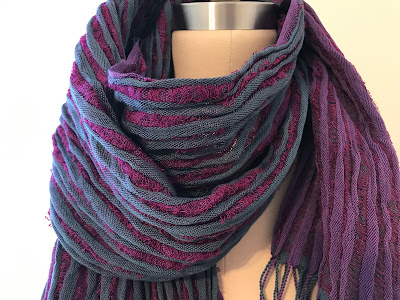
Pictured above: A scarf woven on 4 shafts in deflected double weave. The warp is 20/2 cotton in stripes of teal and purple and the weft uses these yarns plus a wool/stainless-steel yarn (see the floats above, in fuchsia). The scarf looks like gauze on the loom, but when you wash it in gentle soap and lukewarm water, the wool/stainless floats crinkle up and draw in horizontally, creating vertical pleats in the fabric.

I love these surprises in the finishing! And one of the easiest ways to achieve them is by using active or energized or exotic yarns -- a large category that includes yarns that will shrink, twist, collapse, and/or relax after washing.

Right now I'm teaching a Zoom workshop for the Reno Fiber Guild, "Deflected Double Weave for Collapse Fabrics." I put together a short handout on the active yarns we're using and how they work and I thought it was worth sharing in a blog post. Here's the list -- of course, it's not comprehensive -- along with photos and images of the yarns under magnification.

Fine Gold Gimp (Metallic Yarn)


The thicker version of this yarn doesn't work well for creating texture in fabrics, but the finer version can add a lot of interest. It's really 77% polypropylene and 23% metallic. And it's hard to find: The only vendor in the States that sells it is Made in America Yarns, a Philadelphia company that lists it under the name "fine metallic gimp yarn."

This is what a single strand looks like at 60X magnification.

And here's what it looks like after weaving and washing.


The polypropylene shrinks up with warm water and soap, bending and crimping the metallic coils around it. When used as weft, this can create some interesting motifs as it shrinks the fabric width-wise.


Wool/Stainless-Steel Yarn


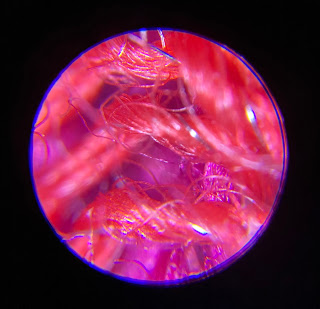
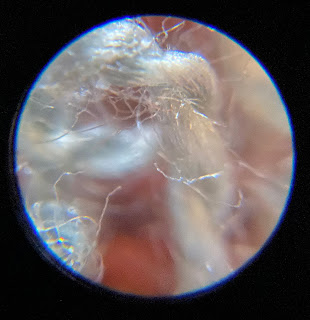
This yarn, available from Habu Textiles, is what I used as weft in the scarf pictured at the beginning of my post. You can achieve similar effects with silk/stainless-steel yarn, available from Lunatic Fringe. Here's what it looks like under 60X magnification, unwoven (first photo) and woven and washed (second photo).


The wool shrinks in the washing and the stainless-steel filament bends with it, so that the sample is drawn in. I find that you can actually shape the garment, either flattening it out or stretching it vertically to create vertical pleats. It all depends on your mood ;o)


Deflected double weave sample on 8 shafts


Deflected double weave sample on 12 shafts

18/2 Merino Wool

Nothing beats wool for differential-shrinkage effects. Combine it with cotton or silk or some other inactive yarn and you'll get pleats and poufs and lots of texture. (Note: I don't recommend using JaggerSpun Zephyr, because the silk component doesn't full in comparison with the 18/2 superfine merino. Also, be careful not to purchase super-wash wool yarn, because these yarns are chemically treated NOT to full or shrink.)

Hand-painted warp of 18/2 JaggerSpun superfine merino


1 strand of 2-ply yarn, before fulling


Magnified image of the yarn after weaving and fulling


16-shaft deflected double weave sample after fulling, using 18/2 merino and 10/2 cotton in both warp and weft (hand-painted warps and wefts)

Venne Colcolastic (and Other Elasticized Yarns)


This yarn has two components: a fine 2-ply mercerized cotton and an elasticized single. Here's what it looks like under magnification:


And here's what it looks like under magnification and after weaving and washing:


My explanation for this effect is that the elastic draws in and the cotton is drawn in with it, crinkling and twisting up as it goes. Below is a sample of a 4-shaft deflected-double-weave piece I wove with long weft floats of the Colcolastic. (You're viewing the warp horizontally.)


This second sample, below, has no floats on the front and narrow floats on the back, simply because there are just 4 warp yarns in the block it floats over. It's a 12-shaft deflected double weave. Colcolastic is used as weft for the middle section only.


Active yarns are just one way to create textured fabrics. You can also achieve dimensional effects just by weaving structures that lend themselves to texture: turned twills, honeycomb, waffle weave, and of course deflected double weave will create curves and pleats even without the aid of active yarns.

Weavers will sometimes get preoccupied with color and structure, forgetting about that third invaluable characteristic of our craft, that of texture. In her definitive book, On Weaving, Anni Albers devotes a chapter to "Tactile Sensibility," focusing on the importance of matière:

"Matière is the word now usually understood to mean the surface appearance of material, such as grain, roughness or smoothness, dullness or gloss, etc., qualities of appearance that can be observed by touch.... Surface quality of material -- that is, matière -- being mainly a quality of appearance, is an aesthetic quality and therefore a medium of the artist...."

Weaving, in her view, brings us back to our ancient tactile sense. Of course, the yarns we use are central to this achievement.

Thanks for reading!