Showing posts with label Convergence. Show all posts

Tuesday, July 30, 2024

A Talk with Master Weaver Lillian Whipple


The photo resolution may not be good enough to show it very well -- but the warp for this piece is 240/2 silk! Or maybe it's 260/2, which is another yarn she often used for warps.... 

Here's another example of her work:


That's Lillian Whipple's superpower: weaving with silk so fine that most of us would need our reading glasses to see it. Here are a few more of her ever-so-delicate, feather-light "kimono" weavings, each one a work of art on its own, each about 1" wide by 2" long.


Many weavers boast of having an entire collection of Lillian's pieces. That's because, at every Convergence conference for many years, she was known for sharing them with every attendee she encountered, myself included.

Motifs on Lillian's loom

Lillian's beloved 24-shaft AVL

I first met Lillian at Convergence (not sure which year), standing in a group of friends, when she approached us, introduced herself, and shared her tiny, lovely kimono samples with all of us. This was my first time I'd received one of her weavings and I felt like I had been initiated into a very special club. Since then, I've met many people at weaving conferences proudly wearing name-tags accompanied by maybe half a dozen of Lillian's postage-stamp-sized pieces, each woven in exquisite detail. 

And one day, surprisingly, she appeared in one of my workshops. It may have been at Convergence in Reno in 2018. (Side note here: Like Lillian, many well-known, highly respected teachers are more than happy to take workshops. I think of Chaucer's quote about the Clerk in his Canterbury Tales: "And gladly would he learn, and gladly teach." But I didn't know that then. All I knew was that Lillian Whipple was in my class and I'd better be on my toes.) 

"It was about 50 years that I was weaving," Lillian told me in a recent phone conversation from her home in California. "I can't weave anymore but I had a great time and I'm still hearing about it," she continues, laughing. "I have many pieces on my walls and in my closet to remind me."

She has two COEs (Certificates of Excellence from the Handweavers Guild of America), highlighted by an in-depth study for her second COE entitled "By a Fine Silk Thread." For more than 15 years, she chaired the Fine Threads Study Group for Complex Weavers, serving as a mentor to talented artists like Molly McLaughlin. Her many accomplishments include teaching, exhibiting, writing and publishing, and a host of awards for her garments and wall hangings. She is perhaps best known for her Taqueté and Summer and Winter weavings in fine silk -- such as the pieces shown at the beginning of this post.

What drew her to weaving? "It satisfied something in me," she muses. "I was able to create what I wanted. I was able to design what I wanted and the field was open to me, wide open."

Her advice to aspiring weavers relates to this. "I would tell people to enjoy themselves and do what you want and go where you want, because it's wide open! You can do anything you want, I believe."

Words to weave by. Thank you, Lillian!


Top, Whipple in 2009 and below, one of her Summer and Winter weavings. 
(From WeaveZine, October 1, 2009.)


Friday, May 24, 2024

It's Conference Season -- Which Means Exhibits!


Every other year, in some city in the U.S., weavers travel from all around the globe to attend two of the best conferences worldwide: Convergence, sponsored by the Handweavers' Guild of America, and "Seminars," sponsored by Complex Weavers.

There are classes, talks, gatherings formal and informal, vendors (of course), and exhibits (of course). Among the best-attended exhibits are Complexity, an international show sponsored by Complex Weavers, and the Convergence fashion show. 

And every other year, I challenge myself to weave and apply to both of these shows. (Some pieces are juried in, some pieces aren't, but that's how it goes....)

The piece shown at the beginning of this post is titled "Harriet Tubman Dreams of the North Star," and I'm proud to say it was juried into this year's Complexity exhibit, to be mounted at Mark Arts Gallery from July 7-August 16 this summer in Wichita, KS, where both conferences will be based. Here are a couple more views.

A detail pic of the corner of this piece --
including the beaded fringe, 
which took months to complete....

Here's a medium-range photo of the weaving, 
which also took months 
to design, dye, wind the warps, and weave.

Tubman was born into slavery in 1822 in Maryland and died a free woman at 91 in Auburn, NY, near my home in Rochester. Before the Civil War, she escaped slavery and returned to the South to lead some 70 slaves to freedom, traveling through the night, following the North Star, making stops along the Underground Railroad on their way to freedom in Canada. After enduring the hell of slavery, she faced down unimaginable dangers and terrors to rescue others, leaving a legacy of bravery that inspires and awes millions. My weavings are a modest tribute to the woman who was called the Moses of her people.

These photos of my work were taken by Tim Fuss of Pixelwave photography. We've worked together for at least a decade and he never fails to get the lighting and the setup just right. 

Below are more photos by Tim -- images of another piece that was juried into Complexity 2024, also honoring Tubman and to be on exhibit at Mark Arts in Wichita.


I've named this "Harriet's Shawl," inspired by photos of Tubman wearing a shawl in her later years.

Harriet Tubman, taken in 1885 in Auburn, NY

Tubman at the end of her extraordinary life, 
again photographed in Auburn.

A third piece completed last year for exhibit is a dress I wove on 24 shafts, on a warp of 16/2 bamboo/rayon in orange and purple. I call it "Purple Waves." It was woven in doubleweave on an Echo threading, as one piece of yardage on my loom that was simply folded in half horizontally and sewn only at the shoulders and seams.

This dress will appear in the fashion show at Convergence in July -- an event that is always the high point of the conference. Again, the photos are by Tim Fuss.


Because it's doubleweave, there are two wefts involved. 
For the bodice, one of the wefts is linen crepe, 
which draws in and creates gentle pleats 
that mold themselves over the body above the waist.

For me, it's important to set up a weaving challenge for myself every year or so, to aim for a juried exhibit or a show. It makes me work harder, take some risks, aim a bit higher. Of course it can hurt when a piece doesn't get accepted or there are issues -- which I won't share, it's complicated -- but I keep trying, focusing on the next one. I always learn, regardless. And I have an excuse to attend these wonderful events....

Convergence and Complex Weavers Seminars, taking place this July in Wichita, KS. Hope to see you there!

And, as always, thanks for reading.


Saturday, February 17, 2018

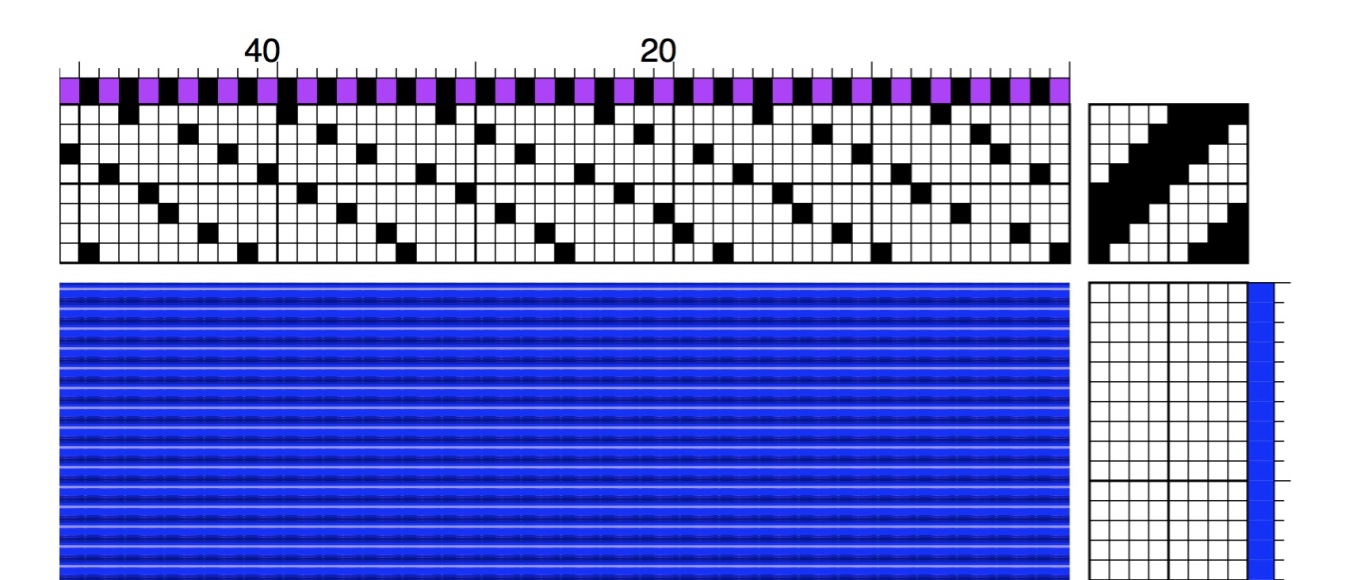
How to Design 8-Shaft Echo Using Fiberworks


Just finished: this sample above on 8 shafts, in preparation for my workshop at Convergence this July. (For details, click here and scroll down to the eleventh listing.) I'm using 10/2 pearl cotton in the warp, sett at 36 epi, with a 20/2 pearl cotton weft (in black). I like to call it "Many Rivers" because of the vertically flowing design.

In this blog post, I'll try to outline the steps it took to design this in Fiberworks. No easy task, learning how to do this! But it's so worth it: While weaving most any pattern can be a delightful journey, it's a great pleasure to create your own designs and then weave them up to see exactly what happens. I encourage you to try.

So here goes! (Note: I have a Mac, so keep in mind that the commands in Fiberworks may differ slightly for PCs.)

STEP 1: Create a design line


Using the "Draw Freehand" button, I designed curves that change in shape and size. Try it! Any rounded forms will do for starters.

STEP 2: Create a networked threading based on the design line


Click on the drop-down menu under "Warp" and then click "Redraw on network." A box will appear and you want it to have these settings: "No reduction," "Straight Twill" (under "Style of Initial"),  "4" (under "Height of the Initial").  (You do not need to enter anything under "Set Result to X Shafts.") Then click "Apply" and "Accept." Voila! You've created a networked threading.

Notice how the curves in the threading, based on a twill structure, follow the curves of the design line. If you want to learn more about network drafting, the definitive book is written by Alice Schlein.

STEP 3: Create an extended parallel threading


Again in the drop-down menu under "Warp," this time click on "Parallel Repeat," then "Extended Parallel," "Shafts Shift by 4," and then "Apply."

This threading may look at little strange if you're not familiar with extended parallel threadings. (For more on this, read the first four paragraphs of my blog post here.) But look carefully at the threading and compare it with the threading in the previous image: The first and second warp threads in the earlier image are on 1 and 2. In the second image, the extended parallel threading shown above, the first warp end is on 1, followed by its "echo" four shafts higher on 5. The second warp end is on 2, followed by its "echo" four shafts higher on 6. Echo threadings are in two parallel lines. Corkscrew twills are based on this concept as well. The threading goes round and round.

STEP 4: Assign colors to your extended parallel threading


In the "Warp" drop-down, click on "Fill Warp Colors." In the next box, set the colors for "AB," then drag the colors you want from the color panel into boxes A and B. Then click "Replace."

Why use two different colors? As each thread in the original networked draft is followed by its echo or parallel, so you have to distinguish these parallel patterns by using different colors. Otherwise, you wouldn't see the echo! So the colors are always A-B-A-B, etc. (In Marian Stubenitsky's book, Weaving with Echo and Iris, she often designs with as many as four different colors on four parallel threadings, for the beautiful effect that she terms "iridescence.")

STEP 4: Create a twill tieup


That's a simple twill repeat, rising, with 4 shafts up and 4 shafts down. This means that, for any warp thread and its parallel (for any pair of purple and black threads), one is up and one is down at any given time. This is the 4-shaft interval for the parallel threading, allowing the patterns to play one against the other.

STEP 5: Decide on a treadling pattern, based on a twill

For the treadling, I usually "draw" it in by hand, using the "Draw Freehand" button at the top left. There are lots of other ways to do this, but it's my preferred method.

I chose an advancing point twill, with a pattern of 1-2-3-4-5-4-3, 2-3-4-5-6-5-4, etc. I love the way the "points" in the treadling seem to sparkle in the drawdown! But there's a problem: there are long floats in the warp. If you can't tell just by looking at the drawdown, it's a good idea to check: You do this by clicking on the "Tools" menu, and then clicking on "Float Search." You can search for floats of any number in both warp and weft -- but Bonnie Inouye suggests that, with Echo, you don't want floats of more than 5 ends or 5 picks. That's a lot, particularly if you're using threads that are as thick as 10/2 cotton or thicker.

STEP 6: Change the tieup, if needed, to reduce the number of floats

This means that you will have to add more variety in the tieup, so there are more tie-down threads in the warp. You may have to play with the tieup a bit to see how it works and what you like.

So that's the how-to. Hope it's clear enough to get you started. And then, if you're really ambitious, you can begin designing other patterns using different tieups and treadlings. For instance...

STEP 7: Bonus! Add tabby for Turned Jin.

This is a structure that automatically eliminates floats of longer than 3: Jin! Just by adding tabby to a 4/4 tieup for an extended parallel threading, you can create a Jin design. (It's not TRULY tabby, but rather a half-basket weave, but that's another discussion for another time.)

In any event, here's how to do this: Under the "Treadling" drop-down menu, scroll to the end and click on "Insert Tabby." What you'll get is a form of tabby -- but you'll have to adjust it so that treadle 1 lifts shafts 1, 3, 5 and 7 and treadle 2 lifts shafts 2, 4, 6 and 8. It's always a reward to see the design nice and clear and neat -- which is why I love Jin.

Here, in conclusion, is a detail of the back side of my Echo sample, which is quite different from the front, pictured at the beginning of this post. Thanks for reading!


Thursday, February 18, 2016

Collapse Fabric in Twill Blocks with 60/2 Silk and... Mystery Yarn


I am very happy with this sample! However, there were plenty of obstacles in beaming this warp. And then there's the question of the mystery yarn....

Here it is (next photo, below) on the loom -- about 12" wide in the reed with two different wefts. The weft in the bottom sample is from Giovanna Imperia. It's an Italian 100% cotton crepe in a terra cotta color. At 24,000 yards per pound, it's perfect for a collapse weft on a 60/2 silk warp.

The weft on the top is a silk tram, purchased from John Marshall at Convergence in 2014. Gorgeous pale olive color! Slippery as anything, but about the grist of 120/2 silk -- which is also great for a collapse effect on this warp.


And here's the draft. Simple enough.

I wound a warp of 9.5 yards, 756 ends, with alternating stripes of 12 ends each using 60/2 silk in orange and a variegated hand-dyed yarn I purchased from Randall Darwall -- also at Convergence in 2014.

Darwall is a brilliant weaver and dyer. I loved the yarn. Looked like silk to me. Trouble is, I could not, for the life of me, figure out what the grist was. I think, based on the inaccurate measurements of my McMorran Balance, that it's somewhere around 18,000 yards per pound. I sent it to Michael Cook, dedicated lover of all things silk and creator of Wormspit.com, to test it to see whether it was fine silk still in the gum. He sent back the disappointing answer that it was rayon or some kind of cellulose fiber.

Still, it was gorgeous and I started beaming the warp. Long story short, rayon -- and more specifically, Lyocell -- have a strong tendency to pill (or as the experts call it, fibrillate). This means that the yarns will often get stuck together, bound by these tiny and incredibly annoying fibrous pills. I spent an inordinate amount of time breaking them up, sometimes resorting to using a seam ripper.

Still, eventually, I was able to beam the entire warp. And the yarn is gorgeous, in the subtle colors that Darwall uses so well. 60 ends per inch, and no breaking whatsoever.

Here's the sample just off the loom.


You can see that it already tends to create vertical pleats, even before washing. And after washing in hot water and mild soap, with a bit of coaxing by pulling on the fabric vertically, the fabric collapses nicely.


All's well that ends well! Or begins, as I'm starting to weave a set of samples for the next Collapse Weave Study Group sample exchange (a study group of the Complex Weavers). Thanks for reading!


Monday, July 21, 2014

An Entirely Arbitrary Look at Convergence 2014

From a very biased viewpoint: Mine! A group of Rochester Guild members -- including two "Convirgins," as weavers affectionately call those who are attending the convention for the first time -- journeyed to Providence on Wednesday, July 16, to see the fashion show and the exhibits. And, of course, the vendors.

For those who aren't familiar with what Convergence is: this is the biennial convention of the Handweavers Guild of America, held somewhere in the continental United States and drawing a couple of thousand weavers, teachers, exhibitors, and vendors from all over the world. It is an inspiring event and -- because it's usually held on the West Coast -- I was not about to miss it.

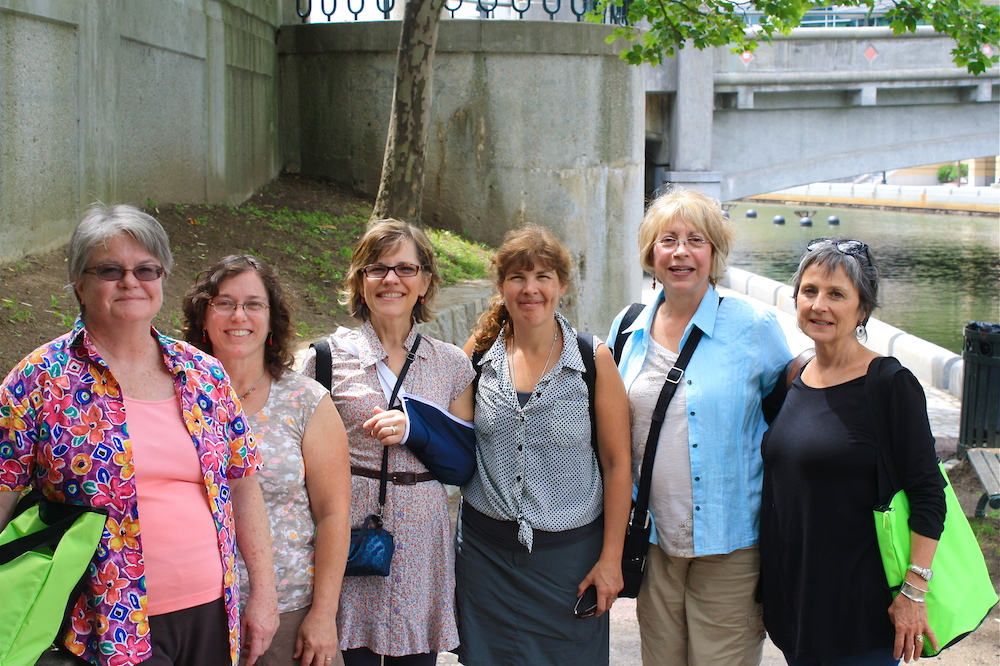
My traveling companions (left to right): Leslie Mendelson, Karen Berk, Hope Herting, Jenn Snyder, Teri Silsby, and me. Jenn, a Rhode Island native, was our wonderful hostess AND tour guide.

Among the many tempting vendors: Master weaver Randy Darwall, 
whose scarves are pictured above

The Glimakra booth, which to me is pretty much 
the weaving equivalent of Disneyworld....

None of us took classes, but instead visited the exhibits and toured the Providence area -- again, guided by Jenn Snyder. The fashion show was a highlight and spurred a lot of discussion. The first-place winner was not a weaver, for instance, but the garment itself was masterful and showed great skill in surface design, couture sewing, and garment design.

(I had an item juried into the show -- but found out at the last minute that my garment had been disqualified because there was a tear in the back seam. I was told that they had received the garment that way, but there is no way on earth I would have shipped it like that. Most likely, it tore when a model tried it on. Still, quite honestly, the fabric was fragile and I had not reinforced the seam. I learned NOT to do that again, for sure. A painful experience but also a lesson.)

Moving on: the Complex Weavers exhibit, named "Complexity," was a highlight of the conference for me. Again, for those who don't know, Complex Weavers is an international organization of handweavers who are interested in working with more than four harnesses -- although four-harness weaving is also explored by this group, as it can offer many challenges for advanced weavers. 

A dimensional wall hanging by Susie Taylor,
double woven on 10 shafts with an origami layer 

Bonnie Inouye, whose work I admire greatly, wove this Echo weave piece
with looped and interlocked strings on 24 shafts

A detail of a Jacquard-woven piece by Lois Bryant,
in weft-backed 8-shaft twills and 16-shaft satin

One of my personal favorites: a scarf by Lesley Willcock 
created from network threading, woven on 32 shafts 
in a treadling range of 8-end satins

The first-place winner was another piece by Lesley Willcock: a 4-color double weave
using an extended parallel on a network threading and woven on 32 shafts

Another personal favorite: a fancy twill scarf by Carol Wooten woven on 32 shafts

This scarf is by Elizabeth Calnan, woven on 32 shafts 
in a double-weave point threading

So much to see, so much to learn! With all the conversations, reading, and viewing, my head was fit to burst. The ideas will last me for at least two years -- until the next Convergence, just about....