Showing posts with label Complex Weavers. Show all posts

Friday, May 24, 2024

It's Conference Season -- Which Means Exhibits!


Every other year, in some city in the U.S., weavers travel from all around the globe to attend two of the best conferences worldwide: Convergence, sponsored by the Handweavers' Guild of America, and "Seminars," sponsored by Complex Weavers.

There are classes, talks, gatherings formal and informal, vendors (of course), and exhibits (of course). Among the best-attended exhibits are Complexity, an international show sponsored by Complex Weavers, and the Convergence fashion show. 

And every other year, I challenge myself to weave and apply to both of these shows. (Some pieces are juried in, some pieces aren't, but that's how it goes....)

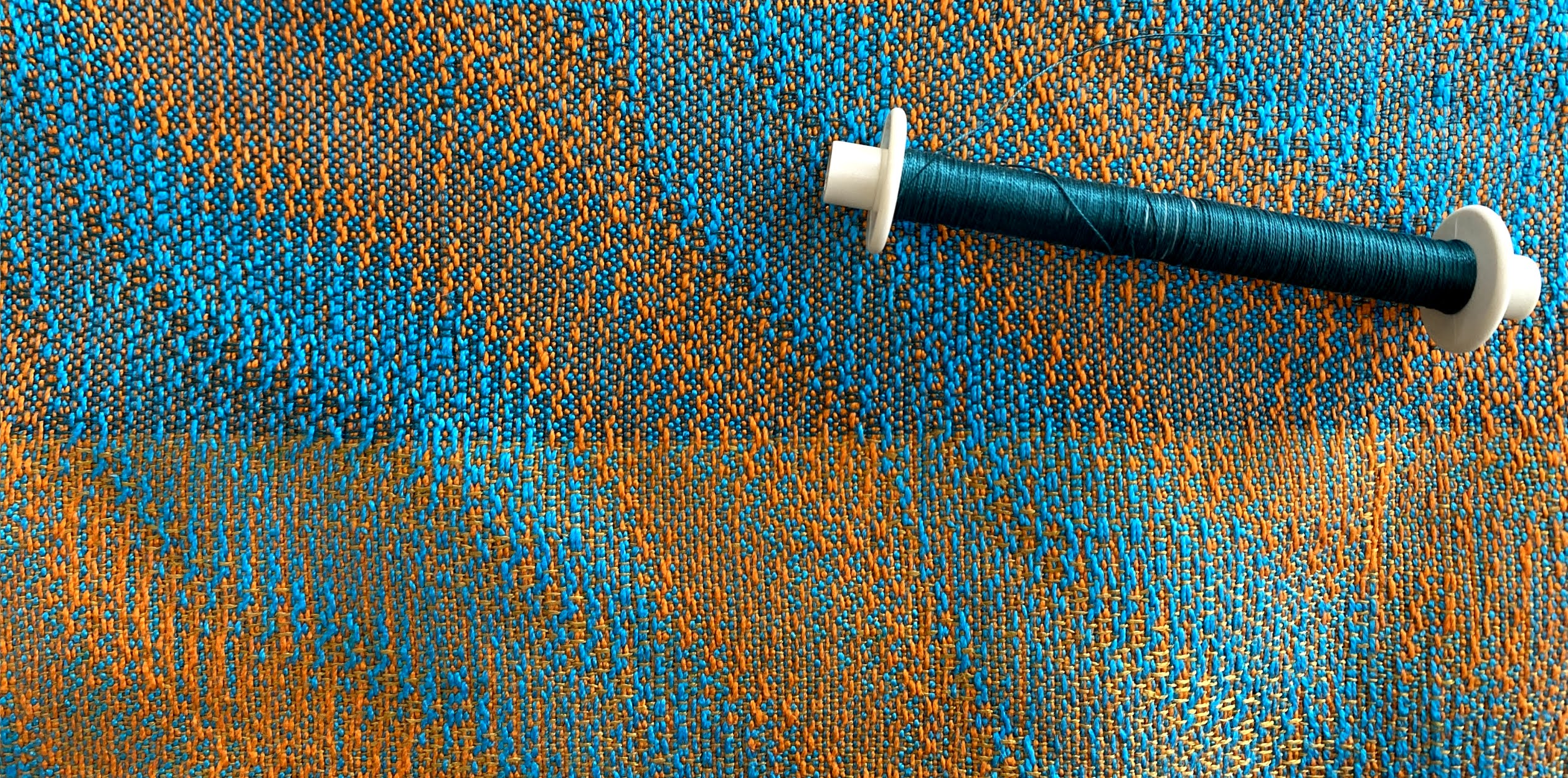
The piece shown at the beginning of this post is titled "Harriet Tubman Dreams of the North Star," and I'm proud to say it was juried into this year's Complexity exhibit, to be mounted at Mark Arts Gallery from July 7-August 16 this summer in Wichita, KS, where both conferences will be based. Here are a couple more views.

A detail pic of the corner of this piece --
including the beaded fringe, 
which took months to complete....

Here's a medium-range photo of the weaving, 
which also took months 
to design, dye, wind the warps, and weave.

Tubman was born into slavery in 1822 in Maryland and died a free woman at 91 in Auburn, NY, near my home in Rochester. Before the Civil War, she escaped slavery and returned to the South to lead some 70 slaves to freedom, traveling through the night, following the North Star, making stops along the Underground Railroad on their way to freedom in Canada. After enduring the hell of slavery, she faced down unimaginable dangers and terrors to rescue others, leaving a legacy of bravery that inspires and awes millions. My weavings are a modest tribute to the woman who was called the Moses of her people.

These photos of my work were taken by Tim Fuss of Pixelwave photography. We've worked together for at least a decade and he never fails to get the lighting and the setup just right. 

Below are more photos by Tim -- images of another piece that was juried into Complexity 2024, also honoring Tubman and to be on exhibit at Mark Arts in Wichita.


I've named this "Harriet's Shawl," inspired by photos of Tubman wearing a shawl in her later years.

Harriet Tubman, taken in 1885 in Auburn, NY

Tubman at the end of her extraordinary life, 
again photographed in Auburn.

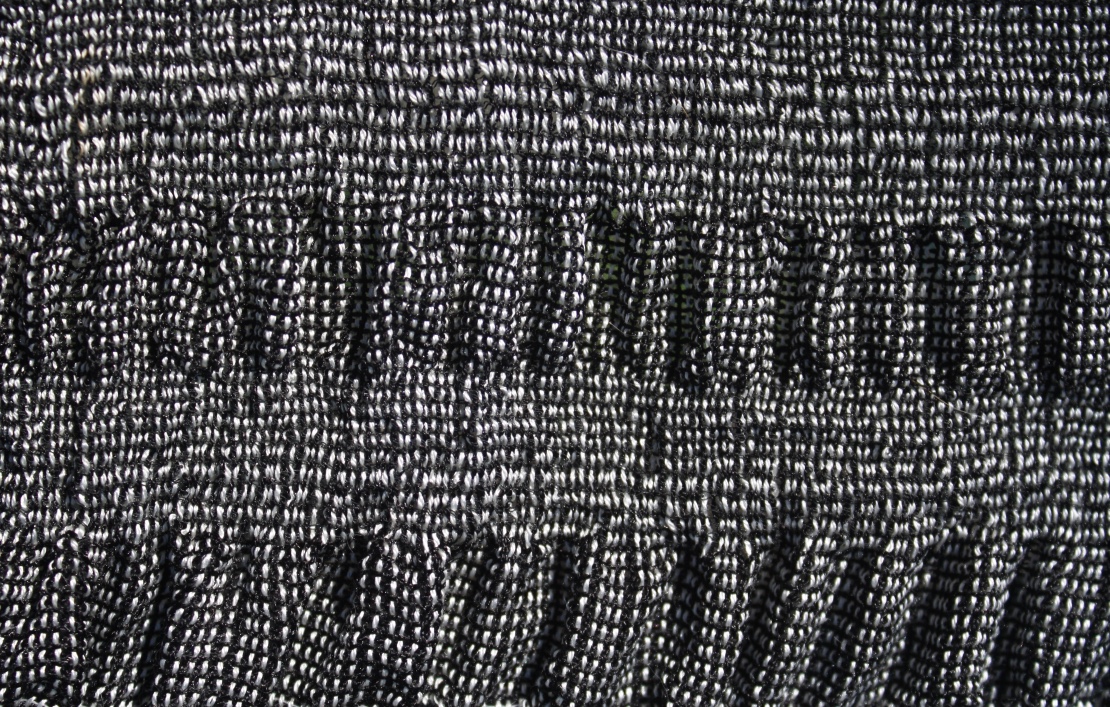
A third piece completed last year for exhibit is a dress I wove on 24 shafts, on a warp of 16/2 bamboo/rayon in orange and purple. I call it "Purple Waves." It was woven in doubleweave on an Echo threading, as one piece of yardage on my loom that was simply folded in half horizontally and sewn only at the shoulders and seams.

This dress will appear in the fashion show at Convergence in July -- an event that is always the high point of the conference. Again, the photos are by Tim Fuss.


Because it's doubleweave, there are two wefts involved. 
For the bodice, one of the wefts is linen crepe, 
which draws in and creates gentle pleats 
that mold themselves over the body above the waist.

For me, it's important to set up a weaving challenge for myself every year or so, to aim for a juried exhibit or a show. It makes me work harder, take some risks, aim a bit higher. Of course it can hurt when a piece doesn't get accepted or there are issues -- which I won't share, it's complicated -- but I keep trying, focusing on the next one. I always learn, regardless. And I have an excuse to attend these wonderful events....

Convergence and Complex Weavers Seminars, taking place this July in Wichita, KS. Hope to see you there!

And, as always, thanks for reading.


Sunday, February 21, 2021

Learning Curves


Learning curves, plural. For example: In the photo above -- a networked Echo threading on 32 shafts -- can you see two threading errors? I will give you a clue: They're pretty obvious ;o)

These are just two of nine, count 'em, nine threading errors in this project so far. I've named it "Learning Curves" because it's the inaugural project for a new-to-me 32-shaft Louet Megado.

I am thrilled, to say the least, to have this loom. However -- and this is a big however -- it may be 15 to 20 years old and may have sat unused for the past four years or more. Which means that, not only did I have to up my game to weave on such a complex machine (which meant hours and hours of designing on Fiberworks), but the loom itself had to be reconditioned, basically. (Spouses are useful in this regard, particularly if they are smart and willing to help out.) And learning how to recondition it involved making mistakes, lots of mistakes, in the process of weaving this first design.

For instance, ends fraying and breaking at the left selvage: Too much draw in (which I should know enough to avoid). My answer was to go easier with the shuttle and, more important, to use my lovely Bluster Bay end-feed-delivery shuttle, which really makes a difference on the "drag" of the weft against the selvages.


And then I needed Texsolv cord. Lots of it.


Texsolv: Don't weave home without it.

I needed -- well, rather, WE needed -- lots of Texsolv because the cords that ran the pulleys that connected to the dobby box that lifted the shafts... kept breaking. But what we didn't know was that, more than Texsolv, we needed Teflon spray to un-gum-up all the pulleys. 


Teflon spray: It works.

We did lots of consulting, too, primarily through that brainy listserve known as WeaveTech (weavetech@groups.io, an invaluable resource for all questions weaving). There I learned how to get in touch with Dave Vanstralen, president of Louet Looms, who got back to me immediately and gave me lots of pointers on how to get this ship out of dry dock. And then there was Mimi Anderson, president of Complex Weavers, who pointed out to me that I should actually check back on WeaveTeach to look at all the answers people had posted. And Fran Osten (www.danforthweavers.com) who suggested using heat-shrink tubing to protect the Texsolv cord from abrading when it meets a screw that's attached to one of the pulleys.


Heat-shrink tubing, which we haven't used yet, because painter's tape is doing the job. 

I won't bore you with a photo of painter's tape! And I may be boring you right now, if you've read this far, because this is a blog about weaving and I haven't shown you any weaving.

Well, long story slightly shortened, I am finally weaving. There is just one more threading error to fix, but here is where I am at this point, weaving an Echo design on 32 shafts.

This same is the same tieup and threadling as the design in the first photo of this blog post -- but here the weft is an azalea-colored 20/2 cotton.

I didn't mention that the warp comprises two highly saturated complementary colors in 10/2 cotton:


These are colors I would not ordinarily have chosen for an Echo warp, but that my previous blog post discussed the use of complementaries with Echo designs. I was thinking out loud about how complementaries can add so much energy and interest to a weaving -- and so I decided to go full bore with these striking colors. Not pretty, but striking.

I really like the results so far.


The top sample uses a dark forest green/emerald weft in 20/2 cotton, while the bottom portion uses a gold/khaki-colored linen singles that I don't think works as well as the cotton.

After this, I hope to do more samples: another Echo design, a few in Jin and a couple in double weave. I'm hoping to try some differential-shrinkage techniques with one of the double-weave designs. Here's the drawdown I'm thinking will work for pleating and puckering.


Meanwhile, I will keep the Teflon spray nearby. Thanks for reading!


Wednesday, November 16, 2016

How Do You Weave This Collapse Scarf? There's a Surprise at the End....


Sometimes when you see something beautiful, you can't get it out of your mind. Which is the case for me with this silk scarf woven by British weaver Sally Weatherill (shown above in detail). I came upon it maybe 3 years ago when I took a workshop with Ann Richards at the Handweavers Studio and Gallery in London.

Here's what I gathered from the photo. Simple fact: It's silk, probably 60/2 silk, in double weave. With two different blocks -- one threading for the blue/green horizontal stripes and one threading for the red/purple. A twill threading, probably a 3/1 tieup.

Too many shafts for my loom, as I have only 12 (a large Macomber and a Leclerc Voyageur table loom). So, for starters, I can't weave a sample in 3/1 twill blocks. Fine with me; I will weave plain weave instead.

Second problem: There is no way I can achieve that small blue/green block in the center of the fabric without adding another block of threading. (That's because the wefts in the red/purple block are discontinuous, right? That weft would have to go in between the middle blue/green block.)

So here's what I came up with.


I used 20/2 cotton on shafts 1 through 4 and 9 through 12 and then 18/2 merino on shafts 5 through 8. I did not like the sample at all (so I won't even post a photo). The weft was 20/2 cotton. The sett was too loose -- so loose that, even after fulling in soap and hot water, the cotton looked like cheesecloth underneath the section where the wool shrank.

Next sample. I decided to tighten up the sett and eliminate the middle block of the warp -- thereby reducing the sample to 8 shafts.


Getting there! Here's how the sample looked.


Still not working well, however. Too messy where the wool warp floats over the merino weft. So I tried weaving the wool block in plain weave right along with the blocks of cotton. Here's the altered draft.

Here are the results. Much better.


I still didn't like the way the cotton plain weave cloth looked after finishing. Maybe it was the matte finish (even though it's pearl cotton). I decided to try superwash wool along with the 18/2 merino, so that the merino would shrink while the superwash wouldn't. I looked at my JaggerSpun color samples and found a red that looked the same in both superwash and merino. The blacks in both yarns matched fine, as you might expect. Here's what the sample looked like before and after finishing.


I like this, but some tweaking is still in order. In any event, I promised a surprise at the end of this post. So, going back to the source of inspiration: the gorgeous silk scarf in blue/green and red/purple double weave stripes.

Remember how I set out to figure out the structure? And it took me three different samples to find something even remotely pleasing -- not to mention the fact that I didn't really figure out the original structure?

Well, through the Complex Weavers Collapse Weave Study Group I have been in touch with Wendy Morris -- a gifted weaver who, at the time I visited the Handweavers Studio and Gallery in London, owned and managed the place. I wrote an article for our study group newsletter discussing the scarf and my efforts to copy it and she wrote me back with this surprise: The scarf was woven SIDEWAYS. Those beautiful red/purple layers are woven horizontally. THAT'S how the weaver achieved the gap in the middle.

Thinking out of the box. I will try always to remember to look at something from a different angle! Thank you, Wendy -- and thanks to Sally Weatherill for designing and weaving the gorgeous piece that got me started on this quest. Here's the draft, for your weaving wonderment.


Thursday, February 18, 2016

Collapse Fabric in Twill Blocks with 60/2 Silk and... Mystery Yarn


I am very happy with this sample! However, there were plenty of obstacles in beaming this warp. And then there's the question of the mystery yarn....

Here it is (next photo, below) on the loom -- about 12" wide in the reed with two different wefts. The weft in the bottom sample is from Giovanna Imperia. It's an Italian 100% cotton crepe in a terra cotta color. At 24,000 yards per pound, it's perfect for a collapse weft on a 60/2 silk warp.

The weft on the top is a silk tram, purchased from John Marshall at Convergence in 2014. Gorgeous pale olive color! Slippery as anything, but about the grist of 120/2 silk -- which is also great for a collapse effect on this warp.


And here's the draft. Simple enough.

I wound a warp of 9.5 yards, 756 ends, with alternating stripes of 12 ends each using 60/2 silk in orange and a variegated hand-dyed yarn I purchased from Randall Darwall -- also at Convergence in 2014.

Darwall is a brilliant weaver and dyer. I loved the yarn. Looked like silk to me. Trouble is, I could not, for the life of me, figure out what the grist was. I think, based on the inaccurate measurements of my McMorran Balance, that it's somewhere around 18,000 yards per pound. I sent it to Michael Cook, dedicated lover of all things silk and creator of Wormspit.com, to test it to see whether it was fine silk still in the gum. He sent back the disappointing answer that it was rayon or some kind of cellulose fiber.

Still, it was gorgeous and I started beaming the warp. Long story short, rayon -- and more specifically, Lyocell -- have a strong tendency to pill (or as the experts call it, fibrillate). This means that the yarns will often get stuck together, bound by these tiny and incredibly annoying fibrous pills. I spent an inordinate amount of time breaking them up, sometimes resorting to using a seam ripper.

Still, eventually, I was able to beam the entire warp. And the yarn is gorgeous, in the subtle colors that Darwall uses so well. 60 ends per inch, and no breaking whatsoever.

Here's the sample just off the loom.


You can see that it already tends to create vertical pleats, even before washing. And after washing in hot water and mild soap, with a bit of coaxing by pulling on the fabric vertically, the fabric collapses nicely.


All's well that ends well! Or begins, as I'm starting to weave a set of samples for the next Collapse Weave Study Group sample exchange (a study group of the Complex Weavers). Thanks for reading!


Thursday, May 28, 2015

Collapse Cloth in 60/2 silk warp and overtwist weft


Many years ago, there was a wonderful magazine called Weaver's -- and in it, an article by Ann Richards on using crepon yarns for collapse fabrics. I have had it in my files for more than 15 years and FINALLY I wove up some samples. The impetus was the annual sample exchange for the Collapse Weave Study Group in Complex Weavers.

The warp is 60/2 spun silk in black and natural, threaded alternately in a straight draw. The photo at top shows the fabric after washing, with a number of different wefts. A closer look, below.

Here's the fabric on the loom, showing horizontal stripes woven alternately in 60/2 spun silk in natural and 30/1 wool in a Z twist.


And then off the loom, before washing.


Here's what the same fabric looks like, close up, after washing in lukewarm water with a bit of Orvus paste.


And here are two other samples. Below, I have alternated weft stripes of black gossamer-weight silk crepe from Habu with 60/2 spun silk in black. The crepe draws in more than any other energized yarn I have used, so this is a very elastic fabric when you stretch it horizontally.


Finally, a softer collapse fabric, as the weft is just one yarn: 30/1 wool in S overtwist (natural color).


Threading 1,456 ends on the loom at a sett of 32 epi amounted to some 45 1/2 inches in width, which collapsed to roughly 30 inches in width after washing. The length didn't change much, from around 45 inches long to 41 inches after washing. Lots of weaving for a shrinkage of 33%, but it was so worth it!

Monday, March 23, 2015

12 Harness Turned Taqueté: From Dismal Failure to Success (with a Few Treadling Errors)


First, the success: Finally, after what seemed like hours on the floor fiddling with treadles, I'm able to weave the draft I envisioned in my head (and on Fiberworks): a 12-harness turned taquete adapted from a profile draft for 8 harnesses published by Bonnie Inouye in the Complex Weavers Journal. I fell in love with the circles and curves and have been working on it through several iterations.

Now, the dismal failure.


Right. Not the same draft, but that's not the reason it doesn't look like turned taqueté. The treadling was all wrong (that accounts for the hours under the loom) AND I forgot to check for floats. The pattern is all floats. Although I do acknowledge that it might be interesting if you wove it as an eyelash fabric (cutting the floats so that they became like "eyelashes" on top of the fabric).

Now, for those of you who are better math-heads than I am, this all might seem terribly obvious. For me, I didn't get it until I wove it. And then I got it pretty quickly, as you can see, because I wove about an inch before I cut it off. Stewed about it for quite a while and wondered what the heck was wrong.

Went back to the drawing board -- Fiberworks, that is -- and succeeded in creating a network draft with parallel threading for 12 harnesses based on the profile draft mentioned above. I used two different painted warps of 20/2 silk and combined them, threading them A-B-A-B for the parallel threading. The weft is 60/2 silk in purple from Webs. Snatching success from the jaws of failure!


This is only a sample, aiming for a fabric I would like to weave for a jacket.  Right now, I'm playing with treadlings. And getting the threading right, of course. A careful observer might notice three threading errors in this piece -- but I won't tell you where they are ;o) Suffice it to say that I broke down and bought some repair heddles, because I'm tired of making them out of string. I find that turned taqueté is a challenge to thread, particularly with parallel threading, because it has no regular blocks. It's all over the place and, if your attention lapses for only a second or two, you have to deal with it when you're weaving.

Here's one more view of the sample, with a different treadling and an off-white weft. I think it looks washed out, but it always pays to experiment. You never know!


A post-script: tying up 14 treadles for 12 harnesses is enough to convince me I need to purchase a computer dobby loom....


Monday, July 21, 2014

An Entirely Arbitrary Look at Convergence 2014

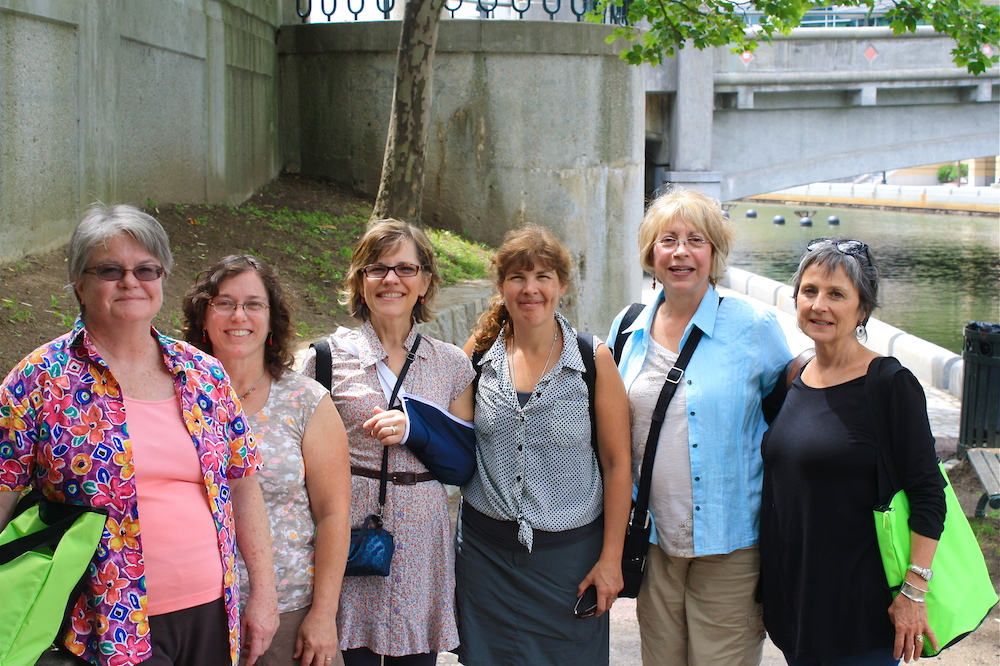
From a very biased viewpoint: Mine! A group of Rochester Guild members -- including two "Convirgins," as weavers affectionately call those who are attending the convention for the first time -- journeyed to Providence on Wednesday, July 16, to see the fashion show and the exhibits. And, of course, the vendors.

For those who aren't familiar with what Convergence is: this is the biennial convention of the Handweavers Guild of America, held somewhere in the continental United States and drawing a couple of thousand weavers, teachers, exhibitors, and vendors from all over the world. It is an inspiring event and -- because it's usually held on the West Coast -- I was not about to miss it.

My traveling companions (left to right): Leslie Mendelson, Karen Berk, Hope Herting, Jenn Snyder, Teri Silsby, and me. Jenn, a Rhode Island native, was our wonderful hostess AND tour guide.

Among the many tempting vendors: Master weaver Randy Darwall, 
whose scarves are pictured above

The Glimakra booth, which to me is pretty much 
the weaving equivalent of Disneyworld....

None of us took classes, but instead visited the exhibits and toured the Providence area -- again, guided by Jenn Snyder. The fashion show was a highlight and spurred a lot of discussion. The first-place winner was not a weaver, for instance, but the garment itself was masterful and showed great skill in surface design, couture sewing, and garment design.

(I had an item juried into the show -- but found out at the last minute that my garment had been disqualified because there was a tear in the back seam. I was told that they had received the garment that way, but there is no way on earth I would have shipped it like that. Most likely, it tore when a model tried it on. Still, quite honestly, the fabric was fragile and I had not reinforced the seam. I learned NOT to do that again, for sure. A painful experience but also a lesson.)

Moving on: the Complex Weavers exhibit, named "Complexity," was a highlight of the conference for me. Again, for those who don't know, Complex Weavers is an international organization of handweavers who are interested in working with more than four harnesses -- although four-harness weaving is also explored by this group, as it can offer many challenges for advanced weavers. 

A dimensional wall hanging by Susie Taylor,
double woven on 10 shafts with an origami layer 

Bonnie Inouye, whose work I admire greatly, wove this Echo weave piece
with looped and interlocked strings on 24 shafts

A detail of a Jacquard-woven piece by Lois Bryant,
in weft-backed 8-shaft twills and 16-shaft satin

One of my personal favorites: a scarf by Lesley Willcock 
created from network threading, woven on 32 shafts 
in a treadling range of 8-end satins

The first-place winner was another piece by Lesley Willcock: a 4-color double weave
using an extended parallel on a network threading and woven on 32 shafts

Another personal favorite: a fancy twill scarf by Carol Wooten woven on 32 shafts

This scarf is by Elizabeth Calnan, woven on 32 shafts 
in a double-weave point threading

So much to see, so much to learn! With all the conversations, reading, and viewing, my head was fit to burst. The ideas will last me for at least two years -- until the next Convergence, just about....