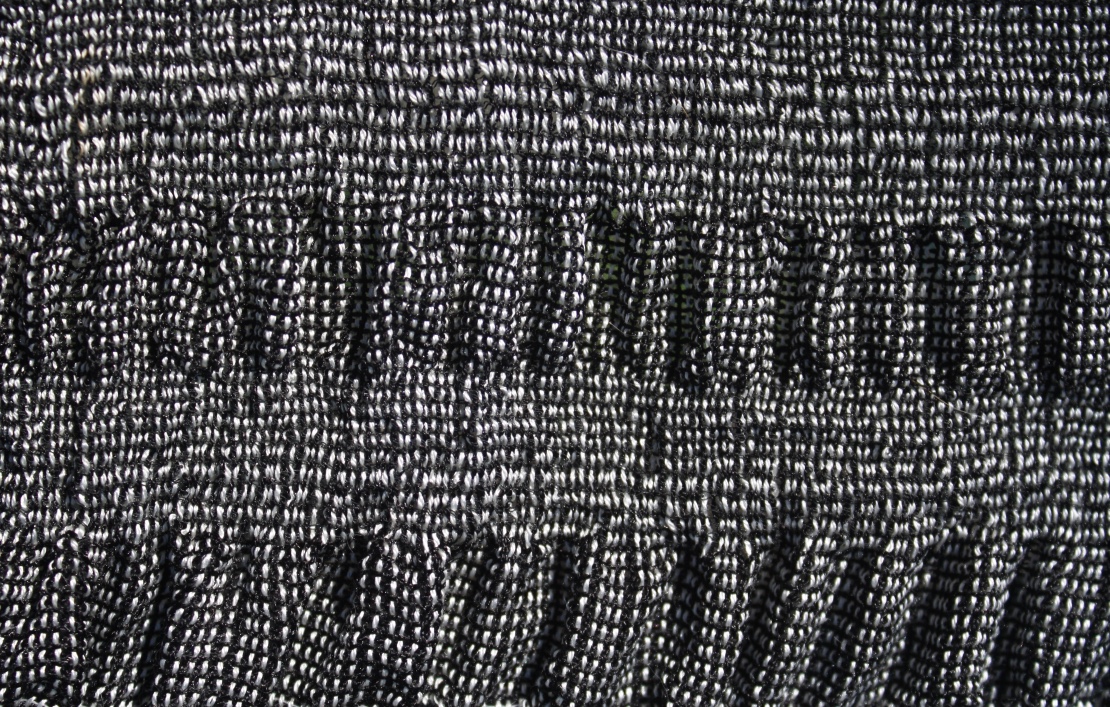
One side of the fabric

The other side
While it may not look like it, the above sample is Deflected Double Weave. Because it's woven on just 4 shafts, it's a very simple two-block pattern -- but it's Deflected Double Weave nonetheless, woven as a collapse fabric.
Here's the drawdown.

It looks pretty simple, eh? The warp is 20/2 cotton in stripes of purple and teal, sett at 36 epi. The weft is 20/2 cotton in a deep purple alternating with a fine wool/stainless steel yarn in fuchsia. This yarn is what creates the collapse effect: See the weft floats across the second block in the warp? At 75% wool and 25% stainless steel, these weft floats will relax and collapse when washed with hot water and soap, because the wool fulls while the stainless makes it crinkle. You can actually take this fabric and flatten it out or you can scrunch it up to get the crumpled effect you see in the photos.
Here's what it looks like on the loom. -- gauzy, flat, and simple.

I used another yarn for the second weft in another sample: silk crepe from Habu Textiles. It's about 33,000 yards per pound, so fine that you can hardly see it!

It's very tough to wind this gossamer thread on a pirn (I always use an end-feed-delivery shuttle for fine and overtwisted yarns). It breaks so easily, as you can imagine. I actually used a doubling stand to help me, where I place the large bobbin that holds the silk crepe at the bottom of the stand and feed the yarn up through the tube that's used for doubling. It keeps the yarn nice and straight, which helps as I wind it onto the pirn.
So in this case I've substituted the silk crepe for the fuchsia-colored wool/stainless. The silk crepe floats and draws the warp ends in dramatically, making neat pleats!

One side of the fabric

The other side

To me, this fabric presents a real problem, because the sample is only about 7" wide! On the loom, it's 24.44" wide. -- that's more than 70% shrinkage, width-wise. So I like the first sample better, because it's about 12 to 14" wide after washing, which seems like a better width for a scarf. (That's what I want this fabric to become.)
Votes, opinions? I welcome you to voice your choice before I start weaving!
But before I end this post, I wanted to add a couple more photos. If you read my blog regularly, you may remember last month's post, showing a baby wrap I just finished for our new grandson, Owen. This month I finished knitting a sweater for him, using Elizabeth Zimmerman's Baby Surprise Jacket, knitted on #5 knitting needles with Kauni Effektgarn in space-dyed rainbow colors. I love the autumn colors and the vegetable buttons, especially since my daughter and son-in-law love vegetable gardening.


That's all for this month! Thanks for reading.