Showing posts with label rep weave. Show all posts

Thursday, July 19, 2018

What We Wove at Convergence: Echo, Jin, Shadow Weave, Rep, Double Weave, and Even Collapse Fabric

Echo Weave on 8 shafts on a warp of light blue and dark blue 10/2 cotton. 
The weft is 20/2 cotton in golden orange. Woven by Virginia Lee.

You've heard about Echo, which is based on an extended parallel threading that weaves a warp-emphasis fabric with lots of color and strong patterns. But do you know about all the different structures you can weave on the same parallel threading? In addition to Echo, you can weave Jin, Shadow Weave, Rep Weave, Double Weave and even collapse cloth, simply by changing your tieups and treadlings.

I taught a workshop on this subject last week at Convergence, the biennial conference for the Handweavers Guild of America, held this year in Reno, Nevada. "One Warp, Many Structures: An Exploration of Extended Parallel Threading" looked at all the possibilities I mentioned above. To teach this, I designed 9 different patterns -- 3 for 4 shaft looms, 3 for 8 shafts, and 3 for 12 shafts -- and invited students to choose a pattern and wind a warp using two colors of 10/2 pearl cotton. (I also named all of these patterns, using simple descriptions as a mnemonic device -- otherwise I couldn't remember them all!)

Below is a photo essay showing some of the beautiful samples the folks in my workshop created, with brief descriptions for each. It was a visual feast!

Above on left: Echo Weave sample using 8-shaft pattern, "Many Rivers," in light blue and off-white warp yarns. On right: the same pattern, this time in Double Weave, with top layer woven in off-white 10/2 cotton and bottom layer woven in 18/2 merino. The bottom layer fulls with hot water, soap, and agitation, making the top layer collapse and pucker. Woven by Roberta McKinney.


 Echo in the 8-shaft pattern, "Falling Stars," using different colors of weft yarns in 20/2 cotton. 
Note how the the weft color completely changes the color of the fabric. Woven by Teresa Edmisten.

Left to right: Double Weave and Shadow Weave samples woven on 8 shafts in the "Fun House" pattern. 
Woven by Judith Rees.

 Clockwise, starting from top left: Echo,
Double Weave, and Rep Weave on a 4-shaft pattern called "Op Art."  Woven by Diana Abrell.

Rep Weave in the "Fun House" pattern on 8 shafts. Woven by Virginia Lee. 

Shadow Weave on 8 shafts in the "Falling Stars" pattern. I think this was woven 
by Rachelle Weiss -- my apologies for not knowing for certain.

 Above, the 8-shaft "Fun House" pattern on a warp in two shades of blue for warp yarns. 
The red weft creates the impression of 4 different colors in the fabric. Woven by Judith Rees.
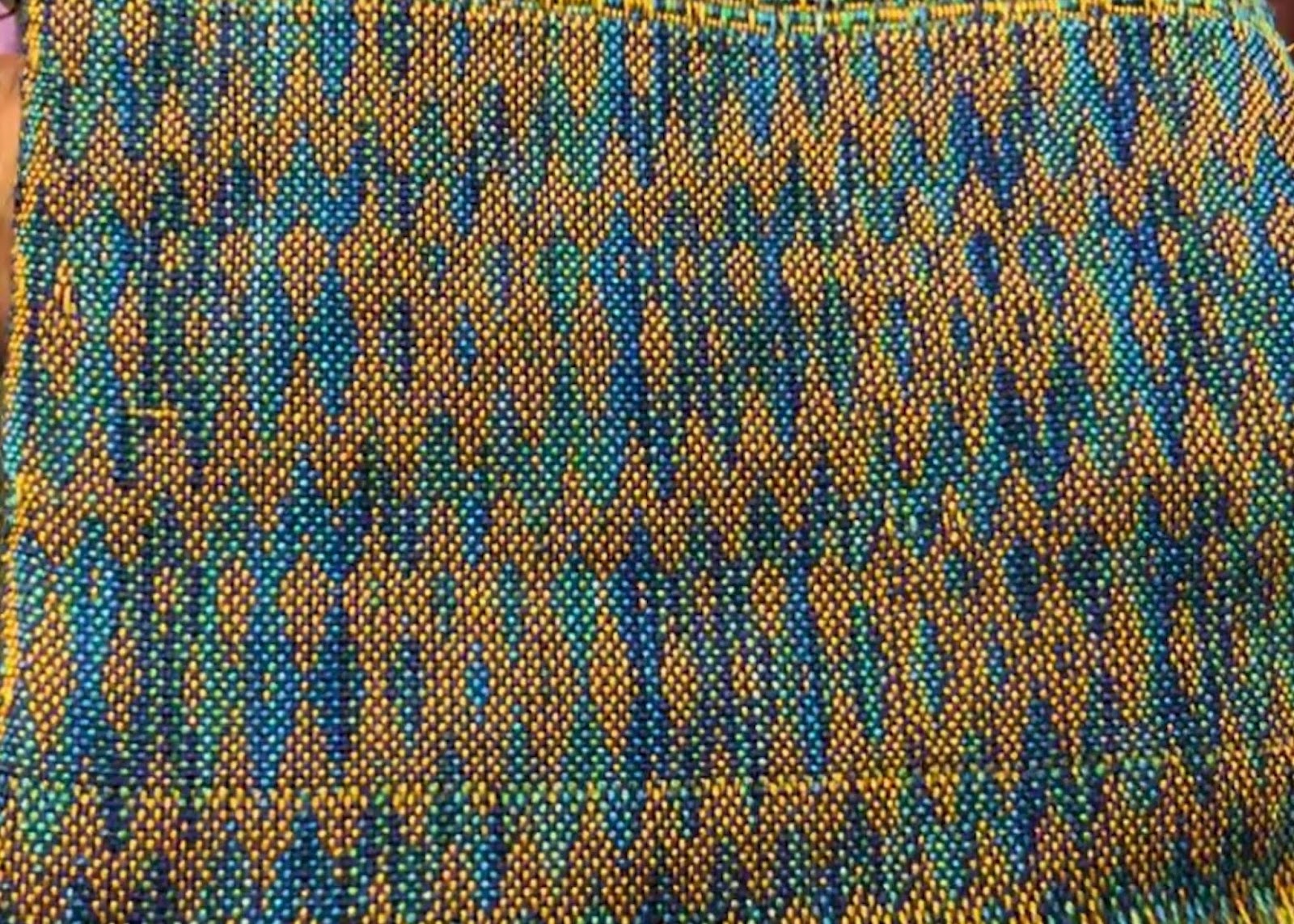

The two photos above: front and back of the "Falling Stars" pattern on 8 shafts in Double Weave. 
The warps alternate between a golden yellow and a hand-painted yarn in shades of green and blue. Woven by Sharlet Elms.


The two photos above: front and back of collapse cloth in the 8-shaft "Falling Stars" pattern, woven as Double Weave. The weft alternates between 10/2 cotton in gold (front) and 18/2 merino in purple (back). With washing, soap, and a lot of agitation, the merino fulls on the back, making the layer on the top collapse into pleats. Woven by Sharlet Elms.


"Many Rivers" design woven on 8 shafts. Pictured from top to bottom: 
Echo, Shadow Weave, and Jin. Woven by Virginia Glenn.


Pictured above, clockwise from top left: 8-shaft "Falling Stars" pattern in Shadow Weave, 
Double Weave, Rep Weave, and again in Double Weave. Woven by Ruth Ronan.


Blooming Leaf pattern on 4 shafts woven as Jin. Woven by Sharolene Brunston.


Above, top to bottom: "Fun House" pattern for 8 shafts. The top two samples are woven using a different Echo tieup and treadling from the bottom 4 samples. The bottom 4 samples are all the same tieup and treadling for Echo, but using different colored wefts. The warp yarns are light blue and turquoise. Woven by Carie Kramer.


Thanks for reading! And many thanks to the staff of HGA for putting together another wonderful gathering of the clan!


Tuesday, January 17, 2017

The Warp that Keeps on Giving: Echo, Jin, Double Weave, Shadow Weave, and Warp Rep All on One Threading


How do you weave a countless number of structures on one warp? With an extended parallel threading, of course! This particular technique offers a lot of "bang for the buck" for weavers. All you have to do is modify your treadling and, in some cases, change the tie-up. If you're REALLY ambitious, you can change the tie-up and re-sley as well to achieve Double Weave or Shadow Weave.

What is an extended parallel threading? For those who follow the work of Marian Stubenitsky and/or Bonnie Inouye, it needs no introduction. For the rest of us, all it means is that, for starters, you use two colors in your warp, so that you can thread them A-B-A-B, etc. (A being your first color and B being your second). Then, instead of threading a straight draw of 1, 2, 3, 4, 5, 6, 7, 8 (just as an example), you thread your two colors using the same line, but separately, at a set interval. 

For example, if you decide you're going to thread at an interval of 4, for an extended parallel threading on a straight draw, you will thread it this way: 1, 5, 2, 6, 3, 7, 4, 8, 5, 1, 6, 2, 7, 3, 8, 4, alternating between color A and color B. Here's a drawdown, by way of example. (I've posted it before, but it bears repeating.)


So your tie-up allows you to lift every other thread in an ascending twill order. This is the basic idea behind the structures I have been weaving. Because I like to paint warps -- and because I like to paint two separate warps in complementary but different palettes and beam them together and then thread them A-B-A-B in an extended parallel threading -- I decided to create an advancing point-twill using this technique. 

Here are some drafts and photos of what I've weaving. 

Variation #1: Echo

Here is the the drawdown, with a tie-up and treadling for Echo. Note that this is simply an advancing twill treadling.
And here is a photo of the sample I wove. You'll see that I didn't weave the entire treadling, because I was just trying to get an idea of how it would look.


Variation #2: Echo

Next treadling for Echo, same tie-up. This treadling is for an advancing-point twill.


My woven sample, below. I love the way the pattern seems to sparkle, which enhances the color shifts.


Next, I crawled under the treadles to do another tie-up. (Truth be told, I usually make an error when I'm tying up and have to start all over again. Which causes a lot of sweating and cursing, which is not to be written about in a blog post.) 

Variation #3: Doubleweave 

Here is the drawdown for treadling as doubleweave. I will not show you my sample, as I really messed up! I had to re-sley the reed to make the warp ends much denser -- and somewhere along the way my shed got really boggled up. I do have a sample, but again, not for public consumption ;o)


Yes, this would work well with a collapse-cloth technique, with one layer shrinking and pulling in while the other layer would "pouf" and add texture. Even with the poor shed I had -- owing mostly to the fact that I was using two different devices (Texsolv and metal hooks) to tie up my treadles and their lengths varied -- I could tell from my sample that this design has promise.

Variations #4 and #5: Jin

Then I got down under the loom and re-did my tie-up to weave Jin -- one of my favorite structures because it is so versatile. Here's the first treadling I used. If you look at the treadling, you'll see that, if you remove the tabby, it's the same advancing-twill sequence as in variation #1 above.


And here is the second treadling, an advancing point-twill. Again, if you take away the tabby, it's exactly like variation #2 for Echo.


Here is how the two samples wove up. (The first treadling appears at the bottom of the photo and the second is at the top.)


Variation #6: Jin

Here's yet another treadling, the results of which I love!

The sample:


Variation #7: Rep


There are a countless variations for an extended-parallel threading like this. One additional structure I did not mention was shadow weave. Here's a drawdown I came up with.


However, this post is getting way too long and it's taking way too much time! Suffice it to say that I'm hoping to create a workshop out of this. And as for all the samples I have been weaving: I beamed a 12-yard warp, 46" wide, using 20/2 silk sett at 40 ends per inch. The weft is, for the most part, 60/2 silk.  

I'm weaving yardage for a garment. Most likely, I will use four or five different treadlings for Jin -- I might even add a networked treadling in there somewhere -- and alternate them randomly throughout the fabric. I can't choose just one, so I have to weave them all.

And here's the photo that inspired this project to begin with. I can't attribute it to any source, because I found it on the internet long ago. The combination of pinks and greens is irresistible!