Showing posts with label deflected doubleweave. Show all posts

Sunday, April 28, 2024

Notes from CNCH, the Conference of Northern California Handweavers


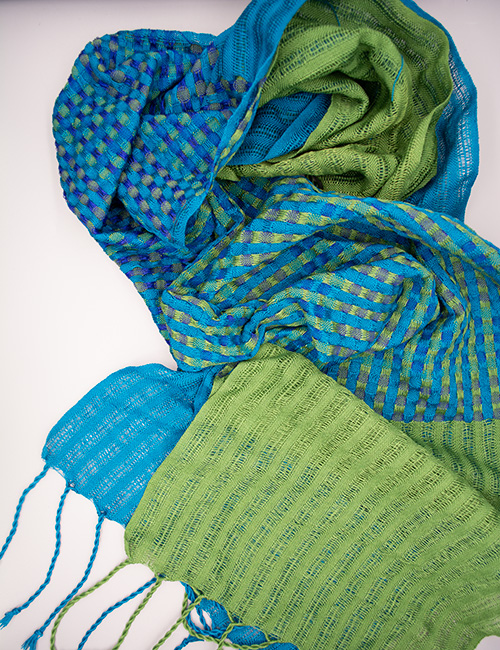
Let's start with the photo above: a series of samples woven on eight shafts in deflected doubleweave by Marta Shannon. It's just one picture of dozens of interesting, colorful, and always original samples created by weavers in my workshop this past weekend: "Deflected Doubleweave for Collapse Fabrics."

The goal of my workshop was twofold: 1) to teach weavers to recognize and even design deflected doubleweave patterns and 2) to push the already tactile, off-the-grid quality of DDW by using "energized" yarns such as Colcolastic, metallic gimp, wool-stainless steel, silk-stainless steel, overtwisted linen singles in S and Z twist, overtwisted wool singles in S and Z twist, and, of course, the ever-reliable Jaggerspun 18/2 superfine merino, which fulls beautifully when you give it some wiggle room in the cloth. (Bottom line: plain weave resists fulling and other collapse techniques, because it's the most stable, firm structure of all, while DDW encourages pleating, poufing, and billowing of your fabric because it has warp and weft floats built in, by design,)

That's a lot of words, so here are some photos to give you a better idea of what we were working on.

Some four-shaft samples woven with wefts of both active and inactive yarns. Weaver Rusti Icenogle points to the bottom sample, which pleats vertically because the rose-colored weft is wool/stainless-steel yarn, which fulls and draws the fabric in after it's washed and agitated with hot water and soap.

You know that famous quote, I think it's from Laura Fry, "It ain't finished until it's finished"? We spent a lot of time at the sinks in the ladies' room scrubbing away at our samples, using regular hand soap....

Above, a series of samples woven by Autumn Barr, who was weaving on her brand new eight-shaft loom for the first time. Her warp was 10/2 cotton (brown) and 18/2 merino (white) and she alternated these two yarns as weft also. It's hard to see in this photo, but the sample at the bottom shows lots of horizontal pleats in the brown stripes, which are drawn in as the white wool fulls in the washing.

This sample belongs to Denise Lee, who wove an eight-shaft pattern I call Mardi Gras. For this sample, she alternated green Colcolastic and 10/2 cotton in the weft. The Colcolastic yarn, brand name Venne, has a 20/2 cotton strand combined with a strand of elastic, which shrinks up immediately when washed.

These samples are woven on eight shafts by Colleen Harvey-Arrison. The larger blocks in teal are 18/2 merino, which fulls and draws in the magenta cotton blocks, adding texture and making them curve and flow over the fabric.

The CNCH conference, affectionately known as "Cinch," is held every year in a different area of northern California. It's well worth attending, with exhibits, vendors (including Lunatic Fringe Yarns, Dharma Trading, and Eugene Textile Center), a keynote speech (this year by tapestry artist Susan Iverson), terrific meals, and lots of friendly fiber artists.

Take Sara Lamb, for instance, who is a well-known author, teacher, spinner, dyer, and weaver.


Sara wears a jacket she wove and sewed, of course! Plus the yarns are handspun silk that she dyed, all plain weave in structure -- showing off those yarns to the maximum.


The cloth is warp-emphasis (and is displayed horizontally in this photo).

I got to rub shoulders with other weaving royalty as well: seen below, Ana Lisa Hedstrom and Peggy Osterkamp. I had dinner with Peggy -- during which at least two weavers came up to our table to thank her for her many books that helped them build their weaving skills.


I fell in love with this tapestry on exhibit, shown below, titled "Pandemic Oasis" and woven by Nancy Isaac of the Loom and Shuttle Guild in San Francisco.


I also fell in love with this tatted piece, a work in progress by Nancy Alegria, in which she is recording the temperature and the sunlight (encoded in colors) of every day in 2024.


Even after the conference, I'm still taking it all in. Lots of learning, too many purchases (I won't list them, but there was yarn involved), and great camaraderie. 

Here's to next year!


Saturday, October 21, 2023

'Weaving Outside the Box' with Katherine Luhring of Lunatic Fringe Yarns

Deflected doubleweave scarf woven by Katherine Luhring from my workshop, 
"Weaving Outside the Box"

This month I'd like to share an essay by "Katzy" (pronounced "KAHtzee") Luhring, one of the managers at Lunatic Fringe Yarns. Some background: Over the summer, I taught "Weaving Outside the Box: 12 Projects for Creating Dimensional Cloth" at the Intermountain Weavers Conference in Logan, Utah, a workshop based on my book of the same name. We were lucky to have Katzy in our class, as she brought a lot of knowledge and information about some of the special yarns that are sold by Lunatic Fringe. 

Here's a post she wrote for the Lunatic Fringe blog, starting with an introductory paragraph about her weaving adventures. Thank you, Katzy!

_____________________________________________________

We Lunatics have gone to a lot of conferences over the 30-plus years that we have been in business.  However, it isn’t very often that we give ourselves the time to participate in the classes offered at the conferences. This year at IWC in Logan Utah, we sprang our fearless leader, Katzy, from booth duty so she could take Denise Kovnat’s dimensional-cloth workshop. Let her tell you about a few of the wonderful things she learned along the way.

By Katzy Luhring

Denise Kovnat’s dimensional-cloth workshop at IWC was a fabulous opportunity to experiment with interesting yarns and learn some new things! Denise asked all the class participants to choose a project from her book,  "Weaving Outside the Box, 12 Projects for Creating Dimensional Cloth." I chose project #1, the Deflected-Doubleweave Scarf on four shafts.  To be perfectly honest, I chose it because the project didn’t have too many ends, it used 10/2 mercerized cotton yarns, and it would fit on the 4-shaft Wolf Pup Loom that we had room to take with us to Logan. Seemed like a perfect fit all the way around!


I wanted to spend the workshop time making samples and learn more about elastic yarn during the workshop.  To give myself plenty of warp for playing, I wound a six-yard warp of 10/2 Tubular Spectrum Thyme and 5 Blue. This was twice the warp length that Denise recommends in her book. I knew I would have plenty of warp to experiment to my heart's desire.

What Is Colcolastic Cotton Yarn?

Denise's instructions call for Colcolastic cotton yarn for one of the weft yarns. This is a yarn that I was unfamiliar with, but after a quick Internet search, I found it at Lone Star Loom Room. When I received the yarn (in a very short amount of time), I discovered that the yarn is a two-stranded yarn: One strand is 20/2 cotton and one strand is a thin elastic, and these two yarns are wound together onto the spool. I could make my own yarn by using one strand of 20/2 Tubular Spectrum mercerized cotton yarn and combining it with any of our thin elastic yarns: ramie, cotton, silk. The color possibilities are endless!

And how did these two yarns wind onto a bobbin? No problem there. I have since used both a hand winder and an electric bobbin winder to wind the spools from two cones and have not had any trouble with the yarns getting tangled either as I wound onto the spools or while I was weaving. 


Play Time!

Three days of class trying different yarns and learning how the weave structure works and interacts with the weft yarns. It was heavenly! I tried elastic ramie, elastic silk, elastic cotton, both by themselves and with cotton yarns. I experimented with weft yarn colors to see how the two layers interacted. So much experimenting and so many things to try!


Not So Plain Weave.

Denise designed an interesting project: The first 18" is doubleweave with a top layer and a bottom layer. When I first warped the loom and sleyed the reed, I couldn't understand how we were going to get a functional fabric in those first 18" from the big spaces that are in between the yarns on each layer. There are gaps of about 1/4 inch! I trusted Denise's instructions and wove the fabric with the weft yarn floating across those gaps. When the fabric is washed, the warp yarn shifts over to fill the gaps and you can an interesting, almost plain-weave fabric with lots of drape.

Plain-weave section before washing

Plain-weave section after washing

Splash! Now to Make Things Go Bump!

The center section of the scarf contains the elastic and cotton weft. There is a nice texture to the fabric while on the loom, but it is relatively flat.  And the fabric remains flat when you take it off the loom.  The magic really happens when the fabric gets wet! When washed, the elastic in the weft shrinks up and takes the warp yarns along for a ride, creating ridges in the fabrics.  The 20/2 weft yarns bubble up and make a loopy texture on one side of the fabric.  You can stretch the fabric out to see how it originally looked, but when you let it go, the pleats reappear. Magical!

Center section before washing

Center section after washing

To the Loom!

When I left Logan, my brain was bursting with new ideas and I have been spending lots of time at the loom finishing up the first batch of scarves and working on new ones.  Thanks Denise for a wonderful workshop!

Finished scarf before washing


Saturday, August 19, 2023

New Zoom Workshop Beginning October 14: 'Weaving Outside the Box: 12 Projects for Creating Dimensional Cloth'


Based on my book of the same name, this workshop is being offered for the first time online -- thanks to MAFA, the Mid-Atlantic Fiber Association, which is offering Zoom workshops this fall for weavers near and far.

For three Saturdays in October, you'll weave a project of your choice from the book, on 4, 6, 8, 12, or 16 shafts. The photo above, woven on 4 shafts, is one of the projects you can choose from. 

Here's the link to register: https://www.lessonface.com/apply/Weaving-Outside-Box-12-Projects-Creating-Dimensional-Cloth

And here are photos of a few more of the projects you can weave at home, on your own time.

"Ruffles Scarf," 8 shaft doubleweave using differential-shrinkage

Shawl on 6 shafts, detail, deflected doubleweave and fulling techniques

Scarf from the book cover, 4 shafts, wool/stainless-steel and 20/2 cotton yarns

8-shaft scarf in 60/2 silk, pleats in turned twill

4-shaft scarf in deflected doubleweave, using Colcolastic (cotton/elastic yarn) 
to create shrinkage in center

Woven-shibori scarf on 4 shafts, differential-shrinkage techniques

Participants will learn how to optimize the effects of structure, energized yarns, and finishing techniques to achieve three-dimensional texture in their cloth. The goal is to venture off the rectilinear grid of handwoven cloth, exploiting texture to work with color and form, adding interest and tactile appeal to your woven creations. It all happens in the wash and the results are often surprising!

A summary of the focus of this workshop, taken from the back of the book:

Color and structure are key elements in weaving, of course. But we often overlook the importance of texture. Dimensional fabrics, with their pleats, puffs, and curves, take us off the grid, reflecting the organic forms of nature. We can both see and feel the tactile quality of dimensional cloth, which adds much to the beauty of handwoven fabric.

If you're interested or if you have questions, please send me an email (click on the "About Me" section on the front page of this blog, at the right, then click on "Email" underneath my photo). And yes, one enticement: Lunatic Fringe Yarns is offering participants a coupon on the special yarns that are used on several of the projects.

Thanks for reading!


Friday, January 6, 2023

Book Launch!

Weaving Outside the Box: 12 Projects for Creating Dimensional Cloth is now available for purchase! It's been a long road but at last it's ready to launch.

Front and back covers (right and left respectively) for printing

The book is 122 pages long, in full color, with a soft cover and a coil binding so that you can lay it flat as you read and weave. It's also available as an eBook and in hardcover. You'll find all these options on this blog site under the page titled "Publications for Purchase".

Here's a brief description:

"Color and structure are key elements in weaving, of course. But we often overlook the importance of texture. Dimensional fabrics, with their pleats, puffs, and curves, take us 'off the grid', reflecting the organic forms of nature. We can both see and feel the tactile quality of dimensional cloth, which adds much to the beauty of handwoven fabric.

"This book gives you tools to optimize texture in your weaving. Starting with background on the techniques involved, it then offers step-by-step instructions for 12 projects for four to 16-shaft looms: four for beginning weavers, four for intermediate weavers, and four for advanced weavers. As a bonus, there are two patterns that allow you to weave three different projects on a single warp.

"Weaving Outside the Box provides the tips and resources you need to move beyond the two-dimensional plane and rectilinear patterns of warp and weft."

Here are a few of the projects offered.

Among the four projects for four shafts: woven shibori using fulling techniques


Doubleweave layers and ruffles for eight shafts 
using differential-shrinkage techniques


Deflected doubleweave on 16 shafts 
using differential-shrinkage techniques

There are diagrams and even microscopic photos of yarn throughout the book, to help you understand the mechanics behind these designs, all using some combination of active and inactive yarns, structure, and finishing.


I will teach a workshop straight from the book June 11-16 at the Michigan League of Handweavers Conference in Holland, MI. Participants will choose one of the 12 projects from the book and start by weaving up samples so they can learn how to finish their projects to get just the right textured effects.

Dimensional cloth is a specialized area of weaving, one that is sometimes overlooked but has been woven for centuries. My book begins -- and this blog post concludes -- with this quote from Anni Albers, from her definitive book, On Weaving

All progress, it seems, is coupled to regression elsewhere. We have advanced in general, for instance, in regard to verbal articulation -- the reading and writing public of today is enormous. But we certainly have grown increasingly insensitive in our perception by touch, the tactile sense.

I hope my book inspires weavers to explore all three of the wonderful tools we have in our craft: those of structure, color, and the tactile sense.

Thanks for reading!


Detail of Echo threading in four-color doubleweave on 28 shafts, 
using cotton/stainless-steel yarn for one of the wefts 
to achieve crinkled layers