Monday, November 10, 2014

November 14-16: Pop Up Art Sale at the Old Pickle Factory, Pittsford


This Thursday at the Old Pickle Factory on Grove Street in the village of Pittsford: 16 awesome artists! Free admission, free parking, and lots of wonderful pieces to choose from.

I will be there selling my handwoven, knitted, dyed and sewn garments and accessories. Among them:


This silk scarf, featuring a collapse-weave structure


This wool coat, also a collapse-weave structure, handwoven in handspun S and Z twist yarns

Grove Street is off of French Road, close to where it ends at East Avenue. The Old Pickle Factory is a big old wooden building, sort of like a warehouse, at 1 Grove Street. The parking lot is on the other side of the building, away from the street. 

Follow the signs with the yellow bows on them. Hope to see you there!

Friday, November 7, 2014

Going Green with Weld and Indigo


The technique is known as "Arashi Shibori" -- that is, using Japanese shibori-resist techniques to achieve patterns on cloth. The arashi version of shibori creates a striped design, because the dyer wraps fabric around a pole, wraps rope around this to secure it, scrunches the fabric down and repeats the process until the entire piece of fabric is wrapped and tied.

The top above was made with a medium weight cotton muslin, which is very inexpensive -- maybe $5 a yard -- and wonderful to work with! I first immersed the fabric in weld, which produced a vivid yellow color, almost neon. (The important thing to remember, when dyeing cotton with natural dyes, is to pre-mordant the cotton with aluminum acetate, NOT aluminum sulfate. I use an over-the-counter topical astringent known as Domeboro, available online and from your local drugstore. I figure about one packet per ounce of fiber and immerse it in the mordant overnight before dyeing.)

After dyeing and drying the fabric in weld, I next immersed it once or twice in an indigo vat, producing the lighter green you seen on the fabric. Finally, I did the arashi wrapping around a PVC pipe that was 8" in diameter -- as large a pipe as I could get my hands on, thanks to my good friend Joy Duskin. Wrapping, typing, scrunching is exhausting work and it took maybe an hour to prepare about two yards of fabric for immersing in the indigo vat. (The entire project took four yards of fabric.)

The result was the dark green horizontal stripes on the fabric. Sort of a forest/jungle/fern feeling, don't you think? I was very happy with the way it turned out -- which isn't always the case with dyeing, I have to confess.


This pattern is from Linda Lee's Sewing Workshop, which is a great source of creative patterns for artists. This is the pattern known as "Kinenbi Top," which is discontinued, but still available on Etsy and other sites. I highly recommend the Sewing Workshop patterns because they are well thought out, easy to understand, and well detailed: finished to a "T" and that's without even mentioning how attractive they are.

If you want to learn more about this pattern and how it worked for me, visit my review at patternreview.com -- another source for people who love to sew.

The piece is for sale this weekend at the Weavers' Guild of Rochester Holiday Show and Sale. If it doesn't sell, I will have another chance at the Pop-Up Art Show and Sale next weekend at the Old Pickle Factory in Pittsford. Maybe I will see you there!

Sunday, October 19, 2014

Come to the Weavers' Guild of Rochester Holiday Sale, November 7-9


This year, we're in a new venue: the Century Club, a beautiful old mansion on East Avenue located across from the Strathallan hotel at the corner of Strathallan Park. Much bigger than our previous site and we will have lots of events!

First, the details: ADMISSION IS FREE. Most important. The sale takes place from noon to 9 p.m. on Friday, November 7; from 10 a.m. till 5 p.m. on Saturday, November 8; and from 11 a.m. till 3 p.m. on Sunday, November 9. Our members have an enormous range of talents, so you will be tempted not only by handwoven pieces, but also by jewelry, pottery, woodworked pieces, baskets, visual art, and handspun yarns. I have probably missed something on this list, but you get the idea.

On Friday evening, we will have a fashion show featuring garments that are for sale. Weavers and handspinners will demonstrate their craft throughout the sale and there will be information on classes at the Weaving and Fiber Arts Center. For more information, here's the link: Weavers' Guild of Rochester Holiday Sale

Every year, our members put on a great display -- and every year, we have a line at the door before we open. The show has continued to grow as more and more people from the Rochester area and beyond have learned about it -- and about the quality of items for sale. Come see for yourself!

Friday, October 3, 2014

Colors of Earth and Sky: Arashi Shibori Techniques with Walnut and Indigo Dyes


Silk gauze has a mystery to it: When you hold the fabric up to the light, it nearly disappears -- but when you wrap it around you, it gains color and adds warmth. Plus, it responds wonderfully to natural dyes.

A few days ago I mordanted a piece of silk gauze in alum and waited overnight to make sure it would take the dye well. Next, I immersed it just once (honest!) in an indigo vat, and again let it sit overnight to oxidize. Finally, I folded it in half lengthwise, wrapped it around a 12" diameter PVC pipe, wound twine around and around and around the pipe, and finally scrunched the fabric down as densely as it could go. The process took a long time and hurt my hands, but that's what you do to achieve the beautiful patterns of arashi shibori.

I see these colors as earth and sky -- and the arashi lines look to me like tree bark or waves on the water. Random but rhythmic and endless intriguing, like the patterns of nature herself.

Here's another photo, showing the shibori pattern a bit better.


It's for sale in my Etsy shop -- or look for it at the Weavers' Guild of Rochester Holiday Show and Sale, coming up in early November!

Tuesday, September 2, 2014

Collapse Weave with Overtwist Yarns: It All Comes Out in the Wash

I just finished weaving and plying the fringe of another collapse-weave scarf in silk and silk crepe. I love seeing the magic in the water, to use the words of Laura Fry. Here's a video, maybe a little rough around the edges, but successfully capturing the immediate change that happens when you first immerse this kind of fabric in water.


Wednesday, August 20, 2014

Collapse Weave -- on Four Harnesses!


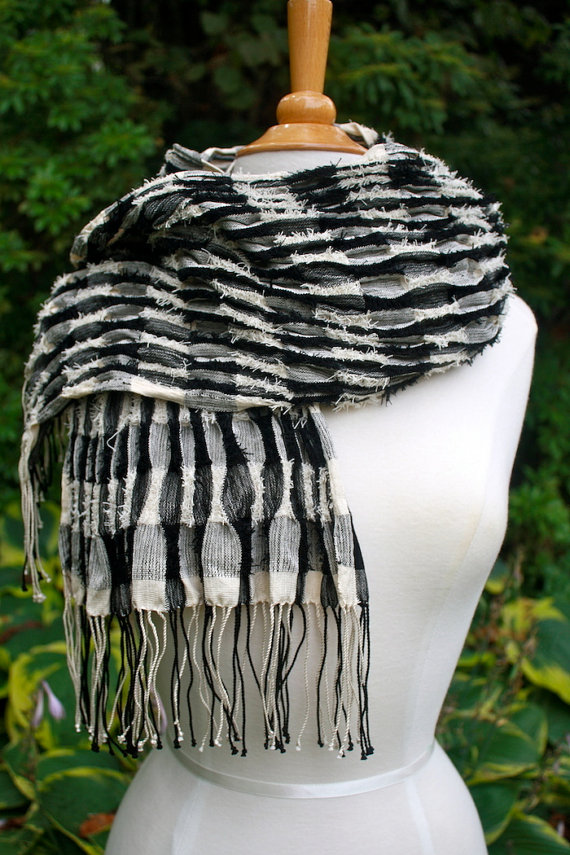
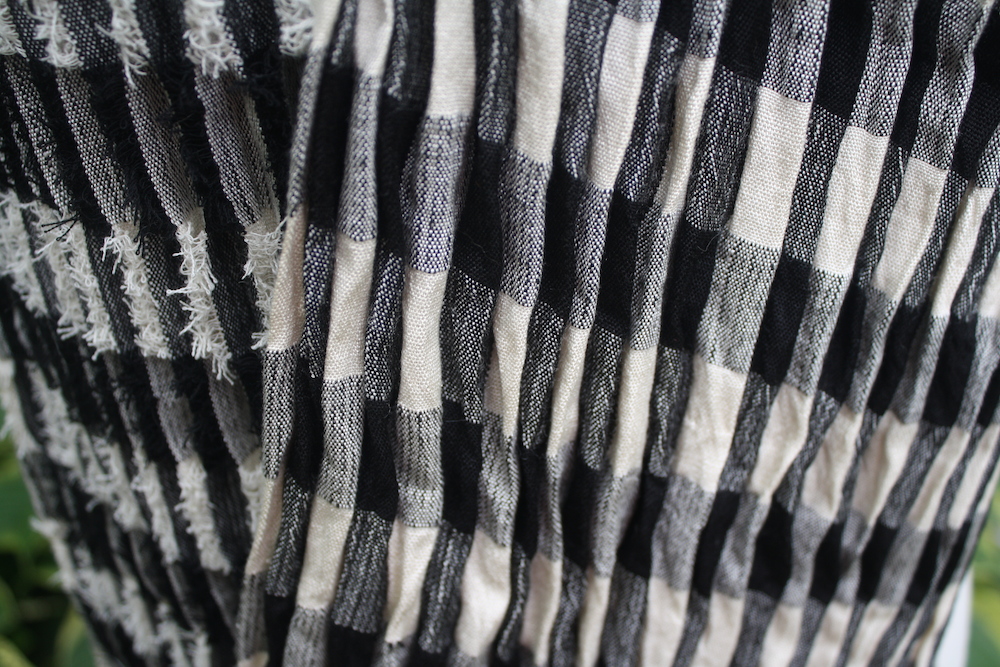
In 16 years of weaving, this may be my favorite piece: a collapse-weave scarf in 60/2 silk and 30/1 overtwist wool. Black and white checkered pattern, with a warp of 60/2 silk stripes and the weft alternating between 60/2 silk and the overtwist wool yarn.

Here's the drawdown.


It's that simple! Understand that, while the weft color is all black on the drawdown, you have to alternate (A-B-A-B) between 60/2 silk in black and 30/1 overtwist wool in black. And while the weft color changes to white, you have to alternate between 60/2 silk in white and 30/1 overtwist wool in white. The weft floats are the overtwist, which pulls the fabric in, making it collapse into a fabric with a soft and cushy hand. The sett is 54 epi, which makes for a high quality fabric with a wonderful hand -- but it takes a long time to weave.


The floats (the wild and twisted yarns you see in the photo) are on the front only. Here, below, is a look at both the front and the back of the scarf.


Most weavers know that 60/2 silk is available from Webs in Northampton, Massachusetts. Few weavers, however, are familiar with where to buy overtwist, crepe, and other specialty yarns. Habu Textiles is one retailer, here in the States, but I purchased my 30/1 overtwist from the Handweavers Studio and Gallery in London. Even with shipping, the prices aren't bad and the yarn is wonderful!

The scarf is for sale now in my Etsy shop, but I'm still thinking I don't want to sell it....


Tuesday, July 29, 2014

'What Is Turned Taqueté? A Weave by Any Other Name...'


I have been trying, with modest success, to understand the weave structure known as Turned Taqueté. 


Turned Taqueté is described alternately as polychrome Summer and Winter but without tabby... or warp-faced compound plain weave... or like Samitum but based on plain weave, not twill.... Quite honestly, I do not have enough weaving background -- or I am not enough of a math-head -- to fully understand all the analyses and terminology. I do know that there is a tie-down weft and that the pattern warps float over three wefts and then are tied down as well. Ideally, the weft is much finer than the warp, allowing the warp pattern to show. And for what I want to do -- that is, paint two different warps and then weave them together in one fabric, so that the colors play against each other and with the pattern -- Turned Taqueté is terrific. Alliteration intended. 

Simply put, this structure provides for a wonderful drape and beautiful design possibilities. I wove the sample above (and below) on 8 harnesses using two hand-painted warps in 20/2 silk and a weft of black 60/2 silk.  


The incomparable Bonnie Inouye designed the pattern and I modified the treadling a bit. Below is a small version of the drawdown. (If you would like me to share with you the WIF file, send me an email at dkovn@hotmail.com.) The pattern appears in the most recent issue of the Complex Weavers Journal, in an article by Inouye, "Turned Taqueté, An Introduction." In the article, she also discusses how to draw this structure on a network, using either Fiberworks or WeavePoint software. Network drafting is another wonderfully intricate subject -- one that is discussed and illustrated at length in Marian Stubenitsky's new book, Weaving with Echo and Iris. Network drafting allows weavers to soften and curve their patterns, so that the structure appears fluid rather than rectilinear.

I think I have just dipped my toe in the water....