Tuesday, November 17, 2020

Gebrochene, Echo and Jin with Fiberworks: Putting 'The Earl' Through His Paces


Ah, the old Weaver's magazine... such an endless source of inspiration! Recently, I was looking at an issue from 1997 and came upon a story by Marjie Thompson about the source of the above draft, "The Earl's Canvas." (Thanks to Thompson for sharing it with me.) She had given a talk to our guild about this years ago and I never forgot the beautiful silk scarf she wove. 

The pattern was discovered in a portrait of John Erskine, second Earl of Mar in Scotland, in the National Portrait Gallery in Edinburgh. Painted in 1626 by Adam de Colone, it features a Jacobean noble with a lace ruff and badge of office. 


What's interesting to weavers, however, isn't the painting itself, but rather the canvas it's painted on. According to Thompson, a museum curator analyzed the pattern in the 1970s and found that it's actually a 14-shaft Gebrochene design that was probably an old tablecloth. 

And what is Gebrochene (pronounced in German "geBROKena")? Literally it means "broken," but to weavers it's basically M's and W's. According to Thompson:

"It's a twill interlacement with an elaborate threading and treadling and a twill tieup. Usually both warp and weft are the same yarn, historically linen. Gebrochene tablecloths are pictured in medieval art and Gebrochene drafts are found in... books from the early 17th century. Patterns can be quite elaborate; one design by Jacob Angstadt shows over 900 ends in one repeat."

At last we get to the point of this blog post, which is: This beautiful draft can easily be translated into an Echo threading. And a Jin design. And Shadow Weave and Rep and Double Weave, all through the magic of Fiberworks.

You start by reducing the "The Earl" threading to 8 shafts (because not everyone has a 16-shaft loom). Next, under the Treadling dropdown menu, select "Weave as drawn in" and then make the treadling tromp as writ. Then select "Draft" and "Thickness" and click on "Exactly as drawn."


Next, using the Warp dropdown menu, click on "Parallel Repeat." In the box that opens, select "Extended Parallel," "Shafts shift by 4" and "Also duplicate colors and spacing." Then click "Apply." (And then "Close.")


Next, still in the Warp dropdown menu, click on "Fill Warp Colors." In the space that says "Single Color A," scroll down and select "AB." Then click "Replace." (Because this is just an exercise, I've simply gone along with the pre-selected colors in boxes A and B in the "Fill Warp Colors" box. You can select your own colors by using your cursor to drag colors from the "Colors" column that appears when you click on "Fill Warp Color.")

Hard to see in the above image, but if you look closely you can find blue and aqua in the boxes above the threading, indicating the colors of the warp threads below.

Next, create a 4/4 ascending twill tieup, which is a classic Echo tieup. The elementary way to do this is to draw it in by clicking on the boxes you want -- but to do it faster, you can just fill in the tieup for the first treadle and then click on the "Tieup" dropdown menu, select "Twill Repeat" and then "Step Up," "Step by 1," "Treadles per group 1" and "Apply."


Yes, it's Echo and yes, the Earl pattern is identifiable -- but it has long floats. (A good rule of thumb, according to Bonnie Inouye, is that floats in Echo should be no longer than 5. This is where the "Float Search" function on the "Tool" dropdown menu in Fiberworks comes in handy.)

Next step, alter the tiedown by breaking it up so that the floats aren't as long. Here's an example.

The motifs are still a bit squashed, right? There are ways to fix that -- one of them being to change the treadling.


Another way to alter the "flattened" Echo draft is to add tabby to the tieup, changing the structure to Jin.


You can alter the Jin design a bit by changing the tieup to create what Bonnie Inouye describes as "decorated Jin" -- changing it from a 4/4 tieup to a 4/2/1/1 tieup (plus tabby, of course).


Now that's a design befitting an Earl, don't you think? At the risk of losing readers, I will show you a few more designs. Here's how the Earl looks as Double Weave (both front and back views).


And here's a Rep version:


And then there's Shadow Weave -- although I'm not sure I like it so much.


So there you have it: "The Earl" as interpreted for extended parallel threadings, 400 years after it was used as the canvas for a nobleman's portrait. 

Thanks for reading!

[For further study: Eva Stossel is a blogger and peerless weaver who wrote about this subject on her blog and in the Complex Weavers Journal in 2012. You can read her blog post by clicking here.] 


Monday, October 19, 2020

Finally... a Design I Like!


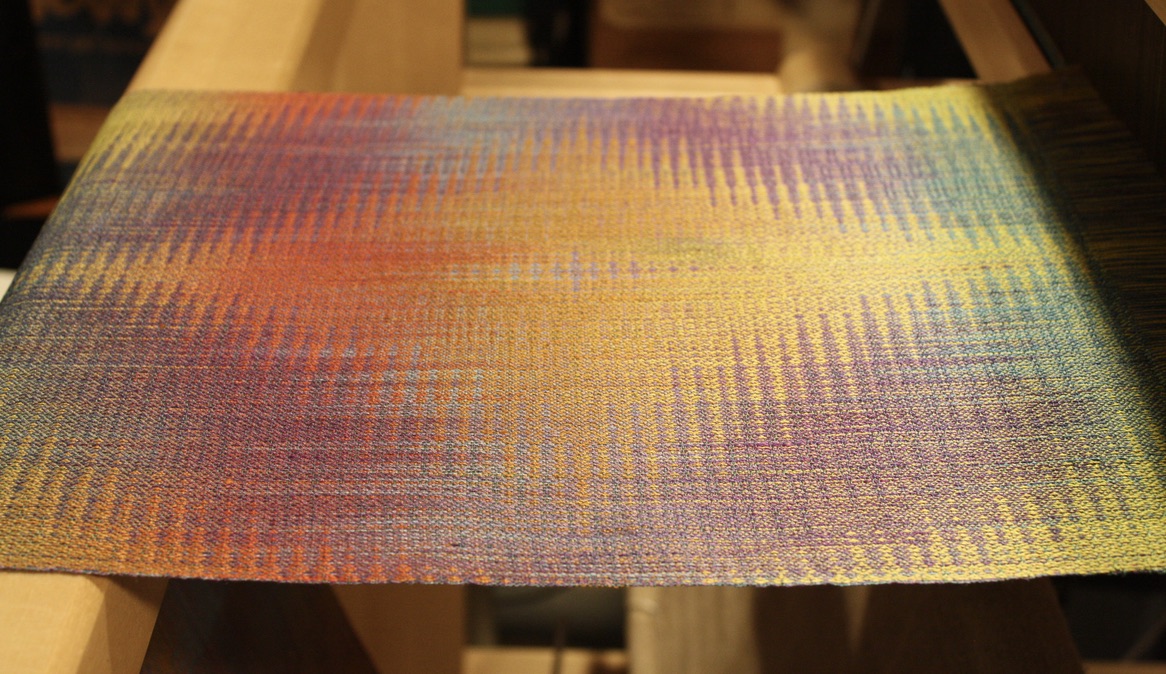
In a way, the design is hard to see, isn't it? That's been the problem. This is a 16-shaft Echo pattern on a 60/2/2 silk/ramie warp that I dyed in two color palettes. (I really love doing this: You paint two warps in complementary colorways and then beam them together on the loom. For this Echo piece, I threaded the warps A/B/A/B, etc., so that the pattern and the colors create a lot of dynamic shifts.)

I was really excited as I completed this design, which I call "North Star" in honor of the newspaper edited by Frederick Douglass when he lived here in Rochester, NY, in the mid-19th century. Rochester was a stop on the Underground Railroad and the North Star itself was a beacon for slaves fleeing to the northern states and Canada. It's a beautiful and tragic symbol of hope in dark times. And meaningful, too, at this point in our history.

And so, after lots of experimenting on Fiberworks, I settled on a Jin (Turned Taqueté) design. I'm posting it here in black and white -- because it's really hard to see the pattern in color, the values are so soft.


I really loved the design -- but when I wove it up I could hardly see it. Here are two samples, using a 20/2 cotton weft in olive green (bottom of photo) followed by a sample using a weft of teal blue (top of photo).


The back of the fabric (still on the loom) gives you a slightly better representation of the colors.


Close, yes, but still not exactly what I was going for. This happens all the time to me: I work and work to create a design I like in Fiberworks, but I have to keep in mind that it won't necessarily translate well on the loom. There's a lot of tweaking involved: sett, beat, the grist of the weft yarn, the color of the weft yarn, which treadling and tieup to use.... 

So many options! Does this happen to you? Sometimes I wonder if I'm just chasing a carrot in front of my nose, always seeking that perfect design. Don Quixote would understand....

But onward. Keeping in mind what I say when I teach -- that Jin can soften a design, making it look like it has a sprinkling of dusting powder over it -- I decided to try the Echo version of this threading, avoiding the tabby tie-downs in the Jin treadling, which can obscure the pattern. 

Here's what the Echo drawdown looks like in black and white, again to show you how the motif plays out.

To my eye, this design is stronger and a bit more graphic. And I was much happier with the result. Below is another view of the sample at the beginning of this post, woven with a light aqua weft in 20/2 cotton.


So often with Echo and Jin, the pattern looks bolder when you peer at it from the side, at a low angle, as in this photo. And by the way, I'm really happy weaving on a silk/ramie warp, because it has both a luster (silk) and a grit to it (ramie). Soft cocoons and bristly nettles together. Sort of like the experience of weaving itself ;o)

I hope to have a scarf finished before I teach my next warp-painting class. Oh yes, and I had to order more of the aqua weft yarn....

Thanks for reading!


Tuesday, September 8, 2020

Designing Echo as Double Weave for 16 Shafts


Pictured above: a drawdown of the front of a 16-shaft 4-color double-weave pattern that I just finished designing. (You'll find the tieup for this, as well as a view of the back of the pattern, at the end of this post. I have to go through all my steps in figuring it out before I reveal it to you!)

My inspiration came from Pinterest, where a while back I came upon a design I really admired. 


It was for 24 shafts and I have just 16 on my Toika, but still I had to figure out what made it so appealing. It was for double weave in an Echo threading and the tieup looked like this:


My first reaction was, "Oh boy, here's one of those irregular double-weave tieups that makes absolutely no sense." And my second reaction was, "How did they DO that?" My third reaction was, "I want to do that!" 

I knew that the original tieup had been modified -- "carved" you might say -- to veer off a straight twill angle for some of the shafts, creating interesting and eccentric patterns in the cloth. So I set about adapting the design to 16 shafts, first by breaking the 24-shaft tieup into two sections, one each for the top and bottom layers of the original 24-shaft draft.

Here's what they look like.

Tieup for the top layer

Tieup for the bottom layer

Back to Stubenitsky's Echo and Iris, of course. On page 89, she lays out her method of designing double weave tieups based on what she terms a "ratio." (Note here: Of all the listings in the index of this book, "Ratio" is cited the most. Something to ponder.)

She begins with what she calls the "ground tie-up." Below is what the ground tieup looks like for a 16-shaft double weave in Echo. For both layers, this ensures that half of the shafts will weave plain weave throughout. (You can't really weave anything with this tieup; it just gives you a stable ground for creating designs using the other half of the shafts.)


It isn't as inscrutable as it may first appear. On treadle 1 (for the top layer, which is treadled with all the odd-numbered treadles), you'll weave plain weave by raising shafts 1, 3, 5 and 7. On treadle 2 (for the bottom layer, which is treadled with all the even-numbered treadles), you'll weave plain weave by lifting shafts 10, 12, 14 and 16. 

An aside: With double weave, the shafts that are "raised" to weave the bottom layer are actually being lowered from the perspective of the bottom layer, because the bottom layer is weaving upside down (from the weaver's perspective). It's helpful to think of the tieup for the bottom layer as a sort of photo negative, where up is down (black is white) and down is up (white is black).

Note that the second half of the tieup for both layers is totally blank. That's where Stubenitsky's ratio comes in. For this, I tried a tieup with a ratio of 4:4, meaning that, in the second half of the treadling above the ground tieup, 4 shafts are raised and 4 shafts are down in an ascending order for both layers (top and bottom layers, on odd and even-numbered treadles).

Here's how that 4:4 ratio looks.

Next I created a tieup with a 5 to 3 ratio, which looks like this.


Here's a 6 to 2 ratio:


And finally I designed a 7 to 1 ratio:

So here is what the drawdowns look like, respectively.


4 to 4 ratio


5 to 3 ratio


6 to 2 ratio


7 to 1 ratio

And here, below, is the grand finale: what I call a "carved" tieup for this pattern on 16 shafts (the pattern that appears in the first image of this post). 


And here's the image of the back of the drawdown for this (again, the front is the first image that appears in this blog post).


I like both sides quite a bit, but the problem is that there are quite a few warp floats of 7 picks. Not great, really, but then again, I'm considering that this is double weave -- so 7 divided by 2 layers is really a float of 3.5 for one layer. Round that up to 4 and it would be acceptable if this were Echo or Jin, so maybe it's not a problem?

More to ponder... Thanks for reading!


Tuesday, August 18, 2020

Ready, Sett... Re-Sley!


I wove the sample above with a silk/ramie blend yarn -- which I love -- that has a grist of about 8,000 yards per pound. This is about the same as 30/2 silk, which calls for a plain-weave sett of 32 epi. But because silk/ramie has the look and feel of linen, I wanted to loosen up the sett a bit, to give it a lacy hand. So I decided to sett it at 28 epi. It was too loose, as you can see from the photo. The square-shaped motifs (in orange) are flattened, making the pattern less appealing. And the selvages are way loosey-goosey, even for Deflected Double Weave.


Just some background: For these samples, I painted two warps, one in warm colors and one in cool, and created an 8-shaft design in Deflected Double Weave that I thought would show off the changes in the warp colors.

So, for the sample shown above, I re-sleyed to a sett of 36 epi, which was then too tight. The selvages are OK -- remember, this is Deflected Double Weave, which typically has two selvages -- but the motifs are now elongated. A too-tight sett bunches up the warp and stretches the pattern vertically.


Goldilocks was picky too, as you know, but she got it right on the third try.

So I re-sleyed again, this time to a sett of 32 epi, which you see in the sample pictured above. I probably should have used this sett right from the start.... The motifs are still slightly elongated, but that can be fixed with a slightly harder beat. And my selvages are better, as you can see on the left side of the photo.

The sample below, sett at 28 epi, was another of my samples woven at 28 epi, and it offers more evidence that my sett was too loose: Look at the wavy, off-kilter wefts in orange, particularly as I switched the layers. Even though the wefts usually do have room to move about as you switch layers with Deflected Double Weave, a tighter sett will give them less room to do so. 


As obvious as it may seem, it's important to remember that the right sett makes all the difference. And often, just like Robert Frost's two roads in a wood, the right sett is the road less traveled by, at least at the beginning of the warp. So my second point is: When you're taking the trouble to weave up a piece that you truly care about -- and some would argue that this should be every piece -- you may not get it right the first time and you may have to make some adjustments, re-sleying and even re-re-sleying, like me. 

(This is actually part of a larger discussion, as I find that just about every warp I put on the loom is like a new car: You have to drive it a while to get the kinks out.)

And then there's your beat, of course, which also can unbalance your plain weave or flatten or elongate your pattern or your twill line. To me, there's a sweet spot where the right sett meets the right beat and your pattern just looks... sweet.

Top sample: The right sett and beat. Bottom sample: Over-zealous beat.

To wax philosophical about it: This is where our weaving practice is like meditation or yoga: It's all about mindfulness. And it's truly a practice, never perfect, but sometimes pointing the way....

Thanks for reading!


Saturday, July 18, 2020

Zooming Ahead with Deflected Double Weave


8-shaft Deflected Double Weave sample by Karen Berk. 
Warp and weft yarns are 10/2 Tencel/cotton (in fuchsia) 
and 18/2 Jagger Spun superfine merino.


Like many of us these days, I've been Zooming a lot with friends and family. All of my workshops through January have been cancelled, so I've begun teaching on Zoom -- in some cases, to replace my cancelled on-site workshops and in other cases because guilds are scrambling to offer remote workshops for this fall.

While Zoom workshops can't replace face-to-face communication and hands-on learning -- not to mention the joy of actually touching a handwoven sample -- online workshops can offer a worthwhile learning experience. It all depends on the investment of the students, in my view. And I can't say enough about the investment of the weavers who took my recent workshop, "Deflected Double Weave for Collapse Fabrics."

It served as a fundraiser for the Weaving and Fiber Arts Center here in Rochester, NY (the teaching arm of the Weavers' Guild of Rochester) and also helped test-drive the Zoom format for both the center and our guild. Weavers joined us from near and far -- from California to Canada to Michigan to Virginia to Delaware -- with the bulk of us coming from the Rochester area. 

Over the course of eight sessions in 2 1/2 days -- June 22, June 29 and July 6 -- we gathered on Zoom to study handouts and samples, to analyze drafts in Fiberworks, to view PowerPoints and, thanks to Google Drive, to survey everyone's work. In between sessions, we communicated largely via email and sometimes on the phone. 

Here are more samples:

 
12-shaft Deflected Double Weave sample by Lillian Whipple.
Warp and weft yarns are 10/2 cotton and lace-weight wool/silk.
The gold yarn is the black motifs is real gold.


4-shaft Deflected Double Weave sample by Barbara Mauger.
Her warp and weft yarns are 8/4 Tencel. 
The gray weft yarns are wool crepe.


12-shaft Deflected Double Weave sample by Linn Sadjak.
Her warp and weft yarns are 10/2 cotton. 
In this sample, she added picks of rayon-tape yarn.


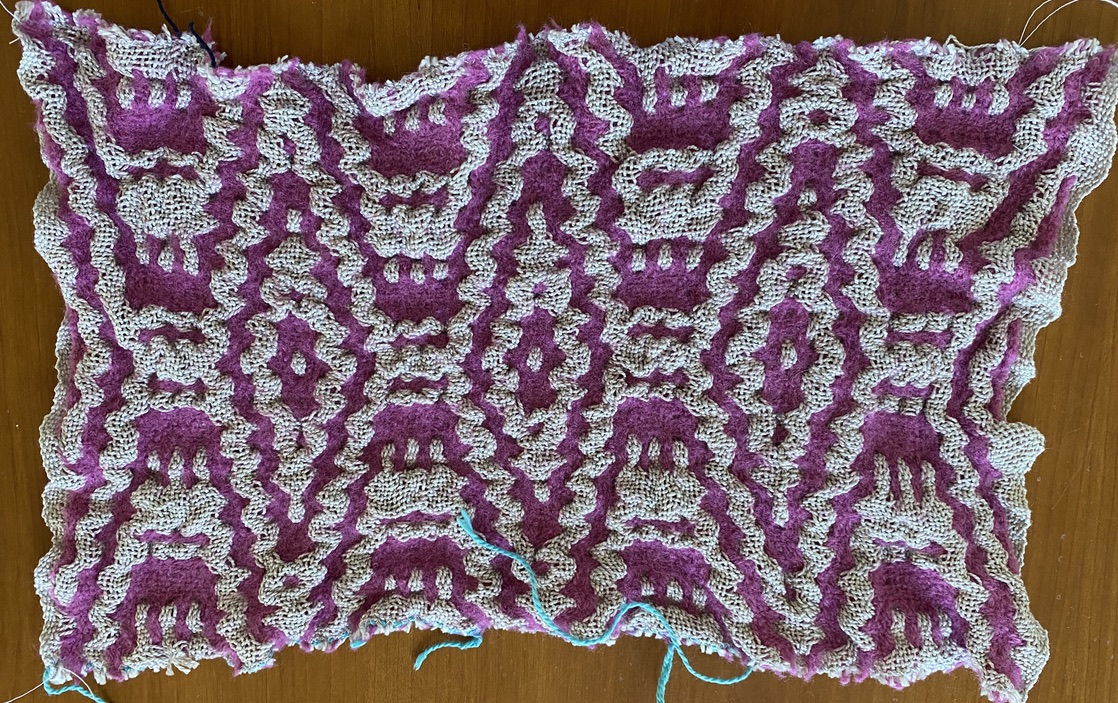
This sample by Jaime Pierce has 10/2 cotton (off-white)
and 18/2 Jagger Spun superfine merino (magenta) in warp and weft.


This is a sample by Eleanor Hartquist shown before finishing.
The gold-colored wefts in the upper horizontal stripe (mostly black) 
will draw the fabric in, creating vertical pleats, after washing.


This 4-shaft sample by Marianne Antczak
uses Colcolastic in the weft (in purple/pink) 
to draw the fabric in width-wise.


Cindy Greenfelder wove this 8-shaft swatch 
using 18/2 Jagger Spun superfine merino (in dark purple) 
to create puckers and pleats after finishing.

My takeaway: Despite the pandemic and social distancing, weavers want to keep on learning. And let's face it, weaving can be a solitary pursuit, so we thoroughly enjoy the company of other weavers. It's why we gather.

For anyone considering teaching or taking a Zoom workshop, I have a few lessons. First off, schedule a dress rehearsal within a week before the class. That way, you can iron out all the kinks -- technology problems, questions about the workshop format, questions about the weaving itself -- before the actual work begins. Who wants to waste time with technology when we could be talking weaving, right?

Another point: For teachers, it's useful to have a document camera on your desk so that everyone can see your samples up close, pick by pick, in focus, well lit and not in motion. (For those of you who have tried holding a sample up to the camera on your computer for others to see, you'll know what I'm talking about.)

A third idea, suggested by a weaver in another Zoom workshop, is to set up a Google Drive file dedicated to the workshop. I uploaded handouts, photos, drafts and other resources and, more important, created an individual file for everyone so they could upload their photos and then I could share them with the group. 

One big benefit is that you can have another teacher take over (in Zoom language, they serve as a co-host, meaning that they can share images from their home computer). In our case, we were fortunate to have Joyce Robards (whom I call my "Weaving Mother" even though we are not that far apart in age) give a presentation on Marian Stubenitsky's newest book, Double with a Twist, which has a different approach to drafting designs.

The course evaluations surprised me, with some folks saying that they actually preferred the Zoom format, mostly because they could weave on their own looms (no schlepping everything to the workshop site) and they had plenty of time to absorb information and work on their samples (no rushing to get everything done in the normal format of 2-1/2 days).

To me, this means that, while nothing can replace the learning that comes with an on-site workshop, much can be gained by teaching or taking a workshop over Zoom. Maybe the greatest benefit is that online workshops can bring weavers from around the globe together virtually, building a sense of community and adding another option to learn about our craft.

I'll close with a Deflected Double Weave sample I wove on 12 shafts using Colcolastic in the middle section (black and gold vertical stripes) to achieve width-wise shrinkage. I wove this in 10/2 cotton, using four colors in both warp and weft, substituting the Colcolastic for one of the colors as I wove the mid-section.


Thanks for reading!
 

Thursday, June 18, 2020

Weaving Psychology: The End of the Warp Phenomenon


I’d like to make an observation – there's a question in there, too – about something you may have experienced in your own weaving practice. I certainly have.


Why is it that, so often, something we weave at the end of a warp comes out really, really well? Sometimes even better than the first part of the warp that we planned and wove so carefully?


The photo above shows you one of my favorite end-of-the-warp toss-offs. I'm being honest -- and I hope it doesn't sound boastful -- when I say I love it! And it just sort of happened, with less than a yard to spare at the end of my warp.


I was weaving the fabric below, with Echo and Jin treadlings on 12 shafts. I had planned the colors for months, painting two warps of 20/2 silk and beaming them together on the loom; carefully designing the threading, tieups and treadlings; and dutifully weaving it all up on about 12 yards of warp, using a 60/2 silk weft.


So at the end of the warp, I had maybe a yard left over and I got a little lazy. I wanted to weave it off quickly -- so I threw in some hand-dyed silk ribbon, just to see what happened, using a Rep-style treadling that alternated the ribbon weft with 60/2 silk for the thick-and-thin effect of Rep.


And here's what I got, which I did not expect at all and liked immensely:


So there I was, with one yard of fabric that I wish had been 10 yards! Thank you, Robert Burns, for reminding us...


The best laid schemes o' Mice an' Men

Gang aft agley,

An' lea'e us nought but grief an' pain,

For promis'd joy!


This kind of thing happens to me often enough that I have given a name to it: "The End of the Warp Phenomenon." Honest, I could go on and on about projects like these, snatching (unplanned) success from the jaws of (carefully planned) mediocrity. So I will show you just one more example.


It's another piece that came from the end of the warp and it was so short that I could make only a poncho from it. (The beautiful model is our future daughter-in-law, Catherine Demmer.)


Same principle as the first piece I showed you: At the end of the warp, I had only a yard or so to weave, so I thought I would just try some metallic gold gimp as weft. (I was looking for a collapse fabric that I hadn't quite achieved with the rest of the warp.) Below is what it looks like up close. I was happy with the results, a Deflected Double Weave design with lots of texture on a ground layer of alpaca (lavender) that I worked hard to full. The turquoise warp is silk noil, which doesn't full. So that weft of gold gimp, alternating with the lavender alpaca, just wrinkled and curled in all sorts of interesting ways. 


I mentioned this stumble-bumble achievement to a friend of mine and she observed, "Now you see what happens when you just throw cares to the wind!" Which she seems to be able to do all the time. (Laurie, are you listening?) 


My frustration is, I can’t seem to make this happen all the time. The weaving goddesses have to be with me, you might say. Or, to put it another way: You win some, you lose some, some are tied and some get rained out. 


Which brings me to the subject of psychology, because I think there are sound principles that apply to my End of the Warp Phenomenon. Psychologist and author Art Hochberg has said,


"The best way to do something is to do it without thought. That's real concentration."


Athletes do it all the time, simply because their reactions have to be faster than thought. So sports psychology comes into play here. Here's an observation about the flow state in athletic performance, written by sports psychologist Mike Edger:


"Many athletes who have achieved breakthrough performances say that it was 'effortless,' or that 'everything else disappeared.' This feeling that some call 'flow' and others call 'the zone' is a state where the athlete acts without thinking."


Of course, if athletes -- or weavers, for that matter -- acted without thinking all the time, we would not be productive or creative or focused at all. So, it's a matter of being prepared and being open to opportunity and being ready to take chances. To offer yet another quote, this one from Louis Pasteur:


"Chance favors the prepared mind."


Pictured above, yet one more chance success, in my view: This scarf began as a 60/2 silk warp that was just hanging around my studio. I took it to a warp-painting workshop on natural dyes, just to see what happened. And I really like what happened. And it could very easily have gone the other way. I know, because it happens; I just don't post my goof-ups on my blog ;o)

Thanks for reading!