Friday, July 24, 2015

Just Back from MAFA 2015: Paint Two, Beam One


That's the Mid-Atlantic Fiber Association (MAFA), which sponsors a biennial conference -- and this year, the committee members outdid themselves. Lots of learning, excitement, friendship, and for my class, a terrific classroom space.

"Paint Two, Beam One" refers to the warps: You wind two identical warps, paint them in two different but harmonious color palettes, beam them together on your loom (as in the photo above), and weave the entire warp in a structure that shows off the colors to the max. Typically, that's a warp-emphasis structure such as twill or Turned Taquete.

Our class was in the pottery studio at Millersville University in Millersville, Pennsylvania (Lancaster County), which was ideal. The work tables were counter-height -- maybe higher -- so we could stand and paint comfortably, rather than bending down as we painted out warps.

And we could make a mess without any worries. Here are a couple of images.

Autumnal hues, reminding me of Gauguin's palette

Midnight blues and greens, 
thinking of Chagall

Our only challenge was when it came time to dry the painted warps using hair dryers. We kept tripping the circuit breaker! Fortunately, Jason Thompson was working in the studio next door and help us out immensely.

(Plus, he is a great metal worker. Check out his website: Jason Thompson Sculpture.)

Finally finished unpacking. Thanks to everyone who worked so hard to make the conference a success! And thanks so very much to my students, who were a pleasure to work with.

Monday, June 22, 2015

Deflected Double Weave/Collapse Cloth: Exploring Different Treadlings


One year after taking a collapse-technique workshop with Ann Richards at the Handweavers Studio and Gallery in London -- I continue to try new structures, sampling and sampling to learn what works. And what doesn't work.

Deflected double weave has lots of possibilities as a dimensional weave structure when you use two different kinds of yarns -- wool and silk, for example -- so that one layer shrinks and the other doesn't. Cloqué (lye shrinkage using cellulose fibers) is another wonderful technique to use with deflected double weave. More on that in the year to come, I hope!

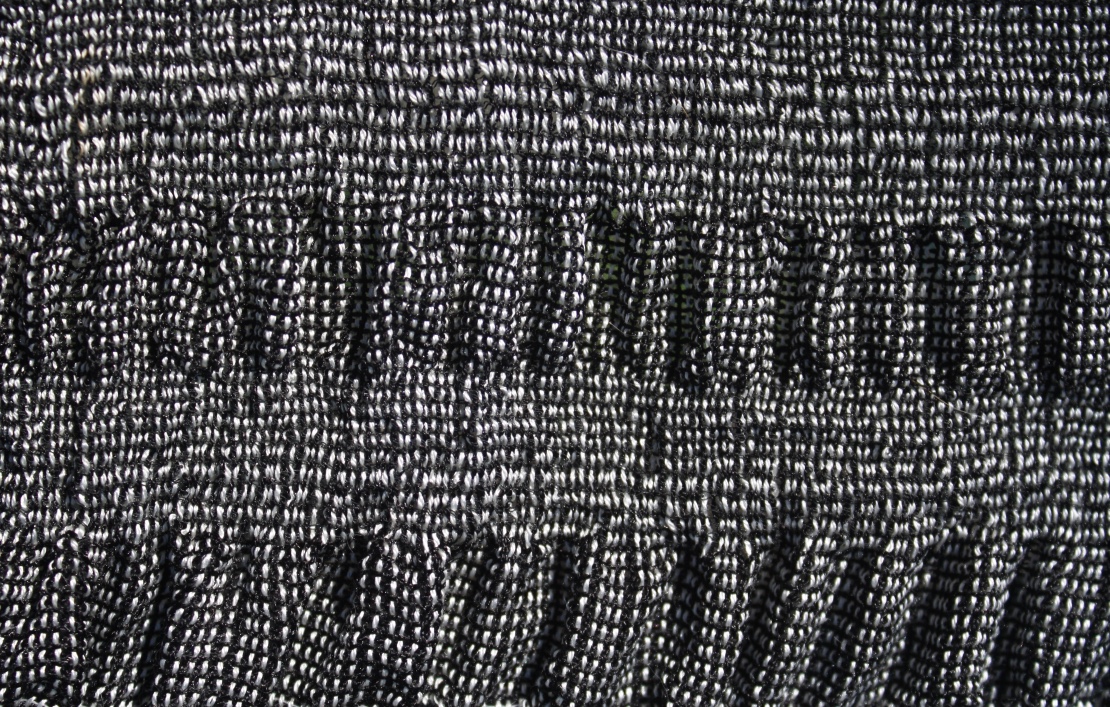
With these samples, I used an 8-harness structure of my own design, derived from other patterns I've seen and lots of reading. My yarns were 18/2 Superfine Merino from JaggerSpun and 20/2 spun silk, both sett at 36 ends per inch. I tried five different treadlings. Pictured above are comparative photos of the first sample: on the top, before washing and agitating with mild soap in warm water, and on the bottom, after washing.

In this case, I definitely like the first sample better! It shows all the patterns clearly. The second photo gives you an idea of how differently the patterns shrink up, with some drawing in more than others. Not a good idea for a handwoven fabric. Also, the silk selvages (in white) were bumpy and uneven and did nothing to enhance the piece.

Still, I learned a lot. So, for the second sample, I tried a technique I had seen other weavers use with differential shrinkage: Add a fairly wide selvage in plain weave using yarns that don't shrink (in this case, silk). For this sample, I used the third treadling on the above samples, the one that creates a "W" shape in the pattern.

The idea is that, when the wool shrinks up, the selvages will pucker and ruffle. I liked these results quite a bit. Again, the first photo shows the sample before washing (shrinking) and the second shows it afterwards.


This sample has lots of potential, I think, as a fulled fabric. The downside is that it's very firm and thick, which would not work well at all for a scarf. Great for a coat or jacket, however, with the ruffled edge used as an accent at the neck, placket, or wrist.

Another try. (Thank goodness for my Leclerc Voyager table loom, which allows for easy adjustments on a short, narrow warp.) For the third sample, I wanted to see what happened when the wool was the selvage, so that you had a much firmer, fulled edge. I also wanted to make sure that the width of the fabric didn't vary with the pattern after shrinking. So I used only two different treadlings, both of which I figured would draw in at pretty much the same percentage. (Top and bottom photos are before and after washing, respectively.)


Another good sample, in my opinion. I particularly like the way the first treadling (the pattern on the bottom part of the sample) shrinks up, so that it looks like vertical rows of beads and chains, to my eye. These are the results I'm looking for, where the appearance of the pattern after washing is unique and eye-catching -- giving you shapes that you wouldn't achieve with "regular" weaving.

I guess that's what we all look for: the surprise, the "aha" moment, the serendipitous results. Those are the invaluable rewards. Thanks for reading!


Thursday, June 11, 2015

Turned Monk's Belt: Another Structure for Combining Two Painted Warps


Weavers love painting warps: You can't buy the beauty of the ever-changing colors. For me, painting two warps brings even greater rewards: When you combine them into one warp and weave a warp-dominant structure, you get a fabric with two continually shifting color palettes.

I'm on a mission to discover the best structures for this technique. To my eye, Turned Taquete is the most magical, as is Echo Weave. Then there's the magic of twill stripes, woven in 3/1 and 1/3 structures.... And double weave. And deflected double weave. And turned overshot. Turned Honeycomb, not so much. The warp-wise tension makes for straight lines, not honeycomb waves.

But why not Turned Monk's Belt? Effectively, you're weaving a supplemental-warp structure, which would allow for all kinds of improvising, using different yarns, random-width blocks, you name it. But for this project, I wanted to stick with a simple, traditional 4-harness Monk's Belt pattern, just to see what happened.

I used a ground warp of 20/2 pearl cotton and a pattern warp of 10/2 unmercerized cotton. (Thank you, Leslie Mendelson, my friend!) I painted the ground warp in a series of peach/gold/soft orange colors, while the pattern warp was painted blue/aqua/purple/sky blue. The sett was 36 ends per inch for each layer, meaning 6 ends per dent in a 12-dent reed.

The weft was 20/2 pearl cotton dyed in soft orange. Since this was only a sample, as it was just 2 2/9" in the reed. I wish I had planned to finish both ends with a nice, neat hem stitch, because this Monk's Belt pattern would have made a nice... belt!


Friday, June 5, 2015

A Poem by D. H. Lawrence, About Creating

Song of a Man Who Has Come Through


Not I, not I, but the wind that blows through me!
A fine wind is blowing the new direction of Time.
If only I let it bear me, carry me, if only it carry me!
If only I am sensitive, subtle, oh, delicate, a winged gift!
If only, most lovely of all, I yield myself and am borrowed
By the fine, fine wind that takes its course through the chaos of the world
Like a fine, an exquisite chisel, a wedge-blade inserted;
If only I am keen and hard like the sheer tip of a wedge
Driven by invisible blows,
The rock will split, we shall come at the wonder, we shall find the Hesperides.

Oh, for the wonder that bubbles into my soul, 
I would be a good fountain, a good well-head,
Would blur no whisper, spoil no expression.

What is the knocking?
What is the knocking at the door in the night?
It is somebody wants to do us harm.

No, no, it is the three angels.
Admit them, admit them

Thanks to Andrew O'Hehir for publishing this in Salon.

Thursday, May 28, 2015

Collapse Cloth in 60/2 silk warp and overtwist weft


Many years ago, there was a wonderful magazine called Weaver's -- and in it, an article by Ann Richards on using crepon yarns for collapse fabrics. I have had it in my files for more than 15 years and FINALLY I wove up some samples. The impetus was the annual sample exchange for the Collapse Weave Study Group in Complex Weavers.

The warp is 60/2 spun silk in black and natural, threaded alternately in a straight draw. The photo at top shows the fabric after washing, with a number of different wefts. A closer look, below.

Here's the fabric on the loom, showing horizontal stripes woven alternately in 60/2 spun silk in natural and 30/1 wool in a Z twist.


And then off the loom, before washing.


Here's what the same fabric looks like, close up, after washing in lukewarm water with a bit of Orvus paste.


And here are two other samples. Below, I have alternated weft stripes of black gossamer-weight silk crepe from Habu with 60/2 spun silk in black. The crepe draws in more than any other energized yarn I have used, so this is a very elastic fabric when you stretch it horizontally.


Finally, a softer collapse fabric, as the weft is just one yarn: 30/1 wool in S overtwist (natural color).


Threading 1,456 ends on the loom at a sett of 32 epi amounted to some 45 1/2 inches in width, which collapsed to roughly 30 inches in width after washing. The length didn't change much, from around 45 inches long to 41 inches after washing. Lots of weaving for a shrinkage of 33%, but it was so worth it!

Thursday, May 14, 2015

Painting Two Warps for Turned Overshot: Cat's Paws and Snail's Trails


We all love color, true? And weaving offers so many techniques -- polychrome, color and weave, supplemental warps and wefts, painted yarns, variegated yarns -- that allow us to play to our heart's content.

I have been experimenting for a number of years now, using two hand-painted warps in complementing color palettes in warp-dominant weaving structures, combing them into one warp to achieve maximum color play. At least that's one slightly complicated way to describe it. (A plug here: I hope to teach a course on this technique this July at the MAFA Conference at Millersville University: "Paint 2 Beam 1." We will find out on Monday, May 18, as to which courses will run.)

Among the structures that lend themselves to this technique: Turned Taquete, Echo Weave, double weave, twill blocks (I like to alternate stripes of 1/3 and 3/1 twill) and Turned Overshot -- which is the sample pictured above.

Cat's Paws and Snail's Trails is a classic 4-harness pattern. When you turn the draft, you're weaving on 6 harnesses because you have a tabby ground cloth. The advantage using my painted-warp technique is that your pattern warp is painted in one set of colors (in this case I used turquoise, purple, teal, and blue) while the ground warp is painted in another palette (coral, orange, gold, yellow, and red). It's a one-shuttle weave, and my weft yarn matched the gold in the warp.

Just coming out of a linen workshop with Kati Reeder Meek, I chose to work with linen. My ground warp is 50/2 half-bleached linen and the pattern warp is 14/1 in natural. Both yarns are wet spun. My weft, like the ground warp, was 50/2 linen.

Here are two more views. The sample is long and narrow, about 4 inches wide, because the sett was about 60 ends per inch. Not hard, really, and well worth the effort!


Saturday, April 11, 2015

Studying 'Lustrous Linens' with Kati Reeder Meek


Sorry for the smaller sized photos, but I took them with my iPhone! Last week, the Weavers' Guild of Rochester hosted a workshop with the wonderful Kati Reeder Meek, author of Reflections from a Flaxen Past, master weaver, and inventor of better warping with the weaving trapeze. The photo above is a sample from the workshop, described as a four-shaft damask, woven with linen warp and weft.

Linen has a character all its own: less forgiving and far more rigid than wool, cotton or silk, but in so many ways more lustrous, durable, and pattern-friendly than almost any other fiber. I have always loved linen, as it harks back to centuries-old weaving and spinning techniques and comes straight from the fields. So ancient and so basic to human needs.

Here are a few more samples from the workshop. (I don't give anybody's name here, because some people would prefer that their names aren't broadcast over the internet -- so we'll let the weavings speak for themselves.)


This one, above, is a bit blurry, but I hope you get the picture. This is a four-harness 17th-century Lithuanian pattern -- a one-shuttle weave that uses tabby throughout.


Above, the weaver used 30/1 linen in both warp and weft. It's woven in plain weave, in a thick-and-thin pattern where four threads are woven as one for all threads on harness 4 and then for every fourth pick. (That is, you thread a straight draw on four harnesses, threading four ends through every heddle on the fourth harness and then, as you weave harnesses one and three against two and four, weave one pick four times every fourth pick. If you want the draft, I can send it to you, because it sounds far more complicated than it is.)


Both samples above are using the same pattern, but with yarns of different weights and colors. It's based on a 19th-century Lithuanian pattern for eight shafts, in two blocks of point twill. So pretty! The first photo is hard to make out, I realize, but the colors alone work well.


Kati Meek calls this a "trouser twill," derived from a pattern on a fragment of fabric from a Lithuanian man's trousers. It's a 2/2 twill in two colors, perhaps not for trousers this time.

My pattern was a gauzy off-white fabric with varied denting -- which I chose in hopes of making curtains for my kitchen, which we are updating. (And boy does it need updating.) Here it is, below, in a photo taken after I had cut the sample off of the loom, washed it, and "cold mangled" it with a marble rolling pin.


Why did I enthusiastically take Kati's class -- if I'm a weaver of collapse-weave fabrics that, unlike linen fabrics, forgive a multitude of sins? Because I love linen fiber, I hope to weave more of it, and, above all, this class revisited so many basic techniques to teach us new, better approaches. Thank you, Kati!

And maybe I will soon weave some new kitchen curtains, also thanks to Kati.